


Another stack/reach question
 03-02-19 | 02:59 AM
#1

Thread Starter
Senior Member
Joined: Nov 2008
Posts: 2,387
Likes: 21
From: Bangalore India
Another stack/reach question
Hi Guys,
I have a Titanium bike which is my best fitting bike. Stack 565, reach 377. Using 20mm of spacers [fat and old :-) ]
Looking at buying a new CF bike which has a stack of 585, reach 378.
Would I be right in assuming that they would fit identically, if I did not use spacers on my new bike?
I have a Titanium bike which is my best fitting bike. Stack 565, reach 377. Using 20mm of spacers [fat and old :-) ]
Looking at buying a new CF bike which has a stack of 585, reach 378.
Would I be right in assuming that they would fit identically, if I did not use spacers on my new bike?

 03-02-19 | 07:06 AM
#3

Senior Member

Joined: Oct 2015
Posts: 15,917
Likes: 3,944
Bikes: 2015 Workswell 066, 2017 Workswell 093, 2014 Dawes Sheila, 1983 Cannondale 500, 1984 Raleigh Olympian, 2007 Cannondale Rize 4, 2017 Fuji Sportif 1 LE
Likely they two frames won't be identical---head- and seat tube angles and bottom-bracket drop will change proportions slightly. However you should be pretty close, and as [MENTION=419048]Racing Dan[/MENTION] says, you should be able to create the same fit without much difficulty.
03-02-19 | 08:09 AM
#4

Advocatus Diaboli

Joined: Feb 2015
Posts: 9,143
Likes: 1,736
From: Wherever I am
Bikes: Merlin Cyrene, Nashbar steel CX
Sorta related question.. is there any web-based calculator or app out there where I can plug in the known geometry sizes from an older bike (before stack and reach were more commonly available in geo charts), and it would be able to spit out the calculated stack and reach figures?
03-02-19 | 09:06 AM
#5

Sunshine
Joined: Aug 2014
Posts: 18,701
Likes: 10,236
From: Des Moines, IA
Bikes: '18 class built steel roadbike, '19 Fairlight Secan, '88 Schwinn Premis , Black Mountain Cycles Monstercross V4, '89 Novara Trionfo
Sorta related question.. is there any web-based calculator or app out there where I can plug in the known geometry sizes from an older bike (before stack and reach were more commonly available in geo charts), and it would be able to spit out the calculated stack and reach figures?
put your bike against a wall with the rear tire touching a wall in back, and make sure the bike is vertical(vs leaning). A strap around the front tire and down tube help keep it from rolling.
measure from the floor vertically to the center of the bottom bracket.
now measure from the floor vertically to the middle point of the top of the head tube.
Subtract small # from big # and that is stack.
measure from the back wall to the center of your bottom bracket.
now measure from the back wall to the center of the top of the head tube.
subtract small # from big # and that is reach.
this is frame stack and frame reach.
another way is to shove the bike into a corner so both tires touch a wall and a handlebar touches a wall. It helps ensure the bike stays still and vertical and gives you the same measurements.
03-02-19 | 09:07 AM
#6
Sunshine
Joined: Aug 2014
Posts: 18,701
Likes: 10,236
From: Des Moines, IA
Bikes: '18 class built steel roadbike, '19 Fairlight Secan, '88 Schwinn Premis , Black Mountain Cycles Monstercross V4, '89 Novara Trionfo
Hi Guys,
I have a Titanium bike which is my best fitting bike. Stack 565, reach 377. Using 20mm of spacers [fat and old :-) ]
Looking at buying a new CF bike which has a stack of 585, reach 378.
Would I be right in assuming that they would fit identically, if I did not use spacers on my new bike?
I have a Titanium bike which is my best fitting bike. Stack 565, reach 377. Using 20mm of spacers [fat and old :-) ]
Looking at buying a new CF bike which has a stack of 585, reach 378.
Would I be right in assuming that they would fit identically, if I did not use spacers on my new bike?

 03-02-19 | 09:45 AM
#9
Advocatus Diaboli
Joined: Feb 2015
Posts: 9,143
Likes: 1,736
From: Wherever I am
Bikes: Merlin Cyrene, Nashbar steel CX
In not aware of it being possible since stack and reach are direct measurements.
put your bike against a wall with the rear tire touching a wall in back, and make sure the bike is vertical(vs leaning). A strap around the front tire and down tube help keep it from rolling.
measure from the floor vertically to the center of the bottom bracket.
now measure from the floor vertically to the middle point of the top of the head tube.
Subtract small # from big # and that is stack.
measure from the back wall to the center of your bottom bracket.
now measure from the back wall to the center of the top of the head tube.
subtract small # from big # and that is reach.
this is frame stack and frame reach.
another way is to shove the bike into a corner so both tires touch a wall and a handlebar touches a wall. It helps ensure the bike stays still and vertical and gives you the same measurements.
put your bike against a wall with the rear tire touching a wall in back, and make sure the bike is vertical(vs leaning). A strap around the front tire and down tube help keep it from rolling.
measure from the floor vertically to the center of the bottom bracket.
now measure from the floor vertically to the middle point of the top of the head tube.
Subtract small # from big # and that is stack.
measure from the back wall to the center of your bottom bracket.
now measure from the back wall to the center of the top of the head tube.
subtract small # from big # and that is reach.
this is frame stack and frame reach.
another way is to shove the bike into a corner so both tires touch a wall and a handlebar touches a wall. It helps ensure the bike stays still and vertical and gives you the same measurements.
I guess I thought that some geometry whiz might have already developed calculators to fill in the blanks using head and seattube angles, top tube lengths, seat tube lengths, BB drop, wheelbase and/or chainstay lengths and I guess HT lengths?
03-02-19 | 09:50 AM
#10
Junior Member
Joined: May 2016
Posts: 121
Likes: 17
From: Arlington, VA
Sorta related question.. is there any web-based calculator or app out there where I can plug in the known geometry sizes from an older bike (before stack and reach were more commonly available in geo charts), and it would be able to spit out the calculated stack and reach figures?
03-02-19 | 10:10 AM
#11
Thread Starter
Senior Member
Joined: Nov 2008
Posts: 2,387
Likes: 21
From: Bangalore India
03-02-19 | 10:39 AM
#12
Perceptual Dullard

Joined: Sep 2009
Posts: 2,916
Likes: 1,754
Thanks for the measurement tutorial, very helpful.
I guess I thought that some geometry whiz might have already developed calculators to fill in the blanks using head and seattube angles, top tube lengths, seat tube lengths, BB drop, wheelbase and/or chainstay lengths and I guess HT lengths?
I guess I thought that some geometry whiz might have already developed calculators to fill in the blanks using head and seattube angles, top tube lengths, seat tube lengths, BB drop, wheelbase and/or chainstay lengths and I guess HT lengths?
03-02-19 | 10:40 AM
#13
Advocatus Diaboli
Joined: Feb 2015
Posts: 9,143
Likes: 1,736
From: Wherever I am
Bikes: Merlin Cyrene, Nashbar steel CX
Check out THIS website. I use it to compare geometries when I'm looking at bikes.
03-02-19 | 10:52 AM
#14
Advocatus Diaboli
Joined: Feb 2015
Posts: 9,143
Likes: 1,736
From: Wherever I am
Bikes: Merlin Cyrene, Nashbar steel CX
Aren't most all bikes built with assumption that same wheel/tire dimension will be used in the front and rear and that the front and rear dropouts will therefore be the same height above the ground? With BB Drop, combined with HT angles, ST angles, HT length, fork rake, wheelbase,.. can't a fork 'length' be calculated?
03-02-19 | 10:57 AM
#15
Perceptual Dullard
Joined: Sep 2009
Posts: 2,916
Likes: 1,754
The guy who devised stack and reach verified that if I handed him just a naked frame he wouldn't be able to measure S&R from it.
03-02-19 | 11:09 AM
#16
Junior Member
Joined: May 2016
Posts: 121
Likes: 17
From: Arlington, VA
Edit to add, I would say most "conventional" modern designs are still in the 370-375 range, though with the advent of aero frames, some seem to have quite long forks, 390+. There is also a lot more variation with disc frames.
Last edited by Quiglesnbits; 03-02-19 at 11:16 AM.
03-02-19 | 11:12 AM
#17
Advocatus Diaboli
Joined: Feb 2015
Posts: 9,143
Likes: 1,736
From: Wherever I am
Bikes: Merlin Cyrene, Nashbar steel CX
In order to measure stack, you need a horizontal line. That horizontal line passes through the wheel axles, so you need to know something about the fork. In fact, if you have a frame with horizontal rear dropouts, exactly where you put the rear wheel in the dropout can affect the horizontal line so can affect stack and reach (obviously, not very much).
The guy who devised stack and reach verified that if I handed him just a naked frame he wouldn't be able to measure S&R from it.
The guy who devised stack and reach verified that if I handed him just a naked frame he wouldn't be able to measure S&R from it.
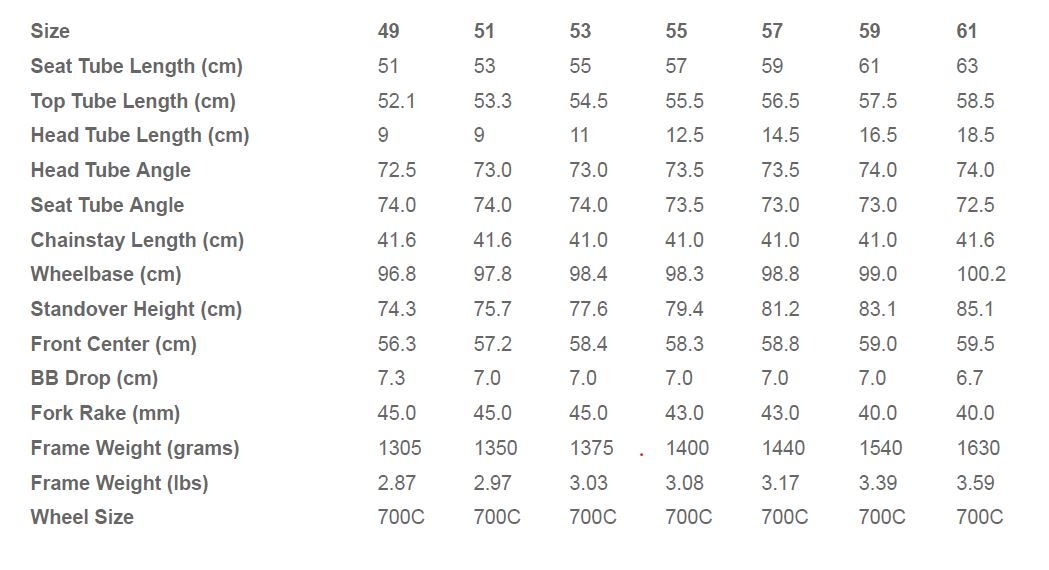
Anyway.. I was working with eg. a Geo chart that looks like the below. Just thinking there's a way to determine the theoretical Stack and Reach with all these numbers, a ruler, some math and a protractor :-) That linked calculator comes really close.
 03-02-19 | 11:20 AM
#18
Perceptual Dullard
Joined: Sep 2009
Posts: 2,916
Likes: 1,754
Ok, but you have HT and ST angles and fork rake. HT and ST angles are dependent on bike being horizontal. If you adjust the horizontal line, then the HT and ST angles would change and move away from the published values, right?
Anyway.. I was working with eg. a Geo chart that looks like the below. Just thinking there's a way to determine the theoretical Stack and Reach with all these numbers, a ruler, some math and a protractor :-) That linked calculator comes really close.
Anyway.. I was working with eg. a Geo chart that looks like the below. Just thinking there's a way to determine the theoretical Stack and Reach with all these numbers, a ruler, some math and a protractor :-) That linked calculator comes really close.
As I said, the guy who devised the system agreed that frame stack and reach depends on the fork (there used to be a lively aftermarket for both road and MTB forks, which is why I posed this question to him).
03-02-19 | 11:42 AM
#19
Senior Member
Joined: Sep 2011
Posts: 4,764
Likes: 235
03-02-19 | 12:16 PM
#20
Senior Member
Joined: Sep 2008
Posts: 7,296
Likes: 577
From: Loveland, CO
Bikes: Cervelo Rouvida x 2
Some folks don't seem to know that reach makes the TT length irrelevant. If the reach is the same, then you only need to consider the difference in the STA, that might require a different seatpost setback to get the saddle in the same location, relative to the BB. Stack usually does not include the headset top section, tube and that can vary quite a bit. Sometimes, you can replace the top section with one that is taller or shorter.
03-02-19 | 02:07 PM
#21
Senior Member
Joined: Oct 2015
Posts: 15,917
Likes: 3,944
Bikes: 2015 Workswell 066, 2017 Workswell 093, 2014 Dawes Sheila, 1983 Cannondale 500, 1984 Raleigh Olympian, 2007 Cannondale Rize 4, 2017 Fuji Sportif 1 LE
I sort of disagree. All horizontal lines are parallel. Once one has a horizontal line, one can lay out seat- and head-tube angles. Stack is measured from the center of the BB shell to a horizontal line extended back from the top center of the head tube. Fork length has nothing to do with it.
The bike’s head- and seat-tube angles were calculated of the horizontal---and all horizontal lines are parallel. The lines between the axles, the line through the BB shell center, and the line extending back from the top-center of the head tube—there is only one “horizontal.”
BB drop is just how far the BB is blow the horizontal connecting the two axles---but since it is horizontal …..
03-02-19 | 02:29 PM
#22
Perceptual Dullard
Joined: Sep 2009
Posts: 2,916
Likes: 1,754
Make your argument to Empfield. He devised the stack & reach system. He sez:
if you put a different fork on the bike, or a tire that's got a higher profile, you now no longer have the same seat angle on your bike. however, the difference is not typically a lot. having said that, when i was a bike maker and kestrel started selling its EMS fork to OEMs, we used to have to make two different frames: one for our standard steel forks, one to accept the EMS fork, because the distance from the center of the brake hole to the crown race seat was 8mm greater on the EMS fork than was evident on our own fork crowns.
03-02-19 | 02:44 PM
#23
Senior Member
Joined: Oct 2015
Posts: 15,917
Likes: 3,944
Bikes: 2015 Workswell 066, 2017 Workswell 093, 2014 Dawes Sheila, 1983 Cannondale 500, 1984 Raleigh Olympian, 2007 Cannondale Rize 4, 2017 Fuji Sportif 1 LE
What is being discussed is being able to calculate stack and reach on a given frame when only the usual geometry charts are published---many of which do not include rake and trail info.
I am responding o the question which was asked.
obviously, fi the owner puts a 24-inch wheel in place of a 700c wheel, if the owner adds a suspension fork, if the owner adds a chopper-style springer front fork .... but what was being discuses was being able to calculate stack and reach given a common geometry chart. The poster stipulated that he knew the head- and seat-tube angles --- and given those angles, is implicit the horizontal plane or reference.
I know you are a serious mathematician, but I also know that while I can barley do 4-function math, I have done engineering drawings based off the geometry numbers listed, and have correctly calculated frame sizes.
Really, I think what the OP is saying is that given certain information, can certain other values be calculated. I say yes, having done so.
You are saying, if those dimensions are varied .....well, yes, change any of the lengths or angles and everything else changes. No one is arguing that. But that is not what the OP asked.
So long as the owner knows the seat- and head-tube angles, the owner know what "horizontal" and "vertical" are for that set of measurements, because the seat- and head-tube angles are measured relative the those "horizontal" and "vertical' planes. Those are industry standards---that is Exactly what those numbers mean.
Would you disagree? Is there some way of measuring those tube angles that I don't know about? (Well, no.)
I am not arguing that changing things does not change things. I am saying that none of that is what the OP asked, and none of it helps him with what he did ask.
03-02-19 | 03:05 PM
#24

Senior Member
Joined: Nov 2017
Posts: 2,095
Likes: 810
From: Seattle
Bikes: Specialized Roubaix, Obed Boundary, Canyon Inflite AL SLX, Ibis Ripley AF, Priority Continuum Onyx, Santana Vision, Kent Dual-Drive Tandem
Check out THIS website. I use it to compare geometries when I'm looking at bikes.
03-02-19 | 03:13 PM
#25
Advocatus Diaboli
Joined: Feb 2015
Posts: 9,143
Likes: 1,736
From: Wherever I am
Bikes: Merlin Cyrene, Nashbar steel CX
Actually, I think it's only possible that different forks will yield different angles (and hence a changed Reach/Stack). Ie. you could take the same bike, mount a fork with 40mm of rake, and another with 50mm of rake -- if they are the same length, the angles will be the same and neither reach or stack are affected.