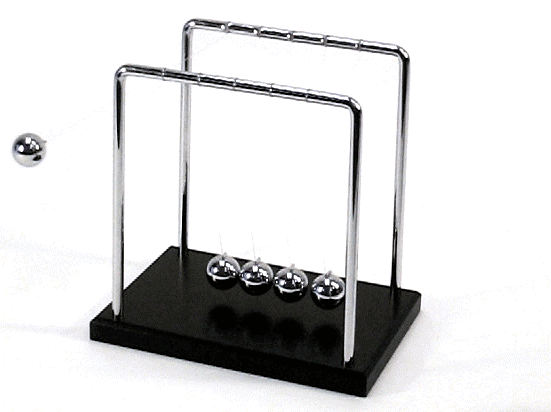
Planing?
 11-18-24 | 10:41 PM
#27

Thread Starter
ignominious poltroon
Joined: Jan 2022
Posts: 6,027
Likes: 5,377
How exactly is a supple, planing frame supposed to "return power"? What exactly is "returning power"? Is the flexing of the frame resulting in the crank rotating? After all, rotating the crank is the only way to generate power that propels the bike and rider forward.
Thinking about it as an oscillator, it will have a characteristic frequency. If you can match that (or one of its harmonics) in phase, you can benefit from it, but if you are 180° out of phase, it can have the opposite, degrading effect.
That's my low-brow mechanical interpretation, FWIW.
I think he would say they have.
Last edited by Polaris OBark; 11-18-24 at 10:51 PM. Reason: somehow stiff became still
 11-18-24 | 10:43 PM
#28

Senior Member


Joined: Apr 2011
Posts: 12,760
Likes: 4,873
How exactly is a supple, planing frame supposed to "return power"? What exactly is "returning power"? Is the flexing of the frame resulting in the crank rotating? After all, rotating the crank is the only way to generate power that propels the bike and rider forward.
Also, in this age of marginal gains down to the height of socks and the size of helmets, don't you think if planing was a thing, that Ineos, Visma, UAE, and others would be incorporating it into their bikes ?
Also, in this age of marginal gains down to the height of socks and the size of helmets, don't you think if planing was a thing, that Ineos, Visma, UAE, and others would be incorporating it into their bikes ?
Several bikes are known for doing this very obviously in corners. And that's just one way a spring (frame) can store energy and deliver it later.
11-18-24 | 10:43 PM
#29
Gruppetto Bob

Joined: Sep 2020
Posts: 11,602
Likes: 11,800
From: Seattle-ish
Bikes: Orbea Orca, Bianchi Infinito & Campione de Mundo
This last year, my legs started getting painful after a couple of hours - which had never happened before. Tired, yes; painful, no. (Except when going anaerobic during a sprint). Same bike, no changes for three years.
Then I changed my on bike fueling strategy. I started eating more carbs, more frequently and “Hey there Sargent!” No more leg pain. No planning or planing involved, just carbs. YMMV
Then I changed my on bike fueling strategy. I started eating more carbs, more frequently and “Hey there Sargent!” No more leg pain. No planning or planing involved, just carbs. YMMV
__________________
“A watt saved is a watt earned” 🚴🏻♂️
 Not a CAT
“A watt saved is a watt earned” 🚴🏻♂️
11-18-24 | 10:45 PM
#30
Thread Starter
ignominious poltroon
Joined: Jan 2022
Posts: 6,027
Likes: 5,377
I'm really sorry to hear that.
One of the best collaborations I have ever had was with a guy at Livermore, who, late in life, took a hobby interest in the kinds of stuff we do. He was one of the smartest and most creative people I had ever met, but spent most of his life on the H-bomb. He was a font of really clever, often crazy ideas, and needed a filter, but was an absolute blast (so to speak) to work with. I got several publications with him out of that.
One of the best collaborations I have ever had was with a guy at Livermore, who, late in life, took a hobby interest in the kinds of stuff we do. He was one of the smartest and most creative people I had ever met, but spent most of his life on the H-bomb. He was a font of really clever, often crazy ideas, and needed a filter, but was an absolute blast (so to speak) to work with. I got several publications with him out of that.
11-18-24 | 10:48 PM
#31
Senior Member
Joined: Jul 2009
Posts: 8,250
Likes: 11,322
Bikes: Colnago, Van Dessel, Factor, Cervelo, Ritchey
11-18-24 | 10:52 PM
#32
Banned.
Joined: Jul 2006
Posts: 4,287
Likes: 838
That's simply not true. Stand on the pedals with the front brake locked, lock the rear and get off the pedals. Now release the front brake then the rear. Bike travels forward because it stored energy.
Several bikes are known for doing this very obviously in corners. And that's just one way a spring (frame) can store energy and deliver it later.
Several bikes are known for doing this very obviously in corners. And that's just one way a spring (frame) can store energy and deliver it later.
ETA: Beat to the punch, very good thread. Everyone should read or re-read this before replying (myself included).
Last edited by Spoonrobot; 11-18-24 at 10:59 PM.
11-18-24 | 10:58 PM
#33

Senior Member

Joined: Oct 2013
Posts: 8,290
Likes: 3,691
From: Mich
Bikes: RSO E-tire dropper fixie brifter
That's simply not true. Stand on the pedals with the front brake locked, lock the rear and get off the pedals. Now release the front brake then the rear. Bike travels forward because it stored energy.
Several bikes are known for doing this very obviously in corners. And that's just one way a spring (frame) can store energy and deliver it later.
Several bikes are known for doing this very obviously in corners. And that's just one way a spring (frame) can store energy and deliver it later.
__________________
-YMMV
-YMMV
11-18-24 | 11:05 PM
#34
Senior Member
Joined: Apr 2011
Posts: 12,760
Likes: 4,873
I don't understand the relation to my point. The frame can store potential energy and release it into the road later. This is no more complicated a concept than the aforementioned pole vaulting. It just isn't as dramatic.
11-18-24 | 11:10 PM
#36
Senior Member
Joined: Jul 2009
Posts: 8,250
Likes: 11,322
Bikes: Colnago, Van Dessel, Factor, Cervelo, Ritchey
A stiffer bike frame is modeled as a stiffer spring, but it doesn't necessarily have higher damping than a more flexible frame.
11-18-24 | 11:11 PM
#37
Senior Member
Joined: Oct 2013
Posts: 8,290
Likes: 3,691
From: Mich
Bikes: RSO E-tire dropper fixie brifter
the pads can & do shift within the caliper. The mount for the caliper at the fork is another factor. Axle torque in the rear hub could contribute some energy.
I'm just thinking outloud, not trying to do a scientific study of it on my own.
I'm just thinking outloud, not trying to do a scientific study of it on my own.
__________________
-YMMV
-YMMV
11-18-24 | 11:16 PM
#38
Senior Member
Joined: Apr 2011
Posts: 12,760
Likes: 4,873
I don't know how pieces of metal could contribute energy unless they were under tension or on fire.
11-18-24 | 11:18 PM
#40
Senior Member
Joined: Jul 2009
Posts: 8,250
Likes: 11,322
Bikes: Colnago, Van Dessel, Factor, Cervelo, Ritchey
This is no more complicated a concept than the aforementioned pole vaulting. It just isn't as dramatic.
11-19-24 | 12:03 AM
#41

Rider. Wanderer. Creator.
Joined: May 2007
Posts: 2,996
Likes: 4,288
From: New Jersey
Bikes: Bike Friday All-Packa, Zizzo Liberte, Ozark Trail G.1 Explorer
That's simply not true. Stand on the pedals with the front brake locked, lock the rear and get off the pedals. Now release the front brake then the rear. Bike travels forward because it stored energy.
Several bikes are known for doing this very obviously in corners. And that's just one way a spring (frame) can store energy and deliver it later.
Several bikes are known for doing this very obviously in corners. And that's just one way a spring (frame) can store energy and deliver it later.
__________________
Rider. Wanderer. Creator.
JohnMFlores.com | YouTube: JohnMFlores
Insta: JohnMichaelFlores | Substack: https://followingwyman.substack.com/
Rider. Wanderer. Creator.
JohnMFlores.com | YouTube: JohnMFlores
Insta: JohnMichaelFlores | Substack: https://followingwyman.substack.com/

 :
: 11-19-24 | 04:48 AM
#44
Senior Member
Joined: Aug 2011
Posts: 1,246
Likes: 292
personal opinion, it's a good book regardless of any adaptation to his points of view.
11-19-24 | 04:56 AM
#45
Senior Member
Joined: Jan 2023
Posts: 2,435
Likes: 2,163
From: Eastern Shore MD
Bikes: Lemond Zurich/Trek ALR/Giant TCX/Stumpy 15
I think the idea is that a flexible bike (or maybe more specifically, a flexible top tube) behaves like a spring, or an un-damped oscillator, and a stiff bike behaves like a highly damped oscillator (or a much more rigid spring). The highly damped oscillator is akin to bouncing off of a cement floor, and the un-damped oscillator is like bouncing off of a sprung wooden floor. You push on it, and then it pushes back, and if you are able to capture that energy as useful work, it helps propel you, but if it is disippated as heat, it doesn't.
Thinking about it as an oscillator, it will have a characteristic frequency. If you can match that (or one of its harmonics) in phase, you can benefit from it, but if you are 180° out of phase, it can have the opposite, degrading effect.
That's my low-brow mechanical interpretation, FWIW.
I think he would say they have.
Thinking about it as an oscillator, it will have a characteristic frequency. If you can match that (or one of its harmonics) in phase, you can benefit from it, but if you are 180° out of phase, it can have the opposite, degrading effect.
That's my low-brow mechanical interpretation, FWIW.
I think he would say they have.
I'm no physicist or professor.
But the simple principal of not being able to create energy from nothing has to apply here.
In order for the frame to store energy, it needs to take that energy from something. And that something would be the pedal stroke.
And knowing that energy return isn't 100% efficient - the system would lose energy.
Thats my Philadelphia public school education at work right there.
11-19-24 | 04:58 AM
#46
Senior Member
Joined: Jan 2023
Posts: 2,435
Likes: 2,163
From: Eastern Shore MD
Bikes: Lemond Zurich/Trek ALR/Giant TCX/Stumpy 15
11-19-24 | 06:08 AM
#47
Senior Member
Joined: Jul 2007
Posts: 1,113
Likes: 31
Wouldn't tires also plane?
11-19-24 | 07:54 AM
#48
Bike Hoarder

Joined: Dec 2019
Posts: 13,333
Likes: 7,096
From: 757
Bikes: Madone Gen 7, Team Machine R01, Ritchey Breakaway, Checkpoint, BMC Kaius
Must not apply to my breakaway. Lovely bike but it’s more of a freight train than snappy.
11-19-24 | 08:05 AM
#49
Senior Member
Joined: Apr 2011
Posts: 12,760
Likes: 4,873
Energy (temporarily) stored in the side deflection of a bottom bracket is not (necessarily) redirected to the drive train in a beneficial way.
Actually, bicycle frames are more complicated. Hand waving arguments that equate the two (very different) systems don't amount to much.
Actually, bicycle frames are more complicated. Hand waving arguments that equate the two (very different) systems don't amount to much.
But the basic idea is that the pedal stroke has higher and lower output. On the downstroke the rider can exceed the ability of the frame's stiffness to transmit all the force to the road. When that happens the BB deflects - but that isn't happening in a vacuum. The BB deflects because the chainstays (among other things) are twisting to allow the rear wheel to be drawn closer to the crank by the load on the chain pulling them together. At the bottom of the pedal stroke the power drops sufficiently for the chainstays to unwind, and the rear wheel pushes to the rear against the mass of the rider - who is still loading the crank. If the rear wheel is pushing to the rear it is forcing the rider and the rest of the bike forward.
What always surprises me in this kind of discussion is that people can see that the bike can flex from exactly the kind of force that drives the bike, but think that force can suddenly be channeled into some sort of BB flex battery that briefly stores that energy and then somehow throws it away. But this is an equal and opposite situation - so that stored flex energy goes back into the mechanical path that created it, and not into some other realm.
Just like how a pole vaulter stores energy in the pole by compressing it and getting it back by allowing the pole to unwind. There is no other place for the pole's stored energy to go - the vaulter never stopped loading the pole, they just decreased peak force. Just like the bottom of the pedal stroke, the vaulter's momentum is still a load, so the pole can only unwind in the opposite way it was compressed, so it gives it back to the vaulter.
Same thing is true of how a rubber ball bounces, or how a half full milk jug acts when you slide it across the counter top. There is only one way to use up energy stored in a system that is mechanically closed - back out the way it came in.
Of course, if the frame isn't made of a material that makes good springs - steel, ti, carbon and (to a lesser extent) aluminum - you aren't going to store and release energy very efficiently. Good spring material has a very high energy transfer efficiency, which is why pogo sticks and the like aren't incredibly tiring to use. They convert very little stored energy to things like heat or sound. A frame made of plastic might not flex more than a steel frame, but you would notice it feel differently because it would use up much more of that peak pedaling compression as heat and the spring rate of the plastic would be low enough to not feed back into the drivetrain at the right time.
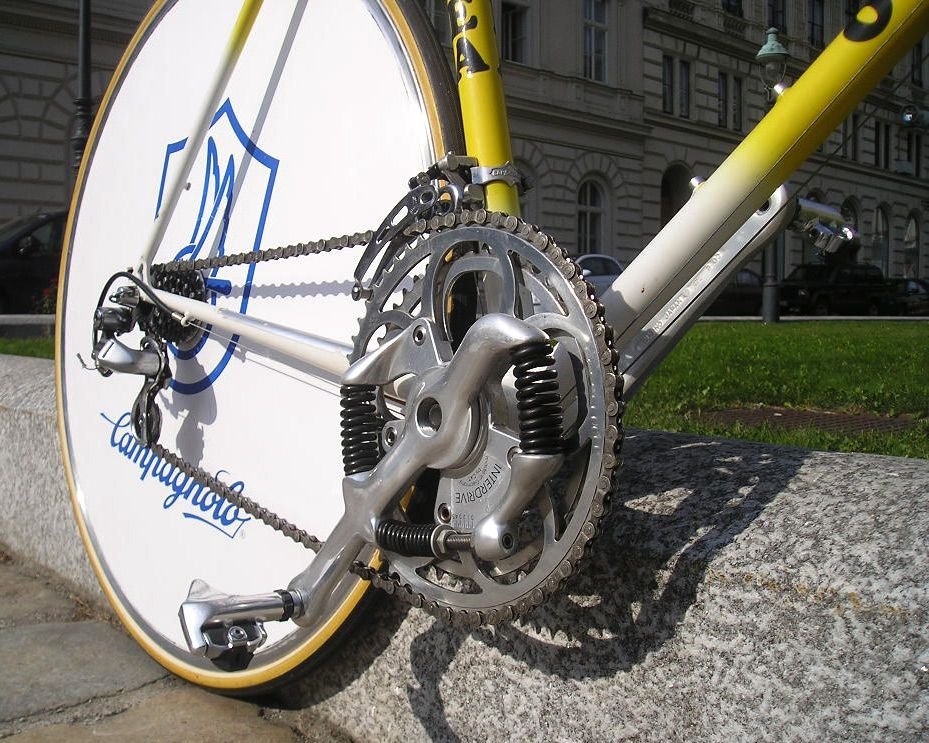
The problem with an ultrastiff frame is that it can't store any energy because it won't flex. So the peak torque while climbing/sprinting out of the saddle has to either go to the road or becomes greater than the system can absorb and feeds back to the rider's legs - opposing their output, making it choppy and less smooth. My Cannondale felt great climbing, but I could scrub the tires more easily than other bikes because peak torque would go right to the road and exceed the traction of the rubber - which is definitely a loss of energy. My Merlin ti deflects under that peak load, distributing forces over a longer period of time, making the chance of breaking traction much lower. So it uses the spring of its construction to accomplish the same thing as an oval chainring - distribute pedaling force better across the pedal stroke. Which is the same concept as those silly spring cranks, just more efficient because there are no moving parts in the spring path.
Last edited by Kontact; 11-19-24 at 08:12 AM.
11-19-24 | 08:17 AM
#50
Senior Member
Joined: Apr 2011
Posts: 12,760
Likes: 4,873
I'm no physicist or professor.
But the simple principal of not being able to create energy from nothing has to apply here.
In order for the frame to store energy, it needs to take that energy from something. And that something would be the pedal stroke.
And knowing that energy return isn't 100% efficient - the system would lose energy.
Thats my Philadelphia public school education at work right there.
But the simple principal of not being able to create energy from nothing has to apply here.
In order for the frame to store energy, it needs to take that energy from something. And that something would be the pedal stroke.
And knowing that energy return isn't 100% efficient - the system would lose energy.
Thats my Philadelphia public school education at work right there.