


Are stiffer frames actually faster? Discuss.
 10-02-07 | 01:09 PM
#201

Thread Starter
Making a kilometer blurry
Joined: May 2006
Posts: 26,170
Likes: 93
From: Austin (near TX)
Bikes: rkwaki's porn collection
If the differences can't be detected between a 54cm CR1 and a 62cm steel bike, then I think I've already proven my point 
I think a better place to cut would be the seat tube and down tube. Cutting the chainstays will allow compression and expansion very nearly parallel to the chain, which would pretty obviously return to the drivetrain. We need to test the kind of flex that exists in real cycling.
I don't see what variables we have to worry about between two bikes. The chain length differences should be minor. We can run the tests with the same gear ratios. We could go single speed with it to eliminate the derailleur pulley differences.
While using real bikes may add a few variables, I think it eliminates anyone claming that a cut frame can't make up the differences with intentional engineering in stiffness improvements. Like it just can't be simulated accurately.
That, and we'd have to buy a sacrificial frame. My Bridgestone is worth as much on ebay as a PowerTap, so it's not getting cut.
I think a better place to cut would be the seat tube and down tube. Cutting the chainstays will allow compression and expansion very nearly parallel to the chain, which would pretty obviously return to the drivetrain. We need to test the kind of flex that exists in real cycling.
I don't see what variables we have to worry about between two bikes. The chain length differences should be minor. We can run the tests with the same gear ratios. We could go single speed with it to eliminate the derailleur pulley differences.
While using real bikes may add a few variables, I think it eliminates anyone claming that a cut frame can't make up the differences with intentional engineering in stiffness improvements. Like it just can't be simulated accurately.
That, and we'd have to buy a sacrificial frame. My Bridgestone is worth as much on ebay as a PowerTap, so it's not getting cut.
Last edited by waterrockets; 10-02-07 at 01:15 PM.
 10-02-07 | 01:15 PM
#202


Senior Member

Joined: May 2002
Posts: 10,123
Likes: 4
From: Near Portland, OR
Bikes: Three road bikes. Two track bikes.
If the spring takes time to load and unload (which it does), you'll have additional force after you've finished the power stroke so you'll make up the speed.
You could argue that a 'flexy' bike could be faster because it could smooth out the power curve. To go 20mph with the least amount of power you want to go exactly 20mph with no surges at all. A stiff frame would cause you to accelerate for each stroke, going slightly over 20mph then slightly under 20mph after each stroke giving an average of 20mph. But since drag isn't linear, you'll need more power for the over than you'll save on the under. So there, a flexy bike is faster! You just need a flexy bike that works with the exact frequency that you are pedaling.
You could argue that a 'flexy' bike could be faster because it could smooth out the power curve. To go 20mph with the least amount of power you want to go exactly 20mph with no surges at all. A stiff frame would cause you to accelerate for each stroke, going slightly over 20mph then slightly under 20mph after each stroke giving an average of 20mph. But since drag isn't linear, you'll need more power for the over than you'll save on the under. So there, a flexy bike is faster! You just need a flexy bike that works with the exact frequency that you are pedaling.
Put another way, with the pedals at noon and 30, if you increased the tension on the tension side of the chain, would it be easier for your foot to move backwards a little, or the bike+rider to accelerate a little?
The time delay in returning the power stored in the frame will end up chopping up your pedal stroke. It won't go into moving the bicycle forward.
__________________
Cat 2 Track, Cat 3 Road.
"If you’re new enough [to racing] that you would ask such question, then i would hazard a guess that if you just made up a workout that sounded hard to do, and did it, you’d probably get faster." --the tiniest sprinter
Cat 2 Track, Cat 3 Road.
"If you’re new enough [to racing] that you would ask such question, then i would hazard a guess that if you just made up a workout that sounded hard to do, and did it, you’d probably get faster." --the tiniest sprinter
10-02-07 | 01:19 PM
#203
Thread Starter
Making a kilometer blurry
Joined: May 2006
Posts: 26,170
Likes: 93
From: Austin (near TX)
Bikes: rkwaki's porn collection
Put another way, with the pedals at noon and 30, if you increased the tension on the tension side of the chain, would it be easier for your foot to move backwards a little, or the bike+rider to accelerate a little?
The time delay in returning the power stored in the frame will end up chopping up your pedal stroke. It won't go into moving the bicycle forward.
The time delay in returning the power stored in the frame will end up chopping up your pedal stroke. It won't go into moving the bicycle forward.
You certainly don't want to impart flex that will cause detectable out of phase springiness, because that will chop up your pedal stroke, but we're talking about reasonable quality frames here, like ones that won't flex enough to cause any drivetrain issues.
Last edited by waterrockets; 10-02-07 at 01:27 PM.
10-02-07 | 01:23 PM
#204
Senior Member
Joined: Apr 2007
Posts: 323
Likes: 0
From: Dallas, TX
Remember that the pedals are also attached to the transmission, and if you are done with the pedal stroke, there is no reason for the returning energy to be transferred to the wheel - the easier path would be to transfer the energy into stalling your pedal stroke, as at the point where the pedals are at 12:00/6:00; there is almost no force on the pedals but there is still plenty of force from the momentum of the bike and rider on the wheel.
Put another way, with the pedals at noon and 30, if you increased the tension on the tension side of the chain, would it be easier for your foot to move backwards a little, or the bike+rider to accelerate a little?
The time delay in returning the power stored in the frame will end up chopping up your pedal stroke. It won't go into moving the bicycle forward.
Put another way, with the pedals at noon and 30, if you increased the tension on the tension side of the chain, would it be easier for your foot to move backwards a little, or the bike+rider to accelerate a little?
The time delay in returning the power stored in the frame will end up chopping up your pedal stroke. It won't go into moving the bicycle forward.
I do agree that some energy could go back into the rider. But some goes to the rear wheel.
10-02-07 | 01:27 PM
#205
Senior Member
Joined: Apr 2007
Posts: 323
Likes: 0
From: Dallas, TX
If the differences can't be detected between a 54cm CR1 and a 62cm steel bike, then I think I've already proven my point
I think a better place to cut would be the seat tube and down tube. Cutting the chainstays will allow compression and expansion very nearly parallel to the chain, which would pretty obviously return to the drivetrain. We need to test the kind of flex that exists in real cycling.
I don't see what variables we have to worry about between two bikes. The chain length differences should be minor. We can run the tests with the same gear ratios. We could go single speed with it to eliminate the derailleur pulley differences.
While using real bikes may add a few variables, I think it eliminates anyone claming that a cut frame can't make up the differences with intentional engineering in stiffness improvements. Like it just can't be simulated accurately.
That, and we'd have to buy a sacrificial frame. My Bridgestone is worth as much on ebay as a PowerTap, so it's not getting cut.
I think a better place to cut would be the seat tube and down tube. Cutting the chainstays will allow compression and expansion very nearly parallel to the chain, which would pretty obviously return to the drivetrain. We need to test the kind of flex that exists in real cycling.
I don't see what variables we have to worry about between two bikes. The chain length differences should be minor. We can run the tests with the same gear ratios. We could go single speed with it to eliminate the derailleur pulley differences.
While using real bikes may add a few variables, I think it eliminates anyone claming that a cut frame can't make up the differences with intentional engineering in stiffness improvements. Like it just can't be simulated accurately.
That, and we'd have to buy a sacrificial frame. My Bridgestone is worth as much on ebay as a PowerTap, so it's not getting cut.
I do think cutting a frame would be tough to correctly simulate the variation in stiffness of various bikes, but it would give you very discrete steps with very few variables.
 10-02-07 | 10:40 PM
#207

Wheelsuck
Joined: Jun 2007
Posts: 6,158
Likes: 0
I haven't read all of this, but I've read a chunk of it.
I'm in the camp of it can't matter unless the frame is deflecting enough to cause the chainring and cogs to be significantly misaligned creating friction (heat). The magazine articles that claim X set of cranks is 'noticeably stiffer' than Y set of cranks seems silly. What is the magnitude of crank arm deflections?
As far as the frame itself goes, it seems to me that the 'buzzing' we feel in some frames and 'damped' feeling in others is really our best way of measuring stiffness. If a frame is 'buzzy' and transmits a lot of high frequency vibrations through the frame and to your butt and hands, then, by definition, it has a (relatively) high natural frequency and the transmissibility of high frequency road content is greater. Likewise, a frame that we would consider 'flexible' would have a low natural frequency and the transmissibility of high frequency road inputs would be relatively low.
I'm not really sure what kind of frequencies we're talking about, but to throw some numbers at it, let's say we're traveling 30 feet per second (20.5mph). If the rocks in the pavement have an average size of 1 inch, then the input frequency of pavement aggregate would be 360 Hz, or, musically speaking, 4 notes above 'middle C'. That could very well be felt as a 'buzzing' through the handlebars.
So could it be that the 'damped' feeling from carbon and titanium frames isn't some magical material attribute, but it's just simple a function of frame stiffness? It think that it's very likely so.
I'm in the camp of it can't matter unless the frame is deflecting enough to cause the chainring and cogs to be significantly misaligned creating friction (heat). The magazine articles that claim X set of cranks is 'noticeably stiffer' than Y set of cranks seems silly. What is the magnitude of crank arm deflections?
As far as the frame itself goes, it seems to me that the 'buzzing' we feel in some frames and 'damped' feeling in others is really our best way of measuring stiffness. If a frame is 'buzzy' and transmits a lot of high frequency vibrations through the frame and to your butt and hands, then, by definition, it has a (relatively) high natural frequency and the transmissibility of high frequency road content is greater. Likewise, a frame that we would consider 'flexible' would have a low natural frequency and the transmissibility of high frequency road inputs would be relatively low.
I'm not really sure what kind of frequencies we're talking about, but to throw some numbers at it, let's say we're traveling 30 feet per second (20.5mph). If the rocks in the pavement have an average size of 1 inch, then the input frequency of pavement aggregate would be 360 Hz, or, musically speaking, 4 notes above 'middle C'. That could very well be felt as a 'buzzing' through the handlebars.
So could it be that the 'damped' feeling from carbon and titanium frames isn't some magical material attribute, but it's just simple a function of frame stiffness? It think that it's very likely so.
10-02-07 | 11:01 PM
#208
Senior Member
Joined: May 2002
Posts: 10,123
Likes: 4
From: Near Portland, OR
Bikes: Three road bikes. Two track bikes.
^^^
This is incorrect. There are many modes of vibration. The ones that have to do with energy are vibrations with wavelengths on the order of the tube lengths (high energy vibrations have longer wavelengths). The ones that have to do with "buzz" felt through your hands are on the order of the tube wall thickness. The former is affected more by frame geometry and tube shape. The latter is due to frame material and tube wall thickness.
For example, a Cannondale CAADx and a Trek Madone feel different at the hands due to the difference in frame material. Some say C'dales are "harsh" and some say that Madones are "dead". But while they feel different, the stiffness of the two frames are pretty close to the same.
This is incorrect. There are many modes of vibration. The ones that have to do with energy are vibrations with wavelengths on the order of the tube lengths (high energy vibrations have longer wavelengths). The ones that have to do with "buzz" felt through your hands are on the order of the tube wall thickness. The former is affected more by frame geometry and tube shape. The latter is due to frame material and tube wall thickness.
For example, a Cannondale CAADx and a Trek Madone feel different at the hands due to the difference in frame material. Some say C'dales are "harsh" and some say that Madones are "dead". But while they feel different, the stiffness of the two frames are pretty close to the same.
__________________
Cat 2 Track, Cat 3 Road.
"If you’re new enough [to racing] that you would ask such question, then i would hazard a guess that if you just made up a workout that sounded hard to do, and did it, you’d probably get faster." --the tiniest sprinter
Cat 2 Track, Cat 3 Road.
"If you’re new enough [to racing] that you would ask such question, then i would hazard a guess that if you just made up a workout that sounded hard to do, and did it, you’d probably get faster." --the tiniest sprinter
10-03-07 | 06:26 AM
#209
Thread Starter
Making a kilometer blurry
Joined: May 2006
Posts: 26,170
Likes: 93
From: Austin (near TX)
Bikes: rkwaki's porn collection
Either way, it doesn't matter for the purposes of this test -- we'll be looking at the relative difference in the same gear.
The variables I'd consider would be the rider's physical properties and their pedal stroke and losses due to varying drivetrains. Switch to single speed, with equal chain tension and I guess that would help a lot. Do they make seat posts big enough for you to ride a 54? I doubt UT_Dude will fit a 62 unless he sits on the top tube.
02-19-08 | 02:39 AM
#213
Member
Joined: Jun 2007
Posts: 45
Likes: 0
From: Seattle, WA
Bikes: Cannondale SuperSix (2008), Cannondale st400 (1987)
So what i was thinking about when reading this thread is a bouncy ball. A bouncy ball returns most of the energy you put into it when it flexes. If you took a ball of steel and dropped it it would not return as much of the energy. Does this mean that rubber is a better biking material? Obviously not but it points out that perhaps there can be 2 stiff bikes, 1 that returns the energy and another that doesn't as well.
So can anyone who understands this better explain how maybe a bike could be flexy but in an efficient way? It makes sense that stiffness is overall better if you consider this scenario:
Imagine you are pedaling on your bike and therefore the chain stay is being compressed. The chain stay shrinks a small amount and wants to rebound back into its regular size/shape. As you finish your stroke and lead into the deader areas at the top and bottom of stroke you could slack the chain letting the chain stay expand again without transferring energy into the drive train.
If you kept up the tension evenly through the stroke i would imagine the chain stay would reach a point that it wont flex anymore and will be transferring almost 100% of your power into the cassette. Or as you slack a little on the stroke the chain stay would expand a bit transfering the stored power (minus the loss based on the material) back into the cassette.
That seems to make logical sense to me. Is there anything wrong with that view of whats going on in a bike?
So can anyone who understands this better explain how maybe a bike could be flexy but in an efficient way? It makes sense that stiffness is overall better if you consider this scenario:
Imagine you are pedaling on your bike and therefore the chain stay is being compressed. The chain stay shrinks a small amount and wants to rebound back into its regular size/shape. As you finish your stroke and lead into the deader areas at the top and bottom of stroke you could slack the chain letting the chain stay expand again without transferring energy into the drive train.
If you kept up the tension evenly through the stroke i would imagine the chain stay would reach a point that it wont flex anymore and will be transferring almost 100% of your power into the cassette. Or as you slack a little on the stroke the chain stay would expand a bit transfering the stored power (minus the loss based on the material) back into the cassette.
That seems to make logical sense to me. Is there anything wrong with that view of whats going on in a bike?
02-19-08 | 02:50 AM
#214
If the energy returned has to be somehow accommodated for by your muscles in any way, that's sunk cost and slows you down by siphoning off energy. If it flexes against your natural motions, that taxes you. If you have to flex your upper body more to keep a noodly bike in line better in a sprint, then that's energy lost. Same way that an overly stiff frame beats you up - your body and muscles deal with all that extra jarring, and that's energy and endurance not spent going forward.
That's one (overly) simple way I can see it being slower.
That's one (overly) simple way I can see it being slower.


 02-19-08 | 07:14 AM
#220
Aluminium Crusader :-)
Joined: Apr 2004
Posts: 10,050
Likes: 11
From: Melbourne, Australia
 I posted the link here, just a little while ago
02-19-08 | 09:03 AM
I posted the link here, just a little while ago
02-19-08 | 09:03 AM
#221
Senior Member


Joined: Feb 2007
Posts: 15,410
Likes: 188
From: Tariffville, CT
Bikes: Tsunami road bikes, Dolan DF4 track
WaterRockets have you used your PT to experiment? I'd figure a PT between two virtually identical bikes would be the easiest to test (same bars, stem, post, seat, cranks, front wheel/tire, etc, and obviously the same rear wheel/tire).
I finally read through this thing, skimming the complicated equation stuff that I failed to understand in school anyway.
However, to quickly go through what I think are mistaken assumptions or updated reports which make older posts incorrect:
1. The bucket test - to take the crank out of it, put the pedal at 6 o'clock then repeat test. I suspect nothing will happen with the wheel since I can perform a drastic version of this without using the brakes at all. In fact, I do this test with every bike I "examine", along with a torsional flex test of the top tube.
2. On the downstroke I don't wait at 3 o'clock for the crank or whatever to spring the wheel forward. If I need help with transmitting energy during the pedal stroke, I need it at 6 o'clock or thereabouts. A springy anything won't help me here since at 6 o'clock the spring is acting perpendicular to the chain line.
3. They now admit that pros get extra layups in carbon frames. I think Magnus gets a pound (!) of carbon added to his frame. Some companies are going to sell these frames (Felt, I think Look too)
4. Sean Kelly won in spite of everything about his bike. If he was optimally set up on his bike, we'd all need to subtract 10% from our seat-bar and seat-crank distance and get back to toe clips and straps. He once commented on Phil Anderson dropping out of an early season (Classic I think) race, his quote was something like, "Even if I hadn't ridden the bike at all I could have still finished the race." He obviously thought Anderson needed to HTFU. The clips of him accelerating and splitting the field while on the tops are quite remarkable. I think he was an incredible talent. Look at him vs McQuaid. They were teammates once, and Kelly is still racing, sort of. McQuaid looks like he's never ridden a bike. Doesn't mean anything, I'm just sayin'.
5. I also got rid of every flexy frame I got, even though I desperately wanted them to work. I felt they were "real" race bikes, since the pros used them. One of them I did a sprint, slammed on the brakes, hopped off, and checked the bottom bracket for cracks (this in the middle of a 100-150 rider group). The last time I'd ridden a bike so flexy was when the BB shell was cracked. Every steel frame, the carbon lugged frame, the Cannondale 3.0 Road frame (skinny tubed Cannondale), all of them I sold (mainly to women, but that's beside the point, exception being two steel frames which ended up bent and I gave them to an aspiring frame builder a couple years ago). I really, really wanted those frames to work for me but I always went back to relatively rigid frames - Cannondale 3.0 crit, 2.8, Specialized M2 S Works.
I think that stiff frames help most when the rider is applying a lot of pressure, out of the saddle, when they are not as smooth, or have extremely forceful downstrokes.
Less stiff frames don't matter as much when seated, not accelerating, and under riders who are either very light or not that strong.
Re: sneakers on a bike. One year at Killington a Cat 1 (Amos for those who are in New England) forgot his shoes at home. He rode and finished (in the field) the first road stage in sneakers in the Pro race. Since there were no "climbs" (to him, to me they'd have been hors category climbs), the sneakers were fine. I confirmed this by accident by riding one day in sneakers with some other riders, I think it was during a test ride with potential customers. I was fine until I had to climb, then I couldn't keep up.
cdr
I finally read through this thing, skimming the complicated equation stuff that I failed to understand in school anyway.
However, to quickly go through what I think are mistaken assumptions or updated reports which make older posts incorrect:
1. The bucket test - to take the crank out of it, put the pedal at 6 o'clock then repeat test. I suspect nothing will happen with the wheel since I can perform a drastic version of this without using the brakes at all. In fact, I do this test with every bike I "examine", along with a torsional flex test of the top tube.
2. On the downstroke I don't wait at 3 o'clock for the crank or whatever to spring the wheel forward. If I need help with transmitting energy during the pedal stroke, I need it at 6 o'clock or thereabouts. A springy anything won't help me here since at 6 o'clock the spring is acting perpendicular to the chain line.
3. They now admit that pros get extra layups in carbon frames. I think Magnus gets a pound (!) of carbon added to his frame. Some companies are going to sell these frames (Felt, I think Look too)
4. Sean Kelly won in spite of everything about his bike. If he was optimally set up on his bike, we'd all need to subtract 10% from our seat-bar and seat-crank distance and get back to toe clips and straps. He once commented on Phil Anderson dropping out of an early season (Classic I think) race, his quote was something like, "Even if I hadn't ridden the bike at all I could have still finished the race." He obviously thought Anderson needed to HTFU. The clips of him accelerating and splitting the field while on the tops are quite remarkable. I think he was an incredible talent. Look at him vs McQuaid. They were teammates once, and Kelly is still racing, sort of. McQuaid looks like he's never ridden a bike. Doesn't mean anything, I'm just sayin'.
5. I also got rid of every flexy frame I got, even though I desperately wanted them to work. I felt they were "real" race bikes, since the pros used them. One of them I did a sprint, slammed on the brakes, hopped off, and checked the bottom bracket for cracks (this in the middle of a 100-150 rider group). The last time I'd ridden a bike so flexy was when the BB shell was cracked. Every steel frame, the carbon lugged frame, the Cannondale 3.0 Road frame (skinny tubed Cannondale), all of them I sold (mainly to women, but that's beside the point, exception being two steel frames which ended up bent and I gave them to an aspiring frame builder a couple years ago). I really, really wanted those frames to work for me but I always went back to relatively rigid frames - Cannondale 3.0 crit, 2.8, Specialized M2 S Works.
I think that stiff frames help most when the rider is applying a lot of pressure, out of the saddle, when they are not as smooth, or have extremely forceful downstrokes.
Less stiff frames don't matter as much when seated, not accelerating, and under riders who are either very light or not that strong.
Re: sneakers on a bike. One year at Killington a Cat 1 (Amos for those who are in New England) forgot his shoes at home. He rode and finished (in the field) the first road stage in sneakers in the Pro race. Since there were no "climbs" (to him, to me they'd have been hors category climbs), the sneakers were fine. I confirmed this by accident by riding one day in sneakers with some other riders, I think it was during a test ride with potential customers. I was fine until I had to climb, then I couldn't keep up.
cdr
02-19-08 | 10:13 AM
#222


Super Moderator
Joined: Jul 2004
Posts: 21,986
Likes: 1,165
From: Ffld Cnty Connecticut
Bikes: Old Steelies I made, Old Cannondales
So what i was thinking about when reading this thread is a bouncy ball. A bouncy ball returns most of the energy you put into it when it flexes. If you took a ball of steel and dropped it it would not return as much of the energy. Does this mean that rubber is a better biking material? Obviously not but it points out that perhaps there can be 2 stiff bikes, 1 that returns the energy and another that doesn't as well.
__________________
Bikes: Old steel race bikes, old Cannondale race bikes, less old Cannondale race bike, crappy old mtn bike.
FYI: https://www.bikeforums.net/forum-sugg...ad-please.html
Bikes: Old steel race bikes, old Cannondale race bikes, less old Cannondale race bike, crappy old mtn bike.
FYI: https://www.bikeforums.net/forum-sugg...ad-please.html
02-19-08 | 10:41 AM
#223

Senior Member
Joined: Apr 2005
Posts: 8,276
Likes: 3
From: Austin, TX
My Giant was flexy compared to my Scott Speedster, but I always felt like the Giant was faster. I'd love to talk to the engineers at Giant, because after riding my '08 TCR for almost a year I really felt that they built some compliance into the frame on purpose to almost give it a "suspension" of sorts.
Here's the two bikes:
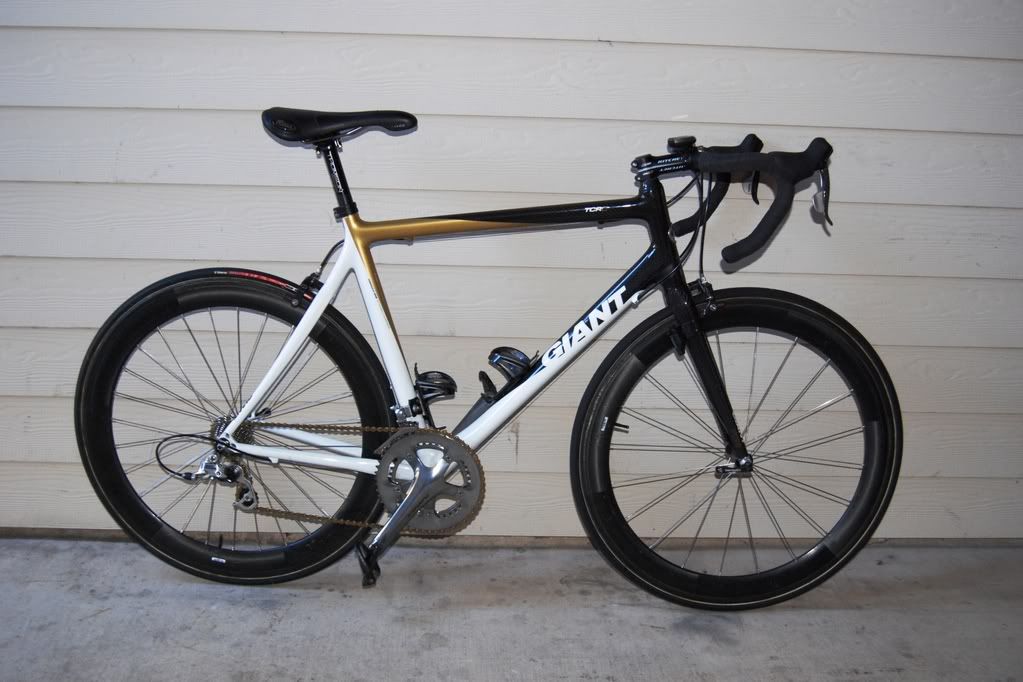
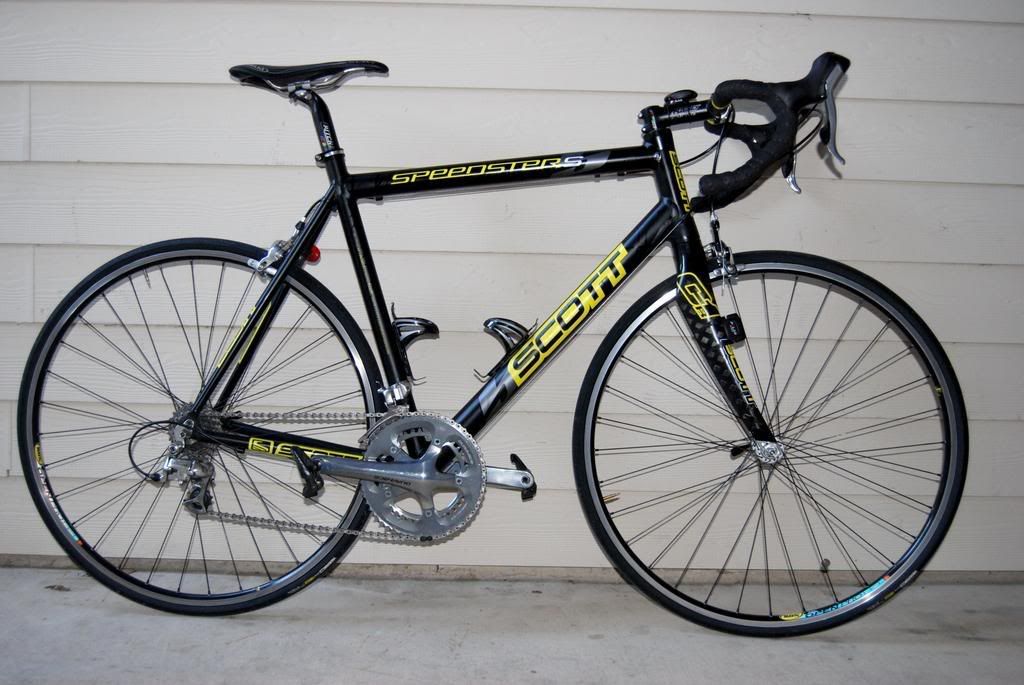
and here's me going up Jester on the "flexier" bike. It climbed like a mountain goat...

Here's the two bikes:
and here's me going up Jester on the "flexier" bike.
It climbed like a mountain goat...
Last edited by ravenmore; 02-19-08 at 11:01 AM.
02-19-08 | 11:18 AM
#224
Thread Starter
Making a kilometer blurry
Joined: May 2006
Posts: 26,170
Likes: 93
From: Austin (near TX)
Bikes: rkwaki's porn collection
I haven't yet. UT_Dude and I are going to use his SRM with my PT on two bikes (my 62cm Ritchey --- pictured above in Ravenmore's pic, and UT_Dude's 54? 56? Scott). There will be a substantial stiffness difference between the frames, which we'll quantify. If there's a difference in efficiency, then the PT should show a greater difference vs. the SRM on my bike.
My hypothesis remains that we will be unable to measure a difference in efficiency.
You should read some more of this thread.
This is also discredited in this thread.
Yeah, make it out of titanium, which is probably the most efficient spring material. Steel is right up there. Carbon fiber is actually a dampener, and will absorb energy through flex. So a CF frame may flex less, but that flex is absorbing some energy, where metal frames return it with great efficiency.
This is also covered in this thread.
My hypothesis remains that we will be unable to measure a difference in efficiency.
If the energy returned has to be somehow accommodated for by your muscles in any way, that's sunk cost and slows you down by siphoning off energy. If it flexes against your natural motions, that taxes you. If you have to flex your upper body more to keep a noodly bike in line better in a sprint, then that's energy lost. Same way that an overly stiff frame beats you up - your body and muscles deal with all that extra jarring, and that's energy and endurance not spent going forward.
That's one (overly) simple way I can see it being slower.
That's one (overly) simple way I can see it being slower.
This is also covered in this thread.
02-19-08 | 11:48 AM
#225

Trying to keep up
Joined: Jan 2007
Posts: 2,137
Likes: 136
From: Fort Worth
Bikes: Pinarello Prince, Orbea Onix, Ridley Fenix