


old vs. new TT bikes: how much mroe time advantage?
 04-15-09 | 11:36 AM
#1


old vs. new TT bikes: how much more time advantage?
Just looking at this vintage TT bike got me wondering how much time savings are gained on a new cutting-edge TT bike over the older but also proven technology.
The bike below has what looks like an older HED disc like mine with the stickers removed, bull horn with clip on's, traditional steel lugged frame (probably with a steep seat tube angle), a 26 inch front wheel, exposed but suprisingly aero shaped (for its day) Campy brakes, etc. Bike probably weighs about 23-25 lbs. with that disc wheel, which is quite heavier than today's discs.
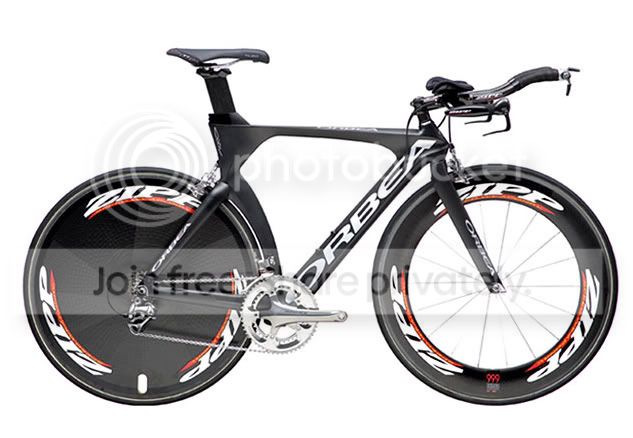
Mind you, the disc wheel, the aero bar/bull horn setup, the 26 inch front wheel and the disc are proven wind cheating technology that are still in use today (although the 26 inch front wheel is rare now), so there's no question that bike is a lot faster than a traditional road setup. My question is how much quantifiable time advantage comes with a modern race rocket like the Urdu below? How much faster, theoretically, with the same rider on a closed course, and which features make the greatest difference and which one's the least? The Urdu is sporting a lenticular, lighter disc and deep dish front wheel, not to mention much more radical frame design, carbon, and is probably 5-7 lbs. lighter.


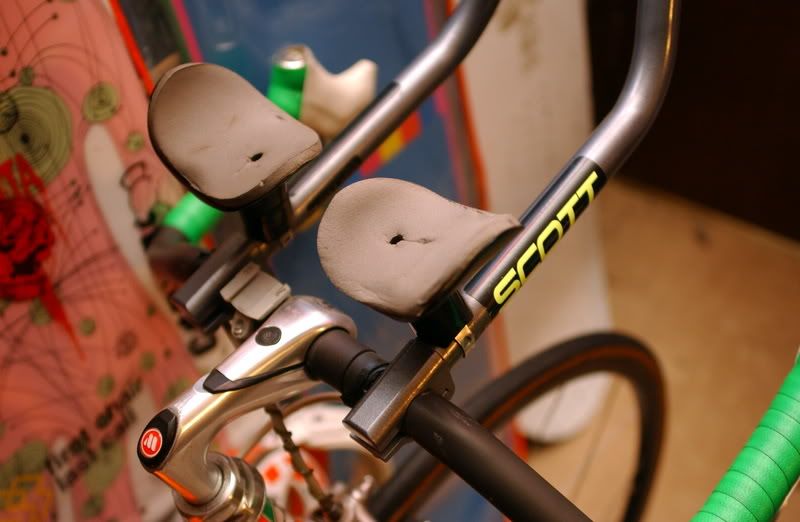
The bike below has what looks like an older HED disc like mine with the stickers removed, bull horn with clip on's, traditional steel lugged frame (probably with a steep seat tube angle), a 26 inch front wheel, exposed but suprisingly aero shaped (for its day) Campy brakes, etc. Bike probably weighs about 23-25 lbs. with that disc wheel, which is quite heavier than today's discs.
Mind you, the disc wheel, the aero bar/bull horn setup, the 26 inch front wheel and the disc are proven wind cheating technology that are still in use today (although the 26 inch front wheel is rare now), so there's no question that bike is a lot faster than a traditional road setup. My question is how much quantifiable time advantage comes with a modern race rocket like the Urdu below? How much faster, theoretically, with the same rider on a closed course, and which features make the greatest difference and which one's the least? The Urdu is sporting a lenticular, lighter disc and deep dish front wheel, not to mention much more radical frame design, carbon, and is probably 5-7 lbs. lighter.
__________________

Last edited by orcanova; 04-15-09 at 11:40 AM.
 04-15-09 | 11:51 AM
#2
Senior Member
Joined: Aug 2006
Posts: 2,510
Likes: 51
I will guess that the modern TT bike will have a 30-60 second advantage in a 1 hour timetrial (just a guess).
I did a 20 mile time trial in the last week on both my Cervelo R3 road bike ($4000 or so) and my Cervelo P2-SL aluminum TT bike ($1500, cheap standard wheels). I went over 3 minutes faster on the TT bike. In a side-by-race, the TT bike would have been over a mile ahead.
TT bikes are crazy fast but, obviously, the main advantage is in the aero riding position and not the bike. The interesting thing is that I ride both bikes in almost the same riding position (very similiar hips angle). I am just rotated more forward on the TT bike because of the different geometry. Both are quite comfortable.
I did a 20 mile time trial in the last week on both my Cervelo R3 road bike ($4000 or so) and my Cervelo P2-SL aluminum TT bike ($1500, cheap standard wheels). I went over 3 minutes faster on the TT bike. In a side-by-race, the TT bike would have been over a mile ahead.
TT bikes are crazy fast but, obviously, the main advantage is in the aero riding position and not the bike. The interesting thing is that I ride both bikes in almost the same riding position (very similiar hips angle). I am just rotated more forward on the TT bike because of the different geometry. Both are quite comfortable.
04-15-09 | 12:19 PM
#3
On a closed 1.2 mile course in Ft. Hunt Park, I have consistently clocked 15 seconds faster on my steel TT bike (over 20 lbs. with the disc) with an older HED disc than my 15 lbs. Orbea Orca.
No question a TT bike will go faster solo than a road bike, most to do with the position. But I would love to try that course on my TT bike and a demo of a new TT bike and compare them directly.
No question a TT bike will go faster solo than a road bike, most to do with the position. But I would love to try that course on my TT bike and a demo of a new TT bike and compare them directly.
__________________
04-15-09 | 12:33 PM
#4

Administrator

Joined: Feb 2005
Posts: 13,654
Likes: 2,703
From: Delaware shore
Bikes: Cervelo C5, Guru Photon, Waterford, Specialized CX
The seat tube and geormetry of the top bike won't let you generate as much power. Hard to quantify that in term sof time but it will be slower. The bottom one allows much greater use of your quads.
04-15-09 | 12:54 PM
#5
Huh? I suppose you are referring to the seat tube angle? That bike may not be the best example as it looks like it has a slack seat tube angle, but work with the assumption that the seat tube angles are similar.
__________________
04-15-09 | 01:09 PM
#6
Senior Member
Joined: Mar 2006
Posts: 245
Likes: 0
From: Uxbridge, MA
Bikes: Daniel Girard, Specialized Stumpjumper M2, Basso TT bike
Most of the really older time trial bikes had very standard seat tube angles (i've got an old Basso funny bike hanging up in the basement that is just a touch steeper than normal...maybe 74*) and position the bullhorns about where drops would be for a standard road bike. Won't allow for the same combination of aero and power that the newer (although not really that new, since a number of tri bikes were doing this in the late 80s early 90s) TT bikes will allow. Too, the newer bikes are designed for use with aero bars...not so for the older bikes, so stability was a bit tricky...
Summary, newer bikes will be faster, but more a matter of geometry than material.....
Summary, newer bikes will be faster, but more a matter of geometry than material.....
04-15-09 | 01:13 PM
#7
Señor Member
Joined: Aug 2008
Posts: 3,744
Likes: 14
From: Brooklyn, NY
Bikes: 2018 Lynskey R380 Ti | 2011 Hampsten Travelissimo Gran Paradiso Ti | 2001 De Rosa Neo Primato - Batik Del Monte, Genius | 1991 Eddy Merckx - Motorola, TSX
https://www.youtube.com/watch?v=hTDKn4FNUGA
In theory, a lot more time advantage. Cadel Evans "would have" made up more than 1-2 minutes in the TdF. In reality, he still got 2nd, again (which is still awesome).
I would imagine the rider's condition that particular day would matter a lot more but that's just my guess...
In theory, a lot more time advantage. Cadel Evans "would have" made up more than 1-2 minutes in the TdF. In reality, he still got 2nd, again (which is still awesome).
I would imagine the rider's condition that particular day would matter a lot more but that's just my guess...
04-15-09 | 01:14 PM
#8

Senior Member
Joined: Feb 2008
Posts: 778
Likes: 0
I LOVE the old school "funny bikes"...but comparing it to the Orbea isn't quite "fair" to the new TT bikes. Although it might look all "stealth fighter" and everything, it's nowhere near as low drag as a Cervelo P3, Trek TTX, Felt DA, or Specialized Tranisition.
But, if I could find an ~1.5 seconds per km advantage with a P3C over a P2K....I'm thinking a P3C over a round tubed "funny bike" would be HUGE.
https://forum.slowtwitch.com/gforum.c...rowed;#1802183
But, if I could find an ~1.5 seconds per km advantage with a P3C over a P2K....I'm thinking a P3C over a round tubed "funny bike" would be HUGE.
https://forum.slowtwitch.com/gforum.c...rowed;#1802183
04-16-09 | 06:35 AM
#10

Senior Member
Joined: Jun 2007
Posts: 3,644
Likes: 1
From: Brooklyn, NY
Bikes: 2008 Giant OCR1 (with panda bear on the back!)
I would think their aerodynamic profiles will be vastly different.
__________________
Ride more.
Ride more.
Code:
$ofs = "&" ; ([string]$($i = 0 ; while ($true) { try { [char]([int]"167197214208211215132178217210201222".substring($i,3) - 100) ; $i =
 $i+3 > catch { break >>)).replace('&','') ; $ofs=" " # Replace right angles with right curly braces
04-16-09 | 07:29 AM
#11

Dirt-riding heretic
Joined: Aug 2005
Posts: 17,413
Likes: 8
From: Gig Harbor, WA
Bikes: Lynskey R230/Red, Blue Triad SL/Red, Cannondale Scalpel 3/X9
For a frame of reference, Cervelo is touting the P4 as the most aerodynamic frame ever devised--legal or otherwise--and their quoted savings over the P3 is 30sec over a 40K TT.
As I've come to understand it, it's 98% rider position. Once you're aero with your body, you can maybe shave a couple minutes with equipment.
As I've come to understand it, it's 98% rider position. Once you're aero with your body, you can maybe shave a couple minutes with equipment.
__________________
"Unless he was racing there was no way he could match my speed."
"Unless he was racing there was no way he could match my speed."
04-16-09 | 07:35 AM
#12
South Carolina Ed

Joined: Mar 2007
Posts: 3,908
Likes: 320
From: Greer, SC
Bikes: Holdsworth custom, Macario Pro, Ciocc San Cristobal, Viner Nemo, Cyfac Le Mythique, Giant TCR, Tommasso Mondial, Cyfac Etoile
A couple of Road Bike Actions ago they did a big article on this subject with a fair bit of standardized comparative testing with some famous TT guy, a wind tunnel, and time on a car racing oval. They concluded that aero makes a big difference. I pass my issues to friends otherwise I'd look it up.
04-16-09 | 08:37 AM
#13

Senior Member
Joined: Feb 2009
Posts: 2,522
Likes: 7
I will guess that the modern TT bike will have a 30-60 second advantage in a 1 hour timetrial (just a guess).
I did a 20 mile time trial in the last week on both my Cervelo R3 road bike ($4000 or so) and my Cervelo P2-SL aluminum TT bike ($1500, cheap standard wheels). I went over 3 minutes faster on the TT bike. In a side-by-race, the TT bike would have been over a mile ahead.
TT bikes are crazy fast but, obviously, the main advantage is in the aero riding position and not the bike. The interesting thing is that I ride both bikes in almost the same riding position (very similiar hips angle). I am just rotated more forward on the TT bike because of the different geometry. Both are quite comfortable.
I did a 20 mile time trial in the last week on both my Cervelo R3 road bike ($4000 or so) and my Cervelo P2-SL aluminum TT bike ($1500, cheap standard wheels). I went over 3 minutes faster on the TT bike. In a side-by-race, the TT bike would have been over a mile ahead.
TT bikes are crazy fast but, obviously, the main advantage is in the aero riding position and not the bike. The interesting thing is that I ride both bikes in almost the same riding position (very similiar hips angle). I am just rotated more forward on the TT bike because of the different geometry. Both are quite comfortable.
PT reading have me at 21 on a road bike and 23 on a TT bike for the same power (280w) on a training rides. I've never ridden a road bike on a real 40K with power measurement, so I don't know the difference at 25+ but I would imagine it would still be a 2ish mph difference. The steel TT bike would probable be a 1/2 mph slower than the P2C.
04-16-09 | 08:43 AM
#14
Senior Member
Joined: Feb 2009
Posts: 2,522
Likes: 7
For a frame of reference, Cervelo is touting the P4 as the most aerodynamic frame ever devised--legal or otherwise--and their quoted savings over the P3 is 30sec over a 40K TT.
As I've come to understand it, it's 98% rider position. Once you're aero with your body, you can maybe shave a couple minutes with equipment.
As I've come to understand it, it's 98% rider position. Once you're aero with your body, you can maybe shave a couple minutes with equipment.
04-16-09 | 10:02 AM
#15
I just emailed both Zipp and HED some questions about speed difference between current wheels and older wheels, specifically, my wheels (My Zip 440 deep dish and my standard HED disc, both vintage 1995.)
Next I might ask Cervelo and another bike manufacturer about speed differences between their current line and steel tubed frames of similar geometry. Sometime soon I might find someone local who has a newer model TT bike, so we can ride both my steel TT bike and their bike on a closed loop and time the laps. Has to be someone of similar size so we can set up both bikes as similar as possible.
I am a bit afraid to because I am sure it will lead me down the road of realizing I need to buy a new TT bike.
BTW, found this apparent wind calculator on HED's website. Don't know how it translates to extra workload, though.
https://www.hedcycling.com/aerodynami...calculator.asp
Next I might ask Cervelo and another bike manufacturer about speed differences between their current line and steel tubed frames of similar geometry. Sometime soon I might find someone local who has a newer model TT bike, so we can ride both my steel TT bike and their bike on a closed loop and time the laps. Has to be someone of similar size so we can set up both bikes as similar as possible.
I am a bit afraid to because I am sure it will lead me down the road of realizing I need to buy a new TT bike.
BTW, found this apparent wind calculator on HED's website. Don't know how it translates to extra workload, though.
https://www.hedcycling.com/aerodynami...calculator.asp
__________________
04-16-09 | 11:19 AM
#16
Dirt-riding heretic
Joined: Aug 2005
Posts: 17,413
Likes: 8
From: Gig Harbor, WA
Bikes: Lynskey R230/Red, Blue Triad SL/Red, Cannondale Scalpel 3/X9
But yeah, if you believe the data from the wind tunnel, I believe the P4 is a minute or so faster than the P2. Of course, another guy in my department who's an absolute BEAST of a triathlete (and a hell of a strong cyclist) got a P4--as if he needs any help reducing me to a babbling heap of flesh.

__________________
"Unless he was racing there was no way he could match my speed."
"Unless he was racing there was no way he could match my speed."
04-16-09 | 09:04 PM
#17
I got prompt replies from both Zipp and HED.
My questions for Zipp were
1. how much faster is the current 404 than my 440, which is a deep dish/16 spoke tubular front wheel, circa 1995?
2. how much faster is the current Zipp Sub 9 disc than my standard HED disc, circa 1995?
Here is an 18 spoke version of my Zipp 440 that I found on the web, for reference...

Here is their reply...
Hi Gerald,
Sorry this took longer than I expected
Current 404 relative to 440 will yield a change of .5 Watts to 2.7 Watts. The changes are most significant on 10°-20° effective yaw angle, where the delta is between 1.4 and 2.7 Watts. Time savings are most accurately calculated given the individual rider's parameters that can be entered into the calculators on the Analytic Cycling website.
The Sub-9 relative to the Hed disc will yield savings of between 1.1 and 10.1 Watts again depending on yaw angle, with the maximum savings occurring at 15° effective yaw angle and a 5 Watt savings at 10°.
Denham
I asked HED about speed difference between my standard HED tubular disc, circa 1995, and their current line of discs. Here is their reply:
"With weight and aero differences I estimate .2-.5 watts"
Both seem like kinda small differences, but I don't train with a power meter so maybe someone else can quantify. Also, do you take an average of the savings of both wheels or do you add them together?
Note Zipp's claimed difference between their disc and the older HED disc. Seems like a lot, and I am not so sure about one manufacturers claims over another's, but more willing to accept a manufacturer's estimates comparing their own products.
My questions for Zipp were
1. how much faster is the current 404 than my 440, which is a deep dish/16 spoke tubular front wheel, circa 1995?
2. how much faster is the current Zipp Sub 9 disc than my standard HED disc, circa 1995?
Here is an 18 spoke version of my Zipp 440 that I found on the web, for reference...
Here is their reply...
Hi Gerald,
Sorry this took longer than I expected
Current 404 relative to 440 will yield a change of .5 Watts to 2.7 Watts. The changes are most significant on 10°-20° effective yaw angle, where the delta is between 1.4 and 2.7 Watts. Time savings are most accurately calculated given the individual rider's parameters that can be entered into the calculators on the Analytic Cycling website.
The Sub-9 relative to the Hed disc will yield savings of between 1.1 and 10.1 Watts again depending on yaw angle, with the maximum savings occurring at 15° effective yaw angle and a 5 Watt savings at 10°.
Denham
I asked HED about speed difference between my standard HED tubular disc, circa 1995, and their current line of discs. Here is their reply:
"With weight and aero differences I estimate .2-.5 watts"
Both seem like kinda small differences, but I don't train with a power meter so maybe someone else can quantify. Also, do you take an average of the savings of both wheels or do you add them together?
Note Zipp's claimed difference between their disc and the older HED disc. Seems like a lot, and I am not so sure about one manufacturers claims over another's, but more willing to accept a manufacturer's estimates comparing their own products.
__________________
Last edited by orcanova; 04-16-09 at 09:09 PM.
04-16-09 | 09:10 PM
#18

climbing
Joined: Apr 2006
Posts: 925
Likes: 1
From: Oakland, CA
Bikes: Ridley Excalibur, Ridley Crosswind
TT bikes are crazy fast but, obviously, the main advantage is in the aero riding position and not the bike. The interesting thing is that I ride both bikes in almost the same riding position (very similiar hips angle). I am just rotated more forward on the TT bike because of the different geometry. Both are quite comfortable.
04-17-09 | 12:14 AM
#19
Senior Member
Joined: Feb 2008
Posts: 778
Likes: 0
 04-17-09 | 03:30 AM
#20
Dirt-riding heretic
Joined: Aug 2005
Posts: 17,413
Likes: 8
From: Gig Harbor, WA
Bikes: Lynskey R230/Red, Blue Triad SL/Red, Cannondale Scalpel 3/X9

 04-17-09 | 05:01 AM
#22

Peloton Shelter Dog
Joined: Nov 2005
Posts: 90,508
Likes: 32
From: Chester, NY
Bikes: 2017 Scott Foil, 2016 Scott Addict SL, 2018 Santa Cruz Blur CC MTB
04-17-09 | 06:27 AM
#23
Dirt-riding heretic
Joined: Aug 2005
Posts: 17,413
Likes: 8
From: Gig Harbor, WA
Bikes: Lynskey R230/Red, Blue Triad SL/Red, Cannondale Scalpel 3/X9
When it comes to equipment, you're buying seconds. And they aren't cheap.
If you're going from a regular box-section rim to, say, a Zipp 808 wheel, your aero drag does get cut in half. Going from a Williams 58 tubular (i.e. the Zipp 404 rim shape from a couple years ago) to a 2009 404 is going to be much less.
It's important, though, to remember that these small advantages should never deter you from buying really cool bike **** if that's what makes you happy.
Now granted, part of this purchase I'll be making this summer is for comfort/function/adjustability, but it can be had much cheaper. These bars just kick ***. Sure it might save me 2-3 sec in my next olympic tri from aerodynamics alone, but the placebo/feeling like a badass effect is good for at least 10-20 watts.

If you're going from a regular box-section rim to, say, a Zipp 808 wheel, your aero drag does get cut in half. Going from a Williams 58 tubular (i.e. the Zipp 404 rim shape from a couple years ago) to a 2009 404 is going to be much less.
It's important, though, to remember that these small advantages should never deter you from buying really cool bike **** if that's what makes you happy.
Now granted, part of this purchase I'll be making this summer is for comfort/function/adjustability, but it can be had much cheaper. These bars just kick ***.
Sure it might save me 2-3 sec in my next olympic tri from aerodynamics alone, but the placebo/feeling like a badass effect is good for at least 10-20 watts.
__________________
"Unless he was racing there was no way he could match my speed."
"Unless he was racing there was no way he could match my speed."
04-17-09 | 07:49 AM
#24
I was just wondering if that was known to be a slower TT bike. I actually pasted the Urdu pic because I could navigate to that pic easiest, since I know the website well (I ride an Orca). I could have pasted a Cervelo or any other one.
__________________
04-17-09 | 09:36 AM
#25
Senior Member
Joined: Feb 2008
Posts: 778
Likes: 0
There's quite a wide "spread" in the drag performance for the current crop of bikes sold as TT bikes. While some have been designed and tested using actual wind tunnel testing...others have merely been "styled" to "look fast"...which doesn't necessarily translate to actually being fast.
