


Double, Triple, or Compact?
 06-28-10 | 01:50 PM
#1
Thread Starter
Member
Joined: May 2010
Posts: 42
Likes: 0
Bikes: 2010 Specialized Allez Sport
Double, Triple, or Compact?
So I am preparing to purchase my first road bike. I am not quite sure what crank would work best for me. My LBS thinks that a double would suit me best, but I'm just not sure. I don't think I want a triple so I guess my biggest question is what are the main differences between a compact or a double? If you had to give a new rider advice between the two what would it be?
 06-28-10 | 01:53 PM
#2

Senior Member
Joined: Jun 2009
Posts: 1,300
Likes: 6
From: Elkridge, MD
Bikes: 2012 Guru Praemio R - 2001 Jamis Ventura - 1990 Specialized Hard Rock (with original tires) - 2012 Trek Cobias
Compact, 11-28 
Not much an advice, I have used triple for a long time, and bought my current bike with a standard double. I then switch it to a compact with a 13-26 cassette. I think it is the most versatile one.
Not much an advice, I have used triple for a long time, and bought my current bike with a standard double. I then switch it to a compact with a 13-26 cassette. I think it is the most versatile one.
 06-28-10 | 01:57 PM
#5
Senior Member
Joined: Apr 2010
Posts: 1,430
Likes: 1
From: Fredericton, NB, Canada
Bikes: 2010 S1, 2011 F75X
If you are concerned about climbing, get a compact. That will give you a bit more of a granny gear at the expense of top speed. You can always change the cassette down the road to fine tune your riding style.
06-28-10 | 02:03 PM
#8


Yes, a compact for hills. I can still pedal 33 mph with my mountain cassette that has only has a 50-13 fastest gear (most bikes have a 50-12). A non-compact 53-12 would go 38 mph at the same pedaling cadence. I just coast downhill instead.
It's not a huge difference. 53 compared to 50 is 6% higher. A lot of the decision depends on your typical road speeds.
If you really want to get into the differences, see Mike Sherman's bike calculator Put in the 53,39 chainrings, use the 12 through 25 cogs, and go down to the "Speed over RPM Range" and select 80 to 100 rpm. Then you can see what speed ranges each gear combination does.
For example:
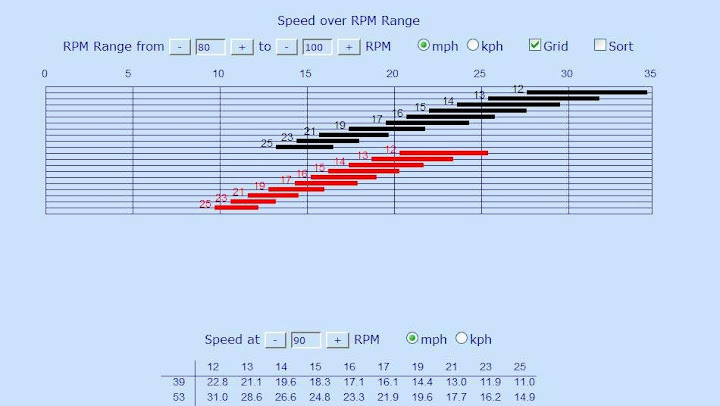
For instance, the 53-15 combination is about 22mph at 80 rpm up to 27 mph at 100 rpm.
The 53 chainring (in black) would be cross-chained at 15 or 16 mph, but good at 17 mph or higher.
Since you are new to road biking, it's hard to predict your typical speeds. You'll be much faster if you are doing fast group rides instead of solo, for instance. (I would cruise at 17-20 mph on flats when solo)
If you really want to get into the differences, see Mike Sherman's bike calculator Put in the 53,39 chainrings, use the 12 through 25 cogs, and go down to the "Speed over RPM Range" and select 80 to 100 rpm. Then you can see what speed ranges each gear combination does.
For example:
For instance, the 53-15 combination is about 22mph at 80 rpm up to 27 mph at 100 rpm.
The 53 chainring (in black) would be cross-chained at 15 or 16 mph, but good at 17 mph or higher.
Since you are new to road biking, it's hard to predict your typical speeds. You'll be much faster if you are doing fast group rides instead of solo, for instance. (I would cruise at 17-20 mph on flats when solo)
Last edited by rm -rf; 06-28-10 at 02:31 PM.
06-28-10 | 02:13 PM
#10
Senior Member


Joined: Jun 2008
Posts: 9,201
Likes: 289
From: Vancouver, BC
I use a compact and find I can stay in the big ring under a wider range of conditions (wind and/or hills) than I would with a double.
 06-28-10 | 02:55 PM
#12

Senior Member
Joined: Feb 2010
Posts: 221
Likes: 0
From: CT
Bikes: Cannondale CAAD9 5...duh!
new to biking and got a compact double. Nothing to compare to but the lowest gear on long, steep or both comes in VERY handy. I would use a lower gear on a rare instance I had one on steep climbs I am strugling on.
compact double gets my vote.
compact double gets my vote.
06-28-10 | 03:56 PM
#14

Senior Member
Joined: Mar 2009
Posts: 855
Likes: 0
From: Nova Scotia
I'm not particularly experienced or very strong, but if you really don't have steep hills (really few) I think the standard double definitely has an edge, and it's got nothing to do with the 2-3 tooth difference in the big rings. I love my compact in the hills but you need to shift as many as 3 or 4 cogs to make the transition between rings smooth, and some really useful gears for solo riding are right in the cross-chaining range. If you really don't need to climb any steep hills a standard ought to give you a more useful range of gears and a more convenient front shift. Otherwise compacts are great.
06-28-10 | 04:18 PM
#15
Batüwü Creakcreak
Joined: Jan 2007
Posts: 20,802
Likes: 294
From: The illadelph
I would suggest a compact. You're rarely going to spin out of a 50x12... If you do, you can just get an 11 cog which makes the 50x11 bigger than a 53x12.
Compacts are great for all around riding. The best scenario is that you can get the same gear range with less of a gear jump. I.e. 50/36 rings to an 11-23 give a similar range to a 53/39, with closer jumps within the cassette.
Compacts are great for all around riding. The best scenario is that you can get the same gear range with less of a gear jump. I.e. 50/36 rings to an 11-23 give a similar range to a 53/39, with closer jumps within the cassette.
06-28-10 | 04:22 PM
#16
Senior Member
Joined: Jun 2009
Posts: 1,272
Likes: 0
From: Austin
I'm not particularly experienced or very strong, but if you really don't have steep hills (really few) I think the standard double definitely has an edge, and it's got nothing to do with the 2-3 tooth difference in the big rings. I love my compact in the hills but you need to shift as many as 3 or 4 cogs to make the transition between rings smooth, and some really useful gears for solo riding are right in the cross-chaining range. If you really don't need to climb any steep hills a standard ought to give you a more useful range of gears and a more convenient front shift. Otherwise compacts are great.
06-28-10 | 04:26 PM
#17

Member
Joined: Oct 2009
Posts: 825
Likes: 1
From: Nor Cal
IMO, compact gives you the highest number of options while still remaining simple (2 rings instead of 3). Swapping the rear cassette to suit your needs (or the needs of a specific ride) is a relatively easy and inexpensive thing to do.
Bob
Bob
06-28-10 | 04:48 PM
#18

Senior Member
Joined: May 2007
Posts: 6,169
Likes: 1
From: Santa Cruz Mountains
If you're a new rider and don't know what you need, get a triple. You'll have a gear for everything and no big gaps between ratios.
If you get a double (compact or regular) and decide later on that you want to ride big mountains, switching to a triple is very expensive. But buying a bike with a triple costs $0-100 more than the double (standard or compact) when buying new. And if you decide to switch it to a double of some sort it's much cheaper to go that direction since the triple shifters will work on a double.
If you get a double (compact or regular) and decide later on that you want to ride big mountains, switching to a triple is very expensive. But buying a bike with a triple costs $0-100 more than the double (standard or compact) when buying new. And if you decide to switch it to a double of some sort it's much cheaper to go that direction since the triple shifters will work on a double.
 06-28-10 | 07:51 PM
#20
Thread Starter
Member
Joined: May 2010
Posts: 42
Likes: 0
Bikes: 2010 Specialized Allez Sport
O no i completely trust the shop...i am just a person who loves to have more than one opinion, so that's the only reason i brought it up on here. i am completely new to cycling so i am really trying to learn as much as i can before i get on the bike
06-28-10 | 08:10 PM
#21

Senior Member
Joined: Apr 2010
Posts: 184
Likes: 0
If you're new to cycling, get the compact. The "going faster" won't be an issue until much later, while getting used to climbing, even small hills, gets new cyclists right at the start. If you really get into it and start excelling and feel the need for the extra speed a standard may give you, then you can always upgrade. Or get another bike and turn the compact into your rain bike.
06-28-10 | 08:13 PM
#22

Live to ride ride to live
Joined: Aug 2006
Posts: 4,896
Likes: 1
From: Austin, Texas
Bikes: Calfee Tetra Pro
I have had a standard double and now a triple. The triple offers the largest range available, however, I am ready to replace it with a compact. The reason is that I can use the big chain ring on the front 98% of the time and never use the smaller chain ring. With the triple, I switched between the middle and large chain ring and only use the small chain ring on the nastiest hillls. Since I am a Campy user I can get a 12-29 cassette on compact which has about the same range as a 13-26 on a triple.
06-28-10 | 08:15 PM
#23
Senior Member
Joined: Jun 2009
Posts: 756
Likes: 0
From: Southeast
Bikes: cyclotank
I would avoid triple for a number of reasons: smoother/simpler shifting, straighter chainline, more forgiving for a beginner. Compact or double - depends how strong/young/fit you are and how steep are the hills. Make up for it with the cassette - SRAM makes 10 speed 11/28.
Have fun
SF
Have fun
SF
06-28-10 | 08:27 PM
#24
Live to ride ride to live
Joined: Aug 2006
Posts: 4,896
Likes: 1
From: Austin, Texas
Bikes: Calfee Tetra Pro
I would avoid triple for a number of reasons: smoother/simpler shifting, straighter chainline, more forgiving for a beginner. Compact or double - depends how strong/young/fit you are and how steep are the hills. Make up for it with the cassette - SRAM makes 10 speed 11/28.
Have fun
SF
Have fun
SF
06-28-10 | 09:15 PM
#25
Senior Member
Joined: Mar 2009
Posts: 855
Likes: 0
From: Nova Scotia
If you're a new rider and don't know what you need, get a triple. You'll have a gear for everything and no big gaps between ratios.
If you get a double (compact or regular) and decide later on that you want to ride big mountains, switching to a triple is very expensive. But buying a bike with a triple costs $0-100 more than the double (standard or compact) when buying new. And if you decide to switch it to a double of some sort it's much cheaper to go that direction since the triple shifters will work on a double.
If you get a double (compact or regular) and decide later on that you want to ride big mountains, switching to a triple is very expensive. But buying a bike with a triple costs $0-100 more than the double (standard or compact) when buying new. And if you decide to switch it to a double of some sort it's much cheaper to go that direction since the triple shifters will work on a double.