


Why silk base layers?
 01-17-11 | 01:01 PM
#1

Thread Starter
Senior Member
Joined: Mar 2010
Posts: 23,208
Likes: 10,653
From: Seattle, WA
Why silk base layers?
A few of the people I work with are skiers, and these people love silk base layers. I haven't been skiing since I was a kid, so I don't know why they're so well loved. Can anybody fill me in?
What I really want to know is if they might be appropriate for cycling.
What I really want to know is if they might be appropriate for cycling.
 01-17-11 | 01:23 PM
#2
Senior Member
Joined: Jan 2008
Posts: 4,556
Likes: 1
From: Boston
I use silk socks and silk glove liners, they seem to be pretty warm and they add almost no bulk. It'd probably do the same as a base layer. For cycling I really doubt it's an improvement worthy of the cost.
I don't have to pack on lots of layers around my torso as it is.
I don't have to pack on lots of layers around my torso as it is.
01-17-11 | 01:27 PM
#3

Speed Freak
Joined: Jun 2009
Posts: 38
Likes: 0
From: Tracy, CA.
Bikes: still building one / owned a Stowe TT bike and a Miyata
i believe moisture wicking.. keeps you dry and that = warmer... but synthetic wicking material is as good and more durable silk wears out tears easy

 01-17-11 | 01:48 PM
#5
Speed Freak
Joined: Jun 2009
Posts: 38
Likes: 0
From: Tracy, CA.
Bikes: still building one / owned a Stowe TT bike and a Miyata

 01-17-11 | 01:58 PM
#8
Thread Starter
Senior Member
Joined: Mar 2010
Posts: 23,208
Likes: 10,653
From: Seattle, WA
This gets to my true motive for this thread. I have three shirts, which are all the same blend: 85 % silk, and 15 % cashmere. All of them are paper thin, like all of my best merino base layers. Naturally, I'm wondering if these will be a good idea for cycling? Seems like silk would hold onto sweat and feel clammy, but I doubt the skiers would like it if it did ... but I want to ask before I try it, and possibly find myself soaked with sweat an hour and 20 miles away from home.
01-17-11 | 02:33 PM
#9

Senior Member

Joined: Feb 2006
Posts: 523
Likes: 17
Silk and wool are much more breathable than any synthetic fiber in use for clothing. Silk and wool also keep you warm even when wet, and don't get smelly like synthetics. Silk tends to be pricier than wool. Merino wool is non-scratchy and machine-washable (but will probably shrink if tossed in a dryer).
 01-17-11 | 02:44 PM
#11
Still can't climb
Joined: Sep 2006
Posts: 23,024
Likes: 6
From: Limey in Taiwan
this is a fun thread. i think people use silk because they are a bit girlie but that's ok if you are a girl.
__________________
coasting, few quotes are worthy of him, and of those, even fewer printable in a family forum......quote 3alarmer
No @coasting, you should stay 100% as you are right now, don't change a thing....quote Heathpack
coasting, few quotes are worthy of him, and of those, even fewer printable in a family forum......quote 3alarmer
No @coasting, you should stay 100% as you are right now, don't change a thing....quote Heathpack
01-17-11 | 02:45 PM
#12
Senior Member
Joined: Jan 2008
Posts: 4,556
Likes: 1
From: Boston
This gets to my true motive for this thread. I have three shirts, which are all the same blend: 85 % silk, and 15 % cashmere. All of them are paper thin, like all of my best merino base layers. Naturally, I'm wondering if these will be a good idea for cycling? Seems like silk would hold onto sweat and feel clammy, but I doubt the skiers would like it if it did ... but I want to ask before I try it, and possibly find myself soaked with sweat an hour and 20 miles away from home.
01-17-11 | 02:50 PM
#13


Overacting because I can
Joined: Jan 2005
Posts: 4,552
Likes: 0
From: The Mean Streets of Bethesda, MD
Bikes: Merlin Agilis, Trek 1500
Because some of us look really, really good in silk.
Of course, some of us just look like silk wrapped Michelin men, but such is life.
Of course, some of us just look like silk wrapped Michelin men, but such is life.
__________________
“Courage is going from failure to failure without losing enthusiasm." (Churchill)
"I am a courageous cyclist." (SpongeDad)
“Courage is going from failure to failure without losing enthusiasm." (Churchill)
"I am a courageous cyclist." (SpongeDad)
 01-17-11 | 03:22 PM
#15
Senior Member
Joined: Jan 2008
Posts: 156
Likes: 0
With winter outfitting, like snowboarding/skiing, the 3 layers approach is recommended to stay dry and warm.
The first layer is either polyester or silk. Typically polyester that is very stretchable and breathable. This "wicks" the moisture away from your skin.
The next layer is fleece. This keeps the body heat inside while also allowing the moisture to escape.
Then, you have the outer shell. This is also for breathability, but also mositure/water resistant to not let moisture back into the other layers. These usually have ratings for breathability and moisture resistance.
Same principle should apply for cycling, yet you want better/thinner clothing to allow movement and be aerodynamic, yet stay warm.
The first layer is either polyester or silk. Typically polyester that is very stretchable and breathable. This "wicks" the moisture away from your skin.
The next layer is fleece. This keeps the body heat inside while also allowing the moisture to escape.
Then, you have the outer shell. This is also for breathability, but also mositure/water resistant to not let moisture back into the other layers. These usually have ratings for breathability and moisture resistance.
Same principle should apply for cycling, yet you want better/thinner clothing to allow movement and be aerodynamic, yet stay warm.
Last edited by techlogik; 01-17-11 at 03:32 PM.
01-17-11 | 03:24 PM
#16
Senior Member
Joined: Jun 2007
Posts: 6,411
Likes: 13
From: Haunchyville
Maybe not the absolute authority, but this REI page has a chart at the bottom detailing silk vs. wool. vs. poly:
https://webcache.googleusercontent.co...&ct=clnk&gl=us
https://webcache.googleusercontent.co...&ct=clnk&gl=us
01-17-11 | 03:26 PM
#17

Senior Member


Joined: Aug 2005
Posts: 4,237
Likes: 92
From: Awesome, Austin, TX
Bikes: Specialized Roubaix, Interloc Impala, ParkPre Image C6
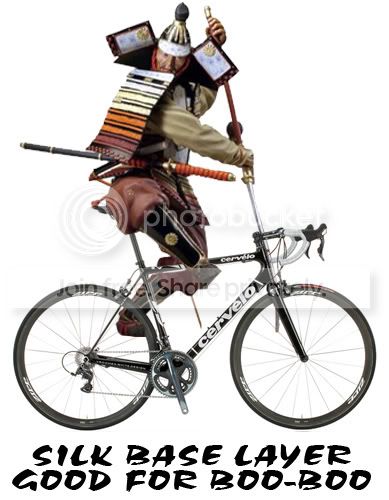
Shouldn't the Samurai be riding a Fuji?
__________________
2014 Specialized Roubaix2003 Interloc Impala2007 ParkPre Image C6 (RIP)
2014 Specialized Roubaix2003 Interloc Impala2007 ParkPre Image C6 (RIP)
01-17-11 | 04:49 PM
#18

Senior Member
Joined: Jul 2002
Posts: 40,863
Likes: 3,115
From: Sacramento, California, USA
Bikes: Specialized Tarmac, Canyon Exceed, Specialized Transition, Ellsworth Roots, Ridley Excalibur
 01-17-11 | 05:09 PM
#20
Thread Starter
Senior Member
Joined: Mar 2010
Posts: 23,208
Likes: 10,653
From: Seattle, WA
Thanks for the info, everyone. Sounds like these are worth a try this time of year.
I asked one of the skiers, but he said he doesn't sweat all that much taking a lift up, then sliding down the hill. He said it's a little bit of work navigating down the slope, but that he's lazy. This thread has been a lot more helpful.
I asked one of the skiers, but he said he doesn't sweat all that much taking a lift up, then sliding down the hill. He said it's a little bit of work navigating down the slope, but that he's lazy. This thread has been a lot more helpful.
 01-17-11 | 06:16 PM
#22

Senior Member
Joined: Oct 2005
Posts: 11,222
Likes: 30
From: South Bend IN
Bikes: 1976 FRESCHI, 2004 Crumpton.
A few of the people I work with are skiers, and these people love silk base layers. I haven't been skiing since I was a kid, so I don't know why they're so well loved. Can anybody fill me in?
What I really want to know is if they might be appropriate for cycling.
What I really want to know is if they might be appropriate for cycling.
01-17-11 | 06:29 PM
#23

Senior Member
Joined: Oct 2009
Posts: 256
Likes: 0
From: Kansas City, Mo
Bikes: CAAD8 5, Killo Stripped
Silk is also the oldest and lightest natural insulator. That is why it started out with backpackers. I don't know how it would work with riding because its so fragile that it would have to be worn loose.
01-17-11 | 10:38 PM
#25
Happily Addicted
Joined: Dec 2010
Posts: 149
Likes: 0
From: San Diego, CA
Bikes: '16 Trek Domane SLR 7 Disc
Look around on Sierra Trading Post or some of the other discount sites-- they often have silk base layers for dirt cheap so you can try at a low entry cost before dropping bigger bucks on quality stuff.