


Stiffness of slender columns - is a curved fork more resiliant than a straight one?
 02-08-11 | 03:57 AM
#1

Thread Starter
Early riser
Joined: Oct 2008
Posts: 198
Likes: 0
Stiffness of slender columns - is a curved fork more resiliant than a straight one?
Hi
It is many summers since one of the smartest men I ever met tried to teach me energy methods, Castigliano's theorums etc, and I have forgetten anything that I may once have known.
Can someone who understands this stuff prove whether a fork that is curved is less stiff (more compliant) than a straight fork of the same cross section. If the curved fork is more resiliant, then why aren't all forks curved?

davida
It is many summers since one of the smartest men I ever met tried to teach me energy methods, Castigliano's theorums etc, and I have forgetten anything that I may once have known.
Can someone who understands this stuff prove whether a fork that is curved is less stiff (more compliant) than a straight fork of the same cross section. If the curved fork is more resiliant, then why aren't all forks curved?
davida

 02-08-11 | 07:37 AM
#3


pan y agua

Joined: Aug 2005
Posts: 31,812
Likes: 1,234
From: Jacksonville
Bikes: Willier Zero 7; Merlin Extralight; Calfee Dragonfly tandem, Calfee Adventure tandem; Cervelo P2; Motebecane Ti Fly 29er; Motebecanne Phantom Cross; Schwinn Paramount Track bike
Back in the day when forks were steel, and the tubing was all pretty much the same diameter and thickness, the shape of the fork, i.e. curved vs straight probably had a direct affect on ride compliance. (although that was the subject of heated debates in itself.)
Today with CF you can affect the qualities of a fork in so many ways, i.e. layup. type of fibers, amount of fiber, etc, that shape is just one variable, and there's no way to say one fork is stiffer than another, or more vibration absorbing just on shape, without controlling for the other variables.
Today with CF you can affect the qualities of a fork in so many ways, i.e. layup. type of fibers, amount of fiber, etc, that shape is just one variable, and there's no way to say one fork is stiffer than another, or more vibration absorbing just on shape, without controlling for the other variables.
__________________
You could fall off a cliff and die.
You could get lost and die.
You could hit a tree and die.
OR YOU COULD STAY HOME AND FALL OFF THE COUCH AND DIE.
You could fall off a cliff and die.
You could get lost and die.
You could hit a tree and die.
OR YOU COULD STAY HOME AND FALL OFF THE COUCH AND DIE.
02-08-11 | 07:56 AM
#4

Senior Member
Joined: Dec 2010
Posts: 8,951
Likes: 14
Material and construction certainly comes into play. Personally, I think the squiggly Pinarello fork is ludicrous and that it serves no function that couldn't be achieved with a straight or curved fork from the engineering perspective.
02-08-11 | 09:00 AM
#5

Senior Member
Joined: May 2002
Posts: 10,123
Likes: 4
From: Near Portland, OR
Bikes: Three road bikes. Two track bikes.
Hi
It is many summers since one of the smartest men I ever met tried to teach me energy methods, Castigliano's theorums etc, and I have forgetten anything that I may once have known.
Can someone who understands this stuff prove whether a fork that is curved is less stiff (more compliant) than a straight fork of the same cross section. If the curved fork is more resiliant, then why aren't all forks curved?
[IMG]https://www.extravaganzi.com/wp-content/uploads/2010/07/Pinarello_Prince_Di2_2009_Fork_FPX_Red.jpg[/ IMG]
davida
It is many summers since one of the smartest men I ever met tried to teach me energy methods, Castigliano's theorums etc, and I have forgetten anything that I may once have known.
Can someone who understands this stuff prove whether a fork that is curved is less stiff (more compliant) than a straight fork of the same cross section. If the curved fork is more resiliant, then why aren't all forks curved?
[IMG]https://www.extravaganzi.com/wp-content/uploads/2010/07/Pinarello_Prince_Di2_2009_Fork_FPX_Red.jpg[/ IMG]
davida
As for why some forks are curved and some are straight, these days, with most competition forks being carbon fiber composite, it's pure aesthetics. And Pinarello is just going for "unique", so there is no mistaking it's a Pinarello frame you are riding. For example, I own three road bikes of various styles. The stiffest fork/front end goes to the bike with the curved fork. The other two bikes have straight forks. If you were to analyse a modern carbon fork, I think you would find that it's strength and stiffness depends more on it's construction, particularly in how the steering tube is joined to the fork blades.
__________________
Cat 2 Track, Cat 3 Road.
"If you’re new enough [to racing] that you would ask such question, then i would hazard a guess that if you just made up a workout that sounded hard to do, and did it, you’d probably get faster." --the tiniest sprinter
Cat 2 Track, Cat 3 Road.
"If you’re new enough [to racing] that you would ask such question, then i would hazard a guess that if you just made up a workout that sounded hard to do, and did it, you’d probably get faster." --the tiniest sprinter
02-08-11 | 09:09 AM
#6

Descends like a rock
Joined: Oct 2010
Posts: 4,034
Likes: 16
From: Fort Worth, TX
Bikes: Scott Foil, Surly Pacer
I would say it all depends on shape, materials, and design. If the materials are properly chosen and shaped properly for the load forces, they should be equally resilient. Like Brian said the loads will be different - a straight fork is close to all compression as the forces are translated vertically through the material (depending on the angle). A curved fork will have compression on the top of the curve and tensile loads on the bottom and compression in the more vertical parts.
I would expect a properly designed curved fork would have the ability to flex more than a perfectly straight fork, but that effect could easily be overcome by the particular shape and thickness of the material, or in the case of CF, maybe even the direction of the fiber. On the other hand a straight fork made of a thin springy steel might be designed to be very flexy.
I would expect a properly designed curved fork would have the ability to flex more than a perfectly straight fork, but that effect could easily be overcome by the particular shape and thickness of the material, or in the case of CF, maybe even the direction of the fiber. On the other hand a straight fork made of a thin springy steel might be designed to be very flexy.
02-08-11 | 10:07 AM
#7

Senior Member
Joined: Nov 2010
Posts: 490
Likes: 0
From: NE, Ohio
Bikes: 2010 Cannondale Supersix 3
I have to agree that construction properties of the fork are the deciding factor. Look at a CF golf club shaft, a manufacturer can determin where that shaft will flex and how much at identical weights depending on how the CFs are distributed throughout the shaft. with that said I think that will more of a significant impact than any designed curves and such.
 02-08-11 | 12:20 PM
#9

Decrepit Member
Joined: Aug 2005
Posts: 10,488
Likes: 92
From: Santa Rosa, California
Bikes: Waterford 953 RS-22, several Paramounts
I can't speak to the value of Pinarello "wavy" CF fork profile, but Jan Heine wrote an article titled "Fork Blades Optimized for Comfort and Speed" in Bicycle Quarterly a couple of years ago in which he analyzes the physics of steel curved fork blades vs. steel straight fork blades with the same rake (or offset if you prefer). His conclusion was that straight fork blades with the rake built into the crown-to-blade angle transmit vertical road surface irregularities (bumps) more directly to the headset/head tube than fork blades with the rake implemented by curving the blades near the dropouts. Since compressibility of fork blade materials (whether steel or composite) is very low, road bumps are absorbed by the compliance in the curve of the fork blades rather than being transmitted more vertically through straight fork blades.
Here is one of Jan's drawings illustrating his point.
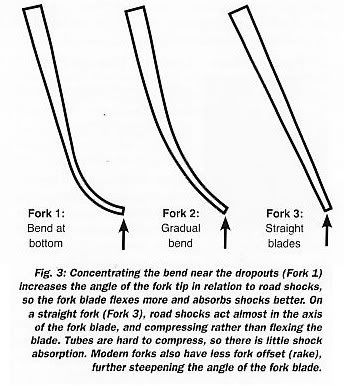
Here is one of Jan's drawings illustrating his point.


 02-08-11 | 12:57 PM
#11
Senior Member
Joined: Dec 2004
Posts: 698
Likes: 0
From: St Paul, MN
Intuitively, it seems to me that the shape of the Pinarello fork has a structural purpose. I believe the wavy shape introduces two additional inflection points that allow the fork to respond differently to axial forces than would a single-bend fork. I don't think it's purely marketing.
02-08-11 | 01:51 PM
#12
pan y agua
Joined: Aug 2005
Posts: 31,812
Likes: 1,234
From: Jacksonville
Bikes: Willier Zero 7; Merlin Extralight; Calfee Dragonfly tandem, Calfee Adventure tandem; Cervelo P2; Motebecane Ti Fly 29er; Motebecanne Phantom Cross; Schwinn Paramount Track bike
it's really just an hommage to Salvidor Dali.
__________________
You could fall off a cliff and die.
You could get lost and die.
You could hit a tree and die.
OR YOU COULD STAY HOME AND FALL OFF THE COUCH AND DIE.
You could fall off a cliff and die.
You could get lost and die.
You could hit a tree and die.
OR YOU COULD STAY HOME AND FALL OFF THE COUCH AND DIE.
 02-08-11 | 03:43 PM
#14

ka maté ka maté ka ora
Joined: Oct 2008
Posts: 4,423
Likes: 4
From: wessex
Bikes: breezer venturi - red novo bosberg - red, pedal force cg1 - red, neuvation f-100 - da, devinci phantom - xt, miele piste - miche/campy, bianchi reparto corse sbx, concorde squadra tsx - da, miele team issue sl - ultegra
looking at a straight fork, there is an obtuse angle between the head tube and the fork legs allowing for deflection. the forces acting at the headtube, fork junction is not compressive, but rather cantilevered.
02-08-11 | 05:06 PM
#15
Decrepit Member
Joined: Aug 2005
Posts: 10,488
Likes: 92
From: Santa Rosa, California
Bikes: Waterford 953 RS-22, several Paramounts
The deflection of the fork blades at the crown is insignificant in both straight and curved bladed forks as that's the beefiest, stiffest part of the fork (that's where the stress is concentrated). The percentage of the compressive vertical vector is significantly greater for the straight bladed fork than for a fork with blades curved near the dropout, and because the curved fork blades are both tapered and taper gauge (thinner walled at the dropouts than at the crown), the curved fork blades have greater shock absorption properties than the straight blades.
02-08-11 | 06:34 PM
#16
Senior Member
Joined: May 2002
Posts: 10,123
Likes: 4
From: Near Portland, OR
Bikes: Three road bikes. Two track bikes.
The deflection of the fork blades at the crown is insignificant in both straight and curved bladed forks as that's the beefiest, stiffest part of the fork (that's where the stress is concentrated). The percentage of the compressive vertical vector is significantly greater for the straight bladed fork than for a fork with blades curved near the dropout, and because the curved fork blades are both tapered and taper gauge (thinner walled at the dropouts than at the crown), the curved fork blades have greater shock absorption properties than the straight blades.
__________________
Cat 2 Track, Cat 3 Road.
"If you’re new enough [to racing] that you would ask such question, then i would hazard a guess that if you just made up a workout that sounded hard to do, and did it, you’d probably get faster." --the tiniest sprinter
Cat 2 Track, Cat 3 Road.
"If you’re new enough [to racing] that you would ask such question, then i would hazard a guess that if you just made up a workout that sounded hard to do, and did it, you’d probably get faster." --the tiniest sprinter
02-08-11 | 06:41 PM
#17
Senior Member
Joined: May 2002
Posts: 10,123
Likes: 4
From: Near Portland, OR
Bikes: Three road bikes. Two track bikes.
No such thing as "cantilevered" force. The fork can be idealized as a cantilever due to it being supported by a single end taking up most of the degrees of freedom (leaving only one free). I think you meant "bending" rather than "cantilevered". In any case, frame stresses are pretty much always a combination of compression, sheer, and bending. It's not an either/or situation, and the forces that are actually applied depend on the load conditions of the bicycle.
__________________
Cat 2 Track, Cat 3 Road.
"If you’re new enough [to racing] that you would ask such question, then i would hazard a guess that if you just made up a workout that sounded hard to do, and did it, you’d probably get faster." --the tiniest sprinter
Cat 2 Track, Cat 3 Road.
"If you’re new enough [to racing] that you would ask such question, then i would hazard a guess that if you just made up a workout that sounded hard to do, and did it, you’d probably get faster." --the tiniest sprinter
02-08-11 | 06:54 PM
#18
Decrepit Member
Joined: Aug 2005
Posts: 10,488
Likes: 92
From: Santa Rosa, California
Bikes: Waterford 953 RS-22, several Paramounts
Fair enough; it was an overly broad generalization.

