


Biking in a thunderstorm: How safe if at all is it?
 08-09-13 | 12:50 PM
#1
Thread Starter
Senior Member
Joined: Jul 2013
Posts: 184
Likes: 0
From: Pleasantville, NY
Bikes: 2012 Redline DS1 & 2014 Giant Defy 2
Biking in a thunderstorm: How safe if at all is it?
See title. I seem to always get stuck a few miles from home (up a very large hill) and its starts pouring, getting very windy and eventually lightning and thunder come out. So I was wondering if I should keep riding or take cover. Take into account I live in southern new york, so these are not tornado bearing storms or supercells...

 08-09-13 | 12:57 PM
#3

Speechless
Joined: Jun 2011
Posts: 8,842
Likes: 39
From: Central NY
Bikes: Felt Brougham, Lotus Prestige, Cinelli Xperience,
I would wager that you are safer getting home and out of a storm than lurking and waiting. I would just make sure you have a blinkie going and are visible, because I think the cars hitting you in a surprise down pour would be worse than the lightning.
08-09-13 | 01:03 PM
#4

On the big ring
Joined: Aug 2006
Posts: 851
Likes: 0
From: Lenexa, Ks
Bikes: Trek 1100, Litespeed Catalyst
I associate t-storm with heavy rain and pour visibility. I think the chance of getting hit by a car is greater than being struck by lightning. In those conditions of reduced visibility drivers will be even less aware of bikes on the street.
08-09-13 | 01:04 PM
#5

Senior Member
Joined: Mar 2010
Posts: 23,208
Likes: 10,653
From: Seattle, WA
I wouldn't worry too much about being struck by lightning on a road bike, but I'd be somewhat concerned about the roads being suddenly wet (especially if they haven't been in a while and both you and the drivers have forgotten the experience a bit), driving rain, hail, winds, less visibility, and drivers in a hurry to get home.
I spent the weekend climbing in Leavenworth, in the hot sun. On my way toward Blewett Pass, I went through a summer thunderstorm. It was producing hail the size of quarters. The music on the radio was interrupted twice for the emergency broadcast system, it warned of flash flooding in a particular canyon and urged people "to take immediate precautions to protect life and property." I don't think flash floods are going to be an issue in NY.
I spent the weekend climbing in Leavenworth, in the hot sun. On my way toward Blewett Pass, I went through a summer thunderstorm. It was producing hail the size of quarters. The music on the radio was interrupted twice for the emergency broadcast system, it warned of flash flooding in a particular canyon and urged people "to take immediate precautions to protect life and property." I don't think flash floods are going to be an issue in NY.
08-09-13 | 01:24 PM
#7


pan y agua

Joined: Aug 2005
Posts: 31,812
Likes: 1,234
From: Jacksonville
Bikes: Willier Zero 7; Merlin Extralight; Calfee Dragonfly tandem, Calfee Adventure tandem; Cervelo P2; Motebecane Ti Fly 29er; Motebecanne Phantom Cross; Schwinn Paramount Track bike
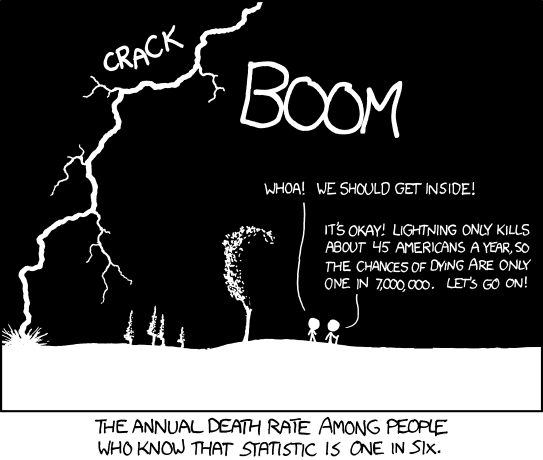
Approximately 100 people a year die in the U.S. from lightning strikes, or about 1/6th of the number of cyclists killed in car accidents.
So it's not a huge risk statistically in an aggregate sense, but if you choose to ride in a thunderstorm, you're sitting up high in an exposed area, riding a bike that includes electrically consuctive parts, substantially increasing the odds you become one of those 100.
Doesn't seem like a very bright thing to do to me.
So it's not a huge risk statistically in an aggregate sense, but if you choose to ride in a thunderstorm, you're sitting up high in an exposed area, riding a bike that includes electrically consuctive parts, substantially increasing the odds you become one of those 100.
Doesn't seem like a very bright thing to do to me.
__________________
You could fall off a cliff and die.
You could get lost and die.
You could hit a tree and die.
OR YOU COULD STAY HOME AND FALL OFF THE COUCH AND DIE.
You could fall off a cliff and die.
You could get lost and die.
You could hit a tree and die.
OR YOU COULD STAY HOME AND FALL OFF THE COUCH AND DIE.
08-09-13 | 01:39 PM
#8
Senior Member
Joined: Nov 2010
Posts: 289
Likes: 1
From: Brooklyn, NY
Bikes: 2013 Trek 1.5
As long as you're not riding through a field you should be ok. Also, you're not grounded while on the bike (rubber tires) so you wouldn't get struck. I would worry about visibility and traction. We've been getting scattered storms the past two days (NYC) and I'm riding home tonight. It's mostly bike paths/lanes so I'll just have to worry about getting soaked and not taking a spill if I'm caught in a storm.
 08-09-13 | 01:45 PM
#10
pan y agua
Joined: Aug 2005
Posts: 31,812
Likes: 1,234
From: Jacksonville
Bikes: Willier Zero 7; Merlin Extralight; Calfee Dragonfly tandem, Calfee Adventure tandem; Cervelo P2; Motebecane Ti Fly 29er; Motebecanne Phantom Cross; Schwinn Paramount Track bike
As long as you're not riding through a field you should be ok. Also, you're not grounded while on the bike (rubber tires) so you wouldn't get struck. I would worry about visibility and traction. We've been getting scattered storms the past two days (NYC) and I'm riding home tonight. It's mostly bike paths/lanes so I'll just have to worry about getting soaked and not taking a spill if I'm caught in a storm.
The lightning bolt just jumped through miles of ungrounded air to reach you. You think it can't jump past 23mm of bike tire?
Not even a substantially thicker car tire keeps you safe in a car. The fact that a car with a metal roof is a relatively safe place to be in a lightning storm is not because of the insulating effect of the tires, it's because the car's body acts as a Faraday cage. Your bike is not a faraday cage.
__________________
You could fall off a cliff and die.
You could get lost and die.
You could hit a tree and die.
OR YOU COULD STAY HOME AND FALL OFF THE COUCH AND DIE.
You could fall off a cliff and die.
You could get lost and die.
You could hit a tree and die.
OR YOU COULD STAY HOME AND FALL OFF THE COUCH AND DIE.
08-09-13 | 01:54 PM
#11
Speechless
Joined: Jun 2011
Posts: 8,842
Likes: 39
From: Central NY
Bikes: Felt Brougham, Lotus Prestige, Cinelli Xperience,
MerlinE~
I disagree with nothing you say, however, if you are out riding and a thunderstorm occurs, unless you get inside at a stranger's home, you are equally exposed moving or stopping.
In the out in an open field scenario, people think they should cower in a ditch. Ditches usually contain water, and have a higher exposure risk from ground currents.
People think trees provide cover, but a lightning tree strike is a bad thing. Sap and water boil and the tree explodes. In hiking, secondary damage and ground currents cause similar damage as direct strikes.
My opinion would be keep moving, avoid hill crests, and get out of the weather. Stopping under an overpass is safer than being in the open, but things can still happen there (ground currents).
I disagree with nothing you say, however, if you are out riding and a thunderstorm occurs, unless you get inside at a stranger's home, you are equally exposed moving or stopping.
In the out in an open field scenario, people think they should cower in a ditch. Ditches usually contain water, and have a higher exposure risk from ground currents.
People think trees provide cover, but a lightning tree strike is a bad thing. Sap and water boil and the tree explodes. In hiking, secondary damage and ground currents cause similar damage as direct strikes.
My opinion would be keep moving, avoid hill crests, and get out of the weather. Stopping under an overpass is safer than being in the open, but things can still happen there (ground currents).
08-09-13 | 02:06 PM
#12
pan y agua
Joined: Aug 2005
Posts: 31,812
Likes: 1,234
From: Jacksonville
Bikes: Willier Zero 7; Merlin Extralight; Calfee Dragonfly tandem, Calfee Adventure tandem; Cervelo P2; Motebecane Ti Fly 29er; Motebecanne Phantom Cross; Schwinn Paramount Track bike
^ I'd agree with that as well.
I do think you're at enough risk that you should watch the weather and try to avoid getting in situations where there's not actual shelter close by.
If there's a high chance of thunderstorms, I'll try to ride close to my house, or on a route where there are frequent stores.
But if you're going to ride in Florida in the summer time, you've got to take some risks , and you'll invariably at some point get caught out. My approach in those instances is to TT to the nearest shelter. At least you'd go down fighting rather than cowering in a ditch.
I do think you're at enough risk that you should watch the weather and try to avoid getting in situations where there's not actual shelter close by.
If there's a high chance of thunderstorms, I'll try to ride close to my house, or on a route where there are frequent stores.
But if you're going to ride in Florida in the summer time, you've got to take some risks , and you'll invariably at some point get caught out. My approach in those instances is to TT to the nearest shelter. At least you'd go down fighting rather than cowering in a ditch.
__________________
You could fall off a cliff and die.
You could get lost and die.
You could hit a tree and die.
OR YOU COULD STAY HOME AND FALL OFF THE COUCH AND DIE.
You could fall off a cliff and die.
You could get lost and die.
You could hit a tree and die.
OR YOU COULD STAY HOME AND FALL OFF THE COUCH AND DIE.
08-09-13 | 03:42 PM
#13
Senior Member
Joined: May 2011
Posts: 367
Likes: 0
From: Cherry Hill, NJ
Bikes: 2014 Boardman SLS 9.4 Di2, 2011 CAAD 10 4
I just got caught in a thunderstorm today. I was only 3 miles from home, so I just kept going.
As for cars, they might be safer than bikes, but my friend's Odyssey got hit by lightning last year and it killed it dead (I-295 in NJ). The car's electronics were fried to the point that the insurance company wrote it off.
As for cars, they might be safer than bikes, but my friend's Odyssey got hit by lightning last year and it killed it dead (I-295 in NJ). The car's electronics were fried to the point that the insurance company wrote it off.
 08-09-13 | 04:04 PM
#15
Senior Member
Joined: Dec 2012
Posts: 63
Likes: 0
Beyond the previously mentioned lightening, hail, and heavy rains/visibility issues, the winds that sometimes precede the storms can be a big problem. Wind gusts in many thunderstorms will routinely will hit 60 - 70 mph, which would either put you on the ground, put you in front of a vehicle, sandblast the exposed skin off of you, or all of the above.
I was caught in a bad one a few years back. Weather forecast didn't suggest a problem but found myself turning around and TT'ing for home. Had a huge tailwind so I thought I could outrun the storm but found out later it was moving close to 60 mph. Thankfully, I ditched my bike on the side of the road and ducked into a State Trooper's car about 30 sec before all hell broke loose. I had about 1/4 mile to a river bridge but these were hailstones that could potentially kill you. Troopers car was literally destroyed by the time he got me home and the bike took a good beating. He could have easily just passed me by but I am grateful he stopped. Thankfully, this was before I bought my carbon road bike. That wouldn't have been pretty.
I was caught in a bad one a few years back. Weather forecast didn't suggest a problem but found myself turning around and TT'ing for home. Had a huge tailwind so I thought I could outrun the storm but found out later it was moving close to 60 mph. Thankfully, I ditched my bike on the side of the road and ducked into a State Trooper's car about 30 sec before all hell broke loose. I had about 1/4 mile to a river bridge but these were hailstones that could potentially kill you. Troopers car was literally destroyed by the time he got me home and the bike took a good beating. He could have easily just passed me by but I am grateful he stopped. Thankfully, this was before I bought my carbon road bike. That wouldn't have been pretty.
 08-09-13 | 04:20 PM
#17
Senior Member
Joined: Mar 2010
Posts: 23,208
Likes: 10,653
From: Seattle, WA
Approximately 100 people a year die in the U.S. from lightning strikes, or about 1/6th of the number of cyclists killed in car accidents.
So it's not a huge risk statistically in an aggregate sense, but if you choose to ride in a thunderstorm, you're sitting up high in an exposed area, riding a bike that includes electrically consuctive parts, substantially increasing the odds you become one of those 100.
Doesn't seem like a very bright thing to do to me.
So it's not a huge risk statistically in an aggregate sense, but if you choose to ride in a thunderstorm, you're sitting up high in an exposed area, riding a bike that includes electrically consuctive parts, substantially increasing the odds you become one of those 100.
Doesn't seem like a very bright thing to do to me.
 08-09-13 | 04:28 PM
#18

Devourer of souls
Joined: Mar 2006
Posts: 1,466
Likes: 0
From: Texas
Bikes: Felt f70
I ride in storms regularly. Its a refreshing change from the blistering texas heat. The odds of you gettin hit by lightning are far slimmer than the odds of you getting hit by a car whilst riding.
08-09-13 | 04:29 PM
#19
Speechless
Joined: Jun 2011
Posts: 8,842
Likes: 39
From: Central NY
Bikes: Felt Brougham, Lotus Prestige, Cinelli Xperience,
I was sitting on top of Mt. Marcy (highest point in NY) about five years ago, all alone (which is a rare summit to have solo) when hail started. I was thinking it was pretty, until I thought about the lightning that usually follows. I ran from the top of that summit, and I have no idea if lightning stuck that day, but it scared the crap out of me.
But that is the type of situation that results in lightning strikes. Not so much your bike on the side of road. No guarantee expressed or implied.
But that is the type of situation that results in lightning strikes. Not so much your bike on the side of road. No guarantee expressed or implied.
08-09-13 | 04:41 PM
#20
pan y agua
Joined: Aug 2005
Posts: 31,812
Likes: 1,234
From: Jacksonville
Bikes: Willier Zero 7; Merlin Extralight; Calfee Dragonfly tandem, Calfee Adventure tandem; Cervelo P2; Motebecane Ti Fly 29er; Motebecanne Phantom Cross; Schwinn Paramount Track bike
Ride intentionally in thunderstorms, oblivious to the risk, and your risk of being struck by lightning, as well as being hit by a car rises dramatically.
Long winded way to say the cartoon above is correct.
__________________
You could fall off a cliff and die.
You could get lost and die.
You could hit a tree and die.
OR YOU COULD STAY HOME AND FALL OFF THE COUCH AND DIE.
You could fall off a cliff and die.
You could get lost and die.
You could hit a tree and die.
OR YOU COULD STAY HOME AND FALL OFF THE COUCH AND DIE.
08-09-13 | 04:56 PM
#21
Devourer of souls
Joined: Mar 2006
Posts: 1,466
Likes: 0
From: Texas
Bikes: Felt f70
Blahg, whatever. Ill keep riding in the crisp, cool rain. You guys can sit in front of your comps and argue statistics and garbage all you want, ill be out riding instead of looking for excuses not to ride.
08-09-13 | 05:05 PM
#22

Zoom zoom zoom zoom bonk

Joined: Sep 2006
Posts: 4,926
Likes: 986
From: New Zealand
Bikes: Giant Defy, Trek 1.7c, BMC GF02, Trek Marlin 6, Scott Sub 35, Kona Rove, Trek Verve+2
08-09-13 | 05:53 PM
#23
pan y agua
Joined: Aug 2005
Posts: 31,812
Likes: 1,234
From: Jacksonville
Bikes: Willier Zero 7; Merlin Extralight; Calfee Dragonfly tandem, Calfee Adventure tandem; Cervelo P2; Motebecane Ti Fly 29er; Motebecanne Phantom Cross; Schwinn Paramount Track bike
With a little sense, watching the forecast, adjusting routes, start times, and occasionally using the trainer, no reason to miss workouts, and also not get fried.
Your position is really stupid. Admittedly not many people die from lightning strikes. But that's in part because most rational people mitigate the risk by making reasonable choices.
You're the poster child for the cartoon above.
__________________
You could fall off a cliff and die.
You could get lost and die.
You could hit a tree and die.
OR YOU COULD STAY HOME AND FALL OFF THE COUCH AND DIE.
You could fall off a cliff and die.
You could get lost and die.
You could hit a tree and die.
OR YOU COULD STAY HOME AND FALL OFF THE COUCH AND DIE.
Last edited by merlinextraligh; 08-09-13 at 05:56 PM.
08-09-13 | 06:12 PM
#24
Senior Member
Joined: May 2010
Posts: 1,099
Likes: 3
From: Madison, WI
Lethal lightning strikes were once far more common. They have gone way down not because the lightning has changed, but because people are more likely to take shelter or have shelter available. Riding in a storm and citing lightning statistics is much like standing in the middle of a freeway while shouting about how unlikely it is to be hit by a car.
And lightning isn't even the most likely way a storm can kill you.
And lightning isn't even the most likely way a storm can kill you.