


Could Almost Use Its Own Forum - Bicycle Path Alternative Architecture: Elevated
 05-03-11 | 03:11 AM
#1

Thread Starter
Junior Member
Joined: Apr 2011
Posts: 11
Likes: 0
From: Oak Brook, IL
Bikes: 1975 Schwinn Continental 10-speed
Could Almost Use Its Own Forum - Bicycle Path Alternative Architecture: Elevated
I've been stewing on an idea for an elevated and covered set of bikeways for cities large and small. They would also effectively cover roadways where they are installed, vastly reducing the need for Winter salting and plowing. (So you would give street repair & plow crews first crack at building and maintaining them.)
Imagine a city-wide network of elevated bikeways that had roofs but open sides and were elevated above major streets. They would be made out of clear recycled plastic. Basically, they would have three levels, motor traffic street level, then bikeway, then roof.
The system would be entirely modular in design, with built-in plumbing, electrical, communications, and solar power panels for lighting at night, planters for greenery, etc. There would also be built-in bike elevators and ramps.
Sides could include spaces for small bike repair kiosks, tea & coffee shops, sandwich shops, convenience stores, etc.
This would allow bicycle, moped, and pedestrian traffic to be out of motor vehicle traffic and shielded from precipitation.
As the modular system started covering major thoroughfares in a given city, bicycle and moped commuting would become much easier over longer distances. Cities that were early-adopters would wind up as cycle-tourism destinations in a big way.
This goes way beyond Portland or Copenhagen, but it would also compliment existing street & ground-level cycle trails.
Thoughts?
Dan
Imagine a city-wide network of elevated bikeways that had roofs but open sides and were elevated above major streets. They would be made out of clear recycled plastic. Basically, they would have three levels, motor traffic street level, then bikeway, then roof.
The system would be entirely modular in design, with built-in plumbing, electrical, communications, and solar power panels for lighting at night, planters for greenery, etc. There would also be built-in bike elevators and ramps.
Sides could include spaces for small bike repair kiosks, tea & coffee shops, sandwich shops, convenience stores, etc.
This would allow bicycle, moped, and pedestrian traffic to be out of motor vehicle traffic and shielded from precipitation.
As the modular system started covering major thoroughfares in a given city, bicycle and moped commuting would become much easier over longer distances. Cities that were early-adopters would wind up as cycle-tourism destinations in a big way.
This goes way beyond Portland or Copenhagen, but it would also compliment existing street & ground-level cycle trails.
Thoughts?
Dan
 05-03-11 | 04:25 AM
#2

Hrumph!
Joined: Jan 2009
Posts: 253
Likes: 0
From: Vancouver, Canada
Bikes: 2007 Dahon Cadenza w/ Alfine IGH11, modified MEC Desire w/Alfine IGH8,+ 2 ebikes: Bionx PL350 & 36V eZee FHB/Tidalforce frames.
Last edited by El Duderino X; 05-03-11 at 04:29 AM.
05-03-11 | 04:31 AM
#3
Senior Member

Joined: Feb 2001
Posts: 12,948
Likes: 9
From: England
In Cambridge (UK) there is a long covered bike/pedestrian bridge over the railway. Is this what you mean.

Last edited by MichaelW; 05-03-11 at 04:35 AM.
 05-03-11 | 06:07 AM
#5
Junior Member
Joined: Dec 2010
Posts: 19
Likes: 0
From: Vannes, France
I also agree with that statement. It is the right of every vehicle user to use the road and, of course, follow traffic regulations.
 05-03-11 | 07:24 AM
#6
Senior Member
Joined: Nov 2010
Posts: 1,255
Likes: 291
From: Along the Rivers of Pittsburgh
Bikes: 2011 Novara Forza Hybrid, 2005 Trek 820, 1989 Cannondale SR500 Black Lightning, 1975 Mundo Cycles Caloi Racer
And the source of funding for this massive infrastructure installation would be....?
05-03-11 | 07:52 AM
#8

The Weird Beard
Joined: May 2005
Posts: 8,554
Likes: 3
From: COS
I take roads wherever possible, and when it's not safe, the trail. I take the trail all the way home from work on Fridays as my experience has proven that drivers have no tolerance when the weekend begins.
This idea sounds like something out of those films we had to watch in grade school in the 70's. Kinda cool, but prohibitively expensive and it does take the outdoor/nature element out of it.
05-03-11 | 08:15 AM
#9
Senior Member
Joined: Aug 2010
Posts: 94
Likes: 0
i like the creativity but i think there are much simpler alternatives that would work just as well (or better) and cost less to implement.
I think re-structuring traffic flows to accommodate the bicycle (and pedestrians) would be best. Take streets that are well used by bikes and install traffic calming devices , especially protected bike lanes. make sure that those well used routes have good connections to public transit and other feeder streets.
imop streets need to be more equitable in terms of how they are designed (and who they are designed for) there is plenty of room for all if thoughtful planning is used.
I think re-structuring traffic flows to accommodate the bicycle (and pedestrians) would be best. Take streets that are well used by bikes and install traffic calming devices , especially protected bike lanes. make sure that those well used routes have good connections to public transit and other feeder streets.
imop streets need to be more equitable in terms of how they are designed (and who they are designed for) there is plenty of room for all if thoughtful planning is used.
05-03-11 | 09:24 AM
#10
Senior Member
Joined: Oct 2007
Posts: 1,522
Likes: 0
From: Madison, WI
Most forms of clear plastic will hold up to 20 years or less of use. Recycled plastics tend to be less durable than new plastics. Most plastic construction is not particularly repairable, and it is often very prone to sudden stress fractures. So you're proposing an expensive separated facility that can't be repaired and will last perhaps 20 years... that sounds like a terrible infrastructure investment.
Further, one of the hallmarks of clear plastic surfaces is that they get slippery when wet. Often, very slippery. About the only thing I can think of that would be a worse hazard to cyclists would be making elevated bikeways out of metal. Putting a roof on but leaving the sides open means that rain will cheerfully get in. This plan sounds like a recipe for sprained knees, spiral femur fractures, pelvic fractures, and the odd tibia or fibula fracture. All of those except the sprained knee can be lethal, and the first aid procedures are not easy or manageable by a single person. Let's not talk about transport, because in general, diversion falls need to be moved on a backboard...
Oh, and better... the plan means that EMS can't reliably get to the patient!
This would have made a great April Fool's post.
Further, one of the hallmarks of clear plastic surfaces is that they get slippery when wet. Often, very slippery. About the only thing I can think of that would be a worse hazard to cyclists would be making elevated bikeways out of metal. Putting a roof on but leaving the sides open means that rain will cheerfully get in. This plan sounds like a recipe for sprained knees, spiral femur fractures, pelvic fractures, and the odd tibia or fibula fracture. All of those except the sprained knee can be lethal, and the first aid procedures are not easy or manageable by a single person. Let's not talk about transport, because in general, diversion falls need to be moved on a backboard...
Oh, and better... the plan means that EMS can't reliably get to the patient!
This would have made a great April Fool's post.
05-03-11 | 10:01 AM
#11

You gonna eat that?
Joined: Sep 2008
Posts: 14,917
Likes: 543
From: Fort Worth, Texas Church of Hopeful Uncertainty
Bikes: 1966 Raleigh DL-1 Tourist, 1973 Schwinn Varsity, 1983 Raleigh Marathon, 1994 Nishiki Sport XRS
1. There is no economic consideration in your post, other than "give street repair & plow crews first crack at building and maintaining them."
2. Without some way to assess the economic costs and benefits, you need to "stew" on this some more.
2. Without some way to assess the economic costs and benefits, you need to "stew" on this some more.
__________________
I stop for people / whose right of way I honor / but not for no one.
 Originally Posted by bragi
  "However, it's never a good idea to overgeneralize."
I stop for people / whose right of way I honor / but not for no one.
Originally Posted by bragi "However, it's never a good idea to overgeneralize."
05-03-11 | 10:04 AM
#12
You gonna eat that?
Joined: Sep 2008
Posts: 14,917
Likes: 543
From: Fort Worth, Texas Church of Hopeful Uncertainty
Bikes: 1966 Raleigh DL-1 Tourist, 1973 Schwinn Varsity, 1983 Raleigh Marathon, 1994 Nishiki Sport XRS
05-03-11 | 11:10 AM
#13

Senior Member
Joined: Jun 2007
Posts: 8,101
Likes: 17
From: Minneapolis
I applaud the OP for thinking outside the box. Though I haven't considered the infrastructure question as much, it is clear to me that riding in the winter is always going to be something left to the nuts like me unless something better than studded tires comes along.
Maybe it's a semi-enclosed trike. Maybe something with electric assist.
Anyway, the idea of mingling with cars on the streets scares a lot of people. And frankly, there are streets I avoid like the plague. My guess is that a fear of getting hit by a car is one of the major barriers that keeps people from commuting by bike.
Maybe it's a semi-enclosed trike. Maybe something with electric assist.
Anyway, the idea of mingling with cars on the streets scares a lot of people. And frankly, there are streets I avoid like the plague. My guess is that a fear of getting hit by a car is one of the major barriers that keeps people from commuting by bike.
05-03-11 | 12:10 PM
#14

Middle-Aged Member
Joined: Apr 2011
Posts: 2,276
Likes: 1
From: Mesa, AZ
Bikes: Bianchi Infinito CV 2014, TREK HIFI 2011, Argon18 E-116 2013
perhaps it would be useful where there is a space constraint, downtown areas where shops are not on the main floor, and where it snows ( no snow in phoenix... except twice that I have ever seen, and it melted as it hit the ground) in rural areas and suburbs the density is too low to justify that construction. Considering downtown Phoenix, there could be some useful places where a raised walkway would benefit the people and allow for more traffic after dissolving the sidewalk, but considering crime: if police have to travel that much farther to respond to a pedestrian incident... what happens to the pedestrian?
05-03-11 | 12:16 PM
#15

Senior Member
Joined: Apr 2011
Posts: 75
Likes: 0
From: Madison WI, USA
The way to get people on bikes is to get bikes out the way of cars, trucks and buses. Just take a look at Copenhagen to see the results. The better the bike infrastructure, and the safer people feel using bikes, the more people will use bikes. It's not rocket science. If you have to be a gonzo daredevil to get to work or the grocery store it's not going to work. As they have found out in Denmark..... build it and they will come.
Nearly all of the mid to large size cities in the US could substantially increase bike use if folks felt safe on a bike. That means separate protected bike paths with physical barriers from other traffic, and where that isn't possible slow the traffic down. I live in Madison WI which is considered a bike friendly city, and it is compared to most other cities in the US, but it still has a long way to go. Still way to much mixing of buses and cars with bikes. An interesting observation is that the most protected bike paths are by far the most used. Doesn't take a brain surgeon to figure out what's needed, it just takes a political will and a move away from a car centric mentality.
Nearly all of the mid to large size cities in the US could substantially increase bike use if folks felt safe on a bike. That means separate protected bike paths with physical barriers from other traffic, and where that isn't possible slow the traffic down. I live in Madison WI which is considered a bike friendly city, and it is compared to most other cities in the US, but it still has a long way to go. Still way to much mixing of buses and cars with bikes. An interesting observation is that the most protected bike paths are by far the most used. Doesn't take a brain surgeon to figure out what's needed, it just takes a political will and a move away from a car centric mentality.
Last edited by Stubby; 05-03-11 at 12:27 PM.
05-03-11 | 01:04 PM
#17

Senior Member

Joined: Oct 2010
Posts: 848
Likes: 21
From: Fort Collins CO
Bikes: Kona Dew, Kona Ute, Salsa Timberjack, Salsa Fargo, New belgium brewery cruisers-2014 and 2009 and 2007
05-03-11 | 01:22 PM
#18

Senior Member
Joined: Mar 2010
Posts: 23,208
Likes: 10,653
From: Seattle, WA
Sounds wonderful. I'd love to see it happen. I don't think I ever will, of course ... but an elevated park with coffee shops and lunch places, basically a bike and pedestrian botanical gardens, would be a great place.
Twice now, we've taken this bridge over at Critical Mass. The experience comes slightly close, but lasts about two or three minutes.
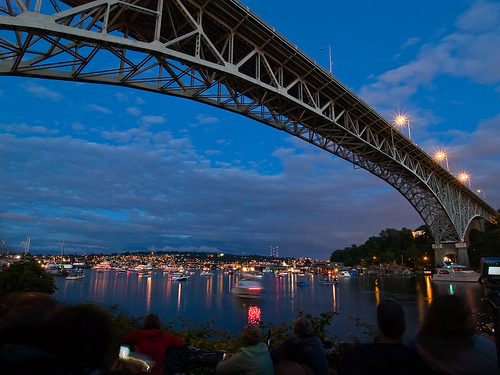

Twice now, we've taken this bridge over at Critical Mass. The experience comes slightly close, but lasts about two or three minutes.
05-03-11 | 01:31 PM
#19

Senior Member
Joined: Aug 2009
Posts: 696
Likes: 1
From: Louisville, CO
Bikes: Many
I think conversion of auto lanes to bike lanes is truly the easiest way to go. Cheap to convert and would cut spending on road maintenance and would actually reduce traffic, according to some studies (see book, "Traffic", Vanderbilt).
05-04-11 | 04:16 AM
#20
Thread Starter
Junior Member
Joined: Apr 2011
Posts: 11
Likes: 0
From: Oak Brook, IL
Bikes: 1975 Schwinn Continental 10-speed
A lot of interesting feedback.
1. I live in the Chicago area (and was in high school in Madison, WI, when bikes & buses were my only transportation options other than Mom.) It SNOWS here. And it ices up even more. Open bike paths on the street become impassable in that kind of weather. Biking basically shuts down in the Winter. You need something covered in the cold season. If you want to talk about falling and breaking various parts of your physical person, bike in that kind of mess routinely. (And I say that from personal experience with getting broken.)
2. You wouldn't be biking on the bare plastic. You could lay in a thin paved surface where the bikes & peds go.
3. Plastic breaks down over time mostly due to ultraviolet rays in sunlight. Its life could probably be extended if some kind of UV block was incorporated.
4. No way, that massive concrete and steel thing. Way too much material and bulk and expense.
5. Like was said by another poster above, 2,000 lbs of metal and an idiot on a cell phone will trump your right to be on the road regardless of liability laws. I'd way rather be completely separated from automotive traffic. People around here drive insane. They routinely do twenty miles over the limit, are under-slept, over-caffeinated, distracted, and have a massively over-developed sense of "me-first" entitlement.
6. A modular system that was over-engineered to have twice the required safety factor in materials strength would make extreme failure unlikely, while making the system fairly repairable. The key would be to think about the design in terms of durability and repairability from the very beginning.
7. There's gotta be some way to deal with rain, though with paved riding and walking surfaces, it would be less of an issue. Good drainage in the design would be a start.
8. EMT access is critical. You make sure that elevators and ramps are plentiful and can easily accommodate a pair of EMT's with a gurney.
Thanks for responding folks. But try to think about what it's like biking in the land of ice and snow and incredibly rude, self-centered drivers.
1. I live in the Chicago area (and was in high school in Madison, WI, when bikes & buses were my only transportation options other than Mom.) It SNOWS here. And it ices up even more. Open bike paths on the street become impassable in that kind of weather. Biking basically shuts down in the Winter. You need something covered in the cold season. If you want to talk about falling and breaking various parts of your physical person, bike in that kind of mess routinely. (And I say that from personal experience with getting broken.)
2. You wouldn't be biking on the bare plastic. You could lay in a thin paved surface where the bikes & peds go.
3. Plastic breaks down over time mostly due to ultraviolet rays in sunlight. Its life could probably be extended if some kind of UV block was incorporated.
4. No way, that massive concrete and steel thing. Way too much material and bulk and expense.
5. Like was said by another poster above, 2,000 lbs of metal and an idiot on a cell phone will trump your right to be on the road regardless of liability laws. I'd way rather be completely separated from automotive traffic. People around here drive insane. They routinely do twenty miles over the limit, are under-slept, over-caffeinated, distracted, and have a massively over-developed sense of "me-first" entitlement.
6. A modular system that was over-engineered to have twice the required safety factor in materials strength would make extreme failure unlikely, while making the system fairly repairable. The key would be to think about the design in terms of durability and repairability from the very beginning.
7. There's gotta be some way to deal with rain, though with paved riding and walking surfaces, it would be less of an issue. Good drainage in the design would be a start.
8. EMT access is critical. You make sure that elevators and ramps are plentiful and can easily accommodate a pair of EMT's with a gurney.
Thanks for responding folks. But try to think about what it's like biking in the land of ice and snow and incredibly rude, self-centered drivers.
Last edited by AquarianM; 05-04-11 at 04:28 AM.
05-04-11 | 04:19 AM
#21
Thread Starter
Junior Member
Joined: Apr 2011
Posts: 11
Likes: 0
From: Oak Brook, IL
Bikes: 1975 Schwinn Continental 10-speed
Oh, and the idea of using plastic was because there's so much going into landfills and oceans that you could get tons and tons of it cheap and keep it from going into the aforementioned two (or more) places.
Regards,
Dan
Regards,
Dan
05-04-11 | 06:53 AM
#24

Senior Member
Joined: Mar 2011
Posts: 132
Likes: 0
From: Fort Worth, TX
As soon as that cheap trash becomes wanted, someone will start charging for it, therefore no longer being cheap. It's just like bio-fuel, at first people were giving away waste oil, even paying to have it hauled off. But now you find them selling it to bio-fuel consumers.