


Tires - Schwalbe G-One RS Pro and RX Pro 45mm
 07-14-25 | 11:36 AM
#1

Thread Starter
Habitual User


Joined: Jan 2020
Posts: 9,928
Likes: 10,766
From: Altadena, CA
Bikes: 2025 Ritte Esprit, 2023 Niner RLT 9 RDO, 2022 Trek Supercaliber
Tires - Schwalbe G-One RS Pro and RX Pro 45mm
After just a couple of months on the Maxxis Reaver HYPR-X a flat tire in not-extreme terrain inspired me to make a change to a couple of Schwalbes from the new "Pro" lineup, and a return to mixed tread patterns, which has worked well for my local terrain in the past (Pirell and Tufo). I'm now on a 45mm RS on the rear and 45mm RX on the front. The tires mounted on my Reynolds ATRx rims without any drama, using my small air compressor.
Measured tire width (23mm ID rim @ 35psi): RX = 44.9mm, RS = 44.4mm
Unfortunately, I didn't take a moment to weigh the RS before I mounted it. I did manage to weigh the RX...604g. They certainly aren't lightweight tires.
First ride impressions...My route included some sustained fire road climbing on 8%avg grades, singletrack, and pavement. On pavement, they seem a little sluggish to spin up (not surprising for their weight), but they REALLY like to roll. Compared to my recent Reaver experience, it had my attention. On a rocky short punch with a little looseness, the rear tire was missing some of the grip I've found with other tires (Reaver and Thundero), but wasn't any worse than the Pirelli H. An adjustment in my weight shift resolved the issue pretty easily, but I could see that there are conditions where it could be more of a challenge. Likewise, braking in steep and loose conditions had the rear tire losing traction fairly easily, but it was manageable. On the front, the RX had all the cornering and braking grip I like having on my gravel bike, and behaved very much like the Swampero and Pirelli M. Overall, I like them quite a lot. For now, I'd put them on par with my favorite 44mm Tufo combo for most of my local riding, with the only downside being weight.
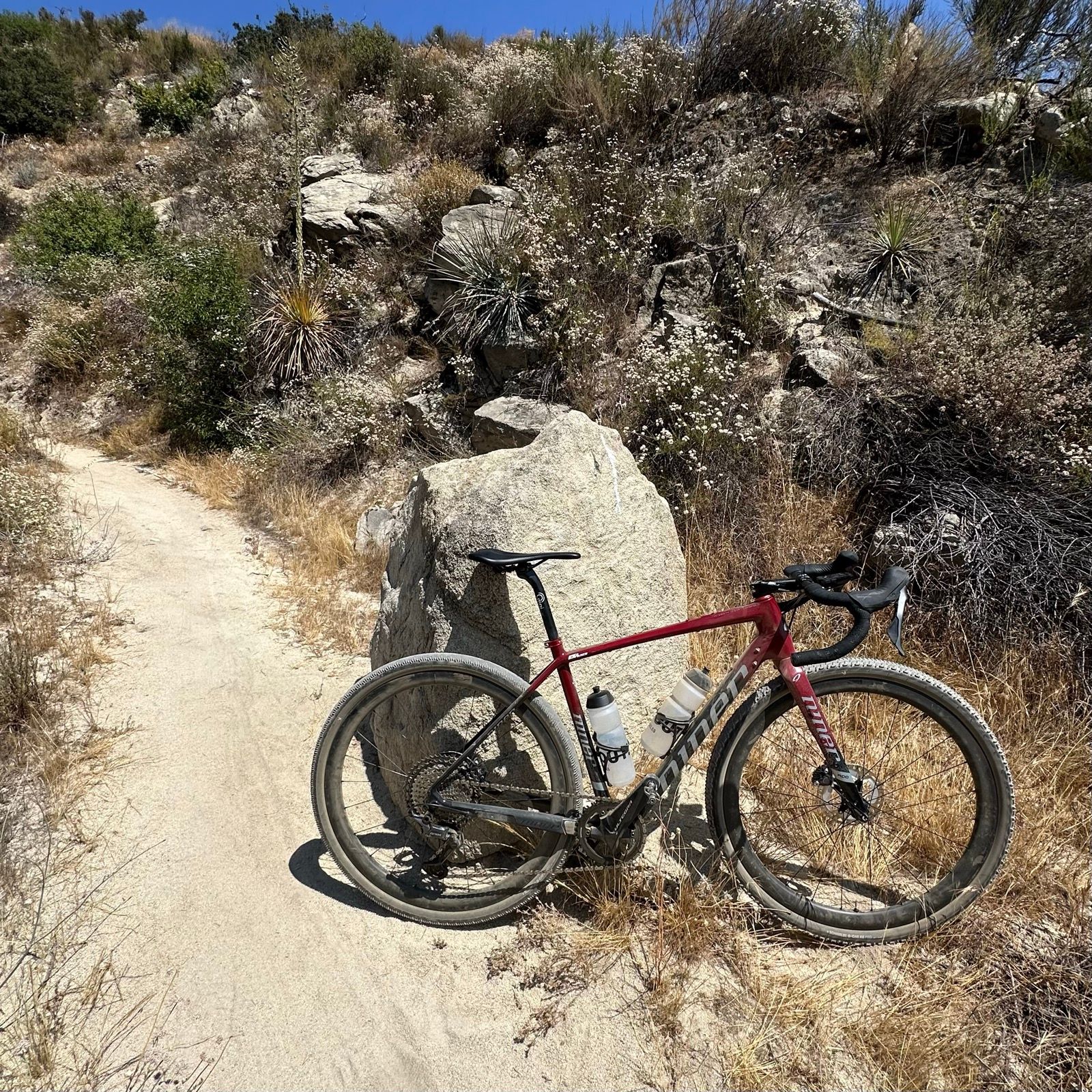
I had first intended to go with the 50mm Schwalbes, but my previous experience with 48mm Tufos on the bike was not favorable for how it changed the bike feel and created a toe overlap issue, so I stayed with the size I've been familiar with. 45mm(ish) feels right to me on this bike.
Measured tire width (23mm ID rim @ 35psi): RX = 44.9mm, RS = 44.4mm
Unfortunately, I didn't take a moment to weigh the RS before I mounted it. I did manage to weigh the RX...604g. They certainly aren't lightweight tires.
First ride impressions...My route included some sustained fire road climbing on 8%avg grades, singletrack, and pavement. On pavement, they seem a little sluggish to spin up (not surprising for their weight), but they REALLY like to roll. Compared to my recent Reaver experience, it had my attention. On a rocky short punch with a little looseness, the rear tire was missing some of the grip I've found with other tires (Reaver and Thundero), but wasn't any worse than the Pirelli H. An adjustment in my weight shift resolved the issue pretty easily, but I could see that there are conditions where it could be more of a challenge. Likewise, braking in steep and loose conditions had the rear tire losing traction fairly easily, but it was manageable. On the front, the RX had all the cornering and braking grip I like having on my gravel bike, and behaved very much like the Swampero and Pirelli M. Overall, I like them quite a lot. For now, I'd put them on par with my favorite 44mm Tufo combo for most of my local riding, with the only downside being weight.
I had first intended to go with the 50mm Schwalbes, but my previous experience with 48mm Tufos on the bike was not favorable for how it changed the bike feel and created a toe overlap issue, so I stayed with the size I've been familiar with. 45mm(ish) feels right to me on this bike.
__________________
RIP 01/08/25...2022 Trek Supercaliber, 2018 Storck Fascenario.3 Platinum, 2018 Trek Procaliber SL Singlespeed, 2017 Bear BR1, 2003 Time VX Special Pro, 2001 Colnago VIP, 1999 Trek 9900 singlespeed, 1977 Nishiki ONP
RIP 01/08/25...2022 Trek Supercaliber, 2018 Storck Fascenario.3 Platinum, 2018 Trek Procaliber SL Singlespeed, 2017 Bear BR1, 2003 Time VX Special Pro, 2001 Colnago VIP, 1999 Trek 9900 singlespeed, 1977 Nishiki ONP
 07-14-25 | 07:41 PM
#2
Riding In the Wind
Joined: Dec 2024
Posts: 228
Likes: 393
From: Kansas
That's great, man. Glad they're both working out for ya.
As I've mentioned before, I've never rode a mixed setup, but that definitely sounds like a good combination. I have a set of each type, and I'm happy with both styles. The RX is really surprising me with the amount of grip it has compared to the RS.
As I've mentioned before, I've never rode a mixed setup, but that definitely sounds like a good combination. I have a set of each type, and I'm happy with both styles. The RX is really surprising me with the amount of grip it has compared to the RS.
07-17-25 | 01:38 PM
#3
Newbie
Joined: May 2025
Posts: 4
Likes: 0
From: USA
So, I guess the old tires got a flat, which totally stinks! Now you've got these new Schwalbe tires, and even though they're kinda heavy, it sounds like they roll super fast on flat ground. They might slip a little on bumpy hills, but overall, you seem to like them!
07-30-25 | 10:41 AM
#4
Thread Starter
Habitual User
Joined: Jan 2020
Posts: 9,928
Likes: 10,766
From: Altadena, CA
Bikes: 2025 Ritte Esprit, 2023 Niner RLT 9 RDO, 2022 Trek Supercaliber
A few more miles...The sensations I felt on my first ride still persist - fast rolling, be cautious with the rear end in loose conditions, and front end cornering grip is pretty good. I haven't yet pushed anything to the point of finding the front end traction limits, but so far, I like the way everything is behaving.
With my current riding habits, I'm usually not on my gravel bike more than 1x per week, so exploring the characteristics of new tires is kind of a slow process. This weekend's gravel ride is being replaced by a MTB race.
With my current riding habits, I'm usually not on my gravel bike more than 1x per week, so exploring the characteristics of new tires is kind of a slow process. This weekend's gravel ride is being replaced by a MTB race.
__________________
RIP 01/08/25...2022 Trek Supercaliber, 2018 Storck Fascenario.3 Platinum, 2018 Trek Procaliber SL Singlespeed, 2017 Bear BR1, 2003 Time VX Special Pro, 2001 Colnago VIP, 1999 Trek 9900 singlespeed, 1977 Nishiki ONP
RIP 01/08/25...2022 Trek Supercaliber, 2018 Storck Fascenario.3 Platinum, 2018 Trek Procaliber SL Singlespeed, 2017 Bear BR1, 2003 Time VX Special Pro, 2001 Colnago VIP, 1999 Trek 9900 singlespeed, 1977 Nishiki ONP
 07-30-25 | 03:08 PM
#5
Riding In the Wind
Joined: Dec 2024
Posts: 228
Likes: 393
From: Kansas
After thinking about it, after you posted this thread, I really wish I'd have gone with a RX Pro on the front of my Lynskey, instead of just the RS Pro both front and back. With the RX's on my Solo, it's pretty wild to me, how much more grip those have in corners on loose sand/gravel. Part of it is the fact that my RX's are 50's and my RS's are 45's, but still, it's significant. I'll have to try your mixed setup next tire swap.
Glad they're still doing good for ya. It's nice when things work out.
Glad they're still doing good for ya. It's nice when things work out.
07-30-25 | 03:41 PM
#6
Thread Starter
Habitual User
Joined: Jan 2020
Posts: 9,928
Likes: 10,766
From: Altadena, CA
Bikes: 2025 Ritte Esprit, 2023 Niner RLT 9 RDO, 2022 Trek Supercaliber
After thinking about it, after you posted this thread, I really wish I'd have gone with a RX Pro on the front of my Lynskey, instead of just the RS Pro both front and back. With the RX's on my Solo, it's pretty wild to me, how much more grip those have in corners on loose sand/gravel. Part of it is the fact that my RX's are 50's and my RS's are 45's, but still, it's significant. I'll have to try your mixed setup next tire swap.
Glad they're still doing good for ya. It's nice when things work out.
Glad they're still doing good for ya. It's nice when things work out.
__________________
RIP 01/08/25...2022 Trek Supercaliber, 2018 Storck Fascenario.3 Platinum, 2018 Trek Procaliber SL Singlespeed, 2017 Bear BR1, 2003 Time VX Special Pro, 2001 Colnago VIP, 1999 Trek 9900 singlespeed, 1977 Nishiki ONP
RIP 01/08/25...2022 Trek Supercaliber, 2018 Storck Fascenario.3 Platinum, 2018 Trek Procaliber SL Singlespeed, 2017 Bear BR1, 2003 Time VX Special Pro, 2001 Colnago VIP, 1999 Trek 9900 singlespeed, 1977 Nishiki ONP


 07-30-25 | 04:41 PM
#8
Thread Starter
Habitual User
Joined: Jan 2020
Posts: 9,928
Likes: 10,766
From: Altadena, CA
Bikes: 2025 Ritte Esprit, 2023 Niner RLT 9 RDO, 2022 Trek Supercaliber
Which G-One? There are multiple models with different tread patterns and different widths. Also, Schwalbe's newest G-One lineup has the "Pro" designation, which includes a new casing design and rubber compounds. All those differences - tread, width, casing, etc. - make a difference in tire performance. If you're new to the world of tire geekdom, it can get a little overwhelming.
__________________
RIP 01/08/25...2022 Trek Supercaliber, 2018 Storck Fascenario.3 Platinum, 2018 Trek Procaliber SL Singlespeed, 2017 Bear BR1, 2003 Time VX Special Pro, 2001 Colnago VIP, 1999 Trek 9900 singlespeed, 1977 Nishiki ONP
RIP 01/08/25...2022 Trek Supercaliber, 2018 Storck Fascenario.3 Platinum, 2018 Trek Procaliber SL Singlespeed, 2017 Bear BR1, 2003 Time VX Special Pro, 2001 Colnago VIP, 1999 Trek 9900 singlespeed, 1977 Nishiki ONP
 07-30-25 | 07:39 PM
#9
Riding In the Wind
Joined: Dec 2024
Posts: 228
Likes: 393
From: Kansas
I need to look into the casing and protection differences between the regular RS's and the RS Pro's, because my original RS's would get punctures (goat heads) pretty much every ride in the country. I always had sealant on my seat tube. But, these RS Pro's have yet to get a single puncture, in about 500 miles. So, they must've upped the puncture protection, in some way.
07-30-25 | 08:43 PM
#10
Thread Starter
Habitual User
Joined: Jan 2020
Posts: 9,928
Likes: 10,766
From: Altadena, CA
Bikes: 2025 Ritte Esprit, 2023 Niner RLT 9 RDO, 2022 Trek Supercaliber
Keep us informed as you push them harder, if you think about it. Our terrain out here is like a sheet of glass, compared to some of your pictures, but it would still be good data to know.
I need to look into the casing and protection differences between the regular RS's and the RS Pro's, because my original RS's would get punctures (goat heads) pretty much every ride in the country. I always had sealant on my seat tube. But, these RS Pro's have yet to get a single puncture, in about 500 miles. So, they must've upped the puncture protection, in some way.
I need to look into the casing and protection differences between the regular RS's and the RS Pro's, because my original RS's would get punctures (goat heads) pretty much every ride in the country. I always had sealant on my seat tube. But, these RS Pro's have yet to get a single puncture, in about 500 miles. So, they must've upped the puncture protection, in some way.
__________________
RIP 01/08/25...2022 Trek Supercaliber, 2018 Storck Fascenario.3 Platinum, 2018 Trek Procaliber SL Singlespeed, 2017 Bear BR1, 2003 Time VX Special Pro, 2001 Colnago VIP, 1999 Trek 9900 singlespeed, 1977 Nishiki ONP
RIP 01/08/25...2022 Trek Supercaliber, 2018 Storck Fascenario.3 Platinum, 2018 Trek Procaliber SL Singlespeed, 2017 Bear BR1, 2003 Time VX Special Pro, 2001 Colnago VIP, 1999 Trek 9900 singlespeed, 1977 Nishiki ONP
07-30-25 | 08:46 PM
#11
Thread Killer

Joined: Aug 2008
Posts: 13,137
Likes: 2,157
From: Ann Arbor, MI
Bikes: 15 Kinesis Racelight 4S, 76 Motebecane Gran Jubilée, 17 Dedacciai Gladiatore2, 12 Breezer Venturi, 09 Dahon Mariner, 12 Mercier Nano, 95 DeKerf Team SL, 19 Tern Rally, 21 Breezer Doppler Cafe+, 19 T-Lab X3, 91 Serotta CII, 23 3T Strada
I dunno, but the RS Pro tread seems very thin and supple to me. I’ve already taken a big cut to the tread center on one in the rear. The offending rock was like a blade, to be fair, but I’ve never taken a cut like that, not in 12 years of road tubeless, and it happened on my first ride on the RS Pro, so it’s shaken my confidence in the tire.
07-30-25 | 08:59 PM
#12
Thread Starter
Habitual User
Joined: Jan 2020
Posts: 9,928
Likes: 10,766
From: Altadena, CA
Bikes: 2025 Ritte Esprit, 2023 Niner RLT 9 RDO, 2022 Trek Supercaliber
I dunno, but the RS Pro tread seems very thin and supple to me. I’ve already taken a big cut to the tread center on one in the rear. The offending rock was like a blade, to be fair, but I’ve never taken a cut like that, not in 12 years of road tubeless, and it happened on my first ride on the RS Pro, so it’s shaken my confidence in the tire.
__________________
RIP 01/08/25...2022 Trek Supercaliber, 2018 Storck Fascenario.3 Platinum, 2018 Trek Procaliber SL Singlespeed, 2017 Bear BR1, 2003 Time VX Special Pro, 2001 Colnago VIP, 1999 Trek 9900 singlespeed, 1977 Nishiki ONP
RIP 01/08/25...2022 Trek Supercaliber, 2018 Storck Fascenario.3 Platinum, 2018 Trek Procaliber SL Singlespeed, 2017 Bear BR1, 2003 Time VX Special Pro, 2001 Colnago VIP, 1999 Trek 9900 singlespeed, 1977 Nishiki ONP
07-31-25 | 03:52 AM
#13
Thread Killer
Joined: Aug 2008
Posts: 13,137
Likes: 2,157
From: Ann Arbor, MI
Bikes: 15 Kinesis Racelight 4S, 76 Motebecane Gran Jubilée, 17 Dedacciai Gladiatore2, 12 Breezer Venturi, 09 Dahon Mariner, 12 Mercier Nano, 95 DeKerf Team SL, 19 Tern Rally, 21 Breezer Doppler Cafe+, 19 T-Lab X3, 91 Serotta CII, 23 3T Strada
These have good potential to be perfect tires for me— I mostly ride hardpack roads— so assuming my cut was a once-in-a-dozen years event, I’m giving the the ol’ college try.
08-01-25 | 01:48 AM
#14
Senior Member

Joined: Aug 2014
Posts: 1,152
Likes: 440
From: UK
Bikes: customized Dahon Helios 1x10, customized Dahon Smooth Hound 1x11, customized Dahon Hammerhead 8.0 d7, Kinesis GX Race 50(mullet setup 1x11), Forme Calver 37 (1x11), Planet X Giovanissimi 20 (1x9), Orange Zest 20 (1x9)
While reading, I couldn't help but wonder about the rationale behind the mixed tread patterns.
The current G-One product line goes: RS->R->RX
The old G-One product line went: speed->all round -> bite ->ultrabite.
I used the Ultrabite on both tires for a while, but I became frustrated with the poor rolling performance on British tarmac. To improve this, I tried using the All Round tire on the rear while keeping the Ultrabite on the front, both in size 42-622 (measured at 45).
However, this setup performed poorly; during off-road corners, it felt like a front-wheel-drive hot hatch with bald rear tires. The rear was skittish, and it seemed like the front was cornering while the rear continued straight, only to be eventually dragged around the corner. I think the difference in grip between the two tires was too great.
I switched to the Bite tire on the rear, which slightly reduced rolling efficiency but significantly improved handling.
I'm curious if you've experienced something similar when mixing the RS with the RX tires, and whether it might be better to combine the R with the RX instead.
I retried the Bite and Ultrabite last year for my final CX race because my Michelin Mud tires had worn down and weren’t suitable for mud. While the combination generally worked well, it lacked grip on off-camber banks, resulting in a significant crash (the second major crash I've had in the last five years, and both involved the Ultrabite on ridge/off-camber sections).
Now, I'm planning to use the X-One R tires (which have a pattern similar to the G-One RX) due to the hookless rims, as the Vittoria tires are not compatible. Any feedback on fast, slippery cornering would be greatly appreciated.
The current G-One product line goes: RS->R->RX
The old G-One product line went: speed->all round -> bite ->ultrabite.
I used the Ultrabite on both tires for a while, but I became frustrated with the poor rolling performance on British tarmac. To improve this, I tried using the All Round tire on the rear while keeping the Ultrabite on the front, both in size 42-622 (measured at 45).
However, this setup performed poorly; during off-road corners, it felt like a front-wheel-drive hot hatch with bald rear tires. The rear was skittish, and it seemed like the front was cornering while the rear continued straight, only to be eventually dragged around the corner. I think the difference in grip between the two tires was too great.
I switched to the Bite tire on the rear, which slightly reduced rolling efficiency but significantly improved handling.
I'm curious if you've experienced something similar when mixing the RS with the RX tires, and whether it might be better to combine the R with the RX instead.
I retried the Bite and Ultrabite last year for my final CX race because my Michelin Mud tires had worn down and weren’t suitable for mud. While the combination generally worked well, it lacked grip on off-camber banks, resulting in a significant crash (the second major crash I've had in the last five years, and both involved the Ultrabite on ridge/off-camber sections).
Now, I'm planning to use the X-One R tires (which have a pattern similar to the G-One RX) due to the hookless rims, as the Vittoria tires are not compatible. Any feedback on fast, slippery cornering would be greatly appreciated.
08-02-25 | 04:01 PM
#15
Method to My Madness
Joined: Nov 2020
Posts: 4,713
Likes: 2,052
From: Orange County, California
Bikes: Trek FX 2, Cannondale Synapse x2, Cannondale CAAD4, Santa Cruz Stigmata 3
I have followed Eric F's threads through several iterations of different front (grippier) and rear (faster rolling) tires. I have not tried the same because I am one of those chicken___ roadies with no off-road bike handling skills. On my more recent gravel rides the rear end of my Stigmata (matching Panaracer SK 40 mm) is getting increasingly skittish, even though I am not locking the rear brake. It turns out the increased wear on the rear tire has over time morphed me toward the same setup.
08-03-25 | 06:20 PM
#16
Thread Starter
Habitual User
Joined: Jan 2020
Posts: 9,928
Likes: 10,766
From: Altadena, CA
Bikes: 2025 Ritte Esprit, 2023 Niner RLT 9 RDO, 2022 Trek Supercaliber
While reading, I couldn't help but wonder about the rationale behind the mixed tread patterns.
The current G-One product line goes: RS->R->RX
The old G-One product line went: speed->all round -> bite ->ultrabite.
I used the Ultrabite on both tires for a while, but I became frustrated with the poor rolling performance on British tarmac. To improve this, I tried using the All Round tire on the rear while keeping the Ultrabite on the front, both in size 42-622 (measured at 45).
However, this setup performed poorly; during off-road corners, it felt like a front-wheel-drive hot hatch with bald rear tires. The rear was skittish, and it seemed like the front was cornering while the rear continued straight, only to be eventually dragged around the corner. I think the difference in grip between the two tires was too great.
I switched to the Bite tire on the rear, which slightly reduced rolling efficiency but significantly improved handling.
I'm curious if you've experienced something similar when mixing the RS with the RX tires, and whether it might be better to combine the R with the RX instead.
I retried the Bite and Ultrabite last year for my final CX race because my Michelin Mud tires had worn down and weren’t suitable for mud. While the combination generally worked well, it lacked grip on off-camber banks, resulting in a significant crash (the second major crash I've had in the last five years, and both involved the Ultrabite on ridge/off-camber sections).
Now, I'm planning to use the X-One R tires (which have a pattern similar to the G-One RX) due to the hookless rims, as the Vittoria tires are not compatible. Any feedback on fast, slippery cornering would be greatly appreciated.
The current G-One product line goes: RS->R->RX
The old G-One product line went: speed->all round -> bite ->ultrabite.
I used the Ultrabite on both tires for a while, but I became frustrated with the poor rolling performance on British tarmac. To improve this, I tried using the All Round tire on the rear while keeping the Ultrabite on the front, both in size 42-622 (measured at 45).
However, this setup performed poorly; during off-road corners, it felt like a front-wheel-drive hot hatch with bald rear tires. The rear was skittish, and it seemed like the front was cornering while the rear continued straight, only to be eventually dragged around the corner. I think the difference in grip between the two tires was too great.
I switched to the Bite tire on the rear, which slightly reduced rolling efficiency but significantly improved handling.
I'm curious if you've experienced something similar when mixing the RS with the RX tires, and whether it might be better to combine the R with the RX instead.
I retried the Bite and Ultrabite last year for my final CX race because my Michelin Mud tires had worn down and weren’t suitable for mud. While the combination generally worked well, it lacked grip on off-camber banks, resulting in a significant crash (the second major crash I've had in the last five years, and both involved the Ultrabite on ridge/off-camber sections).
Now, I'm planning to use the X-One R tires (which have a pattern similar to the G-One RX) due to the hookless rims, as the Vittoria tires are not compatible. Any feedback on fast, slippery cornering would be greatly appreciated.
In off-road conditions the traction demand differences between front and rear are amplified. MTB’ers have been mixing tread patterns for decades for this reason.
__________________
RIP 01/08/25...2022 Trek Supercaliber, 2018 Storck Fascenario.3 Platinum, 2018 Trek Procaliber SL Singlespeed, 2017 Bear BR1, 2003 Time VX Special Pro, 2001 Colnago VIP, 1999 Trek 9900 singlespeed, 1977 Nishiki ONP
RIP 01/08/25...2022 Trek Supercaliber, 2018 Storck Fascenario.3 Platinum, 2018 Trek Procaliber SL Singlespeed, 2017 Bear BR1, 2003 Time VX Special Pro, 2001 Colnago VIP, 1999 Trek 9900 singlespeed, 1977 Nishiki ONP
08-03-25 | 07:58 PM
#17
Thread Killer
Joined: Aug 2008
Posts: 13,137
Likes: 2,157
From: Ann Arbor, MI
Bikes: 15 Kinesis Racelight 4S, 76 Motebecane Gran Jubilée, 17 Dedacciai Gladiatore2, 12 Breezer Venturi, 09 Dahon Mariner, 12 Mercier Nano, 95 DeKerf Team SL, 19 Tern Rally, 21 Breezer Doppler Cafe+, 19 T-Lab X3, 91 Serotta CII, 23 3T Strada
IMO, there are a number of factors involved that might make a difference in how mixed tread patterns perform, including surface composition and handling skills. While the RS certainly isn’t very grippy under braking on loose surfaces, it’s within my comfort zone for being able to get it to do what I need it to do (so far) in the areas Inride most frequently.
In off-road conditions the traction demand differences between front and rear are amplified. MTB’ers have been mixing tread patterns for decades for this reason.
In off-road conditions the traction demand differences between front and rear are amplified. MTB’ers have been mixing tread patterns for decades for this reason.
Anyway, point being that picking best tire combos is a matter of trial and error.
