


Sheldon Brown - U-Lock Technique
 05-17-06 | 12:02 PM
#1

Thread Starter
Junior Member
Joined: May 2006
Posts: 10
Likes: 0
From: Chicago
Sheldon Brown - U-Lock Technique
How To CORRECTLY Lock Your Bike....by Sheldon Brown
www.sheldonbrown.com/lock-strategy.html
Does anyone actually use this technique on a regular basis? The idea makes sense to me, but i've never noticed anyone's bike actually locked up this way in Chicago.
Any testimonials about locking your bike in this manner?
www.sheldonbrown.com/lock-strategy.html
Does anyone actually use this technique on a regular basis? The idea makes sense to me, but i've never noticed anyone's bike actually locked up this way in Chicago.
Any testimonials about locking your bike in this manner?
Last edited by ChicagoEC; 05-17-06 at 12:11 PM.
 05-17-06 | 12:11 PM
#2
cab horn

Joined: Jun 2004
Posts: 28,353
Likes: 30
From: Toronto
Bikes: 1987 Bianchi Campione
Yeah that's the "correct" way (no such thing). The major drawback to that technique is that your bike appears to be very poorly locked to the naked eye (i.e anyone who's not aware of this method).
Someone might easily damage your bike this way trying to steal it. There's no drawback to locking your frame and your wheels at the same time. It acheives the same thing but now there's no reason for someone to stop and think, gee can I steal it?
Theoretically it's great, pratically I wouldn't do it. Just inviting trouble.
Someone might easily damage your bike this way trying to steal it. There's no drawback to locking your frame and your wheels at the same time. It acheives the same thing but now there's no reason for someone to stop and think, gee can I steal it?
Theoretically it's great, pratically I wouldn't do it. Just inviting trouble.
05-17-06 | 12:42 PM
#4

The duda man
Joined: May 2006
Posts: 130
Likes: 0
From: Cobblers Knob, IN
I have never locked mine, but I bought a kryptonite cable lock. I figure if they get it open, they have earned the bike and can have it. If I ever get a real good bike, I'll be glad to know this technique tho. I wouldn't worrky about them damaging the bike. Theives are lazy; they don't want to have to put it back together.
05-17-06 | 12:57 PM
#5

Devil's advocate
Joined: Feb 2006
Posts: 151
Likes: 0
From: Oklahoma
Bikes: Surly Cross-Check, 1976 Schwinn Runabout, 1987 Schwinn Traveler
Originally Posted by operator
Yeah that's the "correct" way (no such thing). The major drawback to that technique is that your bike appears to be very poorly locked to the naked eye (i.e anyone who's not aware of this method).
Most bike thieves are looking for easy to steal bikes. The fact that there's even a lock on the bike will probably be enough to deter most would-be thieves.
More experienced thieves will probably know that they'll need to break both locks and (hopefully) won't be carrying the tools to do both and move on to the next bike instead.
I could be wrong, though. It just seems the presence of any locks will deter your run of the mill opportunist bike thief (and there are plenty of opportunities for them to take) and your more experienced bike thief probably won't bother unless your bike is worth the effort.
05-17-06 | 01:01 PM
#6


45 miles/week
Joined: Mar 2005
Posts: 2,020
Likes: 1
From: Philadelphia, PA
Bikes: Jamis Aurora
I also disagree with his "the rim is hard to cut" bit, because he just said that thieves carry bolt cutters... I removed a tire and tube from a rim in ~10-15 seconds using a bolt cutter, and that was being reasonably careful NOT to damage the rim. I think a bolt cutter would go through a rim like a chainsaw through warm butter... Unfortunately I threw out my old rims so I can't test that theory. Anyone feel like trying it out?
__________________
Treasurer, HHCMF Club
Now living in the land of the cheesesteak.
But working at a job where I can't surf BikeForums all day any more...
Treasurer, HHCMF Club
Now living in the land of the cheesesteak.
But working at a job where I can't surf BikeForums all day any more...
05-17-06 | 01:07 PM
#7
45 miles/week
Joined: Mar 2005
Posts: 2,020
Likes: 1
From: Philadelphia, PA
Bikes: Jamis Aurora
However, speaking of the cable concept... What about those cables without an integral lock, but that you slip over a u-lock? Anyone have that setup and/or how well does it work?
I'm gonna be moving to the Big City where I'll have to start locking my bike, so I'll need to get something beefier than the plain cable I've got now.
I'm gonna be moving to the Big City where I'll have to start locking my bike, so I'll need to get something beefier than the plain cable I've got now.
__________________
Treasurer, HHCMF Club
Now living in the land of the cheesesteak.
But working at a job where I can't surf BikeForums all day any more...
Treasurer, HHCMF Club
Now living in the land of the cheesesteak.
But working at a job where I can't surf BikeForums all day any more...
05-17-06 | 01:12 PM
#8
Devil's advocate
Joined: Feb 2006
Posts: 151
Likes: 0
From: Oklahoma
Bikes: Surly Cross-Check, 1976 Schwinn Runabout, 1987 Schwinn Traveler
Originally Posted by Eggplant Jeff
I also disagree with his "the rim is hard to cut" bit, because he just said that thieves carry bolt cutters... I removed a tire and tube from a rim in ~10-15 seconds using a bolt cutter, and that was being reasonably careful NOT to damage the rim. I think a bolt cutter would go through a rim like a chainsaw through warm butter... Unfortunately I threw out my old rims so I can't test that theory. Anyone feel like trying it out?
Any lock or combination thereof can be defeated. So then the question becomes can you lock your bike up well enough that it'll take too much time to remove the locks or make your bike undesirable to have once it's been broken free of your locks? I don't steal bikes but if I did, I certainly wouldn't want to have to deflate the tube, cut the tire and tube, then cut the rim, and then walk off with the bike. It's just a hassle. And the rear wheel is one of the most expensive parts on the bike.
Unless you're locking up a $3,000+ road bike, a thief isn't going to bother going through all the trouble of cutting through the rim. There's probably another bike close by that's not locked up very well that they can take.
05-17-06 | 01:18 PM
#9
Senior Member
Joined: Feb 2006
Posts: 237
Likes: 0
I use this technique pretty much every day. It's worked so far. While a rim may (or may not, I've no idea) be easy to cut, it involves destroying an expensive part of the bike. If they want the bike that bad they will probably take it no matter what you've done.
Why not do the frame + wheel to something? I haven't had a U-lock that would fit that way. Even my standard size one will not fit through both and still lock to something, the inside width of the shackle is not enough for it. Plus just locking the rear wheel to something lets me use a smaller, easier to carry U-lock that has less room inside for leverage.
Why not do the frame + wheel to something? I haven't had a U-lock that would fit that way. Even my standard size one will not fit through both and still lock to something, the inside width of the shackle is not enough for it. Plus just locking the rear wheel to something lets me use a smaller, easier to carry U-lock that has less room inside for leverage.
05-17-06 | 01:54 PM
#10
Thread Starter
Junior Member
Joined: May 2006
Posts: 10
Likes: 0
From: Chicago
Originally Posted by ceridwen
I use this technique pretty much every day. It's worked so far. While a rim may (or may not, I've no idea) be easy to cut, it involves destroying an expensive part of the bike. If they want the bike that bad they will probably take it no matter what you've done.
Why not do the frame + wheel to something? I haven't had a U-lock that would fit that way. Even my standard size one will not fit through both and still lock to something, the inside width of the shackle is not enough for it. Plus just locking the rear wheel to something lets me use a smaller, easier to carry U-lock that has less room inside for leverage.
Why not do the frame + wheel to something? I haven't had a U-lock that would fit that way. Even my standard size one will not fit through both and still lock to something, the inside width of the shackle is not enough for it. Plus just locking the rear wheel to something lets me use a smaller, easier to carry U-lock that has less room inside for leverage.
I think this technique will work fine considering i'm not riding around on really expensive bike. It must be the idea of not locking my frame that freaks me out. I suppose that if someone ever wants your bike bad enough they are going to get it, and I really don't want to carry 10 lbs of security devices around with me!
peace
05-17-06 | 02:04 PM
#11
I use this method in the worst neighborhoods of the crime capital of the nation. No crook has even attempted to take my bike. Crooks are not very bright, but are not morons. When the "SB" method is used with a beefy mini u-lock, such as an OnGuard Pitbull, and the bike is locked to a thick steel pole set in concrete, the bike is not going anywhere.
Crooks are also lazy. There is always a bike nearby using a cable lock, or with the lock attached to only the front wheel, or locked with a u-lock bought at Wal-Mart. THOSE bikes can be stolen in under thirty seconds. No reason to bring in heavy duty tools, and spend ten or fifteen sweaty minutes struggling with a "SB" locked bike.
I have seen two bikes in downtown Houston with their frames turned into pretzels. If a u-lock from Wal-Mart is placed around the frame of a Wal-Mart bike, a crook can simply pick up the bike, and use its frame as a lever to pop the lock. The tubes on the frame of a Wal-Mart frame are stronger than the tubes on a Wal-Mart U-lock.
When a crook uses the "frame lever" method against a bike with a light weight frame, with paper thin tubing, locked with an OnGuard or Kryptonite U-lock, he ends up turning the frame into a pretzel, but fails to pop the lock.
In theory, a crook could remove the rear tire and tube, and use appropriate tools to cut the rear rim. Doing so would be time consuming, hard work, and would destroy the single most valuable component on the bike, as well as making the bike both impossible to ride, and impossible to easily sell.
How many bike owners use the "SB" method? From what I see in Houston, maybe one or two percent. The majority of bikes in Houston have cheapo locks that are attached to the wrong part of the bike, and attached to poles or racks that are even flimsier than the cheapo lock.
I saw a college student buying a $500 bike to park on campus. She was trying to chose between a $20 cable lock, and a $50 u-lock. She told me "I'm going to get the cable lock...that is what everyone at my school uses, and I can't afford the extra $30"
Which is the reason why her campus is the daily target of crooks seeking to steal nice bikes. I wonder if she can afford $500 to replace her new bike if she can't afford a decent lock?
Crooks are also lazy. There is always a bike nearby using a cable lock, or with the lock attached to only the front wheel, or locked with a u-lock bought at Wal-Mart. THOSE bikes can be stolen in under thirty seconds. No reason to bring in heavy duty tools, and spend ten or fifteen sweaty minutes struggling with a "SB" locked bike.
I have seen two bikes in downtown Houston with their frames turned into pretzels. If a u-lock from Wal-Mart is placed around the frame of a Wal-Mart bike, a crook can simply pick up the bike, and use its frame as a lever to pop the lock. The tubes on the frame of a Wal-Mart frame are stronger than the tubes on a Wal-Mart U-lock.
When a crook uses the "frame lever" method against a bike with a light weight frame, with paper thin tubing, locked with an OnGuard or Kryptonite U-lock, he ends up turning the frame into a pretzel, but fails to pop the lock.
In theory, a crook could remove the rear tire and tube, and use appropriate tools to cut the rear rim. Doing so would be time consuming, hard work, and would destroy the single most valuable component on the bike, as well as making the bike both impossible to ride, and impossible to easily sell.
How many bike owners use the "SB" method? From what I see in Houston, maybe one or two percent. The majority of bikes in Houston have cheapo locks that are attached to the wrong part of the bike, and attached to poles or racks that are even flimsier than the cheapo lock.
I saw a college student buying a $500 bike to park on campus. She was trying to chose between a $20 cable lock, and a $50 u-lock. She told me "I'm going to get the cable lock...that is what everyone at my school uses, and I can't afford the extra $30"
Which is the reason why her campus is the daily target of crooks seeking to steal nice bikes. I wonder if she can afford $500 to replace her new bike if she can't afford a decent lock?
05-17-06 | 02:04 PM
#12
Devil's advocate
Joined: Feb 2006
Posts: 151
Likes: 0
From: Oklahoma
Bikes: Surly Cross-Check, 1976 Schwinn Runabout, 1987 Schwinn Traveler
You should also hit up your LBS and ask them how they recommend locking a bike in your area.
As Jeff mentioned in an earlier post, the place you're located at makes a big difference in what you can get away with in terms of locking your bike. It sounds like Jeff and I live in a similar place - a basic cable lock is enough to deter thieves because, at least in my city, bikes aren't looked upon in a favorable light in the least extent. Chicago is obviously vastly different.
However, you should make sure that you're asking people who have your interests in mind, not their store's bottom line. I'm lucky that out of two bike shops in my city, one of them genuinely cares about their customers and tries to help them find the stuff they need, not what is the most expensive.
As Jeff mentioned in an earlier post, the place you're located at makes a big difference in what you can get away with in terms of locking your bike. It sounds like Jeff and I live in a similar place - a basic cable lock is enough to deter thieves because, at least in my city, bikes aren't looked upon in a favorable light in the least extent. Chicago is obviously vastly different.
However, you should make sure that you're asking people who have your interests in mind, not their store's bottom line. I'm lucky that out of two bike shops in my city, one of them genuinely cares about their customers and tries to help them find the stuff they need, not what is the most expensive.
05-17-06 | 02:22 PM
#13
If you are using a cable lock, and your bike has not been stolen, it does NOT mean "a cable lock is good enough if my neighborhood". It simply means none of the crooks in your area want your bike. Even a heavy weight $40 cable lock can be opened by an experienced crook in under one minute.
Cable locks are NOT locks. They are an ad that says "Get Your Free Bike Right Here". A bike shop ought to be ashamed to sell someone a new bike that costs $500 or $800 and let them out the door with anything less than a good OnGuard or Kryptonite u-lock.
Cable locks are NOT locks. They are an ad that says "Get Your Free Bike Right Here". A bike shop ought to be ashamed to sell someone a new bike that costs $500 or $800 and let them out the door with anything less than a good OnGuard or Kryptonite u-lock.
05-17-06 | 02:45 PM
#14
Devil's advocate
Joined: Feb 2006
Posts: 151
Likes: 0
From: Oklahoma
Bikes: Surly Cross-Check, 1976 Schwinn Runabout, 1987 Schwinn Traveler
Originally Posted by alanbikehouston
If you are using a cable lock, and your bike has not been stolen, it does NOT mean "a cable lock is good enough if my neighborhood". It simply means none of the crooks in your area want your bike. Even a heavy weight $40 cable lock can be opened by an experienced crook in under one minute.
Cable locks are NOT locks. They are an ad that says "Get Your Free Bike Right Here". A bike shop ought to be ashamed to sell someone a new bike that costs $500 or $800 and let them out the door with anything less than a good OnGuard or Kryptonite u-lock.
Cable locks are NOT locks. They are an ad that says "Get Your Free Bike Right Here". A bike shop ought to be ashamed to sell someone a new bike that costs $500 or $800 and let them out the door with anything less than a good OnGuard or Kryptonite u-lock.
However, I only have a cable lock and as such, I don't feel comfortable leaving my bike locked with it and unattended for more than a few minutes. Mostly out of paranoia. I've been looking at u-locks and trying to decide which to invest in. But that leads me to another question - how hard is it to find a "thick steel pole set in concrete" around where you live? The closest I usually see is street signs and it seems like since they'd unbolt easily, they're not a good option. Also, it seems like it'd be hard to get a mini u-lock around a steel pole. Maybe I just don't know what to look for? What method do you go for if/when you can't locate a steel pole that you can get your u-lock around?
05-17-06 | 03:02 PM
#15
Thread Starter
Junior Member
Joined: May 2006
Posts: 10
Likes: 0
From: Chicago
There are plenty of parking meters where I live in the city, which work well.
If there are no poles/bike racks/parking meters around that you can u-lock a bike up to, you would probably be better off with a more heavy-duty chain lock. Kryptonite has some chain locks that are just as highly rated as u-locks for manual attacks. The downside to the chains is that they are usually much more heavy than a small u-lock.
If there are no poles/bike racks/parking meters around that you can u-lock a bike up to, you would probably be better off with a more heavy-duty chain lock. Kryptonite has some chain locks that are just as highly rated as u-locks for manual attacks. The downside to the chains is that they are usually much more heavy than a small u-lock.
05-17-06 | 03:43 PM
#16
The duda man
Joined: May 2006
Posts: 130
Likes: 0
From: Cobblers Knob, IN
Originally Posted by alanbikehouston
Crooks are also lazy. There is always a bike nearby using a cable lock, or with the lock attached to only the front wheel, or locked with a u-lock bought at Wal-Mart. THOSE bikes can be stolen in under thirty seconds. No reason to bring in heavy duty tools, and spend ten or fifteen sweaty minutes struggling with a "SB" locked bike.
I have seen two bikes in downtown Houston with their frames turned into pretzels. If a u-lock from Wal-Mart is placed around the frame of a Wal-Mart bike, a crook can simply pick up the bike, and use its frame as a lever to pop the lock. The tubes on the frame of a Wal-Mart frame are stronger than the tubes on a Wal-Mart U-lock.
When a crook uses the "frame lever" method against a bike with a light weight frame, with paper thin tubing, locked with an OnGuard or Kryptonite U-lock, he ends up turning the frame into a pretzel, but fails to pop the lock.
In theory, a crook could remove the rear tire and tube, and use appropriate tools to cut the rear rim. Doing so would be time consuming, hard work, and would destroy the single most valuable component on the bike, as well as making the bike both impossible to ride, and impossible to easily sell.
How many bike owners use the "SB" method? From what I see in Houston, maybe one or two percent. The majority of bikes in Houston have cheapo locks that are attached to the wrong part of the bike, and attached to poles or racks that are even flimsier than the cheapo lock.
I saw a college student buying a $500 bike to park on campus. She was trying to chose between a $20 cable lock, and a $50 u-lock. She told me "I'm going to get the cable lock...that is what everyone at my school uses, and I can't afford the extra $30"
Which is the reason why her campus is the daily target of crooks seeking to steal nice bikes. I wonder if she can afford $500 to replace her new bike if she can't afford a decent lock?
Originally Posted by www.kryptonitelock.com
Cable security perfect for quick release component and accessory lock-up or as a secondary deterrent. For security in low crime areas and well-lit lock-up situations
For best protection against theft, use cables with a Kryptonite U-Lock or Disc Lock. Cables are recommended as a secondary deterrent, or for additional protection of quick-release components and accessories.
For best protection against theft, use cables with a Kryptonite U-Lock or Disc Lock. Cables are recommended as a secondary deterrent, or for additional protection of quick-release components and accessories.
05-17-06 | 04:09 PM
#17
Senior Member
Joined: Feb 2006
Posts: 237
Likes: 0
Originally Posted by Knudsen
FYI: Walmart carries kryptonite locks, both "U" and cable type, in both key lock and combonation.
Am I the only one who finds a mini U easier to use than a cable? I've always found cable locks clumsy and annoying. My mini U lock is very easy and quick to use.
I looked at the high end chains recently, but they are entirely too heavy for me to deal with.
05-17-06 | 07:44 PM
#18
pointless & uncalled for
Joined: Apr 2006
Posts: 378
Likes: 0
From: TOONCA
The problem with the SB method as EJ pointed out is that a thief could cut through the rear wheel and rim pretty fast. This has already happened to a friend of mine in London and is not the only reported instance.
This probably isn't the work of your opportunist nicking individual bikes and selling them for pot money or the like but something more of a proffesional or possibly part of a group who do things like drive round in vans clearing out whole racks. Theives or groups tend to do well out of channeling lots of bikes through that part of town you all have near you.
Saying that doing this is ruining the most important part of the bike is only partly true and relies on the mentality of the bicycle owner who perceives their bike as a whole. Theives have no problem thinking of bikes as a group of parts that can be interchanged. Back to the aforementioned friend, later on the police advised that there was a corresponding report of a stolen rear wheel. Oddly enough, people who go and buy bikes from second hand shops and pawn shops aren't that interested in matching rims and tires as they are in a bargain price.
As for ABH, saying it has never happend even in the dodgiest parts of town doesn't mean that it won't happen, it just means that he's been lucky so far. I go for the rear wheel and seat tube method. That way any enterprising thief has to cut both the seat tube and the rear wheel. Makes sense to me.
This probably isn't the work of your opportunist nicking individual bikes and selling them for pot money or the like but something more of a proffesional or possibly part of a group who do things like drive round in vans clearing out whole racks. Theives or groups tend to do well out of channeling lots of bikes through that part of town you all have near you.
Saying that doing this is ruining the most important part of the bike is only partly true and relies on the mentality of the bicycle owner who perceives their bike as a whole. Theives have no problem thinking of bikes as a group of parts that can be interchanged. Back to the aforementioned friend, later on the police advised that there was a corresponding report of a stolen rear wheel. Oddly enough, people who go and buy bikes from second hand shops and pawn shops aren't that interested in matching rims and tires as they are in a bargain price.
As for ABH, saying it has never happend even in the dodgiest parts of town doesn't mean that it won't happen, it just means that he's been lucky so far. I go for the rear wheel and seat tube method. That way any enterprising thief has to cut both the seat tube and the rear wheel. Makes sense to me.
05-17-06 | 09:28 PM
#19

el sombrador loco
Joined: May 2006
Posts: 95
Likes: 0
From: Ukiah, CA
Bikes: 1999 Trek 1000, 2006 Specialized Roubaix
I rode several bikes through 5 years in Eugene where some of the semi-pro bike theives ply their trade. I always locked my rear wheel and frame to whatever was handy.
Vandalism was a far bigger risk in Eugene. I had to replace two rims because some a@#h$^%* decided to kick all my spokes out, but there's nothing you can do about that. Now I mostly keep my bikes inside.
Vandalism was a far bigger risk in Eugene. I had to replace two rims because some a@#h$^%* decided to kick all my spokes out, but there's nothing you can do about that. Now I mostly keep my bikes inside.
05-17-06 | 09:37 PM
#20

I use the Sheldon method, works fine for me. I've actually developed numerous cut marks on my U-lock from thieves attempting to saw through, but so far they've only managed to get through the rubber (apparently every one of them gave up as soon as they hit the solid steel). With a U on the rear wheel and a cable on the front wheel/frame, I feel pretty safe.
05-17-06 | 10:18 PM
#21

Footballus vita est
Joined: Jun 2002
Posts: 2,118
Likes: 7
From: Portland, OR
Bikes: Trek 4500, Kona Dawg
I personally will continue to hook my U-lock around my frame. I don't trust the thieves around here to be sensible enough to notice that the wheel won't simply come off the frame with lock around until after they've tried and messed up the paint or even bent my stays. Bike theft is also common enough I could imagine a thief who would cut through the wheel and simply replace it with a wheel off of a stripped bike that was left with a lock around the frame only. I've seen plenty of bikes that were left as a frame chained to a post...often there was nothing left on it but the headset and bottom bracket!
It might be fun to see a dumb thief try to cut the wheel off of a road bike without first deflating it. BAM!
8bitevolution, just because a potential thief thinks his car is better than a bike doesn't mean he isn't interesting in stealing to sell for drug money. BTW, secure locking points are usually pretty easy to find in Portland, OR. I think new buildings downtown are required to include them as part of the building code. One of the subtle nicities of Portland.
It might be fun to see a dumb thief try to cut the wheel off of a road bike without first deflating it. BAM!
8bitevolution, just because a potential thief thinks his car is better than a bike doesn't mean he isn't interesting in stealing to sell for drug money. BTW, secure locking points are usually pretty easy to find in Portland, OR. I think new buildings downtown are required to include them as part of the building code. One of the subtle nicities of Portland.
__________________
"The internet is a place where absolutely nothing happens. You need to take advantage of that." ~ Strong Bad
"The internet is a place where absolutely nothing happens. You need to take advantage of that." ~ Strong Bad
05-17-06 | 10:28 PM
#22

Senior Member
Joined: Jul 2002
Posts: 6,956
Likes: 6
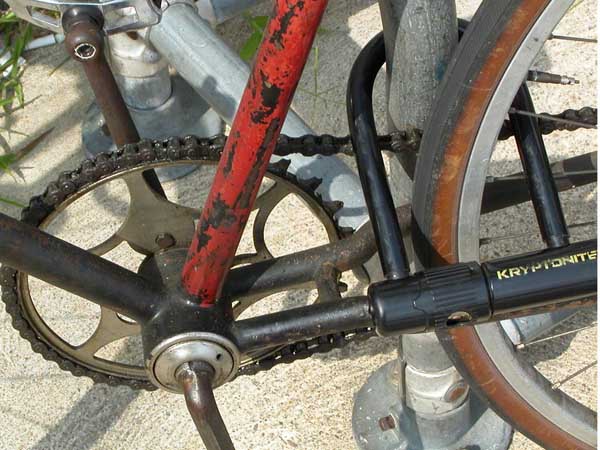
If you look at Sheldon's photo above...
...by tilting the shackle about 30 degrees from horizontal, you could get the rear rim, rear tire, and the chainstays inside the shackle. That fills up the shackle more completely, so there's even less chance of jacking it open. It also means that the thief would have to either defeat the lock or cut the frame (as well as the tire and rim).
In a high-crime area, I would stick with an older, rigid mountain bike (or some other non-vogue bike like a reliable older "ten-speed"), plaster it with retro-reflective tape to make it less attractive, and use a good U-lock in combination with a midrange chain lock.

I have the chain lock shown above, it's not spectacular by itself but I think it's enough for my needs when it's combined with a U-lock. I typically run the chain lock around a post, through the main triangle & rear wheel, and then lock the free ends of the chain to my big chainring with the circular padlock. Not much chance of getting a boltcutter in there, and if they cut the chain instead, the bike's still unrideable with a padlock stuck to its big chainring like that.
I don't enjoy packing 10lb / 5kg of locks around, however. Fortunately I don't routinely make trips where I need them, because I mainly commute to work and back, and can stow my bike in the server room. But when I've got the locks along, I can feel it!
 05-17-06 | 11:28 PM
#23

Mooninite
Joined: May 2006
Posts: 3,186
Likes: 4
From: South of Heaven
Bikes: $53 Walmart Special
I don't trust the thieves around here to be sensible enough to notice that the wheel won't simply come off the frame with lock around until after they've tried and messed up the paint or even bent my stays.
05-18-06 | 05:51 AM
#24
I think most people are missing the point about leaving the seatpost part of the frame out of the picture. By not trying to fit the seatpost portion into the lock, you can use a significantly smaller/narrower U-Lock, which would be harder to jack open.
Nothing is perfect. But this method at least seems to minimize the most common U-Lock cracking strategy.
-D
Nothing is perfect. But this method at least seems to minimize the most common U-Lock cracking strategy.
-D
05-18-06 | 07:59 AM
#25
Reports of a bike being stolen because the crook cut the rear tire and the rear rim are exactly like reports of Martian space ships landing on the White House lawn. Everyone has "a friend, who heard from a guy, who talked to somebody who saw it with his own two eyes". Yet, I've never met anyone who has seen it done with his own two eyes.
The "experts" on bike theft are campus police departments. Why? In the USA, more good quality bikes are stolen on a large urban campus than any other single location. Unlike the city police, who are busy investigating murders, armed robberies, shootings, and stabbings, on a college campus, catching the folks who are stealing bikes is a major priority for the police.
So, campus police actually write reports, and make investigations of bike thefts. And, they learn exactly which bikes are stolen. The reasons: first, the bikes that were not locked at all, or had just a wheel locked, but not attached to a rack or pole. Second, bikes that were locked with cable locks. ALL cable locks are worthless, regardless of weight or price. Third, bikes locked with $19.99 u-locks from Wal-Mart. Fourth, bikes locked with expensive u-locks, but the lock was attached only to the front wheel.
The number of bikes stolen that used a top ranked u-lock and the Sheldon Brown method that have been stolen? To date, I have never seen a credible report of a single bike stolen using this method (and the "I heard from a friend that his cousin heard" is NOT a credible report).
But, any crook can steal a bike if the bike is attractive enough, and he has enough time to plan. If you leave a Trek Madone locked up in public at the same location day after day, sooner or later, it will be stolen.
It might take a crook a week or two to figure out a plan, gather the necessary equipment, pick a time and day...but he will get a bike that appears to be worth big bucks sooner or later. If you commute to work, and lock a bike to the same rack every day, that bike needs to look like it is worth $75. Maybe it is really worth $500, but make sure it LOOKS like it is worth $75.
Last week, Nashbar was selling the OnGuard Brute for $50, just $30 more than a worthless Wal-Mart lock. I'm amazed that people who spend $500 or $1,000 for a bike will agonize and stress over whether or not to invest that extra $30. The cost of dinner and a movie, versus losing a valuable bike.
The "experts" on bike theft are campus police departments. Why? In the USA, more good quality bikes are stolen on a large urban campus than any other single location. Unlike the city police, who are busy investigating murders, armed robberies, shootings, and stabbings, on a college campus, catching the folks who are stealing bikes is a major priority for the police.
So, campus police actually write reports, and make investigations of bike thefts. And, they learn exactly which bikes are stolen. The reasons: first, the bikes that were not locked at all, or had just a wheel locked, but not attached to a rack or pole. Second, bikes that were locked with cable locks. ALL cable locks are worthless, regardless of weight or price. Third, bikes locked with $19.99 u-locks from Wal-Mart. Fourth, bikes locked with expensive u-locks, but the lock was attached only to the front wheel.
The number of bikes stolen that used a top ranked u-lock and the Sheldon Brown method that have been stolen? To date, I have never seen a credible report of a single bike stolen using this method (and the "I heard from a friend that his cousin heard" is NOT a credible report).
But, any crook can steal a bike if the bike is attractive enough, and he has enough time to plan. If you leave a Trek Madone locked up in public at the same location day after day, sooner or later, it will be stolen.
It might take a crook a week or two to figure out a plan, gather the necessary equipment, pick a time and day...but he will get a bike that appears to be worth big bucks sooner or later. If you commute to work, and lock a bike to the same rack every day, that bike needs to look like it is worth $75. Maybe it is really worth $500, but make sure it LOOKS like it is worth $75.
Last week, Nashbar was selling the OnGuard Brute for $50, just $30 more than a worthless Wal-Mart lock. I'm amazed that people who spend $500 or $1,000 for a bike will agonize and stress over whether or not to invest that extra $30. The cost of dinner and a movie, versus losing a valuable bike.