Hills... what is the best plan
 01-11-18 | 05:22 AM
#1

Thread Starter
Senior Member
Joined: Dec 2007
Posts: 3,704
Likes: 355
From: NWNJ
Bikes: Road bike is a Carbon Bianchi C2C & Grandis (1980's), Gary Fisher Mt Bike, Trek Tandem & Mongoose SS MTB circa 1992.
Hills... what is the best plan
OK,
so I never ridden a fixie on the road and wondering how to approach riding down steep hills. Bike set up is also a concern as obviously there is not way to relax on the bike & stretch out down a hill. IS bike set up different than normal road bike. I live in a hilly area so if I plan to ride it on the roads I need to prepare.
Thanks
so I never ridden a fixie on the road and wondering how to approach riding down steep hills. Bike set up is also a concern as obviously there is not way to relax on the bike & stretch out down a hill. IS bike set up different than normal road bike. I live in a hilly area so if I plan to ride it on the roads I need to prepare.
Thanks
 01-11-18 | 06:25 AM
#2

Senior Member
Joined: Nov 2014
Posts: 367
Likes: 37
From: Telford, PA
Bikes: Pinarello FP Due, Cesare track bike modified for the street.
Relaxing on a fixed gear takes a different form than on a geared bike. You will be reminded immediately if you try and coast. Relaxing means not going as fast. You will find that you will get used to not coasting. Going fast uses energy, even if it is down hill. If I am tired, I will slow at the top of a hill and descend slower than I would normally. I may back pedal or drag the brake to keep speed in check. This will be as close as you can get to relax.
Really steep hills require planning. You never want to write a check at the top of a hill that your legs can't cash at the bottom. You really want the to be working the pedals on the decent and not having them work you. Keep your speed in check from the top. If you get going too fast, then pedal harder and hit the rear brake. This will stabilize the bike and allow you to gain control over the cadence.
In time you will find your legs will be able to tolerate a wider cadence than they did with a geared bike. I am 60 and I can spin up to 180 rpm routinely on hills and 200+ in a pinch. When I rode a geared bike I probably never got over 150.
Up hills are another issue. You get better at just grunting it out on hills. You do need to select gears that make it possible to ride on the steepest hills in your area. I get by with 70" gearing and manage short 10% hills routinely. I would start with gearing that is a bit shorter and get a feel for things to start.
Ride Safe,
Joe
Really steep hills require planning. You never want to write a check at the top of a hill that your legs can't cash at the bottom. You really want the to be working the pedals on the decent and not having them work you. Keep your speed in check from the top. If you get going too fast, then pedal harder and hit the rear brake. This will stabilize the bike and allow you to gain control over the cadence.
In time you will find your legs will be able to tolerate a wider cadence than they did with a geared bike. I am 60 and I can spin up to 180 rpm routinely on hills and 200+ in a pinch. When I rode a geared bike I probably never got over 150.
Up hills are another issue. You get better at just grunting it out on hills. You do need to select gears that make it possible to ride on the steepest hills in your area. I get by with 70" gearing and manage short 10% hills routinely. I would start with gearing that is a bit shorter and get a feel for things to start.
Ride Safe,
Joe
01-11-18 | 07:48 AM
#3
~>~
Joined: Mar 2013
Posts: 5,929
Likes: 188
From: TX Hill Country
A FG operated on the open public road can be set-up, as mine is, as any other road bike with a different flavor of drivetrain. Fit gearing appropriate for your experience, terrain and fitness as well as proper foot retention and at least a front brake, mine has F&R. ~70 gear inches as [MENTION=393034]bmwjoe[/MENTION] recommends is the old school road gearing standard and works for many, including myself in rolling terrain. Climbing takes grunt, descending takes calm fluid pedaling technique and common sense. Feathering a brake to prevent "hamster-in-wheel" over-spin is SOP on steep descents, there are no "style points" for being out of control.
Have at it.
-Bandera
Have at it.
-Bandera
01-11-18 | 07:56 AM
#4
- Soli Deo Gloria -
Joined: Aug 2015
Posts: 14,779
Likes: 743
From: Northwest Georgia
Bikes: 2018 Rodriguez Custom Fixed Gear, 2017 Niner RLT 9 RDO, 2015 Bianchi Pista, 2002 Fuji Robaix
Managing speed while descending is best done with brakes.
With brakes, planning for a descent becomes a non issue. Go as fast or as slow as you want and scrub off speed with the brakes as needed to keep from spinning out.
-Tim-
With brakes, planning for a descent becomes a non issue. Go as fast or as slow as you want and scrub off speed with the brakes as needed to keep from spinning out.
-Tim-
01-11-18 | 09:13 AM
#5

bill nyecycles


Joined: Mar 2013
Posts: 3,333
Likes: 360
From: Houston TX
 01-11-18 | 11:43 AM
#8

vespertine member
Joined: Jul 2013
Posts: 2,473
Likes: 223
From: Land of Angora, Turkey
Bikes: Yes
For longer/steep descents, I find having front and rear brakes helpful. The rear brake may not see much action, but I find it helpful for giving the front rim a break so that it doesn't overheat.
For shorter descents, I do not find dual brakes a necessity, though it can kind of suck if the front brake goes out.
For shorter descents, I do not find dual brakes a necessity, though it can kind of suck if the front brake goes out.
01-11-18 | 12:18 PM
#9
Senior Member
Joined: Mar 2006
Posts: 254
Likes: 3
I have been training fixed for a very long time and there are a few things to help you along.
1) Racing on the track has given the ability to have a very high cadence. This is terribly helpful going downhill as you do not want to bounce about the saddle at speed. Work towards a high cadence while having a good position in the saddle.
2) You most definitely have to run a front brake and if you deem necessary, run a front and rear. I ride all my centuries fixed on both flat and rolling courses. You have to save the kickers for going up the buggers. Do not waste your energy resisting the pedals to slow on the way down. Scrub the front brake or both as needed and let your legs "relax" while getting to the bottom of the bowl.
3) Run as big of a gear as you can comfortably. When I first started training fixed on the road back in 2004 I ran the 48x16 that came on my Bianchi Pista. I got stronger pretty quick and now run a 54x16 on all my training rides and flip the carbon in the back to the 14t on the other side on calm days or on flatter courses when I'm in somewhat shape. The bigger gear really helps the cadence going down the rollers.
In any event, good on ya for training fixed. You will most definitely get stronger and faster. It's inevitable.
1) Racing on the track has given the ability to have a very high cadence. This is terribly helpful going downhill as you do not want to bounce about the saddle at speed. Work towards a high cadence while having a good position in the saddle.
2) You most definitely have to run a front brake and if you deem necessary, run a front and rear. I ride all my centuries fixed on both flat and rolling courses. You have to save the kickers for going up the buggers. Do not waste your energy resisting the pedals to slow on the way down. Scrub the front brake or both as needed and let your legs "relax" while getting to the bottom of the bowl.
3) Run as big of a gear as you can comfortably. When I first started training fixed on the road back in 2004 I ran the 48x16 that came on my Bianchi Pista. I got stronger pretty quick and now run a 54x16 on all my training rides and flip the carbon in the back to the 14t on the other side on calm days or on flatter courses when I'm in somewhat shape. The bigger gear really helps the cadence going down the rollers.
In any event, good on ya for training fixed. You will most definitely get stronger and faster. It's inevitable.
01-11-18 | 02:08 PM
#10
Senior Member
Joined: Oct 2012
Posts: 1,631
Likes: 330
Oh Lordy
Yeah, running big gearing like that will sure make it less spinny going downhill
But seriously OP, you been 'round BF long enough - hope that you've caught on to the fact that one of the keys to actually learning anything here is figuring out from among the answers that you may get - which to take seriously

Yeah, running big gearing like that will sure make it less spinny going downhill
But seriously OP, you been 'round BF long enough - hope that you've caught on to the fact that one of the keys to actually learning anything here is figuring out from among the answers that you may get - which to take seriously
01-11-18 | 02:54 PM
#12

Tortoise Wins by a Hare!
Joined: Feb 2006
Posts: 7,393
Likes: 945
From: Looney Tunes, IL
Bikes: Wabi Special FG, Raleigh Roper, Nashbar AL-1, Miyata One Hundred, '70 Schwinn Lemonator and More!!
I have been training fixed for a very long time and there are a few things to help you along.
1) Racing on the track has given the ability to have a very high cadence. This is terribly helpful going downhill as you do not want to bounce about the saddle at speed. Work towards a high cadence while having a good position in the saddle.
2) You most definitely have to run a front brake and if you deem necessary, run a front and rear. I ride all my centuries fixed on both flat and rolling courses. You have to save the kickers for going up the buggers. Do not waste your energy resisting the pedals to slow on the way down. Scrub the front brake or both as needed and let your legs "relax" while getting to the bottom of the bowl.
3) Run as big of a gear as you can comfortably. When I first started training fixed on the road back in 2004 I ran the 48x16 that came on my Bianchi Pista. I got stronger pretty quick and now run a 54x16 on all my training rides and flip the carbon in the back to the 14t on the other side on calm days or on flatter courses when I'm in somewhat shape. The bigger gear really helps the cadence going down the rollers.
In any event, good on ya for training fixed. You will most definitely get stronger and faster. It's inevitable.
1) Racing on the track has given the ability to have a very high cadence. This is terribly helpful going downhill as you do not want to bounce about the saddle at speed. Work towards a high cadence while having a good position in the saddle.
2) You most definitely have to run a front brake and if you deem necessary, run a front and rear. I ride all my centuries fixed on both flat and rolling courses. You have to save the kickers for going up the buggers. Do not waste your energy resisting the pedals to slow on the way down. Scrub the front brake or both as needed and let your legs "relax" while getting to the bottom of the bowl.
3) Run as big of a gear as you can comfortably. When I first started training fixed on the road back in 2004 I ran the 48x16 that came on my Bianchi Pista. I got stronger pretty quick and now run a 54x16 on all my training rides and flip the carbon in the back to the 14t on the other side on calm days or on flatter courses when I'm in somewhat shape. The bigger gear really helps the cadence going down the rollers.
In any event, good on ya for training fixed. You will most definitely get stronger and faster. It's inevitable.
54x14 = 27 mph @ a normal 90 rpm cadence, and well over 30 anytime you topped 100. That would be more than impressive for a training ride! My guess is someone is mashing along at a much lower average speed here.
 Ouch, it's hurts my legs just thinking about it!
01-11-18 | 03:07 PM
Ouch, it's hurts my legs just thinking about it!
01-11-18 | 03:07 PM
#13
Senior Member

Joined: Apr 2009
Posts: 39,897
Likes: 3,865
From: New Rochelle, NY
Bikes: too many bikes from 1967 10s (5x2)Frejus to a Sumitomo Ti/Chorus aluminum 10s (10x2), plus one non-susp mtn bike I use as my commuter
First of all, let's be clear on a specific point.
No bicycle without a front brake is safe on open roads. That's compounded in hilly terrain, even for skilled riders who only use the brake as a backup.
My experience riding fixed in hills is that I have three basic approaches.
1- for hills where the terminal velocity is safe, and within my controlled cadence range, I find I maintain better control when pedaling to apply power, albeit nearly zero. My pedaling habits are conditioned that way so my cadence is smoother and my control better.
2- for hills where I want to control speed, I resist pedal, by consciously apply reverse torque in small bursts when the pedals are horizontal. This is a learned pedaling method, and takes some time to master so it can be done reasonably smoothly. I combine it with relaxing, so overall my legs become a source of drag and I manage speed that way.
3- on steeper, faster descents, I do something that seems illogical, pedaling to go faster, while applying the front at intervals as a speed check. This may seem counter-productive, but as mentioned earlier, my pedal action is smoothest with highest top end cadence in power mode, so I see little choice.
Actually there's a 4th option, for when there's a safe visible end to the descent. Here I'll pedal applying power and riding faster than otherwise, knowing the change in terrain will bring it all home safely.
No bicycle without a front brake is safe on open roads. That's compounded in hilly terrain, even for skilled riders who only use the brake as a backup.
My experience riding fixed in hills is that I have three basic approaches.
1- for hills where the terminal velocity is safe, and within my controlled cadence range, I find I maintain better control when pedaling to apply power, albeit nearly zero. My pedaling habits are conditioned that way so my cadence is smoother and my control better.
2- for hills where I want to control speed, I resist pedal, by consciously apply reverse torque in small bursts when the pedals are horizontal. This is a learned pedaling method, and takes some time to master so it can be done reasonably smoothly. I combine it with relaxing, so overall my legs become a source of drag and I manage speed that way.
3- on steeper, faster descents, I do something that seems illogical, pedaling to go faster, while applying the front at intervals as a speed check. This may seem counter-productive, but as mentioned earlier, my pedal action is smoothest with highest top end cadence in power mode, so I see little choice.
Actually there's a 4th option, for when there's a safe visible end to the descent. Here I'll pedal applying power and riding faster than otherwise, knowing the change in terrain will bring it all home safely.
__________________
FB
Chain-L site
An ounce of diagnosis is worth a pound of cure.
Just because I'm tired of arguing, doesn't mean you're right.
“One accurate measurement is worth a thousand expert opinions” - Adm Grace Murray Hopper - USN
WARNING, I'm from New York. Thin skinned people should maintain safe distance.
FB
Chain-L site
An ounce of diagnosis is worth a pound of cure.
Just because I'm tired of arguing, doesn't mean you're right.
“One accurate measurement is worth a thousand expert opinions” - Adm Grace Murray Hopper - USN
WARNING, I'm from New York. Thin skinned people should maintain safe distance.
01-11-18 | 04:21 PM
#15

Senior Member
Joined: Apr 2016
Posts: 730
Likes: 122
From: Traveling through time, will return last week.
Bikes: Bare Rum Sword Knuckle Runner
Riding hills fixed you're going to suffer going up or going down depending on your gear ratio. I live in a hilly area and currently push either 47x17 or 47x18. I find this a good balance and prefer having to spin a little more on the way down than killing myself mashing up.
Riding down prepare to spin like crazy, it's the name of the game. At first you're going to feel out of control and exhausted but you'll quickly get the hang of it. I don't even think about it anymore, I put a little pressure on the pedals and my legs go along for the ride. Find a comfortable pace and you'll get to the point where you can actually use this time to rest before the next hill.
I assume you will be using a front brake to modulate you're speed so not much to explain there. If you ever want go brakeless or practice not using your brake these are my tips for what they're worth.
1. Come to terms with the fact you will have to ride more cautiously (slowly), and your average speed will likely suffer some.
2. Use wind resistance to help modulate your speed. Sitting upright and going reverse aero really works.
3, Scrub speed way before intersections, stop signs, cars pulling out etc... This will give you ample time to avoid or stop.
3. I don't attempt to slow down by putting back pressure on the pedals at high rates of speed as it kills my legs. I much prefer to scrub speed with a quick skid or skips as it is 90% technique. If you're "killing your knees" then you're doing it wrong. When I'm at a manageable speed I'll use back pressure to control from there.
4. If you're worried about tires then put you're brake back on.
I have less oh ***** moments since going brakeless as I ride more cautiously. It's a lot of fun and challenging in a new way. Plus I enjoy how upset roadies are when they see I have don't brakes. Yet they are the ones tucking and bombing curvy hills 40mph+ with cars pulling out
Riding down prepare to spin like crazy, it's the name of the game. At first you're going to feel out of control and exhausted but you'll quickly get the hang of it. I don't even think about it anymore, I put a little pressure on the pedals and my legs go along for the ride. Find a comfortable pace and you'll get to the point where you can actually use this time to rest before the next hill.
I assume you will be using a front brake to modulate you're speed so not much to explain there. If you ever want go brakeless or practice not using your brake these are my tips for what they're worth.
1. Come to terms with the fact you will have to ride more cautiously (slowly), and your average speed will likely suffer some.
2. Use wind resistance to help modulate your speed. Sitting upright and going reverse aero really works.
3, Scrub speed way before intersections, stop signs, cars pulling out etc... This will give you ample time to avoid or stop.
3. I don't attempt to slow down by putting back pressure on the pedals at high rates of speed as it kills my legs. I much prefer to scrub speed with a quick skid or skips as it is 90% technique. If you're "killing your knees" then you're doing it wrong. When I'm at a manageable speed I'll use back pressure to control from there.
4. If you're worried about tires then put you're brake back on.
I have less oh ***** moments since going brakeless as I ride more cautiously. It's a lot of fun and challenging in a new way. Plus I enjoy how upset roadies are when they see I have don't brakes. Yet they are the ones tucking and bombing curvy hills 40mph+ with cars pulling out
Last edited by REDMASTA; 01-11-18 at 04:27 PM.
01-11-18 | 05:42 PM
#16

Senior Member
Joined: Sep 2009
Posts: 9,948
Likes: 400
From: PHL
Bikes: Litespeed Catalyst, IRO Rob Roy, All City Big Block
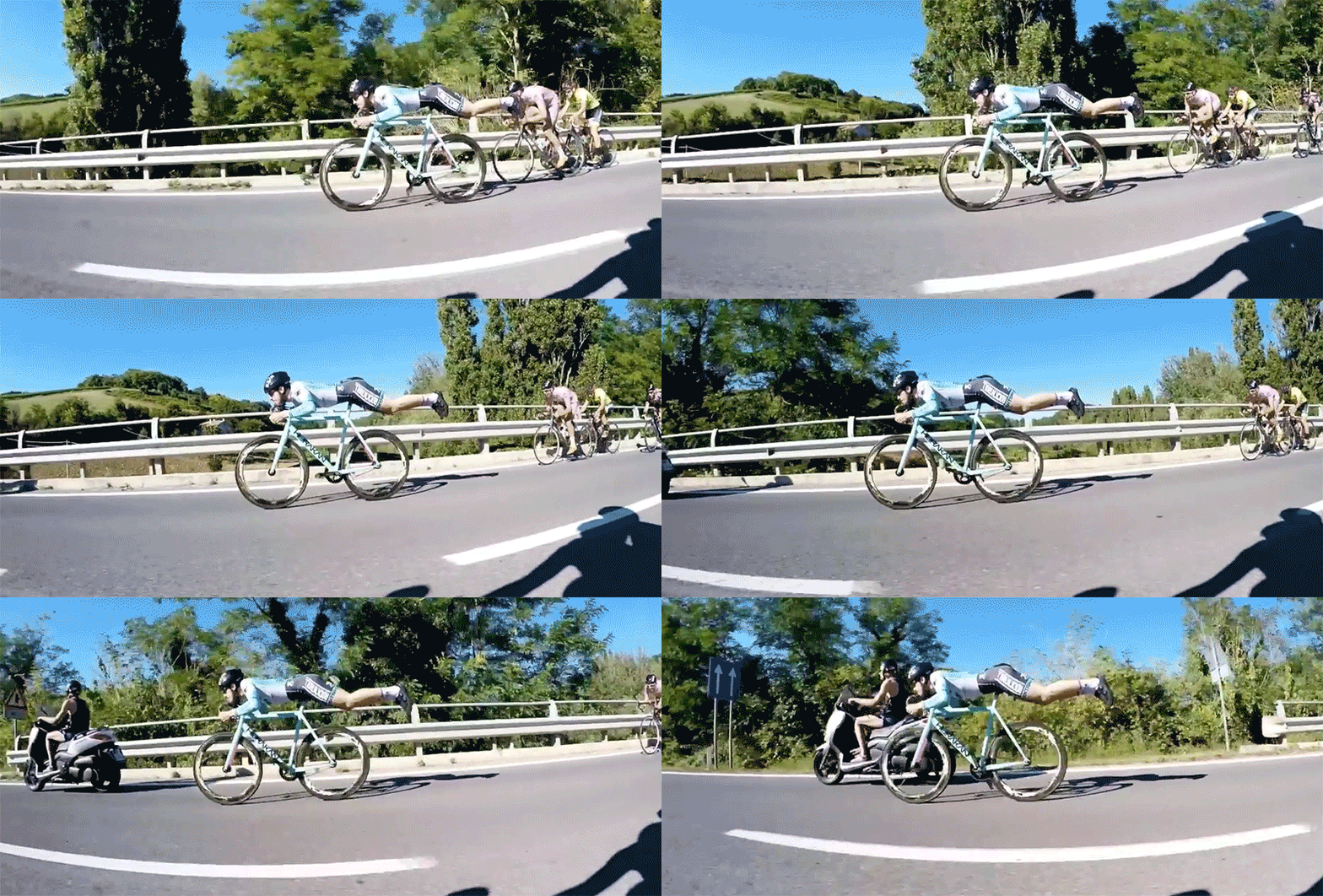
Watch this a few time and slavishly imitate. (Warning: brake advocates will be triggered)
https://www.youtube.com/watch?time_c...&v=iLvDCCvIQbI
https://www.youtube.com/watch?time_c...&v=iLvDCCvIQbI
01-11-18 | 06:35 PM
#17


Not actually Tmonk


Joined: Jun 2007
Posts: 17,357
Likes: 6,143
From: San Diego, CA
Bikes: road, track, mtb
Just ride the brake down the hill. It's not that complicated.
__________________
"Your beauty is an aeroplane;
so high, my heart cannot bear the strain." -A.C. Jobim, Triste
"Your beauty is an aeroplane;
so high, my heart cannot bear the strain." -A.C. Jobim, Triste
 01-11-18 | 07:12 PM
#18
Not actually Tmonk
Joined: Jun 2007
Posts: 17,357
Likes: 6,143
From: San Diego, CA
Bikes: road, track, mtb
I have been training fixed for a very long time and there are a few things to help you along.
1) Racing on the track has given the ability to have a very high cadence. This is terribly helpful going downhill as you do not want to bounce about the saddle at speed. Work towards a high cadence while having a good position in the saddle.
2) You most definitely have to run a front brake and if you deem necessary, run a front and rear. I ride all my centuries fixed on both flat and rolling courses. You have to save the kickers for going up the buggers. Do not waste your energy resisting the pedals to slow on the way down. Scrub the front brake or both as needed and let your legs "relax" while getting to the bottom of the bowl.
3) Run as big of a gear as you can comfortably. When I first started training fixed on the road back in 2004 I ran the 48x16 that came on my Bianchi Pista. I got stronger pretty quick and now run a 54x16 on all my training rides and flip the carbon in the back to the 14t on the other side on calm days or on flatter courses when I'm in somewhat shape. The bigger gear really helps the cadence going down the rollers.
In any event, good on ya for training fixed. You will most definitely get stronger and faster. It's inevitable.
1) Racing on the track has given the ability to have a very high cadence. This is terribly helpful going downhill as you do not want to bounce about the saddle at speed. Work towards a high cadence while having a good position in the saddle.
2) You most definitely have to run a front brake and if you deem necessary, run a front and rear. I ride all my centuries fixed on both flat and rolling courses. You have to save the kickers for going up the buggers. Do not waste your energy resisting the pedals to slow on the way down. Scrub the front brake or both as needed and let your legs "relax" while getting to the bottom of the bowl.
3) Run as big of a gear as you can comfortably. When I first started training fixed on the road back in 2004 I ran the 48x16 that came on my Bianchi Pista. I got stronger pretty quick and now run a 54x16 on all my training rides and flip the carbon in the back to the 14t on the other side on calm days or on flatter courses when I'm in somewhat shape. The bigger gear really helps the cadence going down the rollers.
In any event, good on ya for training fixed. You will most definitely get stronger and faster. It's inevitable.
I'm a "reasonably fit" (150 lbs/300 w FTP) road and track racer an I ride 42/15t as my gear on the road. 17t on the other side for easy days.
__________________
"Your beauty is an aeroplane;
so high, my heart cannot bear the strain." -A.C. Jobim, Triste
"Your beauty is an aeroplane;
so high, my heart cannot bear the strain." -A.C. Jobim, Triste
01-11-18 | 07:35 PM
#19

Senior Member
Joined: Jul 2016
Posts: 224
Likes: 2
OP, you never ride fixed gear before, don't be nut by removed all brakes and go with toes cage, that's it.
I don't recommend you go with clipless "for first ride", go grabs flat pedals, you should get yourself familiar with fixed first.
After, you are on your own
Always try for low gear ratio first though. You will be fine.
I don't recommend you go with clipless "for first ride", go grabs flat pedals, you should get yourself familiar with fixed first.
After, you are on your own
Always try for low gear ratio first though. You will be fine.
01-11-18 | 08:57 PM
#20
Thread Starter
Senior Member
Joined: Dec 2007
Posts: 3,704
Likes: 355
From: NWNJ
Bikes: Road bike is a Carbon Bianchi C2C & Grandis (1980's), Gary Fisher Mt Bike, Trek Tandem & Mongoose SS MTB circa 1992.
01-12-18 | 08:11 AM
#23
- Soli Deo Gloria -
Joined: Aug 2015
Posts: 14,779
Likes: 743
From: Northwest Georgia
Bikes: 2018 Rodriguez Custom Fixed Gear, 2017 Niner RLT 9 RDO, 2015 Bianchi Pista, 2002 Fuji Robaix
^^
Yep.
Use two handlebars, one with lever(s) and one without and swap the bars when you get to the event. I don't know if the officials will permit the brake caliper to be on the bike for the race but removing it isn't a big deal.
The brake doesn't have to be used on the road but is there just in case.
-Tim-
Yep.
Use two handlebars, one with lever(s) and one without and swap the bars when you get to the event. I don't know if the officials will permit the brake caliper to be on the bike for the race but removing it isn't a big deal.
The brake doesn't have to be used on the road but is there just in case.
-Tim-