


Quick release vs. bolt
 07-12-07 | 02:43 PM
#26
Banned
Joined: May 2005
Posts: 5,317
Likes: 0
From: GA
Originally Posted by radical_edward
Think of it in terms of leverage. You have your fulcrum at the BB axle, the load at the chainring and your force at the pedal axle. The closer the load is to the fulcrum (ie a small chainring), the easier it is to move for a given amount of force.
So with a big chainring, YOU need to push a lot harder on the pedal to get things rolling. Those with smaller chainrings may be putting less energy into pushing the bicycle along (from a standstill at least), but they are doing more work
So with a big chainring, YOU need to push a lot harder on the pedal to get things rolling. Those with smaller chainrings may be putting less energy into pushing the bicycle along (from a standstill at least), but they are doing more work
 07-12-07 | 02:49 PM
#27


You're only confusing me more radical_edward.
I'm just trying to think back to physics class. The total amount of energy is the same either way, but you either spin faster or mash harder. It's the mashing on a high gear ratio that pulls the wheel out. If you put your road bike in the same ratio as your SS/FG, you should experience the same thing with the wheel coming loose.
I'm just trying to think back to physics class. The total amount of energy is the same either way, but you either spin faster or mash harder. It's the mashing on a high gear ratio that pulls the wheel out. If you put your road bike in the same ratio as your SS/FG, you should experience the same thing with the wheel coming loose.
__________________
https://blicksbags.com/
https://blicksbags.com/
07-12-07 | 02:50 PM
#28
Banned
Joined: May 2005
Posts: 5,317
Likes: 0
From: GA
Originally Posted by blickblocks
You're only confusing me more radical_edward.
I'm just trying to think back to physics class. The total amount of energy is the same either way, but you either spin faster or mash harder. It's the mashing on a high gear ratio that pulls the wheel out. If you put your road bike in the same ratio as your SS/FG, you should experience the same thing with the wheel coming loose.
I'm just trying to think back to physics class. The total amount of energy is the same either way, but you either spin faster or mash harder. It's the mashing on a high gear ratio that pulls the wheel out. If you put your road bike in the same ratio as your SS/FG, you should experience the same thing with the wheel coming loose.
07-12-07 | 03:18 PM
#29
Originally Posted by dutret
it's not the gear ratio it's the size of the rear cog. If you use a large cog you move the mechanical advantage to a place where the wheel won't get pulled out.
You're talking about the distance from the dropout on the plane of the axle!
Ok. Gotcha.
__________________
https://blicksbags.com/
https://blicksbags.com/
 07-12-07 | 03:54 PM
#32
Banned
Joined: May 2005
Posts: 5,317
Likes: 0
From: GA
Originally Posted by Natron
It's funny when people think higher gearing puts more force on the drivetrain just because it's harder to pedal. hahahahah
07-12-07 | 09:08 PM
#33

Gone, but not forgotten


Joined: Jul 2002
Posts: 2,301
Likes: 12
From: Newtonville, Massachusetts
Bikes: See: https://sheldonbrown.org/bicycles
Originally Posted by blickblocks
I'm kind of confused by what you're saying Sheldon.
As I've understood it, since you're geared too high when starting from a standstill, the force of your pedalling is more than it should, so your chain is pulling harder. When you can spin on a geared bike instead of mash, you're trading an amount of force for an amount of chain pull. The chain isn't pulling as hard since it's moving faster.
As I've understood it, since you're geared too high when starting from a standstill, the force of your pedalling is more than it should, so your chain is pulling harder. When you can spin on a geared bike instead of mash, you're trading an amount of force for an amount of chain pull. The chain isn't pulling as hard since it's moving faster.
A heavy tourist on a loaded bike climbing a steep hill puts WAY more stress on the chain than any track rider ever does on the boards.
I think you may be confusing force and work. Work is force times distance. If you lug a 52 tooth chainring at 50 RPM, or spin a 26 tooth at 100 RPM the same amount of work is getting done every second. The rider with the 26 who is spinning twice as fast, is only pushing half as hard on the pedals. The chain can't tell the difference.
However, if the bike is going slow enough that the rider with the 26 is able to lean his/her full weight on the pedal, the pull on the chain will be twice as high.
Sheldon "Physics" Brown
09-19-07 | 09:25 AM
#34
Senior Member
Joined: Jun 2007
Posts: 365
Likes: 1
But it's not apples-to-apples. Compare a derail to a tensioner, both apples.
The springs absorbing the force is the answer, yeah?
09-19-07 | 01:48 PM
#35
Gone, but not forgotten
Joined: Jul 2002
Posts: 2,301
Likes: 12
From: Newtonville, Massachusetts
Bikes: See: https://sheldonbrown.org/bicycles
See: https://sheldonbrown.com/qr
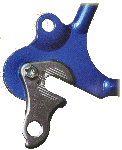
If you removed the adaptor claw with the mangled derailer, the axle stub on the right side may have been long enough to keep the skewer's acorn nut from gripping the dropout...it may have been pressing on the end of the axle. Sometimes removing the coniical spring from the skewer is a quick fix for this.
Sheldon "QR" Brown
09-20-07 | 12:03 AM
#36

Thread Starter
Je pose, donc je suis.
Joined: Mar 2006
Posts: 1,463
Likes: 0
From: Odense, Denmark
RadioFlyer: As far as I'm concerned, the issue is solved.
Sheldon and everyone: I think we're looking at user error here. I have good quality Columbus forged dropouts, a good(?) Campagnolo skewer, and no adaptor claw. I have since put a new derailer on, but before I did I took it out for some serious (single-speed) mashing and it didn't budge a bit.
I don't know what was going on that day: I had the original destruction of the derailer (which I had attributed to bad derailer adjustment, but, in hindsight, may have been caused by a wheel slip) plus one or two slips while in single-speed mode. But given that it hasn't slipped since, I can only assume I wasn't clamping tightly enough.
Sheldon and everyone: I think we're looking at user error here. I have good quality Columbus forged dropouts, a good(?) Campagnolo skewer, and no adaptor claw. I have since put a new derailer on, but before I did I took it out for some serious (single-speed) mashing and it didn't budge a bit.
I don't know what was going on that day: I had the original destruction of the derailer (which I had attributed to bad derailer adjustment, but, in hindsight, may have been caused by a wheel slip) plus one or two slips while in single-speed mode. But given that it hasn't slipped since, I can only assume I wasn't clamping tightly enough.
09-20-07 | 10:38 AM
#38
Senior Member
Joined: Jan 2007
Posts: 1,013
Likes: 0
From: Sacramento
Never had my rear wheel slip on my SS, EVER, when using a steel QR. Had one slip w/ a Salsa ti QR, but those don't have near the clamping force and the aluminum "teeth" don't really grip that well.
I grind up steep hills and never a whimper from the rear wheel..... I can hear my chain groaning, but no slippage.
09-20-07 | 10:51 AM
#39
Senior Member
Joined: Feb 2006
Posts: 1,564
Likes: 1
simple
QR dropouts are fixed position, there is nothing to slide
horizontal dropouts (for adjusting chain slack) can slide, need bolts
or axle stops
no QR will eclipse a grade 8 bolt in tightness
if you tighten the bolt enough. unpossible. qr just cannot do what screw threads can do
for compression force
if you have horizontal dropouts and a qr and it doesn't slip, U are lucky but most peeps need
a surly tuggnut or something similar.
QR dropouts are fixed position, there is nothing to slide
horizontal dropouts (for adjusting chain slack) can slide, need bolts
or axle stops
no QR will eclipse a grade 8 bolt in tightness
if you tighten the bolt enough. unpossible. qr just cannot do what screw threads can do
for compression force
if you have horizontal dropouts and a qr and it doesn't slip, U are lucky but most peeps need
a surly tuggnut or something similar.
09-20-07 | 12:00 PM
#40
Senior Member
Joined: Jul 2007
Posts: 68
Likes: 0
[QUOTE=Sheldon Brown;5297349]Correct. This is a widespread superstition. Good quality quick releases hold as well as nuts, if not better.
See: https://sheldonbrown.com/qr
Mr Brown.
I must preface that you have likely forgotten more about bikes, than I may ever know, but that statement is patently false in regards to my experience.
OFFROAD, I MUST use a tug on my Surly hub and steel track dropouts. The thing would dance with a QR hub on the track ends.
I notice subtle chain tesion variance after several hard backpedals even when using a tug and track nuts.
not trying to be disrepesctful, but my experience is contrary, not a superstition.
See: https://sheldonbrown.com/qr
Mr Brown.
I must preface that you have likely forgotten more about bikes, than I may ever know, but that statement is patently false in regards to my experience.
OFFROAD, I MUST use a tug on my Surly hub and steel track dropouts. The thing would dance with a QR hub on the track ends.
I notice subtle chain tesion variance after several hard backpedals even when using a tug and track nuts.
not trying to be disrepesctful, but my experience is contrary, not a superstition.
07-25-08 | 12:17 AM
#41
Junior Member

Joined: Jun 2008
Posts: 89
Likes: 67
I've been losing the proper chain tension repeatedly on my bike (with quick release) during the first few pedals and back pedals immediately after re-setting the rear wheel. I've been periodically re-setting my rear wheel for about 2 months now. Although the slacking chain tension hasn't caused any problems, It just felt sloppy. Today, I'm glad I've finally discovered the problem: The hollow axle can move independently from the acorn nut and skewers; There's wiggle room for the hollow axle; Their centerline do not always align; If the acorn nut is in fixed in a position, it is still possible for the axle to slightly move fore or aft. I don't know if all quick releases are this way.
Previously, I would loosen the quick release and tug on the rim to increase chain tension. This is primarily pulling from the rim to the hub and axle, then the axle pulls the acorn nut and skewers. But this is also moving the axle aft in relation to the acorn nut and skewers. When I begin riding, the acorn nut and skewers doesn't slip on the dropouts (which I thought was the cause of the problem) and do remain where they are but it's the axle, along with the lock nuts, that move slighly forward and would cause the chain to lose tension. That wasn't a problem when the bike had the chain tensioner from the derailleur. I found that the proper way to increase chain tension is not by tugging on the rim but pulling on the acorn nut and skewer instead. This way moves the acon nut and skewers farther back than the axle so that the axle has no more wiggle room to move forward.
I noticed this this morning as I was trying to tighten the chain (again). I tried the newfound method when I got home and I just got back from doing some sprints and immediate slow downs by back pedaling and the chain tension is still how it was.
anyone else with quick release losing chain tension? might want to try this if my explanation even made sense.
Previously, I would loosen the quick release and tug on the rim to increase chain tension. This is primarily pulling from the rim to the hub and axle, then the axle pulls the acorn nut and skewers. But this is also moving the axle aft in relation to the acorn nut and skewers. When I begin riding, the acorn nut and skewers doesn't slip on the dropouts (which I thought was the cause of the problem) and do remain where they are but it's the axle, along with the lock nuts, that move slighly forward and would cause the chain to lose tension. That wasn't a problem when the bike had the chain tensioner from the derailleur. I found that the proper way to increase chain tension is not by tugging on the rim but pulling on the acorn nut and skewer instead. This way moves the acon nut and skewers farther back than the axle so that the axle has no more wiggle room to move forward.
I noticed this this morning as I was trying to tighten the chain (again). I tried the newfound method when I got home and I just got back from doing some sprints and immediate slow downs by back pedaling and the chain tension is still how it was.
anyone else with quick release losing chain tension? might want to try this if my explanation even made sense.
