


KNEE Question!
 10-23-07 | 07:13 PM
#1

Thread Starter
Hopeful Monster
Joined: Jul 2006
Posts: 100
Likes: 0
From: Virginia
Bikes: cannondale synapse, custom frakenstein fg
KNEE Question!
My knee feels very weird. There is no pain in my knee and it functions normally, but it feels incredibly awkward when I stand and walk on it.
I have a 48 -17 gearing. This gearing was made for my flat commute (Newport News) back during the Summer. After the Summer was over I moved up to Harrisonburg, and from mid-August to the beginning of October I rode sans brakes. Harrisonburg is very hilly, and thus my legs took a beating. Recently I got a brake and the ride has been nicer to my legs.
What do y'all think?
I have a 48 -17 gearing. This gearing was made for my flat commute (Newport News) back during the Summer. After the Summer was over I moved up to Harrisonburg, and from mid-August to the beginning of October I rode sans brakes. Harrisonburg is very hilly, and thus my legs took a beating. Recently I got a brake and the ride has been nicer to my legs.
What do y'all think?
 10-23-07 | 08:35 PM
#3
Banned.
Joined: Jul 2006
Posts: 994
Likes: 1
From: philly
^^ Yes. Bike fit is a big deal. Improper fit can be really hard on lots of your joints, especially the knees. Make sure your saddle is in the right spot (front-to-back), and your bars are high enough/spaced correctly (also front-to-back -- stem length).
Take a rest. Ride easier, and slightly less than you normally would, for a few days. Don't completely stop, since a little all the time is better than lots & then none.
Gear down slightly, and use your brake.
Take care of those knees; you need them!
Take a rest. Ride easier, and slightly less than you normally would, for a few days. Don't completely stop, since a little all the time is better than lots & then none.
Gear down slightly, and use your brake.
Take care of those knees; you need them!
 10-24-07 | 04:19 AM
#5
Thread Starter
Hopeful Monster
Joined: Jul 2006
Posts: 100
Likes: 0
From: Virginia
Bikes: cannondale synapse, custom frakenstein fg
Interesting. I'm pretty sure my bike fits me properly, but I could be wrong. Are there any tell-tale signs of an improper fit. When other people ride my bike they often comment on the high saddle and low bars.
10-24-07 | 05:27 AM
#6
Senior Member
Joined: Nov 2005
Posts: 4,083
Likes: 0
The majority of people I see on bikes (and the vast majority of people of fixed gears) are on bikes that fit them badly. In the case of fixed gear riders, they are often on small frames for their size. Do any shops around you do fittings?
10-24-07 | 06:07 AM
#7
Thread Starter
Hopeful Monster
Joined: Jul 2006
Posts: 100
Likes: 0
From: Virginia
Bikes: cannondale synapse, custom frakenstein fg
I frequent the lbs and they know me pretty well. I'm sure they would say something if my bike didn't fit me properly, but I will ask next time I stop by.
10-24-07 | 06:17 AM
#8

is as Gurgus does.

Joined: Feb 2004
Posts: 910
Likes: 0
From: Otisburg
Bikes: A whole bunch o' bikes.
Along the same lines as this, I thought I had my bike fit perfectly for me. This morning, in the middle of my ride, I raised the saddle less than an inch and immediatley thought "OMG! This is sooooo much better on my knees!" Once you get it right, you'll know. Also, use brakes. They are way cheaper than knee replacements and all the really cool riders use 'em.
 10-24-07 | 07:39 AM
#12

i'd leave the sweet stuff
Joined: Nov 2006
Posts: 727
Likes: 0
From: x32308x: where all our dreams come true!
Bikes: BCA ten speed / 2007 bfssfg group buy IRO
10-24-07 | 09:00 AM
#14

King of the Hipsters
Joined: Jan 2005
Posts: 2,128
Likes: 2
From: Bend, Oregon
Bikes: Realm Cycles Custom
Riding a fixed gear bike doesn't injure people's knees.
However, an improperly-fitting fixed gear bike will reveal body issues, and most often, knee issues.
A properly-fitted fixed gear bike will actually heal knees.
A professional fitting costs money, and most bike shops only pretend they know how to do it.
Some general principles:
1. Most riders have their saddle too high: with the pedal at its bottom position, the rider should have his foot flat, or even heel down, and still have a slight bend in the knee.
2. Ride clipless, and place the cleats under the ball of the foot/big-toe, with the cleat centered between the big-toe and the "index-toe;" and, if the rider walks with his toes out, his cleats should accommodate that toe-out, a little (not a lot), so that for a toe-out walk, the cleats should point in, a little tiny bit (emphasis on "a little tiny bit").
3. Adjust the saddle fore and aft, so that with the cranks horizontal, a string hanging from the hollow just to the inside (towards the center, towards the other knee) of the knee cap passes through the spindle of the forward pedal.
4. If the rider does not race, but rather rides on the street, adjust the stem and handlebars for a more conservative, upright position: hold a pencil in each fist with the point up; sit in a hard chair with feet flat and together; extend the hands forward, as if riding; lean further forward and start to lift the buttocks off the chair; at the moment the buttocks break contact with the chair, look at the angle of the pencils and the angle of the torso; this corresponds to an all around riding position for that particular rider.
To explain the above: we have a very complex set of muscles in our hips and fronts of thighs; one of the quadriceps, the rectus femoris, starts in the pelvis and ends, sort of, at the front of the shin, without ever touching the thigh bone (femur) itself.
The rectus femoris has at least two functions, depending on the relative positions of the thigh, or femur, and the pelvis and torso.
When in a fairly upright body position, the rectus femoris can bring the thigh forward, or up (pulling up on the pedal in the back part of its spin); and then it can transition into straightening the knee (pushing the pedal over the top of the spin and mashing the pedal down in the front part of the spin).
In the racer's aerodynamic position, with the back level with the top tube and the upper body's weight on the handlebars, the rectus femoris will not, can not, pull the thigh forward, nor, then, pull up on the pedal in the back part of the spin, nor push the pedal over the top.
This means all of the quadriceps' energy goes into mashing.
Unhappily, when the quads mash, they also pull the top of the shin bone up into the bottom of the thigh bone, thus multiplying the forces in the knee joint; so that, not only do the thigh muscles push the thigh bone down into the knee joint, they also pull the shin up into the knee.
Riding a fixed gear bike puts much less stress on our knees than does running or going up stairs.
If we work on the fit of the bike, and learn how to distribute the work our legs do throughout the whole circle of the spin, our knees will get healthier and healthier.
Riding a fixed gear bike heals knees.
I expect a lot of disagreement, and I have some errands to run.
I'll check back this afternoon.
However, an improperly-fitting fixed gear bike will reveal body issues, and most often, knee issues.
A properly-fitted fixed gear bike will actually heal knees.
A professional fitting costs money, and most bike shops only pretend they know how to do it.
Some general principles:
1. Most riders have their saddle too high: with the pedal at its bottom position, the rider should have his foot flat, or even heel down, and still have a slight bend in the knee.
2. Ride clipless, and place the cleats under the ball of the foot/big-toe, with the cleat centered between the big-toe and the "index-toe;" and, if the rider walks with his toes out, his cleats should accommodate that toe-out, a little (not a lot), so that for a toe-out walk, the cleats should point in, a little tiny bit (emphasis on "a little tiny bit").
3. Adjust the saddle fore and aft, so that with the cranks horizontal, a string hanging from the hollow just to the inside (towards the center, towards the other knee) of the knee cap passes through the spindle of the forward pedal.
4. If the rider does not race, but rather rides on the street, adjust the stem and handlebars for a more conservative, upright position: hold a pencil in each fist with the point up; sit in a hard chair with feet flat and together; extend the hands forward, as if riding; lean further forward and start to lift the buttocks off the chair; at the moment the buttocks break contact with the chair, look at the angle of the pencils and the angle of the torso; this corresponds to an all around riding position for that particular rider.
To explain the above: we have a very complex set of muscles in our hips and fronts of thighs; one of the quadriceps, the rectus femoris, starts in the pelvis and ends, sort of, at the front of the shin, without ever touching the thigh bone (femur) itself.
The rectus femoris has at least two functions, depending on the relative positions of the thigh, or femur, and the pelvis and torso.
When in a fairly upright body position, the rectus femoris can bring the thigh forward, or up (pulling up on the pedal in the back part of its spin); and then it can transition into straightening the knee (pushing the pedal over the top of the spin and mashing the pedal down in the front part of the spin).
In the racer's aerodynamic position, with the back level with the top tube and the upper body's weight on the handlebars, the rectus femoris will not, can not, pull the thigh forward, nor, then, pull up on the pedal in the back part of the spin, nor push the pedal over the top.
This means all of the quadriceps' energy goes into mashing.
Unhappily, when the quads mash, they also pull the top of the shin bone up into the bottom of the thigh bone, thus multiplying the forces in the knee joint; so that, not only do the thigh muscles push the thigh bone down into the knee joint, they also pull the shin up into the knee.
Riding a fixed gear bike puts much less stress on our knees than does running or going up stairs.
If we work on the fit of the bike, and learn how to distribute the work our legs do throughout the whole circle of the spin, our knees will get healthier and healthier.
Riding a fixed gear bike heals knees.
I expect a lot of disagreement, and I have some errands to run.
I'll check back this afternoon.
10-24-07 | 10:06 AM
#15
rmw
Joined: Jul 2007
Posts: 60
Likes: 0
From: The Netherlands
A basic rule is saddle too high = pain in back of knee
too low and/or too big a gear = pain in front of knee
but you don't have pain right? just a funny feeling? Everyone here is right to encourage you to let someone in the know check your position. After that, you may just need to give it some rest before it does begin to hurt.
And your saddle/bar drop is not much at all, unless you have very poor flexability.
too low and/or too big a gear = pain in front of knee
but you don't have pain right? just a funny feeling? Everyone here is right to encourage you to let someone in the know check your position. After that, you may just need to give it some rest before it does begin to hurt.
And your saddle/bar drop is not much at all, unless you have very poor flexability.
Last edited by RMW; 10-24-07 at 10:21 AM.
10-24-07 | 10:11 AM
#16
Senior Member
Joined: Aug 2007
Posts: 999
Likes: 1
From: the land of ice and snow
It seems the first thing to make sure you've got right is saddle-to-pedals (up-down and front-back positioning). Only after that does it make sense to set and start tweaking your stem length and bar position.
10-24-07 | 10:20 AM
#17
rmw
Joined: Jul 2007
Posts: 60
Likes: 0
From: The Netherlands
^ Right. I mention the drop being normal only because others had commented on it.
Actually you wouldn't expect that to affect the knees at all. Look at the stem for problems with the lumbar and cervical spine (lower back and neck) shoulders and hands.
Actually you wouldn't expect that to affect the knees at all. Look at the stem for problems with the lumbar and cervical spine (lower back and neck) shoulders and hands.
10-24-07 | 10:26 AM
#18
Thread Starter
Hopeful Monster
Joined: Jul 2006
Posts: 100
Likes: 0
From: Virginia
Bikes: cannondale synapse, custom frakenstein fg
Originally Posted by pittmatj Are there any tell-tale signs of an improper fit.
pain, discomfort, and general wierdness in your body.
pain, discomfort, and general wierdness in your body.
10-24-07 | 10:52 AM
#19
Senior Member
Joined: Nov 2005
Posts: 4,083
Likes: 0
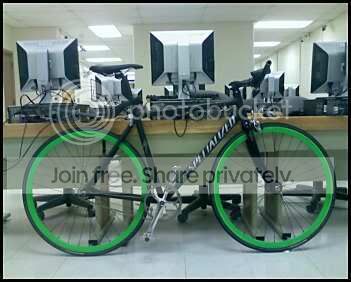
You are not on the bike, and a picture of that would be somewhat more helpful (with your right leg at the bottom of the pedal rotation). There is no way to tell just looking at the bike unless you are doing the cartoon track bike thing. Too me that looks like a lot of seatpost, but nothing outrageous.
The pedals are clipless, right? Are you sure the cleat is positioned correctly?
The pedals are clipless, right? Are you sure the cleat is positioned correctly?
10-24-07 | 01:32 PM
#21
Senior Member
Joined: Nov 2005
Posts: 4,083
Likes: 0
Swapping pedals can change the effective distance from the saddle to the pedal (same with changing saddles). You may want to check to make sure that your saddle hight is still ok. It doesn't take much for the knees to feel it.
