


why a new hub?
 06-18-09 | 05:45 PM
#1

Thread Starter
bicycle reanimator
Joined: Apr 2006
Posts: 82
Likes: 0
From: seacoast New Hampshire
Bikes: Raleigh Touring 18, Bridgestone MB-4 singlespeed, dumpstered Bridgestone Kabuki(?) singlespeed
why a new hub?
So I understand that an a track hub allows you to thread on a sprocket one way and the lock ring the other way. (Why) does this require a whole new hub, or can a double-threaded axle be installed on an existing hub?
about to take the DIY fixed plunge, learn wheel assembly and keep it costefficient,
-Marcus
about to take the DIY fixed plunge, learn wheel assembly and keep it costefficient,
-Marcus
 06-18-09 | 05:51 PM
#2

Bicycle Repair Man !!!
Joined: Sep 2007
Posts: 27,266
Likes: 152
From: YEG
Bikes: See my sig...
The reverse threaded lock ring keeps your cog from un-threading itself when you apply back pressure to the rear wheel... this can be catastrophic as once loosened the cog can unscrew itself while you are riding.
Many people use suicide hubs where a cog is threaded on with loctite and a right handed bottom bracket ring is added (also with loctite) and with a brake and proper assembly, this can be a very solid setup. I have ridden 10,000 km on such a hub and there is no way that cog is coming off without a torch.
Many people use suicide hubs where a cog is threaded on with loctite and a right handed bottom bracket ring is added (also with loctite) and with a brake and proper assembly, this can be a very solid setup. I have ridden 10,000 km on such a hub and there is no way that cog is coming off without a torch.
06-18-09 | 05:52 PM
#3

Senior Member
Joined: Jul 2006
Posts: 11,373
Likes: 8
From: Columbus, OH
Bikes: '08 Surly Cross-Check, 2011 Redline Conquest Pro, 2012 Spesh FSR Comp EVO, 2015 Trek Domane 6.2 disc
Cogs thread onto the hub, not the axle. No matter what you do with the axle, it's never going to magically transform the hub into one with reversed lockring threads.
06-18-09 | 05:57 PM
#4

Senior Member
Joined: May 2008
Posts: 1,938
Likes: 2
From: Tokyo
Double threaded axel.....
Hmmmmm you mean for a track cog and lockring?
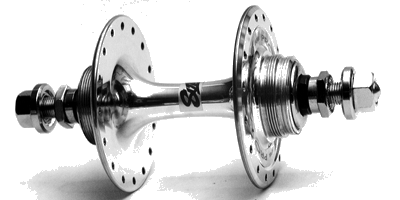
You do realise that it is the hub that has the threading, not the axel. the axel goes through the center of the hub, and the bearings on the axel which connect to the hub.
If you want a track hub, you have to buy one, is you have a Shimano freehub based wheel, then you can buy a Surly Fixxer, but it costs about $80. It is only really used when converting special wheels, like Carbon Wheels that are impossible to change the hub on.
Also, you can buy a new wheelset (front and back) for about $120, so not much point spending on a fixxer, unless you have a really expensive special wheel.
look at the top picture

Hmmmmm you mean for a track cog and lockring?
You do realise that it is the hub that has the threading, not the axel. the axel goes through the center of the hub, and the bearings on the axel which connect to the hub.
If you want a track hub, you have to buy one, is you have a Shimano freehub based wheel, then you can buy a Surly Fixxer, but it costs about $80. It is only really used when converting special wheels, like Carbon Wheels that are impossible to change the hub on.
Also, you can buy a new wheelset (front and back) for about $120, so not much point spending on a fixxer, unless you have a really expensive special wheel.
look at the top picture
Last edited by the_don; 06-18-09 at 06:02 PM.
 06-18-09 | 07:18 PM
#6
Member
Joined: Jun 2009
Posts: 27
Likes: 0
From: Sydney
most people who buy a new hub do so because regular wheels are dished on one side to make room for the cassette to fit on. this means that the spokes on one side are under higher tension, and less angled. removing all that extra space makes the rear hub more like the front hub, and is only dished a little bit to make room for one sprocket and lockring (as opposed to the usual 9-10)
 06-19-09 | 07:08 AM
#9

Ride for Life

Joined: Jun 2004
Posts: 2,740
Likes: 2
From: Houston
most people who buy a new hub do so because regular wheels are dished on one side to make room for the cassette to fit on. this means that the spokes on one side are under higher tension, and less angled. removing all that extra space makes the rear hub more like the front hub, and is only dished a little bit to make room for one sprocket and lockring (as opposed to the usual 9-10)
06-19-09 | 08:27 PM
#10
Member
Joined: Jun 2009
Posts: 27
Likes: 0
From: Sydney
whoops, sorry for not being clear guys. what i meant was that a new rear hub would be wider, as you'd only need to dish for one sprocket instead of a usual 9, meaning more strength in the back wheel. makes sense, right?
