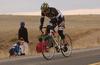
that's one CRAZY Chainring


 11-03-10 | 12:54 PM
#9
Senior Member
Joined: Mar 2010
Posts: 337
Likes: 0
From: Southwest Washington
Bikes: '77 Traveller III '05 Rockhopper.
I thought that moving rake more positive would enhance high speed stability? Like choppers, which handle like crap at slow speed.
That rake would produce the shopping cart wobble as mentioned above... No?
That ring must move a quarter mile per stroke!
That rake would produce the shopping cart wobble as mentioned above... No?
That ring must move a quarter mile per stroke!
11-03-10 | 12:58 PM
#10
:)
Joined: Nov 2006
Posts: 3,391
Likes: 1
From: duluth
Bikes: '07 Pista, '09 Fantom Cross Uno, '8? Miyata, '67 Stingray, '0? Zoo mod trials, Tallbike, Chopper, '73 Schwinn Collegiate, '67 Triumph Chopper, '69 CB350, '58 BSA Spitfire, '73 CB450
needs risers to barspin tho... lame.
11-03-10 | 01:11 PM
#11

Oh, you know...
Joined: May 2009
Posts: 2,834
Likes: 0
From: DC
Bikes: '74 Schwinn Sports Tourer (Polo), S-Works E5 Team Festina (Chorus 11), Trek 2200 Bonded Carbon (Fixed), Trek 920 (7 speed IGH), Chesini Olimpiade SL (1x7)
The negative rake is probably just to move his body further out over the front wheel, so he can get more of his body into the slipstream before his front wheel hits the bumper.
11-03-10 | 01:42 PM
#13

Senior Member
Joined: Jul 2010
Posts: 104
Likes: 0
From: Charleston, SC
"I made a fork with negative rake on which John Stenner (a great rider and friend who tragically died in a bike/car accident more than a decade ago) won the U.S. time trial national championship in the early 1990s. This was before the UCI had mandated that the front and rear wheels had to be of the same size, so Stenner wanted a smaller (26-inch) front wheel for reduced aerodynamic drag, yet he did not want the front end of the bike to drop (and its head angle to steepen and hence trail and stability to decrease) as they would have by simply switching to a 26-inch fork and wheel. He also wanted a lot more stability so he could just concentrate on powering the bike. The solution I came up with was a unicrown fork with negative rake made out of teardrop-shaped steel strut tubing made to separate the wings of biplanes.
As you can see from the formula and discussion in the previous column or in Zinn’s Cycling Primer: Maintenance Tips and Skill Building for Cyclists, decreasing the wheel radius would have decreased the fork trail and hence the bike’s stability. Couple that with a steeper head angle by dropping the front end due to the smaller wheel radius and shorter fork, and you lose a lot more trail and stability. However, by making the fork a long unicrown bend with this aerodynamic tubing which could not be bent sharply, made the fork longer, and turning it around backwards so that the rake was negative lifted the front end yet more. John ultimately decided that he wanted to be a bit lower and wanted to drop the bottom bracket height a bit as well, both to get down out of the wind more. So, we ended up with 0.5 degrees less head angle, 70mm (!) less rake, and around 22mm less wheel radius, all resulting in a net large increase in fork trail.
We worked on the countersteering skills that it takes to put a super-stable bike into a lean and to rapidly turn it (also covered in the primer.). Once he mastered the necessary countersteering, he realized that this bike was also giving him a big advantage at the turnaround. The 70mm reduction in rake reduced his wheelbase, and hence his turning radius, by almost 70mm as well. After winning Nationals, he excitedly described how he was able to just stomp the pedals and not be concerned at all with steering; the bike just went straight without him, and he zipped around the turnaround so fast that he could hear the spectators exclaiming about it! It’s a shame he is no longer around to invent things with.
Lennard"
Looks like the smaller wheel on that bike may have required a similar solution.

 11-03-10 | 02:38 PM
#16
 11-03-10 | 02:38 PM
#17

phony collective progress
Joined: Sep 2006
Posts: 2,973
Likes: 5
From: San Hoosey
Bikes: https://velospace.org/user/36663
I saw this this morning on... where was it, Jalopnik?
Apparently this setup was good for 135 MPH or so.
I'd still rather have the pope-mo-porsche.
Apparently this setup was good for 135 MPH or so.
I'd still rather have the pope-mo-porsche.
__________________

11-03-10 | 04:23 PM
#18

extra bitter

Joined: Apr 2006
Posts: 1,588
Likes: 7
Bikes: Miyata 210, Fuji Royale II, Bridgestone Kabuki, Miyata Ninety
To be clear, the "grocery cart" effect of negative rake (and the resulting high trail) creates stability at speed. Intuitively, much like a wheel on a caster, the wheel tends to align itself with the trajectory of the bike. I'm sure someone will jump in and explain the physics that somehow make this reasoning bogus, but it works for me.

 11-03-10 | 04:51 PM
#22