


Seeking Advice for 2,000 mi Alaska / Yukon Summer Tour
 05-21-17 | 11:23 PM
#1
Thread Starter
Newbie
Joined: May 2017
Posts: 2
Likes: 0
From: Portland, OR
Bikes: Salsa Vaya 2
Seeking Advice for 2,000 mi Alaska / Yukon Summer Tour
Background:
My totally awesome sister and I have decided to spend about six weeks this summer sharing a "quarter-life crisis" bike tour from Portland OR to Fairbanks, AK by way of Vancouver Island and the Inside Passage ferry. (Portland OR -> Port Angeles WA -> Ferry to Victoria BC -> Port Hardy BC -> Ferry to Skagway AK -> Dawson YT -> Anchorage AK -> Fairbanks AK) We'll probably take some detours along the way, so all in all, we expect to bike ~2,000-2,500 miles.
We start pedaling in early July, with the aim flying back to Oregon in mid-August. To preserve our finances and our sense of adventure, we will be mostly self-supported, camping in our tents and cooking our own meals the vast majority of the time. We're both hardy young 20-somethings with plenty of energy and tolerance for discomfort... but we're not looking for a sufferfest.
Our prior experience:
My sister did her first bike tour two years ago, in which she rode 3,000 miles from Denver to Juneau solo and mostly unsupported. So she's not exactly new to this, but she hasn't done any big tours since.
I'm a lot less experienced, having only done one proper bike tour before, ~250 miles through Sweden, never more than two nights of camping between stays with friends and family. However, I've done several dozen backpacking trips between 2 and 10 days long.
I'm simultaneously overjoyed and overwhelmed by the magnitude of this trip. Naturally, I have a lot of questions and would appreciate any helpful suggestions you might care to throw my way.
Big questions:
Invitation to share your experiences:
If you're a veteran long-distance, self-supported bike tourist, preferably with some real-life experience biking around Alaska / Yukon Territories / British Columbia, I'm particularly interested to read about your stories, lessons learned, and gear lists. Feel free to PM me your stories / blog posts / etc... Thanks in advance!
My totally awesome sister and I have decided to spend about six weeks this summer sharing a "quarter-life crisis" bike tour from Portland OR to Fairbanks, AK by way of Vancouver Island and the Inside Passage ferry. (Portland OR -> Port Angeles WA -> Ferry to Victoria BC -> Port Hardy BC -> Ferry to Skagway AK -> Dawson YT -> Anchorage AK -> Fairbanks AK) We'll probably take some detours along the way, so all in all, we expect to bike ~2,000-2,500 miles.
We start pedaling in early July, with the aim flying back to Oregon in mid-August. To preserve our finances and our sense of adventure, we will be mostly self-supported, camping in our tents and cooking our own meals the vast majority of the time. We're both hardy young 20-somethings with plenty of energy and tolerance for discomfort... but we're not looking for a sufferfest.
Our prior experience:
My sister did her first bike tour two years ago, in which she rode 3,000 miles from Denver to Juneau solo and mostly unsupported. So she's not exactly new to this, but she hasn't done any big tours since.
I'm a lot less experienced, having only done one proper bike tour before, ~250 miles through Sweden, never more than two nights of camping between stays with friends and family. However, I've done several dozen backpacking trips between 2 and 10 days long.
I'm simultaneously overjoyed and overwhelmed by the magnitude of this trip. Naturally, I have a lot of questions and would appreciate any helpful suggestions you might care to throw my way.
Big questions:
Invitation to share your experiences:
If you're a veteran long-distance, self-supported bike tourist, preferably with some real-life experience biking around Alaska / Yukon Territories / British Columbia, I'm particularly interested to read about your stories, lessons learned, and gear lists. Feel free to PM me your stories / blog posts / etc... Thanks in advance!
 05-22-17 | 01:34 AM
#2
bicycle tourist

Joined: Dec 2007
Posts: 2,629
Likes: 470
From: Austin, Texas, USA
Bikes: Trek 520, Lightfoot Ranger, Trek 4500
I've done a few related trips:
- Prudhoe Bay to Fairbanks to Whitehorse and further south (starting June 2016) scc2ush.com
- Dalton Highway (2005) mvermeulen.com/dalton
- Haines to Skagway (2000)
mvermeulen.com/klondike
- Alaska Highway (1997)
mvermeulen.com/canada
- Dempster Highway (1996)
A few thoughts on topics you ask:
- Weather: you can get some days of rain. I wouldn't worry much on paved highway portions since worst case, just cycle through and surprised to see continues rain. Where I would allow some contingency time is on unpaved sections like Top-of-the-world Highway since you get a much different experience on wet/muddy gravel road.
- Wildlife. Bear vault seems like reasonable precaution. I carried one last year. I had worse mosquitoes further north on Dempster and Dalton. Nothing bad enough riding during day and having good tent plus some repellent was fine.
- Fuel: some of the small places will have iso-butane as well, e.g. Skagway, Whitehorse, Dawson, Tok, etc. So MSR multifuel or iso-butane would be my choices.
- Pick up a copy of The Milepost. It now also includes downloadable version for phone/tablet and found it very useful.
- Prudhoe Bay to Fairbanks to Whitehorse and further south (starting June 2016) scc2ush.com
- Dalton Highway (2005) mvermeulen.com/dalton
- Haines to Skagway (2000)
mvermeulen.com/klondike
- Alaska Highway (1997)
mvermeulen.com/canada
- Dempster Highway (1996)
A few thoughts on topics you ask:
- Weather: you can get some days of rain. I wouldn't worry much on paved highway portions since worst case, just cycle through and surprised to see continues rain. Where I would allow some contingency time is on unpaved sections like Top-of-the-world Highway since you get a much different experience on wet/muddy gravel road.
- Wildlife. Bear vault seems like reasonable precaution. I carried one last year. I had worse mosquitoes further north on Dempster and Dalton. Nothing bad enough riding during day and having good tent plus some repellent was fine.
- Fuel: some of the small places will have iso-butane as well, e.g. Skagway, Whitehorse, Dawson, Tok, etc. So MSR multifuel or iso-butane would be my choices.
- Pick up a copy of The Milepost. It now also includes downloadable version for phone/tablet and found it very useful.
05-22-17 | 05:40 AM
#3
Hooked on Touring


Joined: Mar 2004
Posts: 3,027
Likes: 358
From: Wyoming
I've toured Alaska, the Yukon, and the NWT a half dozen times.
Perhaps I was unlucky, but I had copious amounts of rain most of the time.
Yes, coastal areas are wet, but the interior is supposed to be relatively dry.
In the far north black spruce are like Charlie Brown Xmas trees - and provide little cover - I know.
And dirt roads, esp. if borderline permafrost, turn into quagmires - even for mountain bikes.
You should be prepared for days of rain - because exhaustion and hypothermia are a risk.
And, yes, lodging is SUPER expensive and may be needed in such cases.
I did play a wonderful copycat game with a big raven while stuck at the Dawson City hostel for days.
Speaking of wildlife, there were times when I was swarmed with 100s of black flies & green flies.
You get used to them, they keep up with you riding. Cover up completely and wear a headnet.
I am more concerned with bears in the Lower 48 - up north they are still hunted and fear humans.
I would use smudge fires camping - both to keep down the bugs and to warn bears.
I have never had a weapon nor bear spray - just careful camping and storage practices.
My MSR was fine - food prices, however, can be a shocker.
On average, I found food to cost about twice as much due to distance and shipping.
In bigger cities it is less, but in small trading posts even more. It's not their fault.
One other thing -
Alcohol and drugs are a serious issue in the far north - esp. for indigenous peoples.
If you drink/partake, be aware that it is illegal to bring either into First Nations reserves in Canada.
I noticed huffing for the first time in my life by the young people with paint streaks on their faces.
And non-natives are also impacted - isolation, rural poverty, seasonal extremes in daylight.
Unfortunately, long-term abuse can lead to serious health and behavioral issues.
At worst, I was harassed - and I was solo - but prudence is advised.
Finally, I would like to thank you in providing careful information about yourselves and your plans.
Too often, people post things like - "Going to Alaska - - any ideas?" So you is da bomb.
Best - J
Photo - Trusty steed "Lucy" on a Delta River gravel bar at midnight

Perhaps I was unlucky, but I had copious amounts of rain most of the time.
Yes, coastal areas are wet, but the interior is supposed to be relatively dry.
In the far north black spruce are like Charlie Brown Xmas trees - and provide little cover - I know.
And dirt roads, esp. if borderline permafrost, turn into quagmires - even for mountain bikes.
You should be prepared for days of rain - because exhaustion and hypothermia are a risk.
And, yes, lodging is SUPER expensive and may be needed in such cases.
I did play a wonderful copycat game with a big raven while stuck at the Dawson City hostel for days.
Speaking of wildlife, there were times when I was swarmed with 100s of black flies & green flies.
You get used to them, they keep up with you riding. Cover up completely and wear a headnet.
I am more concerned with bears in the Lower 48 - up north they are still hunted and fear humans.
I would use smudge fires camping - both to keep down the bugs and to warn bears.
I have never had a weapon nor bear spray - just careful camping and storage practices.
My MSR was fine - food prices, however, can be a shocker.
On average, I found food to cost about twice as much due to distance and shipping.
In bigger cities it is less, but in small trading posts even more. It's not their fault.
One other thing -
Alcohol and drugs are a serious issue in the far north - esp. for indigenous peoples.
If you drink/partake, be aware that it is illegal to bring either into First Nations reserves in Canada.
I noticed huffing for the first time in my life by the young people with paint streaks on their faces.
And non-natives are also impacted - isolation, rural poverty, seasonal extremes in daylight.
Unfortunately, long-term abuse can lead to serious health and behavioral issues.
At worst, I was harassed - and I was solo - but prudence is advised.
Finally, I would like to thank you in providing careful information about yourselves and your plans.
Too often, people post things like - "Going to Alaska - - any ideas?" So you is da bomb.
Best - J
Photo - Trusty steed "Lucy" on a Delta River gravel bar at midnight
05-22-17 | 07:36 AM
#4

Joined: Jul 2007
Posts: 3,423
Likes: 55
From: Chapin, SC
Bikes: all steel stable: surly world troller, paris sport fixed, fuji ss
I rode Seatle to Deadhorse starting May-11 to July-12 in 2011.
Rain: I did hit some rain days but I just turned them into rest-days. I did hit a longer rain-patch (3-4 days), on my return trip (7/13 to 8/8) but was camping at a hostel so I wasn't holed up in my tent the entire time. I never considered rain to be an issue.
Temperatures: My water bottles froze overnight, a few times, but never solid. My layers of down-sweater, down-vest, fleece-pullover, and merino-base adjusted perfectly for any circumstance I encountered. I pretty much lived in my wool-base but I also did have a tech-tee for a warm day here-and-there.
Bears: I carried a BearVault. Its easy. I carried bear-spray for peace-of-mind (never needed). I saw LOTS of bears mostly black, but plenty of grizzly too. I ate away from my tent area. The more bear activity (scat & sightings) I observed near my campsites the further away I cooked and ate.
Mosquitoes: Deet handled most day-to-day circumstances, but there were places that I donned my head-net & rain-gear.
Stove: I used my old Svea with coleman-fuel or gasoline (a little sooty). Obviously fuel was not an issue. If I went today wouldn't hesitate to use my canister. Canister re-supply is easy in any larger town in US or Canada.
Tent: I used my Big Agnes Seedhouse SL-3 and enjoyed its large size, especially on rain-days. Nowadays I, like you, carry the Fly Creek 2 which is what I'd use today. An extra tarp is fine for extreme circumstances. I use spray-on water-repellant periodically and that's been working for me.

BearVault on top of rack and long-tent-poles lashed to top-tube

Wild camping in the Yukon
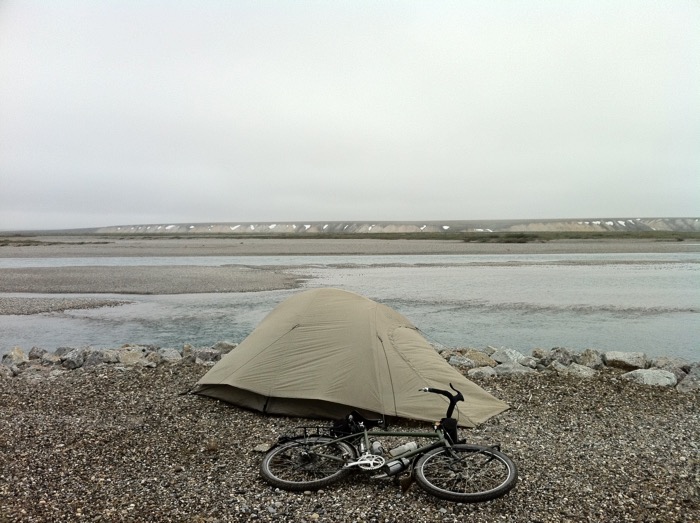
Camped outside of Deadhorse, AK
Rain: I did hit some rain days but I just turned them into rest-days. I did hit a longer rain-patch (3-4 days), on my return trip (7/13 to 8/8) but was camping at a hostel so I wasn't holed up in my tent the entire time. I never considered rain to be an issue.
Temperatures: My water bottles froze overnight, a few times, but never solid. My layers of down-sweater, down-vest, fleece-pullover, and merino-base adjusted perfectly for any circumstance I encountered. I pretty much lived in my wool-base but I also did have a tech-tee for a warm day here-and-there.
Bears: I carried a BearVault. Its easy. I carried bear-spray for peace-of-mind (never needed). I saw LOTS of bears mostly black, but plenty of grizzly too. I ate away from my tent area. The more bear activity (scat & sightings) I observed near my campsites the further away I cooked and ate.
Mosquitoes: Deet handled most day-to-day circumstances, but there were places that I donned my head-net & rain-gear.
Stove: I used my old Svea with coleman-fuel or gasoline (a little sooty). Obviously fuel was not an issue. If I went today wouldn't hesitate to use my canister. Canister re-supply is easy in any larger town in US or Canada.
Tent: I used my Big Agnes Seedhouse SL-3 and enjoyed its large size, especially on rain-days. Nowadays I, like you, carry the Fly Creek 2 which is what I'd use today. An extra tarp is fine for extreme circumstances. I use spray-on water-repellant periodically and that's been working for me.
BearVault on top of rack and long-tent-poles lashed to top-tube
Wild camping in the Yukon
Camped outside of Deadhorse, AK
Last edited by BigAura; 05-22-17 at 07:48 AM.
05-22-17 | 08:00 AM
#5

Senior Member
Joined: Jul 2010
Posts: 566
Likes: 16
From: On the road...
I'm pretty sure there is a regular poster on CGOAB who lives in either Alaska or the Yukon. He's always giving out local advice and meeting up with cyclists who pass near where he lives. If you haven't already, I'd put this post up there as well.
05-22-17 | 08:23 AM
#6
Fraser Valley Dave
Joined: Apr 2009
Posts: 546
Likes: 0
From: Fraser Valley British Columbia Canada
Bikes: devinci monaco (upgraded)
I've ridden quite a bit up north, including the Alaskan Hwy, so will echo other's
suggestions of bringing a head net, pick up the 'The MilePost', and carefully choose your
campsites. I found that frequent good water and food supply was a problem, so carry at
least a 2-3 day reserve. Bring both light gloves for bug protection, and warm ones for those
below freezing days. Be careful about camping in sight of the highways...I almost had my bike
stolen while I was inside my tent. Both of you take the same pictures of your experiences on
different cameras in case something happens to one of them (I have very few pictures because
of camera difficulties while riding solo) Even in these remote areas I suggest wearing high
visibility vests or clothing. You'd be surprised at how many people drive impaired and/or just
aren't expecting to see cyclists. Hope the two of you enjoy your adventure as much as I have mine.
suggestions of bringing a head net, pick up the 'The MilePost', and carefully choose your
campsites. I found that frequent good water and food supply was a problem, so carry at
least a 2-3 day reserve. Bring both light gloves for bug protection, and warm ones for those
below freezing days. Be careful about camping in sight of the highways...I almost had my bike
stolen while I was inside my tent. Both of you take the same pictures of your experiences on
different cameras in case something happens to one of them (I have very few pictures because
of camera difficulties while riding solo) Even in these remote areas I suggest wearing high
visibility vests or clothing. You'd be surprised at how many people drive impaired and/or just
aren't expecting to see cyclists. Hope the two of you enjoy your adventure as much as I have mine.

 05-22-17 | 07:28 PM
#10
Thread Starter
Newbie
Joined: May 2017
Posts: 2
Likes: 0
From: Portland, OR
Bikes: Salsa Vaya 2
Wow, thanks everyone for the super helpful advice. I'm learning a lot, keep it coming!
I'm encouraged to hear that using my old Fly Creek 2 with a tarp might be a viable option... that would save me a big wad of cash. For those who have tried the tent-tarp combo, did you ever have trouble finding trees / tie-ins tall or sturdy enough to support your tarp? I'm fine with biking in the rain, but the moment I have to crawl my sodden carcass into a sopping wet tent and wriggle into a damp down sleeping bag to shiver the night away, that's when things go from Type II Fun (not fun in the moment, but fun looking back on it, would absolutely do again) to Type III Fun (not fun then, not fun in retrospect, would never want to repeat, just a sh*tty experience all around).
Also, duos/trios/groups... how did you manage long-distance communication out of cell reception? My sister and I are looking into radios / walkie talkies in case we want to bike at slightly different paces during the day, while still being able to communicate something like "Hey, wait up, fixing a flat." Or "Come back! You have the spare tire!" Any experience with these or thoughts on their utility? Expensive >$100 options like satellite GPS bike computers with group tracking are simply not in our budget. If no cheap options exist, we'll suck it up and keep within sight of each other.
I'm encouraged to hear that using my old Fly Creek 2 with a tarp might be a viable option... that would save me a big wad of cash. For those who have tried the tent-tarp combo, did you ever have trouble finding trees / tie-ins tall or sturdy enough to support your tarp? I'm fine with biking in the rain, but the moment I have to crawl my sodden carcass into a sopping wet tent and wriggle into a damp down sleeping bag to shiver the night away, that's when things go from Type II Fun (not fun in the moment, but fun looking back on it, would absolutely do again) to Type III Fun (not fun then, not fun in retrospect, would never want to repeat, just a sh*tty experience all around).
Also, duos/trios/groups... how did you manage long-distance communication out of cell reception? My sister and I are looking into radios / walkie talkies in case we want to bike at slightly different paces during the day, while still being able to communicate something like "Hey, wait up, fixing a flat." Or "Come back! You have the spare tire!" Any experience with these or thoughts on their utility? Expensive >$100 options like satellite GPS bike computers with group tracking are simply not in our budget. If no cheap options exist, we'll suck it up and keep within sight of each other.
05-22-17 | 07:44 PM
#11
Senior Member

Joined: Jul 2012
Posts: 3,839
Likes: 57
From: Canada, PG BC
Bikes: 27 speed ORYX with over 39,000Kms on it and another 14,000KMs with a BionX E-Assist on it
Wow, thanks everyone for the super helpful advice. I'm learning a lot, keep it coming!
I'm encouraged to hear that using my old Fly Creek 2 with a tarp might be a viable option... that would save me a big wad of cash. For those who have tried the tent-tarp combo, did you ever have trouble finding trees / tie-ins tall or sturdy enough to support your tarp? I'm fine with biking in the rain, but the moment I have to crawl my sodden carcass into a sopping wet tent and wriggle into a damp down sleeping bag to shiver the night away, that's when things go from Type II Fun (not fun in the moment, but fun looking back on it, would absolutely do again) to Type III Fun (not fun then, not fun in retrospect, would never want to repeat, just a sh*tty experience all around).
Also, duos/trios/groups... how did you manage long-distance communication out of cell reception? My sister and I are looking into radios / walkie talkies in case we want to bike at slightly different paces during the day, while still being able to communicate something like "Hey, wait up, fixing a flat." Or "Come back! You have the spare tire!" Any experience with these or thoughts on their utility? Expensive >$100 options like satellite GPS bike computers with group tracking are simply not in our budget. If no cheap options exist, we'll suck it up and keep within sight of each other.
I'm encouraged to hear that using my old Fly Creek 2 with a tarp might be a viable option... that would save me a big wad of cash. For those who have tried the tent-tarp combo, did you ever have trouble finding trees / tie-ins tall or sturdy enough to support your tarp? I'm fine with biking in the rain, but the moment I have to crawl my sodden carcass into a sopping wet tent and wriggle into a damp down sleeping bag to shiver the night away, that's when things go from Type II Fun (not fun in the moment, but fun looking back on it, would absolutely do again) to Type III Fun (not fun then, not fun in retrospect, would never want to repeat, just a sh*tty experience all around).
Also, duos/trios/groups... how did you manage long-distance communication out of cell reception? My sister and I are looking into radios / walkie talkies in case we want to bike at slightly different paces during the day, while still being able to communicate something like "Hey, wait up, fixing a flat." Or "Come back! You have the spare tire!" Any experience with these or thoughts on their utility? Expensive >$100 options like satellite GPS bike computers with group tracking are simply not in our budget. If no cheap options exist, we'll suck it up and keep within sight of each other.
 05-22-17 | 08:23 PM
#12

Senior Member
Joined: Mar 2016
Posts: 276
Likes: 11
From: Texas Hill Country
Bikes: Invictus, Valeria, Jackie, and Vanguard
It will rain. A lot. But no storms. Probably a lot like what you're used to in Portland. So just bring a good jacket. And a helmet cover. And shoe covers. And possibly rain pants. Your gloves should be waterproof too.
Since it rains often and never gets warm, it's a rare occurrence that everything gets all the way dry.
Mosquitoes...holy ****. It's as bad as you've heard. But it's worth noting that they can't keep up with you while you're pedaling, and they can't bite through anything waterproof (can bite through almost anything else). So as soon as you get off the bike, put on your rain jacket.
As far as bears go, the most important thing is scent. Keep your camp entirely scent-free and you'll be fine. So don't eat where you camp, don't brush your teeth where you camp, definitely don't cook where you camp. Keep all your food inside something odor-proof, and ideally inside something else as well.
If you encounter a bear, stop pedaling and talk to it! I've done this with dozens of bears, and nearly every time, they'll take a step back, pause, and then either run or walk away. Do NOT approach it, do NOT scream at it, and do NOT turn your back. If it approaches you, keep talking and back away slowly. Be prepared to drop your food bag, which is probably what it's most interested in.
On a bike, you'll be moving fast enough that you can find a place selling any kind of fuel often enough. Lots of RV parks and small stores have outdoor supplies. You'll run into one such store almost every day, and if they don't have your fuel, the next one probably will.
I've used a Fly Creek 1 for ~17,000 miles of bike touring and ~3,500 miles of backpacking and it's still going strong. Unless there's a problem with yours, there's no reason not to stick with it. You keep mentioning covering it with a tarp. Is there a problem with the rainfly? If so, you could simply purchase a new rainfly instead of an entire tent.
The people are friendly, the game meat is awesome (moose, caribou, salmon...yum!). Drink a Yukon Gold and a Yukon Red. Yes, both. You can camp pretty much wherever and no one cares, but better yet, most towns will let you camp in the city park, which means running water and possibly even a shower, and there might be RV-ers that share their dinner with you! The long hours of daylight can get kinda weird, and it's easy to lose track of time. Fun trick - wear a beanie to bed and pull it down over your eyes.
Have fun out there!
Since it rains often and never gets warm, it's a rare occurrence that everything gets all the way dry.
Mosquitoes...holy ****. It's as bad as you've heard. But it's worth noting that they can't keep up with you while you're pedaling, and they can't bite through anything waterproof (can bite through almost anything else). So as soon as you get off the bike, put on your rain jacket.
As far as bears go, the most important thing is scent. Keep your camp entirely scent-free and you'll be fine. So don't eat where you camp, don't brush your teeth where you camp, definitely don't cook where you camp. Keep all your food inside something odor-proof, and ideally inside something else as well.
If you encounter a bear, stop pedaling and talk to it! I've done this with dozens of bears, and nearly every time, they'll take a step back, pause, and then either run or walk away. Do NOT approach it, do NOT scream at it, and do NOT turn your back. If it approaches you, keep talking and back away slowly. Be prepared to drop your food bag, which is probably what it's most interested in.
On a bike, you'll be moving fast enough that you can find a place selling any kind of fuel often enough. Lots of RV parks and small stores have outdoor supplies. You'll run into one such store almost every day, and if they don't have your fuel, the next one probably will.
I've used a Fly Creek 1 for ~17,000 miles of bike touring and ~3,500 miles of backpacking and it's still going strong. Unless there's a problem with yours, there's no reason not to stick with it. You keep mentioning covering it with a tarp. Is there a problem with the rainfly? If so, you could simply purchase a new rainfly instead of an entire tent.
The people are friendly, the game meat is awesome (moose, caribou, salmon...yum!). Drink a Yukon Gold and a Yukon Red. Yes, both. You can camp pretty much wherever and no one cares, but better yet, most towns will let you camp in the city park, which means running water and possibly even a shower, and there might be RV-ers that share their dinner with you! The long hours of daylight can get kinda weird, and it's easy to lose track of time. Fun trick - wear a beanie to bed and pull it down over your eyes.
Have fun out there!
05-22-17 | 11:03 PM
#13
Fraser Valley Dave
Joined: Apr 2009
Posts: 546
Likes: 0
From: Fraser Valley British Columbia Canada
Bikes: devinci monaco (upgraded)
Another thing I experienced on my last tour west and north of Whitehorse was
the large number of deer and horse flies which can easily outrun anyone on a
touring bike. How they can fly so fast for such great distances and still rip a
***** out of you is amazing...and very annoying.
the large number of deer and horse flies which can easily outrun anyone on a
touring bike. How they can fly so fast for such great distances and still rip a
***** out of you is amazing...and very annoying.
05-23-17 | 07:14 AM
#14
Hooked on Touring
Joined: Mar 2004
Posts: 3,027
Likes: 358
From: Wyoming
Indeed. Mosquitoes are no big deal. It's the biting flies.
And, yes, they CAN keep up with you cycling - mercilessly.
I found it essential to be completely covered - still they can bite thru light clothing.
Thus, tights don't work for legs - instead you need some kind of lightweight hikers.
Cycling gloves that expose fingers and wrists will be targets - full cover needed.
You will need long sleeves and, perhaps, a double layer for your torso.
They draft on your back and love shoulder blades and other protrusions.
Don't forget to cover your neck - a lightweight neck pullover works.
And the head net - not always - but for the really think swarms.
I would use a bandana flapping behind my helmet to reduce the numbers near my head.
Plus - I would ride with only one hand and use the other to swish another bandana.
There are a couple of advantages to all this clothing.
Most of the time there is a chill - even cold - so it's not oppressive.
(There will be times that it is sunny and hot, but I sweat thru it.)
And bears prefer people with less packaging.
Finally, it's a Zen thing.
You will become accustomed to the hordes of flies and mosquitoes.
It is a small price to pay for the wonders of the Far North.
Those of us who have cycled there know it.
Pic - The Nadahiini Hilton on the Haines Highway
There are emergency cabins along some of the roads - free, leave something like a can of soup.

And, yes, they CAN keep up with you cycling - mercilessly.
I found it essential to be completely covered - still they can bite thru light clothing.
Thus, tights don't work for legs - instead you need some kind of lightweight hikers.
Cycling gloves that expose fingers and wrists will be targets - full cover needed.
You will need long sleeves and, perhaps, a double layer for your torso.
They draft on your back and love shoulder blades and other protrusions.
Don't forget to cover your neck - a lightweight neck pullover works.
And the head net - not always - but for the really think swarms.
I would use a bandana flapping behind my helmet to reduce the numbers near my head.
Plus - I would ride with only one hand and use the other to swish another bandana.
There are a couple of advantages to all this clothing.
Most of the time there is a chill - even cold - so it's not oppressive.
(There will be times that it is sunny and hot, but I sweat thru it.)
And bears prefer people with less packaging.
Finally, it's a Zen thing.
You will become accustomed to the hordes of flies and mosquitoes.
It is a small price to pay for the wonders of the Far North.
Those of us who have cycled there know it.
Pic - The Nadahiini Hilton on the Haines Highway
There are emergency cabins along some of the roads - free, leave something like a can of soup.
05-23-17 | 06:32 PM
#15
Senior Member
Joined: Jul 2012
Posts: 3,839
Likes: 57
From: Canada, PG BC
Bikes: 27 speed ORYX with over 39,000Kms on it and another 14,000KMs with a BionX E-Assist on it
Indeed. Mosquitoes are no big deal. It's the biting flies.
And, yes, they CAN keep up with you cycling - mercilessly.
I found it essential to be completely covered - still they can bite thru light clothing.
Thus, tights don't work for legs - instead you need some kind of lightweight hikers.
Cycling gloves that expose fingers and wrists will be targets - full cover needed.
You will need long sleeves and, perhaps, a double layer for your torso.
They draft on your back and love shoulder blades and other protrusions.
Don't forget to cover your neck - a lightweight neck pullover works.
And the head net - not always - but for the really think swarms.
I would use a bandana flapping behind my helmet to reduce the numbers near my head.
Plus - I would ride with only one hand and use the other to swish another bandana.
There are a couple of advantages to all this clothing.
Most of the time there is a chill - even cold - so it's not oppressive.
(There will be times that it is sunny and hot, but I sweat thru it.)
And bears prefer people with less packaging.
Finally, it's a Zen thing.
You will become accustomed to the hordes of flies and mosquitoes.
It is a small price to pay for the wonders of the Far North.
Those of us who have cycled there know it.
Pic - The Nadahiini Hilton on the Haines Highway
There are emergency cabins along some of the roads - free, leave something like a can of soup.
And, yes, they CAN keep up with you cycling - mercilessly.
I found it essential to be completely covered - still they can bite thru light clothing.
Thus, tights don't work for legs - instead you need some kind of lightweight hikers.
Cycling gloves that expose fingers and wrists will be targets - full cover needed.
You will need long sleeves and, perhaps, a double layer for your torso.
They draft on your back and love shoulder blades and other protrusions.
Don't forget to cover your neck - a lightweight neck pullover works.
And the head net - not always - but for the really think swarms.
I would use a bandana flapping behind my helmet to reduce the numbers near my head.
Plus - I would ride with only one hand and use the other to swish another bandana.
There are a couple of advantages to all this clothing.
Most of the time there is a chill - even cold - so it's not oppressive.
(There will be times that it is sunny and hot, but I sweat thru it.)
And bears prefer people with less packaging.
Finally, it's a Zen thing.
You will become accustomed to the hordes of flies and mosquitoes.
It is a small price to pay for the wonders of the Far North.
Those of us who have cycled there know it.
Pic - The Nadahiini Hilton on the Haines Highway
There are emergency cabins along some of the roads - free, leave something like a can of soup.
05-23-17 | 08:24 PM
#16
Joined: Jul 2007
Posts: 3,423
Likes: 55
From: Chapin, SC
Bikes: all steel stable: surly world troller, paris sport fixed, fuji ss


