


How to organize panniers.
 08-20-25 | 05:42 AM
#1
Thread Starter
Newbie
Joined: Jun 2025
Posts: 19
Likes: 3
How to organize panniers.
I picked up some Ortlieb BackRoller Core Panniers, and they are great, but the one downside is once you get moving, everything in them gets all jumbled and it's hard to find what I need in them, especially small things. I see Ortlieb makes an organizer for them, but it's got a laptop sleeve and it looks like it's more for bike commuters. They also make packing cubes, but it seems those are really only designed for clothes. I'm looking for a way to organize all my bike touring odds and ends so I can find what I need easily, any suggestions are highly appreciated!
 08-20-25 | 05:53 AM
#2

Senior Member


Joined: Apr 2012
Posts: 21,829
Likes: 5,782
From: Middle Earth (aka IA)
Bikes: A bunch of old bikes and a few new ones
I'm sure people have fancier and likely better systems but I like the plastic bags you can get when grocery shopping. That way when you take things out, they are organized and stay dry if its raining.
Last edited by bikemig; 08-21-25 at 04:42 AM.
 08-20-25 | 06:39 AM
#3

Senior Member
Joined: Jul 2011
Posts: 2,924
Likes: 530
From: Turku, Finland, Europe
Bikes: 2011 Specialized crux comp, 2013 Specialized Rockhopper Pro
Packing cubes! Those nifty cuboids make organizing a cavernous pannier a breeze.
Now you can use plastic bags (actually not a bad idea since it's cheap and easy to source etc.) or some other small baggies you have laying around but a set of cheap packing cubes typically has a few advantages.
They usually have a zip closing mesh flap. It both lets you see inside and see what every cube contains and also if your stuff is a bit damp, smelly etc, the mesh lets moisture and smells evaporate. Of course if your pannier is closed that's moot, but it's nifty during times when the cubes are not inside the panniers.
A set of packing cubes is typically quite light weight, but even that small amount of weight is completely offset by the QOL improvement they provide.
They're cuboid shaped! Makes packing and organising and fitting inside panniers effortless. Some square sets are also colour coded so you can choose the correct cube with a glance.
We began using them last year on our Germany tour and it made life so much easier. The amount of stuff that needs to be packed when there's two adults, a three year old and a nine months old, is staggering. But since everything was neatly squared away (or should I say, cubed away...) we could spend a lot less time unpacking, packing, and finding stuff. That then opened up time for play, exploration, spending time together etc.
I am never again touring without packing cubes.
to the claim of being meant only for clothes I say: why should you care? You can put anything you want inside them. We had all our electronics in one. I had tools and spares in another. There's no law that says you can't use them for stuff other than clothes.
Now you can use plastic bags (actually not a bad idea since it's cheap and easy to source etc.) or some other small baggies you have laying around but a set of cheap packing cubes typically has a few advantages.
They usually have a zip closing mesh flap. It both lets you see inside and see what every cube contains and also if your stuff is a bit damp, smelly etc, the mesh lets moisture and smells evaporate. Of course if your pannier is closed that's moot, but it's nifty during times when the cubes are not inside the panniers.
A set of packing cubes is typically quite light weight, but even that small amount of weight is completely offset by the QOL improvement they provide.
They're cuboid shaped! Makes packing and organising and fitting inside panniers effortless. Some square sets are also colour coded so you can choose the correct cube with a glance.
We began using them last year on our Germany tour and it made life so much easier. The amount of stuff that needs to be packed when there's two adults, a three year old and a nine months old, is staggering. But since everything was neatly squared away (or should I say, cubed away...) we could spend a lot less time unpacking, packing, and finding stuff. That then opened up time for play, exploration, spending time together etc.
I am never again touring without packing cubes.
to the claim of being meant only for clothes I say: why should you care? You can put anything you want inside them. We had all our electronics in one. I had tools and spares in another. There's no law that says you can't use them for stuff other than clothes.
08-20-25 | 08:08 AM
#4
bicycle tourist

Joined: Dec 2007
Posts: 2,632
Likes: 470
From: Austin, Texas, USA
Bikes: Trek 520, Lightfoot Ranger, Trek 4500
First everything has a designated pannier. For example camping gear in one pannier, bike and repair in another pannier, electronics in a pannier, etc.
If I'm doing "light" touring then I'll have two smaller panniers. Then "heavy" touring has two larger panniers and two small panniers.
That takes care of most things but sometimes I have a group of a lot of smaller things. Toiletries is a good example. In those cases I use a larger ziplock bag (2.5 gallon or 1 gallon) to group the collection together. Sometimes I also like grouping everything that belongs together like my mini-pump amd water bags together - so those will also use a ziplock bag. There are also sometimes a group of smaller things I might carry in my handlebar bag.
Over time this has worked well enough for me - but also as I'm packing I'll create an inventory list of what is in which pannier. This is more making sure I don't miss those last minute things of stuff like gloves/helmets.
If I'm doing "light" touring then I'll have two smaller panniers. Then "heavy" touring has two larger panniers and two small panniers.
That takes care of most things but sometimes I have a group of a lot of smaller things. Toiletries is a good example. In those cases I use a larger ziplock bag (2.5 gallon or 1 gallon) to group the collection together. Sometimes I also like grouping everything that belongs together like my mini-pump amd water bags together - so those will also use a ziplock bag. There are also sometimes a group of smaller things I might carry in my handlebar bag.
Over time this has worked well enough for me - but also as I'm packing I'll create an inventory list of what is in which pannier. This is more making sure I don't miss those last minute things of stuff like gloves/helmets.
08-20-25 | 11:04 AM
#5

aka Timi
Joined: Feb 2009
Posts: 3,611
Likes: 325
From: Gothenburg, Sweden
Bikes: Bianchi Lupo & Bianchi Volpe Disc: touring. Bianchi Volpe: commuting
Multicolour nylon stuff bags

The one I put extra clothes in doubles as my pillow. The others are for:
Rain gear
Tools
Hygiene
Cooking gear
Dry food (coffee, oats, rice)
Small bits & pieces
The one I put extra clothes in doubles as my pillow. The others are for:
Rain gear
Tools
Hygiene
Cooking gear
Dry food (coffee, oats, rice)
Small bits & pieces
Last edited by imi; 08-20-25 at 11:26 AM.
08-20-25 | 11:21 AM
#6
Bike Noob

Joined: Oct 2019
Posts: 94
Likes: 35
From: Central Oregon
Bikes: Kona, Salsa(s)
Just for clarity and for when you search for some on the internet; in the US we call them "Stuff Sacks"
All good advice up above. I need my gear organized so use a combination of stuff sacks, Ortilieb packing cubes, zip locks and nothing at all.
Have fun playing around to figure out what works for you! -it's an evolving process. Kind of like putting a puzzle together but the puzzle always changes based on what is needed for each trip!!
08-20-25 | 12:19 PM
#7
Senior Member
Joined: Aug 2019
Posts: 1,707
Likes: 879
From: Vermont
Bikes: Bruce Gordon Rock and Road
Nerd Alert!
Well, you asked.
I use four panniers, two in front and two in back.
Front, left stuff I use during the day, plus the tool kit. Map, snacks, sunblock, phone charger, first aid kit.
Front right, stuff I won't use until camp. Towel, camp slippers, air mattress, booties, lights and batteries.
Rear left, stuff I might want underway, rain jacket, warm shirt, under that, clean clothes.
Rear Right, Stove, food.
Tent and sleeping bag in stuff sacks on top or rear rack.
Stuff on the left is daily use stuff and will be available when bike is leaning on a wall, tree, guard rail.
Stuff on the right is less likely to be needed during the day's travel.
To further nerdify it, I do have a list of each pannier's contents, but that is to use as a packing guide for next year.
Well, you asked.
I use four panniers, two in front and two in back.
Front, left stuff I use during the day, plus the tool kit. Map, snacks, sunblock, phone charger, first aid kit.
Front right, stuff I won't use until camp. Towel, camp slippers, air mattress, booties, lights and batteries.
Rear left, stuff I might want underway, rain jacket, warm shirt, under that, clean clothes.
Rear Right, Stove, food.
Tent and sleeping bag in stuff sacks on top or rear rack.
Stuff on the left is daily use stuff and will be available when bike is leaning on a wall, tree, guard rail.
Stuff on the right is less likely to be needed during the day's travel.
To further nerdify it, I do have a list of each pannier's contents, but that is to use as a packing guide for next year.
 08-20-25 | 04:51 PM
#9

Senior Member

Joined: Jan 2010
Posts: 45,429
Likes: 23,590
Nerd Alert!
Well, you asked.
I use four panniers, two in front and two in back.
Front, left stuff I use during the day, plus the tool kit. Map, snacks, sunblock, phone charger, first aid kit.
Front right, stuff I won't use until camp. Towel, camp slippers, air mattress, booties, lights and batteries.
Rear left, stuff I might want underway, rain jacket, warm shirt, under that, clean clothes.
Rear Right, Stove, food.
Tent and sleeping bag in stuff sacks on top or rear rack.
Stuff on the left is daily use stuff and will be available when bike is leaning on a wall, tree, guard rail.
Stuff on the right is less likely to be needed during the day's travel.
To further nerdify it, I do have a list of each pannier's contents, but that is to use as a packing guide for next year.
Well, you asked.
I use four panniers, two in front and two in back.
Front, left stuff I use during the day, plus the tool kit. Map, snacks, sunblock, phone charger, first aid kit.
Front right, stuff I won't use until camp. Towel, camp slippers, air mattress, booties, lights and batteries.
Rear left, stuff I might want underway, rain jacket, warm shirt, under that, clean clothes.
Rear Right, Stove, food.
Tent and sleeping bag in stuff sacks on top or rear rack.
Stuff on the left is daily use stuff and will be available when bike is leaning on a wall, tree, guard rail.
Stuff on the right is less likely to be needed during the day's travel.
To further nerdify it, I do have a list of each pannier's contents, but that is to use as a packing guide for next year.
That’s the same organizational philosophy I follow. If it’s doubtful that I’ll need it on the road, it goes in right panniers. Tent and ground sheet on top of the read rack.
Reverse if you’re traveling in a country where you ride on the incorrect side of the road.

 08-20-25 | 05:52 PM
#10
Senior Member
Joined: Aug 2010
Posts: 12,760
Likes: 2,114
From: Madison, WI
Bikes: 1961 Ideor, 1966 Perfekt 3 Speed AB Hub, 1994 Bridgestone MB-6, 2006 Airnimal Joey, 2009 Thorn Sherpa, 2013 Thorn Nomad MkII, 2015 VO Pass Hunter, 2017 Lynskey Backroad, 2017 Raleigh Gran Prix, 1980s Bianchi Mixte on a trainer. Others are now gone.
I use packing cubes for clean clothing. Dirty clothing gets put in a different stuff sack.
My down sleeping bag goes into a compression sack, that goes on top in an Ortlieb Backroller. Most of my clothing goes into another compression sack of a different color on top in the other Ortlieb backroller. Often a light down vest or down jacket gets packed with the sleeping bag. I think the compression sacks are waterproof Granite Gear, but not 100 percent sure on that.
Heavier stuff goes below that compression stuff sack, I like to have the center of gravity as low as practical, so tool bag, spare tire if I have one, canned food, etc., goes in the Backrollers first. Then the compression sack on top.
Usually cooking gear and some food goes in the front left Ortlieb Front Roller (I think they now call the front ones Sport Roller?). Front right is my tent and anything else that can be packed wet. I often put the air mattress in the front right too, as that dries out fast if it got wet from being packed with the tent.
Some years ago, someone was asking a similar question, they asked before I had a chance to unpack my gear from a trip that I had just gotten home from, so I could take a couple photos of how the compression sack fits in the top of the Backroller.


Thus, roughly half of my volume or maybe a bit more that goes in the rear Ortliebs is in those two compression stuff sacks.
A lot of the smaller items for my cooking gear gets put in a gallon sized zip lock baggie.
Toilet kit is in one or two mesh stuff sacks.
A few years ago someone on this forum was bragging about how he had cut several ounces of weight by getting rid of all of his stuff sacks. I read that just a few days before I left town for a backpacking trip. One morning on a day that was not going to be too many miles, it was going to be a short day, I decided to line up all my stuff sacks and take a photo before I packed up my pack.

This really helped me organize my backpack by having those stuff sacks. I can't figure out why that person wanted to just pack everything loose, I prefer some organization. And being a backpacking trip (not bikepacking), all that weight was on my feet, not on wheels. I was still happy to carry several extra ounces of stuff sacks and dry bags.
My down sleeping bag goes into a compression sack, that goes on top in an Ortlieb Backroller. Most of my clothing goes into another compression sack of a different color on top in the other Ortlieb backroller. Often a light down vest or down jacket gets packed with the sleeping bag. I think the compression sacks are waterproof Granite Gear, but not 100 percent sure on that.
Heavier stuff goes below that compression stuff sack, I like to have the center of gravity as low as practical, so tool bag, spare tire if I have one, canned food, etc., goes in the Backrollers first. Then the compression sack on top.
Usually cooking gear and some food goes in the front left Ortlieb Front Roller (I think they now call the front ones Sport Roller?). Front right is my tent and anything else that can be packed wet. I often put the air mattress in the front right too, as that dries out fast if it got wet from being packed with the tent.
Some years ago, someone was asking a similar question, they asked before I had a chance to unpack my gear from a trip that I had just gotten home from, so I could take a couple photos of how the compression sack fits in the top of the Backroller.
Thus, roughly half of my volume or maybe a bit more that goes in the rear Ortliebs is in those two compression stuff sacks.
A lot of the smaller items for my cooking gear gets put in a gallon sized zip lock baggie.
Toilet kit is in one or two mesh stuff sacks.
A few years ago someone on this forum was bragging about how he had cut several ounces of weight by getting rid of all of his stuff sacks. I read that just a few days before I left town for a backpacking trip. One morning on a day that was not going to be too many miles, it was going to be a short day, I decided to line up all my stuff sacks and take a photo before I packed up my pack.
This really helped me organize my backpack by having those stuff sacks. I can't figure out why that person wanted to just pack everything loose, I prefer some organization. And being a backpacking trip (not bikepacking), all that weight was on my feet, not on wheels. I was still happy to carry several extra ounces of stuff sacks and dry bags.
Last edited by Tourist in MSN; 08-20-25 at 05:55 PM.
08-20-25 | 06:14 PM
#11

Mad bike riding scientist

Joined: Nov 2004
Posts: 29,194
Likes: 6,279
From: Denver, CO
Bikes: Some silver ones, a red one, a black and orange one, and a few titanium ones
If being nerdy is wrong, I don’t wanna be right.
That’s the same organizational philosophy I follow. If it’s doubtful that I’ll need it on the road, it goes in right panniers. Tent and ground sheet on top of the read rack.
Reverse if you’re traveling in a country where you ride on the incorrect side of the road.
That’s the same organizational philosophy I follow. If it’s doubtful that I’ll need it on the road, it goes in right panniers. Tent and ground sheet on top of the read rack.
Reverse if you’re traveling in a country where you ride on the incorrect side of the road.
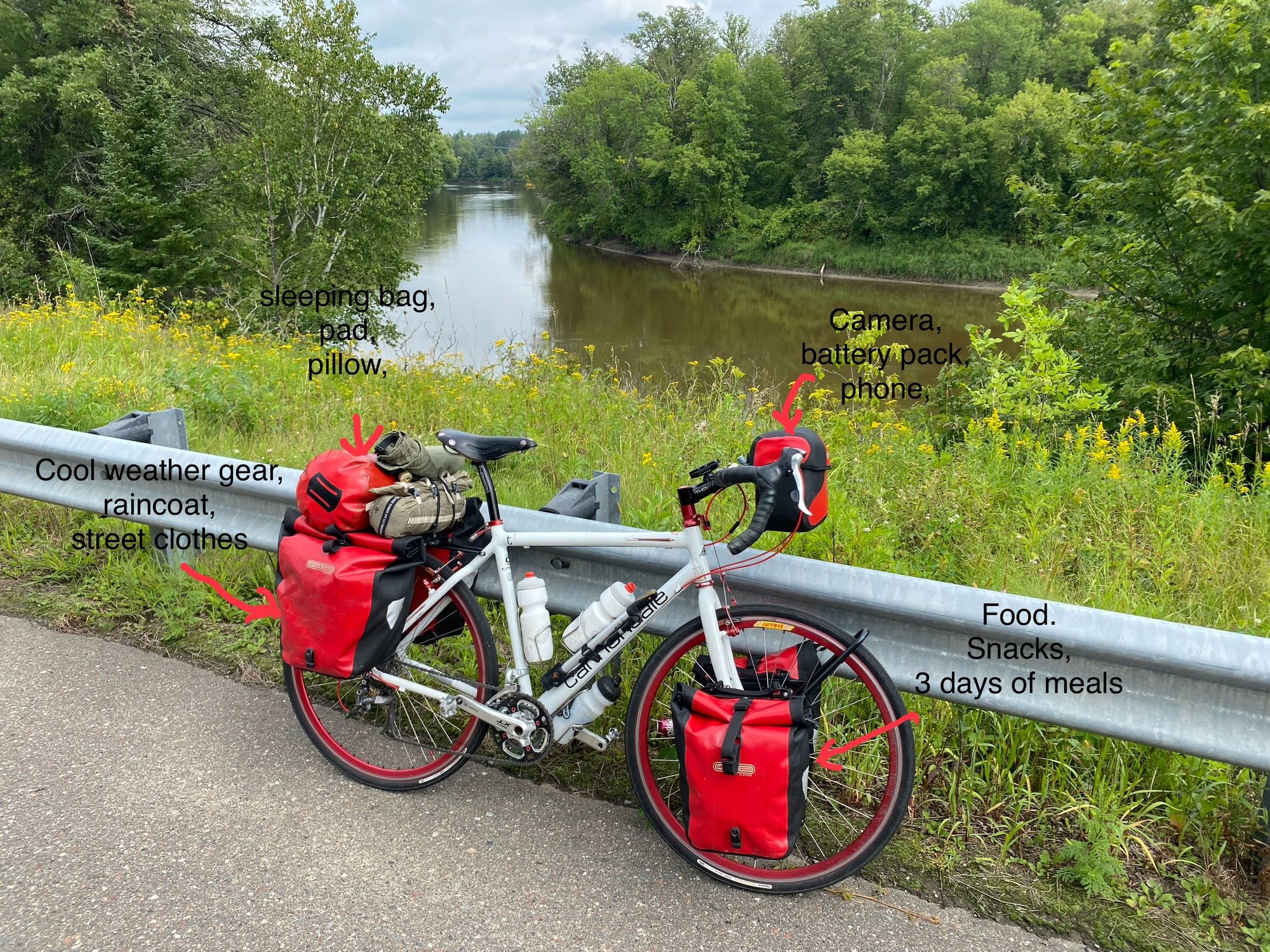
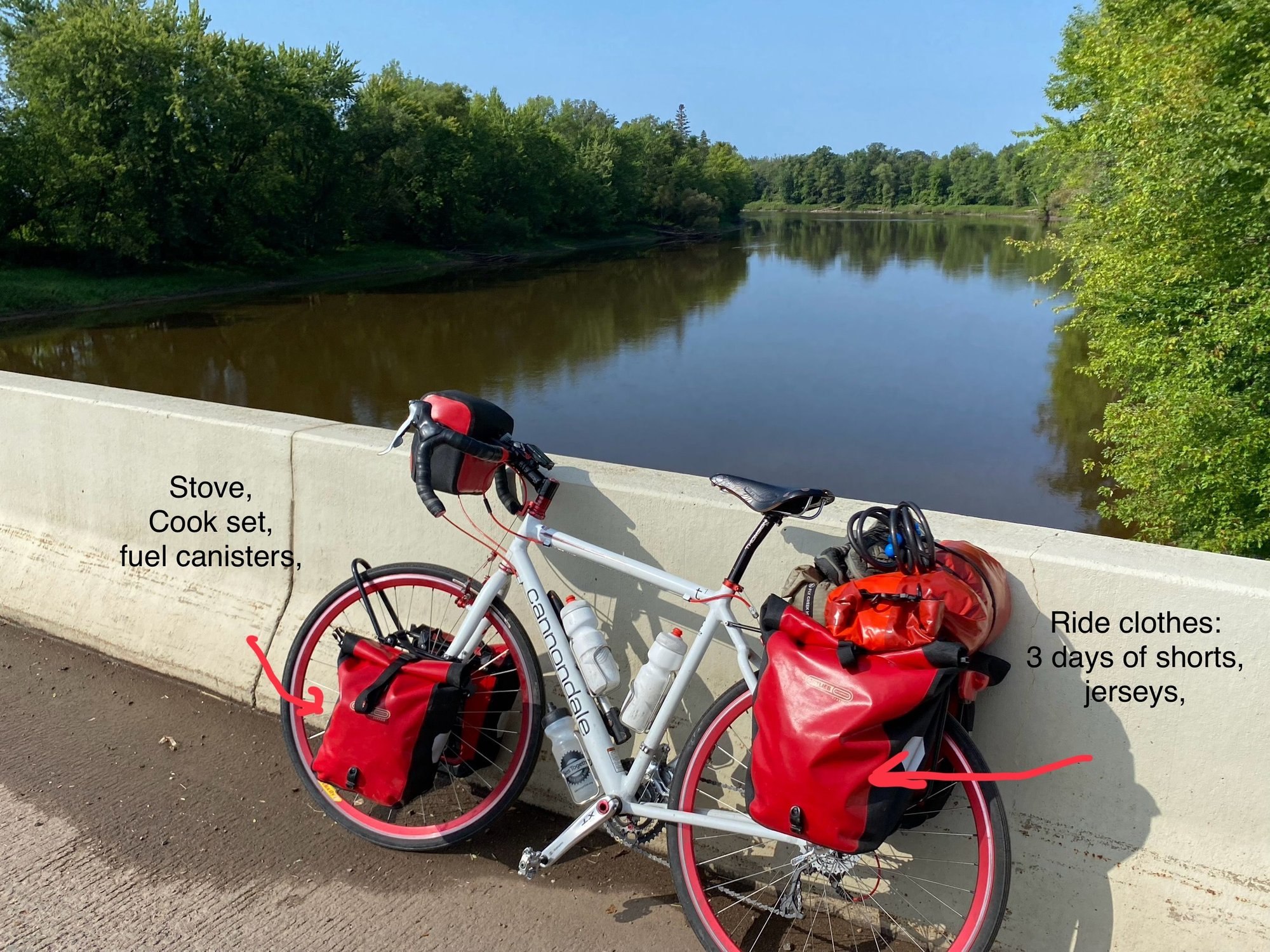
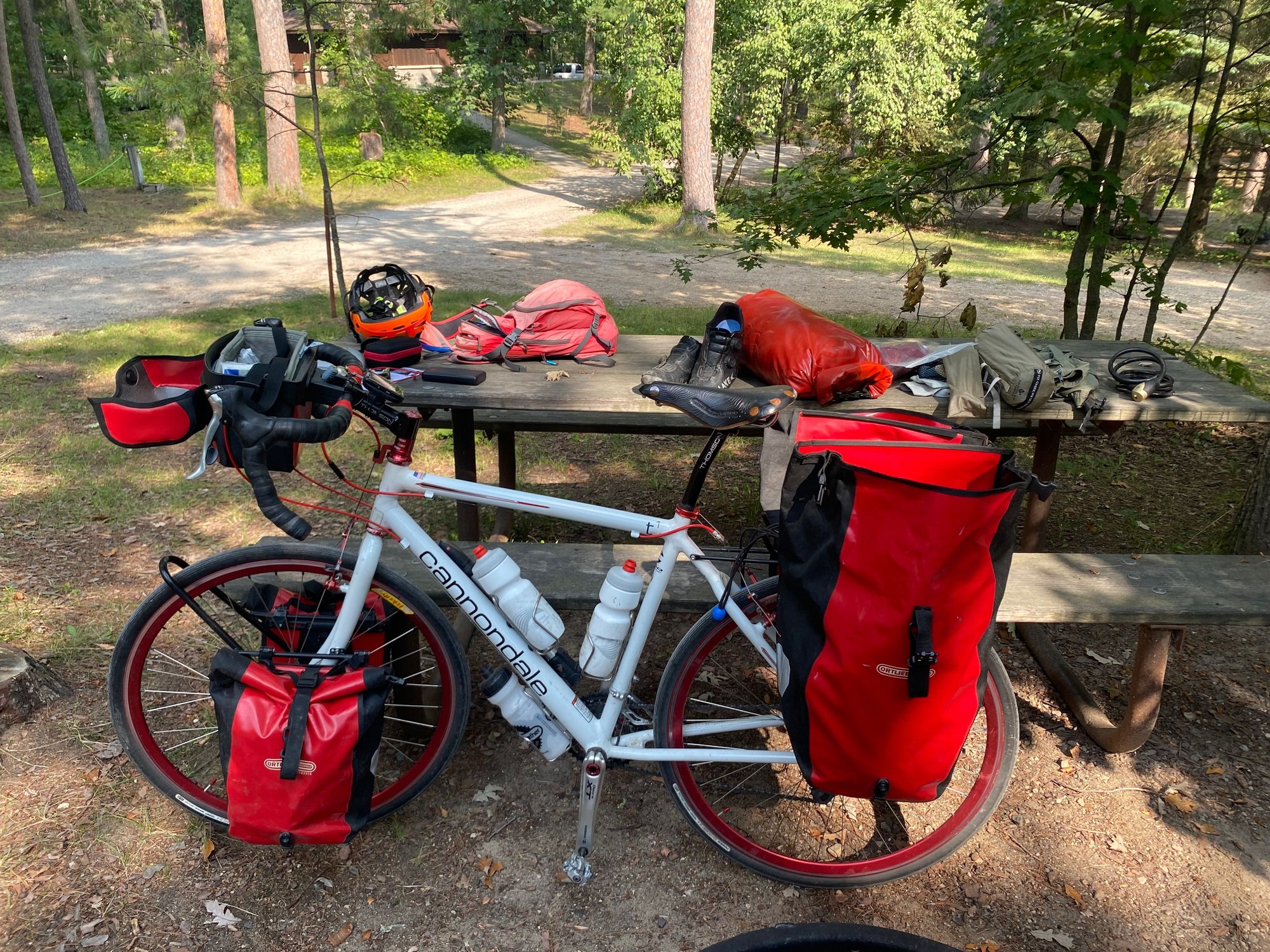
Tools, glasses, and 100 oz of water with as much ice as I can stuff in there go in the Camelbak (seen in the “exploded” version of my luggage below.
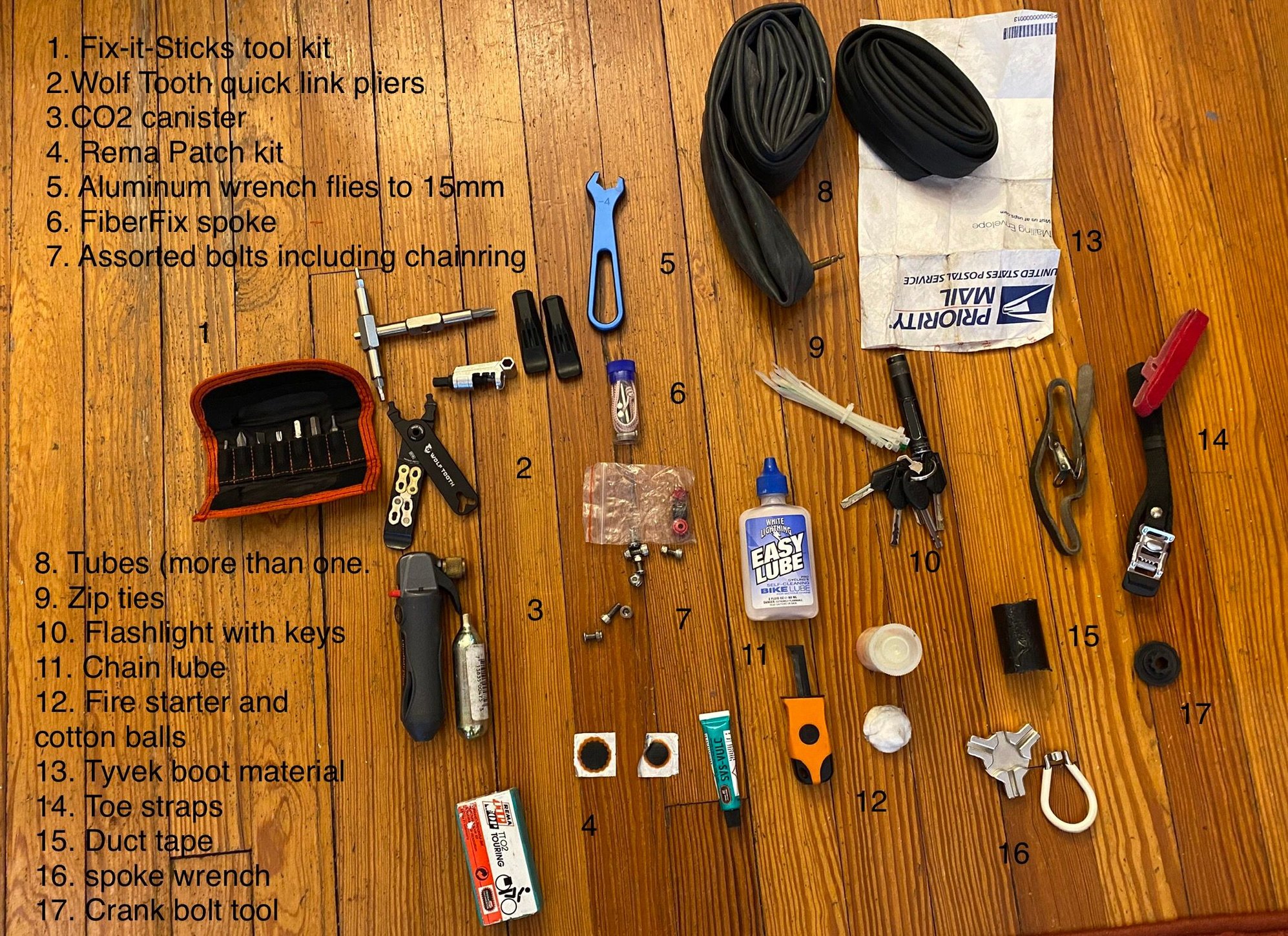
This is the list of tools I carry all the time. For road touring, I carry 3 tubes that are as large as I can stuff into the tire as I’ve found that smaller, lighter tubes tend to split on the inside of the tube (up against the rim). Blew on out on a short descent in Wisconsin once.
__________________
Stuart Black
Dreamin' of Bemidji Down the Mississippi (in part)
Plan Epsilon Around Lake Michigan in the era of Covid
Gold Fever Three days of dirt in Colorado
Pokin' around the Poconos A cold ride around Lake Erie
Dinosaurs in Colorado A mountain bike guide to the Purgatory Canyon dinosaur trackway
Solo Without Pie. The search for pie in the Midwest.
Picking the Scablands. Washington and Oregon, 2005. Pie and spiders on the Columbia River!
Stuart Black
Dreamin' of Bemidji Down the Mississippi (in part)
Plan Epsilon Around Lake Michigan in the era of Covid
Gold Fever Three days of dirt in Colorado
Pokin' around the Poconos A cold ride around Lake Erie
Dinosaurs in Colorado A mountain bike guide to the Purgatory Canyon dinosaur trackway
Solo Without Pie. The search for pie in the Midwest.
Picking the Scablands. Washington and Oregon, 2005. Pie and spiders on the Columbia River!
08-20-25 | 07:12 PM
#12

Senior Member
Joined: May 2010
Posts: 5,628
Likes: 2,500
From: Bastrop Texas
Bikes: Univega, Peu P6, Peu PR-10, Ted Williams, Peu UO-8, Peu UO-18 Mixte, Peu Dolomites
Its kinda funny in a way. All our family comes from Military and Paramedical Backgrounds. We are to say, Out Side People. Thing is all of us think nothing about asking or seeking new ways of packing out SHIP. Its a never ending task that evolves its own trail and error system. So if its a Pannier, or a Back Pack, or a Canoe Ruck, or a simple Go Bag, sure, lets check it out. There is always something to learn...
Surprisingly, most of the bags have more similarities then differences. Ha
Surprisingly, most of the bags have more similarities then differences. Ha
__________________
 No matter where you're at... There you are... Δf:=f(1/2)-f(-1/2)
08-20-25 | 07:39 PM
#13
Clark W. Griswold
Joined: Mar 2014
Posts: 18,402
Likes: 6,729
From: ,location, location
Bikes: Foundry Chilkoot Ti W/Ultegra Di2, Salsa Timberjack Ti, Cinelli Mash Work RandoCross Fun Time Machine, 1x9 XT Parts Hybrid, Co-Motion Cascadia, Specialized Langster, Phil Wood Apple VeloXS Frame (w/DA 7400), R+M Supercharger2 Rohloff, Habanero Ti 26
Eagle Creek PackIts are excellent those are what I use and have used for a while. I got some old ones that are slim and longer and have a mesh front that are really fantastic for clothes I want to air out or for smaller bags but I also have what is now the PackIt Isolate (which I forgot what they called them back when I got mine) They also made a dual sided one that is perfect for clean and dirty clothes.
I have probably had the Eagle Creek stuff for 14 years now and have used them a lot and they have been great and still work well after that time despite being ultralight, they are super well built and I have overloaded them before more than once.
Yes the disposable plastic bags could work and I might use them for small items (like soap and such) but durability and longevity and ease of use is key for me. I have had enough disposable bags fail at the slider or the "zip lock" or whatever it is called and that doesn't work for me for my heavily used stuff. Considering my Eagle Creek stuff is mostly 13 years old and the stuff I just got is probably older knowing who it came from (it did need some cleaning but it looks almost new) it was a fantastic purchase initially and I know they are well worth it.
I have probably had the Eagle Creek stuff for 14 years now and have used them a lot and they have been great and still work well after that time despite being ultralight, they are super well built and I have overloaded them before more than once.
Yes the disposable plastic bags could work and I might use them for small items (like soap and such) but durability and longevity and ease of use is key for me. I have had enough disposable bags fail at the slider or the "zip lock" or whatever it is called and that doesn't work for me for my heavily used stuff. Considering my Eagle Creek stuff is mostly 13 years old and the stuff I just got is probably older knowing who it came from (it did need some cleaning but it looks almost new) it was a fantastic purchase initially and I know they are well worth it.
08-21-25 | 12:02 AM
#14

Full Member
Joined: Jun 2022
Posts: 467
Likes: 399
From: San Diego, California USA
Bikes: 1974 Masi GC, 1982 Trek 728 (aka 720), 1992 Trek Multitrack 750 (Stolen), 2023 Bike Friday Diamond Llama (Fat Boi Edition)
In addition to what everyone above is using I have found the see thru mesh artists bags to be very handy.
They are sturdy and you can see the contents easily.
https://www.jerrysartarama.com/jerry...Ilb6-fzw-3Dqsg

see thru mesh artists bag
They come in various shapes and sizes.
They are great for organizing toiletries and kitchen stuff, tools.
They are sturdy and you can see the contents easily.
https://www.jerrysartarama.com/jerry...Ilb6-fzw-3Dqsg
see thru mesh artists bag
They come in various shapes and sizes.
They are great for organizing toiletries and kitchen stuff, tools.
08-21-25 | 12:06 AM
#15
Full Member
Joined: Jun 2022
Posts: 467
Likes: 399
From: San Diego, California USA
Bikes: 1974 Masi GC, 1982 Trek 728 (aka 720), 1992 Trek Multitrack 750 (Stolen), 2023 Bike Friday Diamond Llama (Fat Boi Edition)
 08-21-25 | 04:16 AM
#16
Senior Member
Joined: Aug 2010
Posts: 12,760
Likes: 2,114
From: Madison, WI
Bikes: 1961 Ideor, 1966 Perfekt 3 Speed AB Hub, 1994 Bridgestone MB-6, 2006 Airnimal Joey, 2009 Thorn Sherpa, 2013 Thorn Nomad MkII, 2015 VO Pass Hunter, 2017 Lynskey Backroad, 2017 Raleigh Gran Prix, 1980s Bianchi Mixte on a trainer. Others are now gone.
I picked up some Ortlieb BackRoller Core Panniers, and they are great, but the one downside is once you get moving, everything in them gets all jumbled and it's hard to find what I need in them, especially small things. I see Ortlieb makes an organizer for them, but it's got a laptop sleeve and it looks like it's more for bike commuters. They also make packing cubes, but it seems those are really only designed for clothes. I'm looking for a way to organize all my bike touring odds and ends so I can find what I need easily, any suggestions are highly appreciated!
For small items that I may want to access quickly, I like to have a handlebar bag that has a quick disconnect that allows me to bring it into grocery stores, restaurants, etc. It has my valuables in it. I also have all those small items in it that I might want to grab at any time while riding the bike, sunscreen, rain cover for my leather saddle, chain lube, camera, camera batteries, granola bar, etc., etc. That is full of small things. And at one time when I got frustrated with how the small item I was looking for was always in the bottom, like lip balm or toothbrush, I put a small cardboard box in there to hold some of those small things in a more vertical orientation. Later replaced the cardboard box with a piece of Coroplast, which is white, you can see the Coroplast in the photo.

In the photo below, you can see my yellow Front Roller panniers, on the right side I have my rain jacket (red color) strapped on top of it using that strap that goes over the top of the pannier. I often strap my rain pants on top of a front pannier too, but did not in this case because it was too hot out to wear rain pants if it rained. Rain gear is one of those things that I like to have ready access to. The straps that go over the tops of the Ortlieb Roller panniers are not very strong, so do not tug on that strap too forcefully. But get it tight enough so that whatever is strapped on top won't fall off.

My handlebar bag is larger than most people use, and it has been out of production for maybe a decade, I have made a few modifications to it. The quick disconnect allows it to be removed or installed in seconds. Putting the shoulder strap on takes several more seconds.
08-21-25 | 06:46 AM
#17
Senior Member
Joined: Jul 2010
Posts: 13,921
Likes: 1,243
From: Montreal Canada
I picked up some Ortlieb BackRoller Core Panniers, and they are great, but the one downside is once you get moving, everything in them gets all jumbled and it's hard to find what I need in them, especially small things. I see Ortlieb makes an organizer for them, but it's got a laptop sleeve and it looks like it's more for bike commuters. They also make packing cubes, but it seems those are really only designed for clothes. I'm looking for a way to organize all my bike touring odds and ends so I can find what I need easily, any suggestions are highly appreciated!
You being new to this, you'll find that doing some test rides or overnighters is the best for you to figure out a system that is logical and works for you--and you start to remember what is where by repetition.
Like others here, I generally have a system that really hasnt changed that much over the decades bike touring.
rain gear in the same pannier or spot - easily accessible an advantage (not underneath other stuff)
clothes you might put on during day on top of clothes pannier, easily reached.
I too use coloured mesh sacks, with a blue one that is now my "keep warm or whatever stuff" -- like a beanie cap, neckup warmer thing, arm sleeves, leg warmers, gloves--big advantage with using a easily seen separate coloured bag is that these smaller things do not get lost in the clothes and stuff in my pannier--so you get things fast and you don't misplace things , either when riding or in the tent.
bigger clothes like spare bike shorts, stuff to sleep in etc, go at bottom of pannier, cuz you don't need to access them when riding, only in tent or at camp after setting up tent
heavier stuff at bottom on pannier too
all in all, yes get ideas from folks, but its pretty much using common sense a lot.
plus we tend not to have that much stuff anyway, so with some practice, you'll get used to it and figure out a good efficient system.
have fun
08-21-25 | 07:52 AM
#19

Rider. Wanderer. Creator.
Joined: May 2007
Posts: 2,996
Likes: 4,288
From: New Jersey
Bikes: Bike Friday All-Packa, Zizzo Liberte, Ozark Trail G.1 Explorer
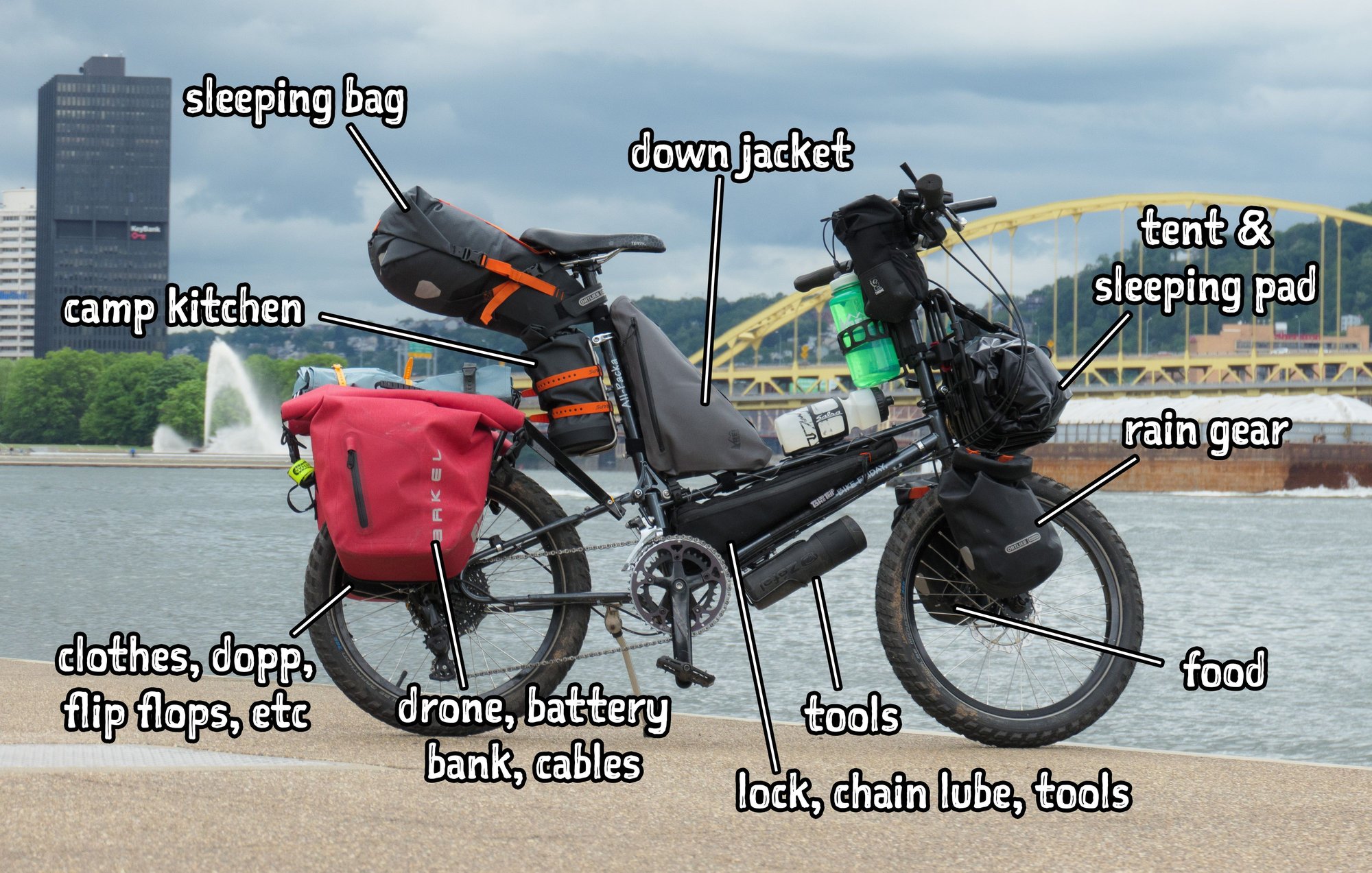
One of the benefits of bikepacking gear is that the bags are smaller and can be dedicated for a single purpose. After a couple of days on the road, it's easy to remember where everything is.
__________________
Rider. Wanderer. Creator.
JohnMFlores.com | YouTube: JohnMFlores
Insta: JohnMichaelFlores | Substack: https://followingwyman.substack.com/
Rider. Wanderer. Creator.
JohnMFlores.com | YouTube: JohnMFlores
Insta: JohnMichaelFlores | Substack: https://followingwyman.substack.com/
08-21-25 | 07:28 PM
#20
Senior Member
Joined: Dec 2010
Posts: 9,690
Likes: 2,610
From: northern Deep South
Bikes: Fuji Touring, Novara Randonee
In a big bag like the Back Rollers, I think the first thing is to stick smaller things into larger things -- bags, stuff sacks, packing cubes, whatever -- and have some sort of map (mental or otherwise) to tell you where things are. A couple of large bags (bags to hold carry-out or sleeping bag storage sack) are good for clean and dirty clothes. I found some heavy-duty tool bags at Home Depot, about 4x10"; the orange one carries electrical/electronic cords, green one tools, etc. It's a whole lot easier to find the orange sack, and then find a couple AA batteries in that sack, than to look for those in the monster Ortlieb sack.
Like Tourist, I find a bar bag incredibly useful for finding wallet, phone, and camera, and for getting all those "valuables" off the bike quickly when going into a store, bathroom, or restaurant.
Like Tourist, I find a bar bag incredibly useful for finding wallet, phone, and camera, and for getting all those "valuables" off the bike quickly when going into a store, bathroom, or restaurant.
08-21-25 | 11:09 PM
#21

Senior Member
Joined: Mar 2009
Posts: 6,638
Likes: 1,070
From: Oregon
Left to Right: compressible pillow (compression sack), tent and rainfly (cs), Thermarest pad, and sleeping bag (cs). The tent poles and ground cloth are also carried in my Ortlieb Rack Pack. Depending on the sleeping bag I use, the weight is 10 lbs. or less.

I also use different colored stuff sacks, Ortlieb Cubes in one of my rear panniers, and small Eagle Creek zip pouches for electronic cords, chargers, and toiletries.
Geared up for a 3-month ride, which included a little more than normal, like some "good clothes".

I also use different colored stuff sacks, Ortlieb Cubes in one of my rear panniers, and small Eagle Creek zip pouches for electronic cords, chargers, and toiletries.
Geared up for a 3-month ride, which included a little more than normal, like some "good clothes".
Last edited by Doug64; 08-22-25 at 04:24 PM.
08-22-25 | 12:40 AM
#22
Highly Enriched Driftium
Joined: Apr 2017
Posts: 6,915
Likes: 2,257
The above have the same benefit for backpacking with a simple pack with one large compartment, canoe bags, or for sea kayaking, having things in smaller bags to easily put in the cargo compartments with small hatch openings where a big bag won't fit.
08-22-25 | 04:46 PM
#23
Senior Member
Joined: Aug 2019
Posts: 1,707
Likes: 879
From: Vermont
Bikes: Bruce Gordon Rock and Road
If you go the stuff sack route, and have old ones, you can save a few grams with modern fabrics. I have a waterproof one for my down jacket. Most of the year the sack lives in a pocket of the jacket. On tour, the jacket stays dry in the sack, ready to be cozy on a cool night.
08-23-25 | 07:54 AM
#24
Senior Member
Joined: Aug 2010
Posts: 12,760
Likes: 2,114
From: Madison, WI
Bikes: 1961 Ideor, 1966 Perfekt 3 Speed AB Hub, 1994 Bridgestone MB-6, 2006 Airnimal Joey, 2009 Thorn Sherpa, 2013 Thorn Nomad MkII, 2015 VO Pass Hunter, 2017 Lynskey Backroad, 2017 Raleigh Gran Prix, 1980s Bianchi Mixte on a trainer. Others are now gone.
If you go the stuff sack route, and have old ones, you can save a few grams with modern fabrics. I have a waterproof one for my down jacket. Most of the year the sack lives in a pocket of the jacket. On tour, the jacket stays dry in the sack, ready to be cozy on a cool night.
But the stuff sack is not waterproof, the vest is usually stored in a waterproof compression sack with down sleeping bag instead.
08-23-25 | 01:12 PM
#25
Senior Member
Joined: Mar 2009
Posts: 6,638
Likes: 1,070
From: Oregon
A few years back my inflatable pillow became dysfunctional. Since then, an important criteria for the stuff sack that I use for my down vest is that the stuff sack with vest in it is the perfect size and shape to function as a pillow that fits well inside my sleeping bag hood.
But the stuff sack is not waterproof, the vest is usually stored in a waterproof compression sack with down sleeping bag instead.
But the stuff sack is not waterproof, the vest is usually stored in a waterproof compression sack with down sleeping bag instead.
My puff jacket in a sil-nylon stuff sack.

My wife and our daughters use the same pillow, and pack their Rack Packs about the same. They all are big fans of cubes and smaller items are packed in various size Eagle Creek pouches. The girls carry their tent, When the daughters tour on their own, they also carry their kitchen and cooking gear. They manage to only use their rear panniers, and a Rack Pack. They are experienced tourers.

Last edited by Doug64; 08-25-25 at 03:26 PM.