


28c VS 32c for loaded touring


 02-14-15 | 09:19 AM
#27

Thread Starter
Senior Member
Joined: Dec 2014
Posts: 793
Likes: 3
From: Australia
Bikes: A few
the key issue here is that the wider the tire, the lower the pressures can be--which can be a major factor in comfort for the rider. Tire construction can be a factor too--two tires the same size can feel very diff, if one is super stiff, stiff thick sidewalls of the tire etc it will have a stiffer ride at the same pressure as another tire that is more supple (on that note, the Schwalbe supremes are a more supple tire)
but back to pressures, because I commute a lot and do the same route over and over, and because Im a bike nerd and find things to amuse myself, I will try diff pressures to see how the bike feels. Going over the same route that is 11-13km long means I have time to feel the diff. You'd be surprised how a tire you put at lets say 110psi will feel quite a bit more comfortable at 100, or 100vs90 or whatever (this example is my 28 slicks)
Same with my 1.5 inch tires, go from 65 to 55, or 60 to 50 (or whatever pressure) and you really feel an improvement in comfort.
so basically, a wider tire allows you to run lower pressures than thinner tires, and so the diff between a 32mm and 35mm may be slight, but it will be there.
*also, wider tires at lower pressures than narrower tires will be a bit easier on your spokes/wheels.
but back to pressures, because I commute a lot and do the same route over and over, and because Im a bike nerd and find things to amuse myself, I will try diff pressures to see how the bike feels. Going over the same route that is 11-13km long means I have time to feel the diff. You'd be surprised how a tire you put at lets say 110psi will feel quite a bit more comfortable at 100, or 100vs90 or whatever (this example is my 28 slicks)
Same with my 1.5 inch tires, go from 65 to 55, or 60 to 50 (or whatever pressure) and you really feel an improvement in comfort.
so basically, a wider tire allows you to run lower pressures than thinner tires, and so the diff between a 32mm and 35mm may be slight, but it will be there.
*also, wider tires at lower pressures than narrower tires will be a bit easier on your spokes/wheels.
02-14-15 | 12:23 PM
#28

Senior Member

Joined: Mar 2009
Posts: 6,637
Likes: 1,070
From: Oregon
Currently I have 37 Marathon Tour Plus tires on my bike, I understand that the side walls on these are meant to be quite stiff or so I've been told, I run them at max pressure 85 psi from memory, the ride does feel quite harsh, when I switch to the 32 Marathon Supremes (at 95psi) will It be a less harsh ride since they have a "supple" sidewall? after that spoke and wheel comment im starting to think mabye I should go with the 37 Marathon Supremes as I'm not planning to to carry spokes with me at this stage.
Here is a good discussion on optimum tire pressures:
https://www.bccclub.org/documents/Tireinflation.pdf
02-14-15 | 12:36 PM
#29

Senior Member
Joined: Dec 2014
Posts: 101
Likes: 1
From: NW suburb of MPLS MN
Bikes: 2012 Specialized Roubaix SL3, Specialized Tricross Comp, Specialized Expedition, Borus X7 Fat Bike
Go wider for comfort. When you are talking touring with loaded bikes, saving a few hundred grams on tires is not worth the comfort factor of the wider tires IMO.
02-14-15 | 04:27 PM
#30

Senior Member
Joined: Aug 2012
Posts: 2,828
Likes: 2
From: West Georgia
Bikes: K2 Mod 5.0 Roadie, Fuji Commuter
Having a starting point to adjust from makes life easier, whether using a fit calculator for seat height or in this case a tire pressure calculator. The only thing almost certain about using the max inflation spec on the sidewall is that you will experience a harsh ride, unless by chance your weight/tire combo happens to fit at the max range.
This is a widely recommended calculator:
Bicycle tire pressure calculator
Use the middle one....the one with the weight of the fully dressed bike and rider. You can input your weights, tire width and it has a few different ft/rr pressure drop rates.
It will be a much better starting point for a comfortable ride than the sidewall.
This is a widely recommended calculator:
Bicycle tire pressure calculator
Use the middle one....the one with the weight of the fully dressed bike and rider. You can input your weights, tire width and it has a few different ft/rr pressure drop rates.
It will be a much better starting point for a comfortable ride than the sidewall.
02-14-15 | 05:11 PM
#31
Thread Starter
Senior Member
Joined: Dec 2014
Posts: 793
Likes: 3
From: Australia
Bikes: A few
Having a starting point to adjust from makes life easier, whether using a fit calculator for seat height or in this case a tire pressure calculator. The only thing almost certain about using the max inflation spec on the sidewall is that you will experience a harsh ride, unless by chance your weight/tire combo happens to fit at the max range.
This is a widely recommended calculator:
Bicycle tire pressure calculator
Use the middle one....the one with the weight of the fully dressed bike and rider. You can input your weights, tire width and it has a few different ft/rr pressure drop rates.
It will be a much better starting point for a comfortable ride than the sidewall.
This is a widely recommended calculator:
Bicycle tire pressure calculator
Use the middle one....the one with the weight of the fully dressed bike and rider. You can input your weights, tire width and it has a few different ft/rr pressure drop rates.
It will be a much better starting point for a comfortable ride than the sidewall.
02-14-15 | 05:28 PM
#32

Senior Member
Joined: May 2014
Posts: 1,604
Likes: 3
From: Rural Minnesota
When it comes to any form of long distance riding, I'm a fan of big tires. I have had 28s on my all-rounder but now have 40s. Lost very little average speed over 50+ mile rides and gained a huge amount of comfort on rough surfaces and minor road imperfections. They handle very nicely in construction zones or other stretches of unplanned unpaved road. I even use them for some gravel grinding.
02-14-15 | 07:06 PM
#33
Senior Member
Joined: Jul 2010
Posts: 13,912
Likes: 1,242
From: Montreal Canada
I have a pretty good feel for tire feel and performance, and going that low up front would feel too loosey goosey around fast corners, and the tire would move around too much for my liking---not even getting into the issue of pinch flats.
I figure you can use these as indicators,or a bit of a starting point, but use your common sense too and listen to what the tire is tellign you. I like to go around corners fast and would never run my front that low.
02-15-15 | 07:54 PM
#34
Macro Geek

Joined: Nov 2003
Posts: 1,362
Likes: 12
From: Toronto, Ontario
Bikes: True North tourer (www.truenorthcycles.com), 2004; Miyata 1000, 1985
I have toured on just about everything between 23 and 32 mm tires. I currently ride on 28 mm tires because the bike store was out of 32's when I last changed them.
I feel more stable on the wider tires. But the main reason I prefer them is that I get fewer flats. In seven years of riding 32 mm tires, I had exactly zero flats. In four or five seasons on 28 mm tires, one or two flats. During the many years I chose 23 and 25 mm tires, I usually had one flat per loaded tour.
I feel more stable on the wider tires. But the main reason I prefer them is that I get fewer flats. In seven years of riding 32 mm tires, I had exactly zero flats. In four or five seasons on 28 mm tires, one or two flats. During the many years I chose 23 and 25 mm tires, I usually had one flat per loaded tour.
 02-16-15 | 02:55 PM
#36

Senior Member
Joined: Jun 2008
Posts: 2,468
Likes: 340
From: Pittsburgh, PA
Bikes: Co-Motion Cappuccino Tandem,'88 Bob Jackson Touring, Co-Motion Cascadia Touring, Open U.P., Ritchie Titanium Breakaway, Frances Cycles SmallHaul cargo bike. Those are the permanent ones; others wander in and out of the stable occasionally as well.
I agree with 32s, but suggest the Vittoria Hypers. I have run the paselas before and they are a great tire, but flat out too often for touring. The Vittirias have nearly as good of a ride and are much more durable. The Marathons are like riding in mud compared to the Vittorias or Panaracers (though I know a lot of people seem to like riding in mud!)
02-16-15 | 04:04 PM
#37

aka Tom Reingold


Joined: Jan 2009
Posts: 44,231
Likes: 6,489
From: New York, NY, and High Falls, NY, USA
Bikes: 1962 Rudge Sports, 1971 Raleigh Super Course, 1971 Raleigh Pro Track, 1974 Raleigh International, 1975 Viscount Fixie, 1982 McLean, 1996 Lemond (Ti), 2002 Burley Zydeco tandem
I hear the Vittoria Hypers ride even better than Paselas. I might be able to give my verdict on that soon.
__________________
Tom Reingold, tom@noglider.com
New York City and High Falls, NY
Blogs: The Experienced Cyclist; noglider's ride blog
“When man invented the bicycle he reached the peak of his attainments.” — Elizabeth West, US author
Please email me rather than PM'ing me. Thanks.
Tom Reingold, tom@noglider.com
New York City and High Falls, NY
Blogs: The Experienced Cyclist; noglider's ride blog
“When man invented the bicycle he reached the peak of his attainments.” — Elizabeth West, US author
Please email me rather than PM'ing me. Thanks.
02-16-15 | 06:07 PM
#38
Senior Member
Joined: Aug 2014
Posts: 341
Likes: 0
From: WA
+1. If you're not plan on off-roading, I would purchase a tire with low rolling resistance as well. Recently I purchased Panaracer Pasela PT 35c- folding variety. They are fairly smooth, fairly high volume tires. They seem light, fast, supple, and really, really comfortable. Best of all they don't break the bank so you can afford an extra one to take with you.
02-16-15 | 08:16 PM
#39
Junior Member

Joined: Jan 2013
Posts: 112
Likes: 1
Here's a great article on tire pressure. It actually quanifies the optimal pressure for cycling efficiency at different tire widths.
https://www.bikequarterly.com/images/TireDrop.pdf
https://www.bikequarterly.com/images/TireDrop.pdf
02-17-15 | 10:43 AM
#40

aka Phil Jungels
Joined: Apr 2005
Posts: 8,234
Likes: 91
From: North Aurora, IL
Bikes: 08 Specialized Crosstrail Sport, 05 Sirrus Comp
Here's a great article on tire pressure. It actually quanifies the optimal pressure for cycling efficiency at different tire widths.
https://www.bikequarterly.com/images/TireDrop.pdf
https://www.bikequarterly.com/images/TireDrop.pdf
Experiment and pick what you want, or develop your own.
If I rode with Berto's charted pressures, I'd be fixing snakebite flats every day, and my tires roll much better at significantly higher pressures..
MHO
02-17-15 | 11:59 AM
#41
Senior Member
Joined: Jul 2010
Posts: 13,912
Likes: 1,242
From: Montreal Canada
02-17-15 | 12:22 PM
#42
Senior Member
Joined: Mar 2009
Posts: 6,637
Likes: 1,070
From: Oregon
I agree with both you guys. The first time I tried lowering my pressure, and not near Betro's recommendations, I got a pinch flat the first day out. Depending on the tire, I do tend to ride 10-15 so psi lower than the max.
04-06-15 | 05:37 AM
#43
Thread Starter
Senior Member
Joined: Dec 2014
Posts: 793
Likes: 3
From: Australia
Bikes: A few
With this weight does the general consensus of 32C still stand?
Last edited by azza_333; 04-06-15 at 06:06 AM. Reason: edit
04-06-15 | 06:01 AM
#44

Senior Member
Joined: Aug 2006
Posts: 12,039
Likes: 828
From: Tallahassee, FL
Bikes: Several
Yes 32mm is a fairly typical size for that load. Folks go narrower and wider, but 32mm is probably the most common size I saw folks using on tour with similar loads. I go narrower these days myself, but when I packed a bit heavier I thought 32mm was the sweet spot for me.
__________________
Pete in Tallahassee
Check out my profile, articles, and trip journals at:
https:/www.crazyguyonabike.com/staehpj1
Pete in Tallahassee
Check out my profile, articles, and trip journals at:
https:/www.crazyguyonabike.com/staehpj1
04-06-15 | 06:50 AM
#45
Senior Member

Joined: Aug 2010
Posts: 12,748
Likes: 2,111
From: Madison, WI
Bikes: 1961 Ideor, 1966 Perfekt 3 Speed AB Hub, 1994 Bridgestone MB-6, 2006 Airnimal Joey, 2009 Thorn Sherpa, 2013 Thorn Nomad MkII, 2015 VO Pass Hunter, 2017 Lynskey Backroad, 2017 Raleigh Gran Prix, 1980s Bianchi Mixte on a trainer. Others are now gone.
Your total weight of rider and bike and gear is lighter than my weight and unladen bike. Thus, you have many options.
04-06-15 | 06:55 AM
#46
Banned
Joined: Aug 2014
Posts: 1,226
Likes: 3
Wider tires seem to wear longer.
I used to tour on 32mm or 35mm. 28mm seemed to wear out too quick under 260 lbs total load but then again, the tire was a different model. A wide, comfy, low rolling resistence set of tires is what I would select.
I used to tour on 32mm or 35mm. 28mm seemed to wear out too quick under 260 lbs total load but then again, the tire was a different model. A wide, comfy, low rolling resistence set of tires is what I would select.
04-06-15 | 07:46 AM
#47
Senior Member
Joined: Sep 2011
Posts: 626
Likes: 0
I use 35mm-38mm for touring. Comfort is king for me and I also like the increased safety, reduced flats, and longer wear associated with wider tires.
See Jan Heine's (Bicycle Quarterly) case for wider tires below. He discusses both he advantages and disadvantages...
https://janheine.wordpress.com/2012/...of-wide-tires/
See Jan Heine's (Bicycle Quarterly) case for wider tires below. He discusses both he advantages and disadvantages...
https://janheine.wordpress.com/2012/...of-wide-tires/
04-06-15 | 05:28 PM
#48

Senior Member
Joined: Oct 2010
Posts: 589
Likes: 1
From: Utah
Bikes: Thorn Nomad Mk2, 1996 Trek 520, Workcycles Transport, Brompton
Here is my table of recommended tire pressures: Interdependent Science: Bicycle Tire Pressure
There are so many factors... rim width, road conditions, etc. Any formula like this is just a starting point for experiments and experience.
I'm riding 47mm Marathon Racers these days:
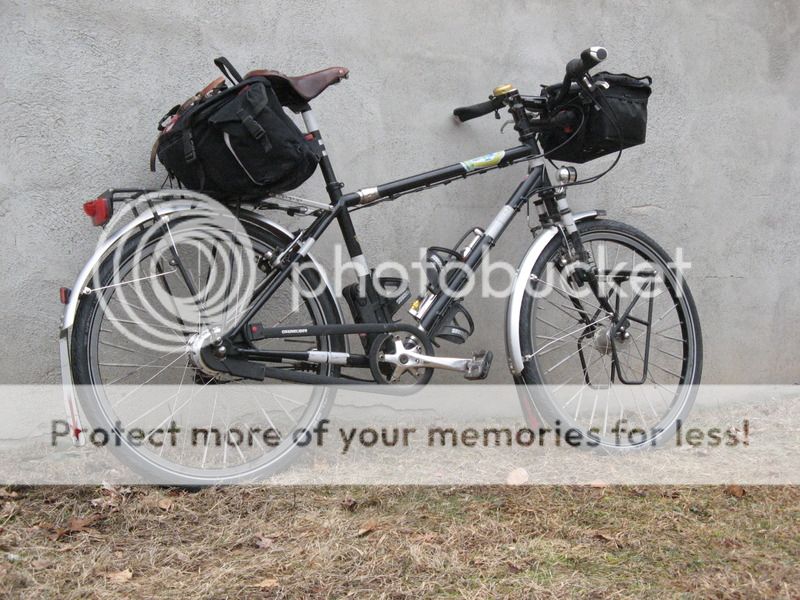
There are so many factors... rim width, road conditions, etc. Any formula like this is just a starting point for experiments and experience.
I'm riding 47mm Marathon Racers these days:
04-06-15 | 07:01 PM
#49
Senior Member
Joined: Sep 2008
Posts: 5,300
Likes: 115
A light tube won't make a perceptible difference once you put on a touring load. The Supreme is a nice rolling tire. I never had a flat with one riding through glass. it's a fine front tire with a heavier rear tire for long wear or as a rear tire with a Panaracer T-serv as a front tire for light riding.
04-06-15 | 07:15 PM
#50
Senior Member
Joined: Sep 2008
Posts: 5,300
Likes: 115
Yes, 32mm is good. You must have lost a lot of weight in the last couple months! With your initial weight of 250lbs 35mm could be worth considering. 28mm is doable but there would be no benefit, higher wear, higher chance of pinch flats, harsher ride. You won't climb faster, descend faster or maintain a higher average speed.