


Alternating Hard and Easy Weeks
 05-13-23 | 02:57 PM
#1

Thread Starter
climber has-been


Joined: Dec 2004
Posts: 9,169
Likes: 6,061
From: Palo Alto, CA
Bikes: Scott Addict RC Pro & R1, Felt Z1
Alternating Hard and Easy Weeks
Anyone have an opinion on alternating between hard and easy weeks?
Due to weather and injury, it turns out I've been alternating hard and easy for a few weeks now. I don't know if it's helpful or not, but my "Efficiency Factor" in trainingpeaks has gone up.
I vaguely remember scanning a study that tested this, and I think the alternating group had better results.
Due to weather and injury, it turns out I've been alternating hard and easy for a few weeks now. I don't know if it's helpful or not, but my "Efficiency Factor" in trainingpeaks has gone up.
I vaguely remember scanning a study that tested this, and I think the alternating group had better results.
__________________
Ride, Rest, Repeat. ROUVY: terrymorse

Ride, Rest, Repeat. ROUVY: terrymorse
 05-13-23 | 05:42 PM
#2
Perceptual Dullard

Joined: Sep 2009
Posts: 2,921
Likes: 1,757
Anyone have an opinion on alternating between hard and easy weeks?
Due to weather and injury, it turns out I've been alternating hard and easy for a few weeks now. I don't know if it's helpful or not, but my "Efficiency Factor" in trainingpeaks has gone up.
I vaguely remember scanning a study that tested this, and I think the alternating group had better results.
Due to weather and injury, it turns out I've been alternating hard and easy for a few weeks now. I don't know if it's helpful or not, but my "Efficiency Factor" in trainingpeaks has gone up.
I vaguely remember scanning a study that tested this, and I think the alternating group had better results.
I think it's easy to distinguish hard from easy, but hard to know what the training consequences are.
05-13-23 | 06:13 PM
#3
Thread Starter
climber has-been
Joined: Dec 2004
Posts: 9,169
Likes: 6,061
From: Palo Alto, CA
Bikes: Scott Addict RC Pro & R1, Felt Z1
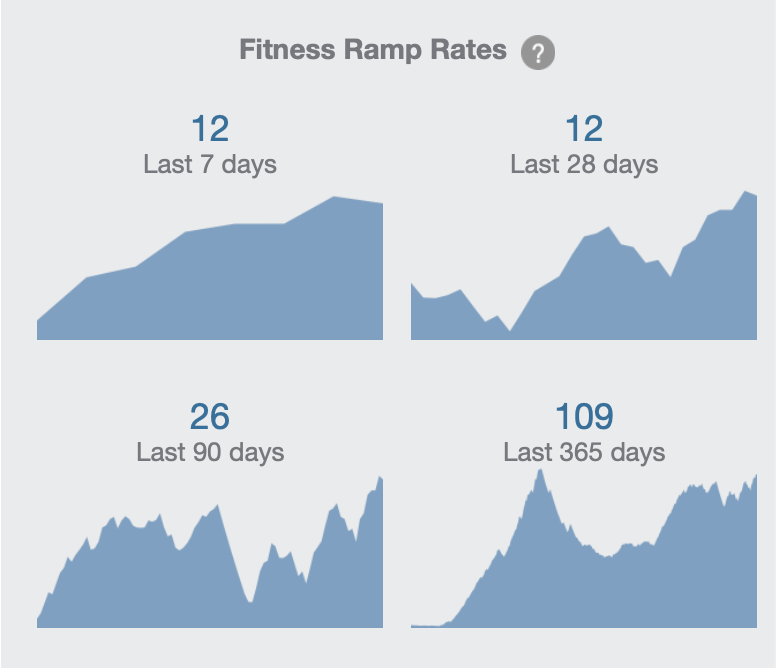
My 7-day ramp rate is currently 12, but it has been up and down for a while now.
__________________
Ride, Rest, Repeat. ROUVY: terrymorse
Ride, Rest, Repeat. ROUVY: terrymorse
05-13-23 | 08:05 PM
#4
Perceptual Dullard
Joined: Sep 2009
Posts: 2,921
Likes: 1,757
I'm sorry, I don't use TP. Does a ramp rate of 12 over a week mean, e.g., that your CTL was X one week ago and it's X+7 today? Does a ramp rate of 109 over 365 days mean that you were doing nothing a year ago and today your CTL is 109? (That is, is RR calculated as the difference between your CTL today and your CTL X days in the past, so to get the daily average rate take that difference and adjust it for the elapsed time?)
This sort of reminds me of interval training on a macro scale: are you better off doing intervals or steady ("sweetspot"-ish) training?
This sort of reminds me of interval training on a macro scale: are you better off doing intervals or steady ("sweetspot"-ish) training?
05-13-23 | 10:27 PM
#5
Thread Starter
climber has-been
Joined: Dec 2004
Posts: 9,169
Likes: 6,061
From: Palo Alto, CA
Bikes: Scott Addict RC Pro & R1, Felt Z1
Saturday, 5/6: 100
Friday, 5/12: 112
Ramp Rate: 12
Does a ramp rate of 109 over 365 days mean that you were doing nothing a year ago and today your CTL is 109? (That is, is RR calculated as the difference between your CTL today and your CTL X days in the past, so to get the daily average rate take that difference and adjust it for the elapsed time?)
__________________
Ride, Rest, Repeat. ROUVY: terrymorse
Ride, Rest, Repeat. ROUVY: terrymorse
05-13-23 | 10:54 PM
#6
Thread Starter
climber has-been
Joined: Dec 2004
Posts: 9,169
Likes: 6,061
From: Palo Alto, CA
Bikes: Scott Addict RC Pro & R1, Felt Z1
I found the paper!
While this study is not precisely "alternating hard and easy weeks", this 4-week program preloaded the first week with 5 days of high intensity (block periodization), followed by 3 weeks with just one high intensity day. And they report power increases over the traditional "two intense days per week" training program:
...The present study suggests that block periodization of training provides superior adaptations to traditional organization during a 4-week endurance training period, despite similar training volume and intensity.
Ronnestad et al, 2014
While this study is not precisely "alternating hard and easy weeks", this 4-week program preloaded the first week with 5 days of high intensity (block periodization), followed by 3 weeks with just one high intensity day. And they report power increases over the traditional "two intense days per week" training program:
Block periodization of high-intensity aerobic intervals provides superior training effects in trained cyclists
...The present study suggests that block periodization of training provides superior adaptations to traditional organization during a 4-week endurance training period, despite similar training volume and intensity.
Ronnestad et al, 2014
__________________
Ride, Rest, Repeat. ROUVY: terrymorse
Ride, Rest, Repeat. ROUVY: terrymorse
05-14-23 | 07:49 AM
#8
Senior Member
Joined: Apr 2021
Posts: 4,081
Likes: 2,104
After more reading, the increase in VO2 max isn't as compelling as power increase at 2 mmol lactate, which looks really good.
https://www.tandfonline.com/doi/full.../OAJSM.S180408
https://www.tandfonline.com/doi/full.../OAJSM.S180408
05-14-23 | 10:52 AM
#9
Perceptual Dullard
Joined: Sep 2009
Posts: 2,921
Likes: 1,757
I think a ramp rate of 12 means CTL was X a week ago, and X+12 yesterday. CTL:
Saturday, 5/6: 100
Friday, 5/12: 112
Ramp Rate: 12
My CTL on 5/14/2022 was 2, and today it is 111. And as you suspected, it appears that RR is simply yesterday's CTL minus the CTL from X days ago.
Saturday, 5/6: 100
Friday, 5/12: 112
Ramp Rate: 12
My CTL on 5/14/2022 was 2, and today it is 111. And as you suspected, it appears that RR is simply yesterday's CTL minus the CTL from X days ago.
Since CTL is a weighted mean of past CTLs (weighted by a constant decay), I'm thinking that both an increase of 12 and an increase of 5 over the course of 7 days is a lot. So rather than "hard" and "easy" I'm thinking you're doing "hard" and "even harder."
How often do you update your FTP? What's your average TSS per ride during a +12 CTL week vs during a +5 CTL week? (Or, what were the TSSes for rides during a +12 CTL week?)
Last edited by RChung; 05-14-23 at 10:58 AM.
05-14-23 | 02:02 PM
#10
Perceptual Dullard
Joined: Sep 2009
Posts: 2,921
Likes: 1,757
I found the paper!
While this study is not precisely "alternating hard and easy weeks", this 4-week program preloaded the first week with 5 days of high intensity (block periodization), followed by 3 weeks with just one high intensity day. And they report power increases over the traditional "two intense days per week" training program:
...The present study suggests that block periodization of training provides superior adaptations to traditional organization during a 4-week endurance training period, despite similar training volume and intensity.
Ronnestad et al, 2014
While this study is not precisely "alternating hard and easy weeks", this 4-week program preloaded the first week with 5 days of high intensity (block periodization), followed by 3 weeks with just one high intensity day. And they report power increases over the traditional "two intense days per week" training program:
Block periodization of high-intensity aerobic intervals provides superior training effects in trained cyclists
...The present study suggests that block periodization of training provides superior adaptations to traditional organization during a 4-week endurance training period, despite similar training volume and intensity.
Ronnestad et al, 2014
05-14-23 | 06:43 PM
#11
dot dash

Joined: Jun 2015
Posts: 12,958
Likes: 6,514
From: Land of Pleasant Living
Bikes: Shmikes
05-14-23 | 08:12 PM
#14
Perceptual Dullard
Joined: Sep 2009
Posts: 2,921
Likes: 1,757
I use Skiba LTS rather than Coggan CTL, but my LTS has increased by 34 since Jan 1, so on average a bit more than 2 points per week. I'm pretty impressed that Terry has been seeing gains of +12 per week for his "hard" weeks and +5 for his easy ones. (To be fair, I also use CP rather than FTP as the base, and my CP is probably a tad old, so those are other ways that my delta LTS isn't exactly comparable to Terry's delta CTL).
05-15-23 | 06:06 AM
#16
dot dash
Joined: Jun 2015
Posts: 12,958
Likes: 6,514
From: Land of Pleasant Living
Bikes: Shmikes
Yeah, you're right; I forgot I was on work VPN. I don't have the time or inclination to read the paper right now, but if you (or anyone) DMs me an email address, I'll send the .pdf.
05-15-23 | 01:40 PM
#17


Version 7.0
Joined: Oct 2006
Posts: 13,844
Likes: 3,859
From: SoCa
Bikes: Road, Track, TT and Gravel
terrymorse Define intensity. Do you consider an FTP high intensity? And above FTP, there is VO2, anaerobic and neuromuscular. One can do a 20-30 second maximum effort which is technically not sprinting and it will really cook ones legs. Rest 10 minutes and do another.
The next question is did the participants do 5 sessions of "HIIT" efforts and what was the level and number of efforts and what were they doing between efforts - maximum or VO2, resting or riding z2?
It seems like a lot of variables to standardize, control and correlate effectively.
I am not being negative. Just trying to understand how one sequence is better than another and against what goal.
The next question is did the participants do 5 sessions of "HIIT" efforts and what was the level and number of efforts and what were they doing between efforts - maximum or VO2, resting or riding z2?
It seems like a lot of variables to standardize, control and correlate effectively.
I am not being negative. Just trying to understand how one sequence is better than another and against what goal.
05-15-23 | 02:27 PM
#18
Senior Member
Joined: Apr 2021
Posts: 4,081
Likes: 2,104
The intervals in the linked Ronnestad study were either 6x5 or 5x6 at the maximum the cyclists could output with 3 minutes rest between, IIRC. So, around VO2 max power.
I looked because I was curious if the intervals would be the traditional ones as above or would be the shorter and even more brutal Ronnestad intervals.
I looked because I was curious if the intervals would be the traditional ones as above or would be the shorter and even more brutal Ronnestad intervals.
05-16-23 | 09:13 AM
#19
Thread Starter
climber has-been
Joined: Dec 2004
Posts: 9,169
Likes: 6,061
From: Palo Alto, CA
Bikes: Scott Addict RC Pro & R1, Felt Z1
There's a graph showing the training for the two groups:

The zones are based on heart rate: "(1) 60–82%; (2) 83–87%; and (3) 88–100% of maximal HR".
__________________
Ride, Rest, Repeat. ROUVY: terrymorse
Ride, Rest, Repeat. ROUVY: terrymorse
05-16-23 | 09:28 AM
#20
Thread Starter
climber has-been
Joined: Dec 2004
Posts: 9,169
Likes: 6,061
From: Palo Alto, CA
Bikes: Scott Addict RC Pro & R1, Felt Z1
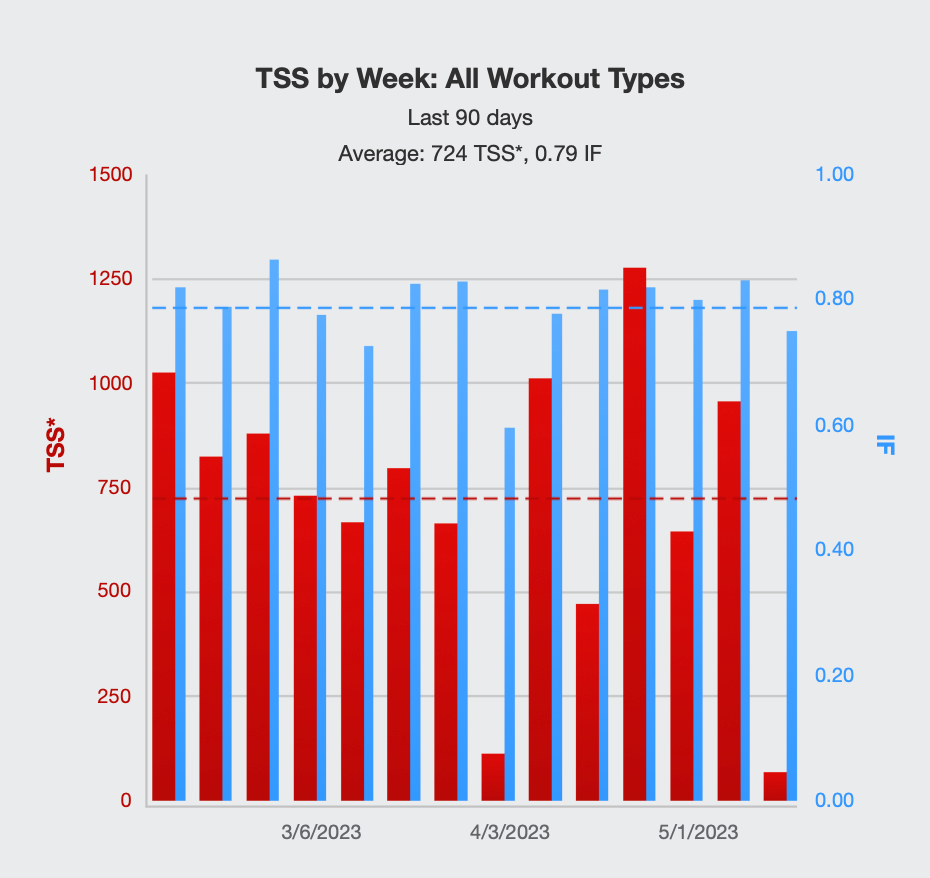
My recent, haphazard, "block periodized", weekly TSS:
Week 1: 665
Week 2: 114 (illness)
Week 3: 1012
Week 4: 472
Week 5: 1276
Week 6: 645
Week 8: 956
__________________
Ride, Rest, Repeat. ROUVY: terrymorse
Ride, Rest, Repeat. ROUVY: terrymorse
05-16-23 | 05:04 PM
#21
Perceptual Dullard
Joined: Sep 2009
Posts: 2,921
Likes: 1,757
Long ago on the old Wattage List, when Andy Coggan first proposed NP, IF, and TSS, we discussed rough categories of rides by their TSS. Here's the graphic from back then. This was his description of how we might label single rides.

05-16-23 | 05:26 PM
#22
Senior Member
Joined: Apr 2021
Posts: 4,081
Likes: 2,104
How does one do a 400 TSS 4 hour ride with an IF of 1.0, yikes. That must be pro level.
The worst I can recall doing was a 2:45 Zwift race, I did just a hair under 0.90 and with the 20 minute warmup, it was a 90%. I was absolutely wrecked. Last race I ever won although zwift racing doesn't seem real.
The worst I can recall doing was a 2:45 Zwift race, I did just a hair under 0.90 and with the 20 minute warmup, it was a 90%. I was absolutely wrecked. Last race I ever won although zwift racing doesn't seem real.
05-16-23 | 08:19 PM
#23
Perceptual Dullard
Joined: Sep 2009
Posts: 2,921
Likes: 1,757
How does one do a 400 TSS 4 hour ride with an IF of 1.0, yikes. That must be pro level.
The worst I can recall doing was a 2:45 Zwift race, I did just a hair under 0.90 and with the 20 minute warmup, it was a 90%. I was absolutely wrecked. Last race I ever won although zwift racing doesn't seem real.
The worst I can recall doing was a 2:45 Zwift race, I did just a hair under 0.90 and with the 20 minute warmup, it was a 90%. I was absolutely wrecked. Last race I ever won although zwift racing doesn't seem real.
05-19-23 | 06:32 AM
#24

Senior Member
Joined: May 2021
Posts: 11,620
Likes: 7,017
Just looking at some pro data, Paris-Roubaix was won last year with an NP = 341W over nearly 6 hours. I would expect Van Baarle's FTP is well north of 400W, so that would be at an IF = 0.85 at best. With a shorter 4 hour effort, maybe he could hit 0.9?
Last edited by PeteHski; 05-19-23 at 06:42 AM.
05-19-23 | 08:50 AM
#25
Senior Member
Joined: Apr 2021
Posts: 4,081
Likes: 2,104
Given the definition of IF = NP/FTP, wouldn't it imply that your FTP was artificially low? I tend to record an higher IF on rides that involve repeated hard efforts with periods of recovery (e.g. Zwift races) where my NP is often higher than my steady state FTP. But 4 hours at at an NP equal to my FTP is never going to happen. I very much doubt pros can do that either, although they would get a lot closer - maybe 0.9 ish.
Just looking at some pro data, Paris-Roubaix was won last year with an NP = 341W over nearly 6 hours. I would expect Van Baarle's FTP is well north of 400W, so that would be at an IF = 0.85 at best. With a shorter 4 hour effort, maybe he could hit 0.9?
Just looking at some pro data, Paris-Roubaix was won last year with an NP = 341W over nearly 6 hours. I would expect Van Baarle's FTP is well north of 400W, so that would be at an IF = 0.85 at best. With a shorter 4 hour effort, maybe he could hit 0.9?
I don't have the paper at hand but a well known exercise physiologist showed that W' could be recycled faster than expended and that this asymmetry could result in higher IF than might be predicted by FTP alone, ostensibly (my guess) due the the nature of the VO2 slow component in the moderate, heavy, and severe domain. I was thinking Pros might be able to go briefly into the severe domain before the slow component rises much and then recover quickly in the moderate domain. Let's say a 2 minute or 120 second hard effort at 100 watts into the severe domain (beyond FTP range)or 12Kj. The idea is this 12kJ could be restored quicker than 120 seconds. Rinse/repeat. Since Pros probably have closer to 30kj, this effect would be greater than what I wrote. ( IF is based on Normalized Power). My interest in the topic started when I tried to explain obvious differences on a very reclined recumbent compared to an upright. I wish I could remember the guy, he posted sometimes in wattage and on slowtwitch. Anyway, I am wrong
Pros are known to be able to go really hard above threshold and recover, I thought this might explain the chart.