Originally Posted by
atbman
And don't forget that only about 5% of collisions are rear end ones - tho' they do seem to be fatal pretty often
This low percent gets quoted often, is incorrect, probably comes from the misleading "Initial Point of Impact" on NHTSA's FARS tables, and depends if you are bicycling in a rural vs. urban environment. In rural North Carolina (and probably elsewhere in the US) the fraction of bicycle crashes due to Motorist Overtaking is increasing; in 2008 these accounted for just over 36% of rural North Carolina bike crashes. Quite correct about high fatality rate of such overtaking crashes.
(The only reason I became aware of all this is it came up on another web site and was news to me; here are the essential details):
The National Highway Traffic Administration's (NHTSA) annual
Fatality Analysis Reporting System (FARS) tables for Pedalcyclists are probably the source of this low percentage because their table's "Point of Initial Impact" is very misleading. In FARS, the "Point of Impact" is the point of impact on the motor vehicle, NOT the bicycle. Bicycles are not motor vehicles. The bicycle could have been hit on the bicycle's front, sides or rear. Their definition of Point of Impact is not mentioned on this table nor on that table's link to the coding of Point of Impact.
You need to read the
FARS Analytic Reference Guide 1975 to 2009, DOT HS 811 352 August 2010 to learn this is how FARS codes the point of impact data:
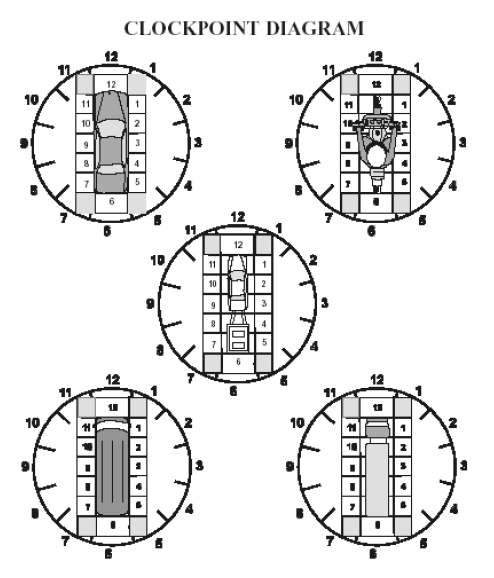
The picture in the upper right is a motorcycle, not a bicycle. These o'clock positions then get grouped for the table, e.g. 11 clockwise through 1 o'clock as "Front" etc.
Note how FARS codes "Manner of Collision"; all pedalcycle crashes get coded "00 - Not a collision with a motor vehicle in transport" rather than "Rear-end" etc. All those "rear-end" collisions in the FARS tables are the rear end of the car, most likely car backing into the bicycle.

So what to use for crash-typing bicycle crashes? In the United States there is the Pedestrian Bicyclist Crash Analysis Tool, PBCAT. Unfortunately, this is not implemented on a national basis. The most extensive contemporary data set I know of is North Carolina's PBCAT coded data (PBCAT was developed in NC). They have coded bicycle crashes in North Carolina from 1997 now up through 2008, a total of 11,842 crashes. You can do
online inquires of this data (just as you can of FARS data). Here are the trends for the fraction of bicycle crashes due to the "Motorist Overtaking" group in the North Carolina data from 1997 through 2008:
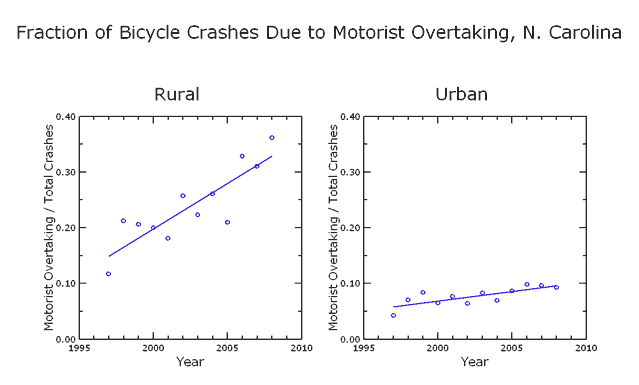
This is not a very reassuring trend, particularly for rural bicycling.
Since this thread started out regarding lighting for conspicuity from the rear, I did an online cross tabulation inquiry on the North Carolina PBCAT data, 1997 through 2008. Of the 1,527 "Motorist Overtaking" crash group, 28.68% (rural + urban) had Light Conditions coded as "Dark - Roadway Not Lighted". I think it is prudent to be conspicuous from the rear on a bike, particularly in rural conditions. Rear lighting is part of that conspicuity.