


A strange thought about lighting...
 12-05-10 | 12:30 AM
#26

Hi, folks
Joined: Jul 2006
Posts: 150
Likes: 0
From: Northern CA
In certain conditions I've noticed that this applies to the flashing red rear light as well. I think the idea in the original post is a good one if used in addition to the usual red rear lights, unless it bugs you when turning your head to check traffic, etc.
 12-05-10 | 06:23 AM
#27
Thread Killer

Joined: Aug 2008
Posts: 13,140
Likes: 2,162
From: Ann Arbor, MI
Bikes: 15 Kinesis Racelight 4S, 76 Motebecane Gran Jubilée, 17 Dedacciai Gladiatore2, 12 Breezer Venturi, 09 Dahon Mariner, 12 Mercier Nano, 95 DeKerf Team SL, 19 Tern Rally, 21 Breezer Doppler Cafe+, 19 T-Lab X3, 91 Serotta CII, 23 3T Strada
if you want some additional light on your vest - try this one out:
https://www.blt-lights.com/product/signal_vest/
https://www.blt-lights.com/product/signal_vest/
The OPs idea of shining a light on himself and relying on reflected light to alert motorists seems like a waste of lumens. Using direct light at drivers will be visible at much greater distance, and this BLT signal vest has several other benefits as well.
I'd never seen that; thanks for posting!
12-05-10 | 11:30 AM
#28
just ride
Joined: Nov 2007
Posts: 375
Likes: 0
From: Philadelphia
For what it's worth - a non cycling friend of mine told me about a cyclist that he regularly passes on the way to work. This guy wears a reflective vest and shines a steady light on his back as you describe. My friend says he can see this guy a long way off.
I would think that a steady light would be less confusing to a motorist and would also be less confusing to the rider when looking back.
I would think that a steady light would be less confusing to a motorist and would also be less confusing to the rider when looking back.
12-05-10 | 05:24 PM
#29

A shrinking member
Joined: Jun 2007
Posts: 288
Likes: 0
From: Tucson
I've thought about doing something similar with my daughter's Pea Pod.

I added a reflective baby on board sign, but I thought illuminating it might be even better.
Currently, I have Christmas lights wrapped around the seat, so I think that helps, but after the holidays I might try to light it up with something else.
Here is a link to a photo of the bike with the Christmas lights.
I added a reflective baby on board sign, but I thought illuminating it might be even better.
Currently, I have Christmas lights wrapped around the seat, so I think that helps, but after the holidays I might try to light it up with something else.
Here is a link to a photo of the bike with the Christmas lights.
12-05-10 | 05:45 PM
#30
Senior Member
Joined: Sep 2008
Posts: 5,300
Likes: 115
I cannot understate the effectiveness of a good helmet mounted light... bike mounted lights work well in quieter situations but a high mounted blinkie will be right in front of a driver and not get washed out in a sea of other tail lights.
I have had motorists stop me and comment on how visible I was and ask where I got the cool helmet not realizing that the blinkie was an extra... and a few helmet makes have integrated led lights into their helmets as well.
I have had motorists stop me and comment on how visible I was and ask where I got the cool helmet not realizing that the blinkie was an extra... and a few helmet makes have integrated led lights into their helmets as well.
same here, the op idea is a good one but a helmet mounted light, visibility vest and rear mounted bike light will do more than illuminating the vest with a blinkie.
12-05-10 | 09:06 PM
#31

...I was just making sure Buzzman didn't feel like an idiot for wanting more than one rear light. Having one rear blinky (especially if it's a dinotte or something equally as bright) can be enough, but in order to feel totally confident I'll keep at least two rear blinkies and some reflectors.
Buzzman, if you decide to do this set up, try to take a picture that shows how well it works. Like I said, I think it's an interesting idea as long as the light illuminates your entire body - not just a 4 inch circle on your back.
Buzzman, if you decide to do this set up, try to take a picture that shows how well it works. Like I said, I think it's an interesting idea as long as the light illuminates your entire body - not just a 4 inch circle on your back.

As for my current light set up:
I have a Planet Bike Beamer 3 handlebar mounted light flashing on the front, a Serfas True Lumens 250 mounted on my helmet. On the rear rack I have a Cat Eye TL LD 1000 and on my person a clip on Planet Bike Superflash.
This time of year I'll usually wear my bright orange Showers Pass Jacket, which has some reflectorized striping.
That said, I'm sure my light set up is fine for most situations.
However, we're in the winter in the Northeast and I ride pretty much every where in all kinds of conditions. In the warmer months, yep, those of you who say "red blinking lights" mean a bicycle- you're probably right. But at this time of year and as the snow starts to fly there will be fewer and fewer cyclists out there.
Once the snow starts to fall out comes my winter MTB with 2.1" studded snow tires for commuting and many a night I'm the only bike I'll see on the road. So, to many drivers and especially to drivers of snow plows and municipal buses I'd like to be as visible as possible and identifiable as a BICYCLE because in snow, sleet or rain they really don't expect to see a bike on the road. A blinking red light in those conditions could basically be anything from a red reflector on a stick blowing in the wind at the end of a driveway to a car signaling a right turn considerable distance away but to people that can't conceive of riding a bike on such a night the last thing they expect is a bike.
I point out snow plows and buses because they tend to crowd the road's edge and I'd prefer they give me wide berth by having as much advance notice as to what I am as possible.
I will post some video or pix as soon as i set it up and do a trial run.
Thanks to all for the input.

Last edited by buzzman; 12-05-10 at 09:10 PM.
12-05-10 | 10:11 PM
#32

Bicycle Lifestyle
Joined: Jan 2008
Posts: 1,737
Likes: 1
From: Pacific Grove, Ca
Bikes: Neil Pryde Diablo, VeloVie Vitesse400, Hunter29er, Surly Big Dummy
sometimes I use a Cateye Uno headlamp and face it rearward
using an amber/orange lens from a Mini MagLite, which happens to fit.
as to judging distances at night; trains used to have 2 big head lights, one on top of the other.
the top light rotates, providing a conical pin point indicator as to the exact front of the train.
using an amber/orange lens from a Mini MagLite, which happens to fit.
as to judging distances at night; trains used to have 2 big head lights, one on top of the other.
the top light rotates, providing a conical pin point indicator as to the exact front of the train.

 12-06-10 | 11:21 AM
#35
Randomhead
Joined: Aug 2008
Posts: 25,930
Likes: 4,825
From: Happy Valley, Pennsylvania
the thing that will best identify you as a cyclist is a reflective vest and reflective ankle bands. It's amazing how effective a good setup can be. I don't see how shining a light on yourself would hurt, but I also don't think it will be that effective.
12-07-10 | 07:55 PM
#36

Junior Member
Joined: Nov 2010
Posts: 15
Likes: 0
From: The rainy state.
Bikes: Specialized Allez Sport '05, Kona 29er 04, Speciallized Sirrus 90's.
But, red lights pointed backwards are very effective, especially when combined with reflective material to give more shape to a cyclist. There are a lot of red lights on the road and I'd hate to have mine blend in with the brake lights of the car in front of me.
12-07-10 | 10:51 PM
#37
Senior Member
Joined: Jun 2008
Posts: 653
Likes: 1
From: Central CT USA
Bikes: 1991 Tomassini Prestige 1973 Raliegh Supercourse, 1975 Panasonic Sport Deluxe, 1983 Fuji S-12, 1975 Motobecane Mirage, 1983 Motobecane Super Mirage 1999 Trek 930 1989 Trek 930 ,
oh man , REI had the Dinotte on closeout for 44.99. They have discontinued it. There's a great write-up about it on Peter White's website. I want to thank you guys, this thread sparked my interest in it. Eventually, I'll get another red blinker for the back of the helmet. I think a dual setup on the rear really works well.
12-07-10 | 11:37 PM
#38

The Professor
Joined: Nov 2009
Posts: 899
Likes: 7
From: Center Sandwich, New Hampshire
Bikes: Alex Moulton Double Pylon, Surly Big Dummy, Alex Moulton GT, AZUB TiFly
Okay, I've been thinking lately of buying a relatively cheap flashing front bike light and mounting it on the milk crate on the back of my bike and aiming it at my back.
That way, especially if I'm wearing reflective or light colored clothing, drivers would see this flashing form of what is obviously a cyclist. I'd still have a red tail light as well.
I just find that no matter how bright the tail light it's difficult to judge the distance and identify it as a bicycle light.
Crazy?... Good idea?... What do you think?- Has anyone else done this?
That way, especially if I'm wearing reflective or light colored clothing, drivers would see this flashing form of what is obviously a cyclist. I'd still have a red tail light as well.
I just find that no matter how bright the tail light it's difficult to judge the distance and identify it as a bicycle light.
Crazy?... Good idea?... What do you think?- Has anyone else done this?
12-08-10 | 03:40 AM
#39
Marqueteur
Joined: Dec 2005
Posts: 81
Likes: 0
Bikes: Primary: Specialized crossroads; Secondary: seldom used specialized MTB
In general, I find myself among those who feel that there is nothing wrong with this setup, but not likely enough benefit to justify the hassle and expense of the light. The question about a small spot on the vest instead of the whole thing being lit up is also a good one.
More important is that this can only have a useful effect with a fluorescent vest - which doesn't have to be reflective for the light to be useful. This is because the reflective material is retroreflective, which means that it reflects light back at the source. Shining light from your flashlight back at your flashlight is going to do absolutely no good for making you visible to cars. While I don't have the knowledge ATM to prove it, I agree with the person who said that by the time the driver can see your flashlight on your vest he would already be able to see your vest with his own headlights. For a fluorescent vest it doesn't matter if the left (driver's side) headlight is out - the right headlight will be equally effective, unlike any reflector.
Bad idea unless you use a red or yellow lens over the headlight. White light is supposed to be pointed in the direction of travel. With a white on the rear you could easily mistaken for a salmon, so once they pass you they could inadvertently right hook you because they think you are traveling in the opposite direction ... and whose fault would that be?
The proposal is to put the light on the back of the bike meaning behind the seatpost, but aimed on the order of 60 degrees above the forward horizon (i.e. aimed somewhat towards the front, but probably mostly at the sky.)
Tor
More important is that this can only have a useful effect with a fluorescent vest - which doesn't have to be reflective for the light to be useful. This is because the reflective material is retroreflective, which means that it reflects light back at the source. Shining light from your flashlight back at your flashlight is going to do absolutely no good for making you visible to cars. While I don't have the knowledge ATM to prove it, I agree with the person who said that by the time the driver can see your flashlight on your vest he would already be able to see your vest with his own headlights. For a fluorescent vest it doesn't matter if the left (driver's side) headlight is out - the right headlight will be equally effective, unlike any reflector.
Originally Posted by akohekohe
Originally Posted by buzzman
Okay, I've been thinking lately of buying a relatively cheap flashing front bike light and mounting it on the milk crate on the back of my bike and aiming it at my back.
Tor
12-08-10 | 01:40 PM
#40

Spinning @ 33 RPM
Joined: Aug 2007
Posts: 747
Likes: 3
From: NE Ohio
Bikes: '89 Fuji Saratoga, '97 Schwinn Mesa SS, '07 Felt F1X, '10 Transition TransAM, '11 Soma Analog SS
I once mounted my old headlight on my rear fender so it would shine on my back. It was pretty cool. OK, maybe "cool" isn't the right word, but it did make me more visible and obvious that I was a guy on a bike. Ended up taking it off because I would forget I had it on there and would then freak out because I thought someone was 1' behind me. 
12-08-10 | 10:42 PM
#41

Senior Member
Joined: Jul 2006
Posts: 2,719
Likes: 4
From: London, UK
Bikes: 2006 road bike, 2012 cx bike, 2012 carbon rb, 2014 hardtail
+1.
Like someone else mentioned, just make sure you have a light that has a wide spread. But even with a narrower spread, it'd be great to see how this works out.
Car headlights do not face entirely forward but instead face downwards to a certain angle illuminating the road surface. So if the driver is a fair distance away, having a light shining on the cyclist's reflective material is a great idea.
I once knew of a cyclist that had a 4 foot pole attached to his bike with a yellow flashing light on the top.
Like someone else mentioned, just make sure you have a light that has a wide spread. But even with a narrower spread, it'd be great to see how this works out.
Car headlights do not face entirely forward but instead face downwards to a certain angle illuminating the road surface. So if the driver is a fair distance away, having a light shining on the cyclist's reflective material is a great idea.
I once knew of a cyclist that had a 4 foot pole attached to his bike with a yellow flashing light on the top.
12-09-10 | 02:01 AM
#42
Marqueteur
Joined: Dec 2005
Posts: 81
Likes: 0
Bikes: Primary: Specialized crossroads; Secondary: seldom used specialized MTB
Originally Posted by mustang1
Car headlights do not face entirely forward but instead face downwards to a certain angle illuminating the road surface. So if the driver is a fair distance away, having a light shining on the cyclist's reflective material is a great idea.
Where this may have some effect is if you use something like a Class II construction worker's fluorescent safety vest, in which case your light may light up the fluorescent vest before the driver's own headlights under some circumstances.
If you want to see the effect that the light has on visibility, try having someone ride your bike away from you whilen wearing your vest and with the light on three times:
1. With you standing in darkness. This is to simulate the situation in which the driver's lights don't illuminate you at all, a situation I suspect is rarely going to be the case when they need maximum reaction time. Note that this should overstate the benefit of the light because your eyes will probably be much more dark adjusted than the driver's eyes.
2. With you standing next to a car with its headlights on and pointed at your retreating bicycle. You should be standing six feet (6') from the headlight nearest you. This simulates a car coming up behind you with its driver's side headlight out.
3. With you preferably seated in the driver's seat or a similar position relative to the headlight. This is what is going to be seen most of the time.
All this being said, if considering this you feel it is worth your time, money, and trouble, I think it is perfectly fine. I just think the proposed benefits I see in this thread overstate the real benefit.
Tor
12-10-10 | 03:46 PM
#43
Senior Member
Joined: Aug 2007
Posts: 501
Likes: 0
From: USA
Overtaking ("rear end") crashes more common, esp rural. NHTSA table misleading.
(The only reason I became aware of all this is it came up on another web site and was news to me; here are the essential details):
The National Highway Traffic Administration's (NHTSA) annual Fatality Analysis Reporting System (FARS) tables for Pedalcyclists are probably the source of this low percentage because their table's "Point of Initial Impact" is very misleading. In FARS, the "Point of Impact" is the point of impact on the motor vehicle, NOT the bicycle. Bicycles are not motor vehicles. The bicycle could have been hit on the bicycle's front, sides or rear. Their definition of Point of Impact is not mentioned on this table nor on that table's link to the coding of Point of Impact.
You need to read the FARS Analytic Reference Guide 1975 to 2009, DOT HS 811 352 August 2010 to learn this is how FARS codes the point of impact data:
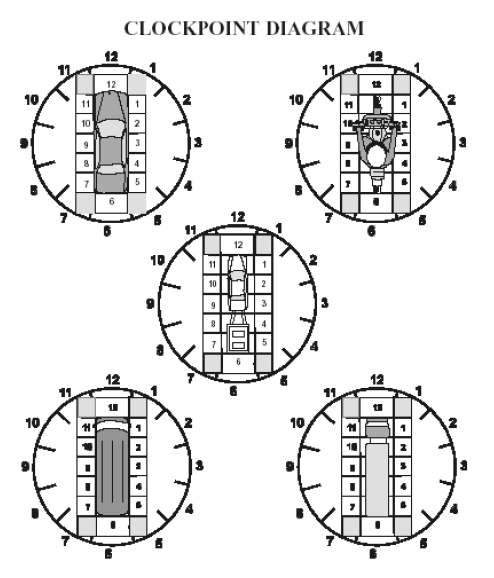
The picture in the upper right is a motorcycle, not a bicycle. These o'clock positions then get grouped for the table, e.g. 11 clockwise through 1 o'clock as "Front" etc.
Note how FARS codes "Manner of Collision"; all pedalcycle crashes get coded "00 - Not a collision with a motor vehicle in transport" rather than "Rear-end" etc. All those "rear-end" collisions in the FARS tables are the rear end of the car, most likely car backing into the bicycle.

So what to use for crash-typing bicycle crashes? In the United States there is the Pedestrian Bicyclist Crash Analysis Tool, PBCAT. Unfortunately, this is not implemented on a national basis. The most extensive contemporary data set I know of is North Carolina's PBCAT coded data (PBCAT was developed in NC). They have coded bicycle crashes in North Carolina from 1997 now up through 2008, a total of 11,842 crashes. You can do online inquires of this data (just as you can of FARS data). Here are the trends for the fraction of bicycle crashes due to the "Motorist Overtaking" group in the North Carolina data from 1997 through 2008:
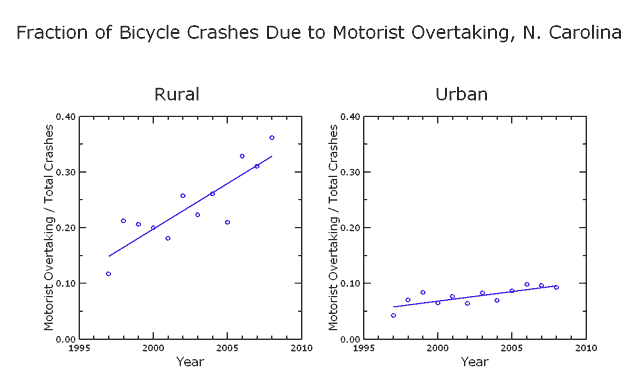
This is not a very reassuring trend, particularly for rural bicycling.
Since this thread started out regarding lighting for conspicuity from the rear, I did an online cross tabulation inquiry on the North Carolina PBCAT data, 1997 through 2008. Of the 1,527 "Motorist Overtaking" crash group, 28.68% (rural + urban) had Light Conditions coded as "Dark - Roadway Not Lighted". I think it is prudent to be conspicuous from the rear on a bike, particularly in rural conditions. Rear lighting is part of that conspicuity.
Last edited by Giro; 12-10-10 at 03:50 PM. Reason: Out, damned typos
12-10-10 | 06:00 PM
#44

genec
Joined: Sep 2004
Posts: 27,072
Likes: 4,533
From: West Coast
Bikes: custom built, sannino, beachbike, giant trance x2
Anything that aids in illuminating your presence to catch the notice of the motoring tards is a good thing. There is no such thing as overkill when it comes to being noticed.
I have a rather unusual headlight, it's a 61-bulb LED, with 1 hi-output LED in the end (flashlight-style), and a 4x15 grid in the side of the thing, pretty bright and noticeable. It's aimed so the grid shines forward. Puts out good glow, and is easy to see....
So I thought; it was bright enough for illuminate the driver's use of his cell phone as he narrowly missed me during my commute home the other evening! He didn't even notice, not even when I cussed him out!
I have a rather unusual headlight, it's a 61-bulb LED, with 1 hi-output LED in the end (flashlight-style), and a 4x15 grid in the side of the thing, pretty bright and noticeable. It's aimed so the grid shines forward. Puts out good glow, and is easy to see....
So I thought; it was bright enough for illuminate the driver's use of his cell phone as he narrowly missed me during my commute home the other evening! He didn't even notice, not even when I cussed him out!
This however is one reason I like the PB superflash... the flash pattern is somewhat irregular, and may even wake up cell phone zombies. (maybe... )
12-10-10 | 06:06 PM
#45
genec
Joined: Sep 2004
Posts: 27,072
Likes: 4,533
From: West Coast
Bikes: custom built, sannino, beachbike, giant trance x2
This low percent gets quoted often, is incorrect, probably comes from the misleading "Initial Point of Impact" on NHTSA's FARS tables, and depends if you are bicycling in a rural vs. urban environment. In rural North Carolina (and probably elsewhere in the US) the fraction of bicycle crashes due to Motorist Overtaking is increasing; in 2008 these accounted for just over 36% of rural North Carolina bike crashes. Quite correct about high fatality rate of such overtaking crashes.
(The only reason I became aware of all this is it came up on another web site and was news to me; here are the essential details):
The National Highway Traffic Administration's (NHTSA) annual Fatality Analysis Reporting System (FARS) tables for Pedalcyclists are probably the source of this low percentage because their table's "Point of Initial Impact" is very misleading. In FARS, the "Point of Impact" is the point of impact on the motor vehicle, NOT the bicycle. Bicycles are not motor vehicles. The bicycle could have been hit on the bicycle's front, sides or rear. Their definition of Point of Impact is not mentioned on this table nor on that table's link to the coding of Point of Impact.
You need to read the FARS Analytic Reference Guide 1975 to 2009, DOT HS 811 352 August 2010 to learn this is how FARS codes the point of impact data:
The picture in the upper right is a motorcycle, not a bicycle. These o'clock positions then get grouped for the table, e.g. 11 clockwise through 1 o'clock as "Front" etc.
Note how FARS codes "Manner of Collision"; all pedalcycle crashes get coded "00 - Not a collision with a motor vehicle in transport" rather than "Rear-end" etc. All those "rear-end" collisions in the FARS tables are the rear end of the car, most likely car backing into the bicycle.
So what to use for crash-typing bicycle crashes? In the United States there is the Pedestrian Bicyclist Crash Analysis Tool, PBCAT. Unfortunately, this is not implemented on a national basis. The most extensive contemporary data set I know of is North Carolina's PBCAT coded data (PBCAT was developed in NC). They have coded bicycle crashes in North Carolina from 1997 now up through 2008, a total of 11,842 crashes. You can do online inquires of this data (just as you can of FARS data). Here are the trends for the fraction of bicycle crashes due to the "Motorist Overtaking" group in the North Carolina data from 1997 through 2008:
This is not a very reassuring trend, particularly for rural bicycling.
Since this thread started out regarding lighting for conspicuity from the rear, I did an online cross tabulation inquiry on the North Carolina PBCAT data, 1997 through 2008. Of the 1,527 "Motorist Overtaking" crash group, 28.68% (rural + urban) had Light Conditions coded as "Dark - Roadway Not Lighted". I think it is prudent to be conspicuous from the rear on a bike, particularly in rural conditions. Rear lighting is part of that conspicuity.
(The only reason I became aware of all this is it came up on another web site and was news to me; here are the essential details):
The National Highway Traffic Administration's (NHTSA) annual Fatality Analysis Reporting System (FARS) tables for Pedalcyclists are probably the source of this low percentage because their table's "Point of Initial Impact" is very misleading. In FARS, the "Point of Impact" is the point of impact on the motor vehicle, NOT the bicycle. Bicycles are not motor vehicles. The bicycle could have been hit on the bicycle's front, sides or rear. Their definition of Point of Impact is not mentioned on this table nor on that table's link to the coding of Point of Impact.
You need to read the FARS Analytic Reference Guide 1975 to 2009, DOT HS 811 352 August 2010 to learn this is how FARS codes the point of impact data:
The picture in the upper right is a motorcycle, not a bicycle. These o'clock positions then get grouped for the table, e.g. 11 clockwise through 1 o'clock as "Front" etc.
Note how FARS codes "Manner of Collision"; all pedalcycle crashes get coded "00 - Not a collision with a motor vehicle in transport" rather than "Rear-end" etc. All those "rear-end" collisions in the FARS tables are the rear end of the car, most likely car backing into the bicycle.
So what to use for crash-typing bicycle crashes? In the United States there is the Pedestrian Bicyclist Crash Analysis Tool, PBCAT. Unfortunately, this is not implemented on a national basis. The most extensive contemporary data set I know of is North Carolina's PBCAT coded data (PBCAT was developed in NC). They have coded bicycle crashes in North Carolina from 1997 now up through 2008, a total of 11,842 crashes. You can do online inquires of this data (just as you can of FARS data). Here are the trends for the fraction of bicycle crashes due to the "Motorist Overtaking" group in the North Carolina data from 1997 through 2008:
This is not a very reassuring trend, particularly for rural bicycling.
Since this thread started out regarding lighting for conspicuity from the rear, I did an online cross tabulation inquiry on the North Carolina PBCAT data, 1997 through 2008. Of the 1,527 "Motorist Overtaking" crash group, 28.68% (rural + urban) had Light Conditions coded as "Dark - Roadway Not Lighted". I think it is prudent to be conspicuous from the rear on a bike, particularly in rural conditions. Rear lighting is part of that conspicuity.
Of course those folks live (and die) by their oft quoted "facts" such as "overtaking collisions occur rarely."
But hey, you can't tell those folks a thing.


