Originally Posted by
Campag4life
No it isn't a style thing. Its a wheelbase, chain stay length, tire clearance, frame weight, bike handling thing.
Setback allows bigger riders on smaller wheelbase frames with good fore/aft weight distribution.
If I went custom which I never would since just about every geometry permutation is available off the rack, I would design the
frame for a 25mm setback seatpost and minimum 1-2 cm clearance to the back tire.
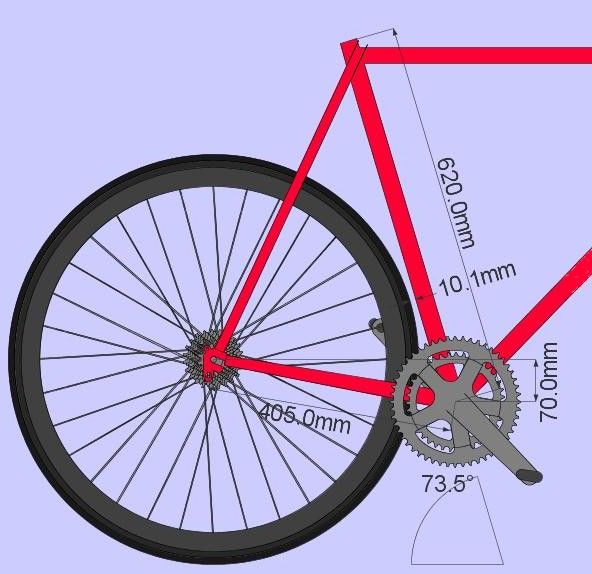
My point in posting the second link was to show that the optimum average seat tube angle for 974 male cyclists with inner leg length between 800mm and 960mm (little guys to big guys) is 73.5°. A 73.5° STA is steep enough so that with a 700c wheel and 25c tires, you can make the chainstays 405mm long and the tire will still clear the seat tube by a centimeter.
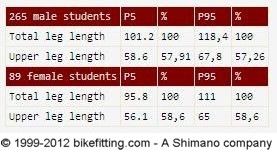
The bikefitting.com article maintains that "standard" seat tube angle geometry in which large frames have shallow seat angle (~72°) and small frames have steeper seat angles (~75°) presupposes that people with longer legs automatically have relatively longer femurs than persons with shorter legs. The table below shows that this presupposition is incorrect. As this table shows, there is no difference in the upper leg length to lower leg length ratio between people with longer legs and people with shorter legs.
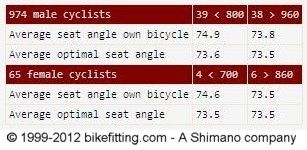
The table below shows the seat angle on the personally owned frames of 1028 cyclists and the optimum seat angle for those cyclists for maximum pedaling efficiency as determined by the bikefitting.com fitting system. While the cyclists’ own frames had STAs from 73.5° to 74.9°, the optimum STA turned out to be 73.6° or 73.5° for all of the cyclists regardless of inner leg length.
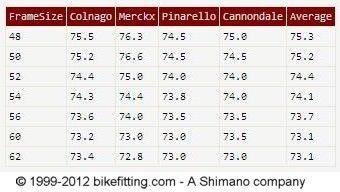
The table below shows that four well known frame manufacturers still build their frames with steeper STAs on smaller frames and shallower STAs on larger frames under the erroneous assumption that people with longer legs have relatively longer femurs.
I maintain that since the OP is having a custom frame made, there is no reason other than style for the frame to be designed to have a setback seatpost to put him in the right position for contact points, fore-and-aft weight distribution on the bike, and good handling assuming the framebuilder knows what he's doing.
If he were using a stock frame that’s too small for him, he might have to use a setback seatpost and a longer stem to put him in the right position, but that’s different than the question he posed regarding a custom frame.