


Seatpost - offset or zero-offset on a custom frame?
 07-29-12 | 07:34 AM
#1
Thread Starter
Senior Member

Joined: May 2009
Posts: 2,783
Likes: 5
From: NYC
Bikes: Felt AR1, Cervelo S2
Seatpost - offset or zero-offset on a custom frame?
I have a custom frame on the way from a builder in italy. When I gave him my measurements, I told him that I wanted to use a 120mm stem, and that I wanted aggressive geometry.
It just occurred to me that I have to decide between a straight or setback seatpost.
I emailed the shop, and they told me they'd ask the builder, but "We advice ever setback seatpost." yes, there's a language barrier. I won't have an answer (or the frame) for a little while.
So in the interim, i'm wondering - if someone was building a bike, would they design it for a setback seatpost or a straight one?
if i remember correctly i don't think i've ever owned a bike with a straight seatpost. it seems like the default is setback.
here's a pic of the frame, btw.

It just occurred to me that I have to decide between a straight or setback seatpost.
I emailed the shop, and they told me they'd ask the builder, but "We advice ever setback seatpost." yes, there's a language barrier. I won't have an answer (or the frame) for a little while.
So in the interim, i'm wondering - if someone was building a bike, would they design it for a setback seatpost or a straight one?
if i remember correctly i don't think i've ever owned a bike with a straight seatpost. it seems like the default is setback.
here's a pic of the frame, btw.
Last edited by Inertianinja; 07-29-12 at 07:37 AM.
 07-29-12 | 07:54 AM
#2


Decrepit Member
Joined: Aug 2005
Posts: 10,488
Likes: 92
From: Santa Rosa, California
Bikes: Waterford 953 RS-22, several Paramounts
If the frame is being made to fit you, why in the world wouldn't you want it designed so that you don't need a setback seat post? A setback seatpost is to permit riders to use stock smaller frames without being cramped.
It sounds like you're asking if something that's used to compensate for a poorly fitting frame should be considered for your custom frame. I'd say no.
It sounds like you're asking if something that's used to compensate for a poorly fitting frame should be considered for your custom frame. I'd say no.
 07-29-12 | 08:08 AM
#3
Thread Starter
Senior Member
Joined: May 2009
Posts: 2,783
Likes: 5
From: NYC
Bikes: Felt AR1, Cervelo S2
If the frame is being made to fit you, why in the world wouldn't you want it designed so that you don't need a setback seat post? A setback seatpost is to permit riders to use stock smaller frames without being cramped.
It sounds like you're asking if something that's used to compensate for a poorly fitting frame should be considered for your custom frame. I'd say no.
It sounds like you're asking if something that's used to compensate for a poorly fitting frame should be considered for your custom frame. I'd say no.
07-29-12 | 08:09 AM
#4

Senior Member
Joined: Jun 2006
Posts: 1,586
Likes: 1
From: Atlanta, GA
Bikes: A couple
If the frame is being made to fit you, why in the world wouldn't you want it designed so that you don't need a setback seat post? A setback seatpost is to permit riders to use stock smaller frames without being cramped.
It sounds like you're asking if something that's used to compensate for a poorly fitting frame should be considered for your custom frame. I'd say no.
It sounds like you're asking if something that's used to compensate for a poorly fitting frame should be considered for your custom frame. I'd say no.
To the OP, do you not have any idea how far behind the BB you prefer your saddle to be? That is what should dictate what amount of setback you need.
07-29-12 | 08:21 AM
#5
Senior Member
Joined: Dec 2005
Posts: 56
Likes: 0
From: Grand Junction, Colorado
Bikes: Gunnar, Surly
Wow! I just went through this very dilemma when I was designing a custom frame for myself, and IF Steel Crown Jewel (which I should be receiving in just another week or two!). In my case I already knew where I'd be wanting the saddle to be located relative to the bottom bracket center, so I started by figuring out where the seat post would need to be in order for the seat post clamp to be right about mid-rail on the saddle (I already knew what saddle I'd be using, in my case a Fizik Alliante). Then it was just a matter of figuring out what seat tube angle would make this work using a straight seat post and a set back seat post. It came out that there was something like a 1.5 degree difference in seat tube angle between the two scenarios.
So what difference does a couple degrees of seat tube angle make? Well, as you relax the seat tube angle you reach a point where in order for the seat tube to clear the rear tire by a comfortable margin, you'll need to extend the chainstays. Chainstays are a source of flex in the bottom bracket, and increased flex can lead to a less responsive and less efficient frame, so keeping the chainstays short is a good thing if you're going after frame efficiency (none of this matters if you're building a touring bike or something like that, though). Since I want my frame to be an efficient frame, I wanted to go with fairly short chain stays. This meant using a somewhat steeper seat tube angle, and then compensating by going with a set back seat post.
My new frame with have chainstays that are 410mm long, a seat tube angle of 72.5 degrees, a gap of right about 1cm between the seat tube and the rear tire, and I'll be using a Thomson setback seat post (16mm set back). Had I wanted to go with a Thomson straight seat post then I'd have needed a seat tube angle of around 71 degrees (or 71.5 or so if I didn't mind the saddle being all the way back on the seat post), and would have needed chainstays of around 420mm in length in order to keep that 1cm gap (the numbers on using a straight post might be a bit off, I rejected this approach as soon as I realized how long the chainstays would need to be).
In your case, since the frame is already built then which type of seat post you go with has more to do with what saddle you're using (how long the saddle rails are) and how much set back you like your saddle to be at relative to the bottom bracket centerline. If you like saddle back and are using a saddle with typical length rails (like the Alliante) then you'll most likely need a set back seat post. However, if you're using a saddle with really long rails (an older Selle Italia Flite comes to mind) and like to be a fit forward relative to the BB, then it might turn out that a straight post will work for you. You won't know for sure till you build it, but if you need to buy your seat post now then going with a set back would probably be the best bet.
Basically, which seat post you use depends on the frame's seat tube angle, the saddle rail length, and how far back you want your saddle to be.
Hope my rambling helps.
John
So what difference does a couple degrees of seat tube angle make? Well, as you relax the seat tube angle you reach a point where in order for the seat tube to clear the rear tire by a comfortable margin, you'll need to extend the chainstays. Chainstays are a source of flex in the bottom bracket, and increased flex can lead to a less responsive and less efficient frame, so keeping the chainstays short is a good thing if you're going after frame efficiency (none of this matters if you're building a touring bike or something like that, though). Since I want my frame to be an efficient frame, I wanted to go with fairly short chain stays. This meant using a somewhat steeper seat tube angle, and then compensating by going with a set back seat post.
My new frame with have chainstays that are 410mm long, a seat tube angle of 72.5 degrees, a gap of right about 1cm between the seat tube and the rear tire, and I'll be using a Thomson setback seat post (16mm set back). Had I wanted to go with a Thomson straight seat post then I'd have needed a seat tube angle of around 71 degrees (or 71.5 or so if I didn't mind the saddle being all the way back on the seat post), and would have needed chainstays of around 420mm in length in order to keep that 1cm gap (the numbers on using a straight post might be a bit off, I rejected this approach as soon as I realized how long the chainstays would need to be).
In your case, since the frame is already built then which type of seat post you go with has more to do with what saddle you're using (how long the saddle rails are) and how much set back you like your saddle to be at relative to the bottom bracket centerline. If you like saddle back and are using a saddle with typical length rails (like the Alliante) then you'll most likely need a set back seat post. However, if you're using a saddle with really long rails (an older Selle Italia Flite comes to mind) and like to be a fit forward relative to the BB, then it might turn out that a straight post will work for you. You won't know for sure till you build it, but if you need to buy your seat post now then going with a set back would probably be the best bet.
Basically, which seat post you use depends on the frame's seat tube angle, the saddle rail length, and how far back you want your saddle to be.
Hope my rambling helps.
John
Last edited by deinonychi; 07-29-12 at 08:26 AM.
 07-29-12 | 09:59 PM
#7
Senior Member
Joined: Feb 2009
Posts: 72
Likes: 0
The Pelizzoli looks like a pretty classic Italian stage race geometry to me (although I didn't see a geometry chart on the site). That pretty much guarantees that it was designed for a setback post.
Good looking frame, congratulations! I bet it will ride really well!
Good looking frame, congratulations! I bet it will ride really well!
07-30-12 | 08:37 AM
#8

Administrator

Joined: Feb 2005
Posts: 13,651
Likes: 2,695
From: Delaware shore
Bikes: Cervelo C5, Guru Photon, Waterford, Specialized CX
Why should a custom frame be designed around a zero setback seatpost? I have two custom frames and to be able to use a zero setback seatpost, the seat tube angle would need to be about 70 degrees, at which point there wouldn't be much clearance for the tire without resorting to long chainstays... So sometimes it is just not practical or the best thing to do.
A setback seatpost is to permit riders to use stock smaller frames without being cramped.
It sounds like you're asking if something that's used to compensate for a poorly fitting frame should be considered for your custom frame. I'd say no.
It sounds like you're asking if something that's used to compensate for a poorly fitting frame should be considered for your custom frame. I'd say no.
07-30-12 | 08:50 AM
#9
Thread Starter
Senior Member
Joined: May 2009
Posts: 2,783
Likes: 5
From: NYC
Bikes: Felt AR1, Cervelo S2
I had surfed CL and eBay for months before going with this frame. all the truly desirable bikes (for example, ~90s colnagos in good condition) were way overpriced, many of them with rust or damage. the sellers had no reason to come down on their prices because a well-maintained vintage frame doesn't get any less vintage as time passes.
a good example, this Cinelli Genius frame - https://www.ebay.com/itm/rare-1993-Ci...item5d344b2efc - has been on eBay at $1950 for easily a year. the guy won't come down on the price, and someone will someday buy it.
When I put in my order, I sent them a picture of my current bike & said I'm looking for aggressive geometry, i plan to use a 120mm stem with a 43mm rake fork, and I plan to use it for aggressive riding and racing (as opposed to touring).
07-30-12 | 08:58 AM
#10
43mm rake fork? What's the HT angle? It's going to have to be really steep to get the trail where you want it for aggressive handling.
I recently did a custom frame. HT angle is slack (I'm short) at 71.5. But the fork rake of 50mm put the front wheel out enough to have short trail. Additionally, the BB is a bit lower than normal to drop CoG. Handling is exactly what I wanted.
Regarding the seatpost, often times to locate the BB in the right spot and the chain stays at an appropriate length for application, seatback seatposts are required.
I recently did a custom frame. HT angle is slack (I'm short) at 71.5. But the fork rake of 50mm put the front wheel out enough to have short trail. Additionally, the BB is a bit lower than normal to drop CoG. Handling is exactly what I wanted.
Regarding the seatpost, often times to locate the BB in the right spot and the chain stays at an appropriate length for application, seatback seatposts are required.
__________________
-------
Some sort of pithy irrelevant one-liner should go here.
-------
Some sort of pithy irrelevant one-liner should go here.
07-30-12 | 09:18 AM
#11
Thread Starter
Senior Member
Joined: May 2009
Posts: 2,783
Likes: 5
From: NYC
Bikes: Felt AR1, Cervelo S2
43mm rake fork? What's the HT angle? It's going to have to be really steep to get the trail where you want it for aggressive handling.
I recently did a custom frame. HT angle is slack (I'm short) at 71.5. But the fork rake of 50mm put the front wheel out enough to have short trail. Additionally, the BB is a bit lower than normal to drop CoG. Handling is exactly what I wanted.
Regarding the seatpost, often times to locate the BB in the right spot and the chain stays at an appropriate length for application, seatback seatposts are required.
I recently did a custom frame. HT angle is slack (I'm short) at 71.5. But the fork rake of 50mm put the front wheel out enough to have short trail. Additionally, the BB is a bit lower than normal to drop CoG. Handling is exactly what I wanted.
Regarding the seatpost, often times to locate the BB in the right spot and the chain stays at an appropriate length for application, seatback seatposts are required.
so, I did ask about it on this forum and others, and I was told repeatedly that I should leave the builder alone and just let him build the bike, and to not trouble him with all my little questions.
07-30-12 | 09:30 AM
#12

Gunner.
Joined: Aug 2005
Posts: 1,735
Likes: 9
From: Santa Clarita, CA
Bikes: Giant TCR, Spooky Skeletor, Pivot Mach 6
When I had my Tsunami made I went with measurements that allowed a straight seatpost. That's just a personal preference though. Looks like your frame is already a done deal so I'd just go with whatever works when it get in.
Rob
Rob
07-30-12 | 12:34 PM
#13
Decrepit Member
Joined: Aug 2005
Posts: 10,488
Likes: 92
From: Santa Rosa, California
Bikes: Waterford 953 RS-22, several Paramounts
I realize I'm in the minority here and don't want to debate the issue since the pros and cons of setback vs. straight seatposts and STA is a lively discussion topic among even the best framebuilders. Read this Velocipede Salon thread for lots of opinions from some of the best designers and builders in the business:
https://www.velocipedesalon.com/forum...s-18675-2.html
I really think it's a style thing. This is translated from German, so it reads a little awkwardly.
https://www.bikefitting.com/English/T...SeatAngle.aspx
Regardless, whatever works for you is right.
https://www.velocipedesalon.com/forum...s-18675-2.html
I really think it's a style thing. This is translated from German, so it reads a little awkwardly.
https://www.bikefitting.com/English/T...SeatAngle.aspx
Regardless, whatever works for you is right.
07-30-12 | 01:49 PM
#14
Senior Member

Joined: Feb 2007
Posts: 15,410
Likes: 188
From: Tariffville, CT
Bikes: Tsunami road bikes, Dolan DF4 track
I have two frames from Tsunami. I basically did what deinonychi did - I wanted to have the seatpost clamp centered on the rails. Since I have short quads I normally shove my saddle all the way forward. I figured out that with a zero setback post I needed about a 76 deg seat tube angle. Joseph/Tsunami suggested going a half degree shallower to 75.5. It worked out well although the rails are not perfectly centered, I still have to move the saddle forward a bit.
For rake/HT angle, 43mm and 73 deg give you an excellent combination of stability and responsiveness. There's a reason so many bikes have those numbers. I spec'ed those for my frames too, after having been on a frame with that front end.
Finally I also spec'ed my top tube to fit with a 120 mm stem. Good weight over the front wheel, stable at speed. This meant going to a 56.5 cm top tube. (My seat tube is compact style so 40 cm, the same as a size S Giant, and my last frame before these was a 52 cm Cannondale.)
For rake/HT angle, 43mm and 73 deg give you an excellent combination of stability and responsiveness. There's a reason so many bikes have those numbers. I spec'ed those for my frames too, after having been on a frame with that front end.
Finally I also spec'ed my top tube to fit with a 120 mm stem. Good weight over the front wheel, stable at speed. This meant going to a 56.5 cm top tube. (My seat tube is compact style so 40 cm, the same as a size S Giant, and my last frame before these was a 52 cm Cannondale.)
07-30-12 | 02:57 PM
#15
Senior Member
Joined: Jun 2006
Posts: 1,586
Likes: 1
From: Atlanta, GA
Bikes: A couple
Plus it didn't hurt the custom frames were very affordable (another satisfied Tsunami owner here).
07-31-12 | 06:08 PM
#16

Voice of the Industry
Joined: May 2007
Posts: 12,572
Likes: 8
I realize I'm in the minority here and don't want to debate the issue since the pros and cons of setback vs. straight seatposts and STA is a lively discussion topic among even the best framebuilders. Read this Velocipede Salon thread for lots of opinions from some of the best designers and builders in the business:
https://www.velocipedesalon.com/forum...s-18675-2.html
I really think it's a style thing. This is translated from German, so it reads a little awkwardly.
https://www.bikefitting.com/English/T...SeatAngle.aspx
Regardless, whatever works for you is right.
https://www.velocipedesalon.com/forum...s-18675-2.html
I really think it's a style thing. This is translated from German, so it reads a little awkwardly.
https://www.bikefitting.com/English/T...SeatAngle.aspx
Regardless, whatever works for you is right.
Setback allows bigger riders on smaller wheelbase frames with good fore/aft weight distribution.
If I went custom which I never would since just about every geometry permutation is available off the rack, I would design the
frame for a 25mm setback seatpost and minimum 1-2 cm clearance to the back tire.
08-01-12 | 12:15 AM
#17
Decrepit Member
Joined: Aug 2005
Posts: 10,488
Likes: 92
From: Santa Rosa, California
Bikes: Waterford 953 RS-22, several Paramounts
No it isn't a style thing. Its a wheelbase, chain stay length, tire clearance, frame weight, bike handling thing.
Setback allows bigger riders on smaller wheelbase frames with good fore/aft weight distribution.
If I went custom which I never would since just about every geometry permutation is available off the rack, I would design the
frame for a 25mm setback seatpost and minimum 1-2 cm clearance to the back tire.
Setback allows bigger riders on smaller wheelbase frames with good fore/aft weight distribution.
If I went custom which I never would since just about every geometry permutation is available off the rack, I would design the
frame for a 25mm setback seatpost and minimum 1-2 cm clearance to the back tire.
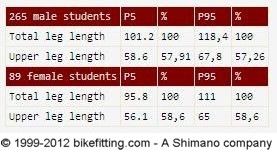
The bikefitting.com article maintains that "standard" seat tube angle geometry in which large frames have shallow seat angle (~72°) and small frames have steeper seat angles (~75°) presupposes that people with longer legs automatically have relatively longer femurs than persons with shorter legs. The table below shows that this presupposition is incorrect. As this table shows, there is no difference in the upper leg length to lower leg length ratio between people with longer legs and people with shorter legs.
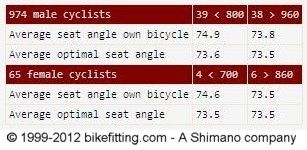
The table below shows the seat angle on the personally owned frames of 1028 cyclists and the optimum seat angle for those cyclists for maximum pedaling efficiency as determined by the bikefitting.com fitting system. While the cyclists’ own frames had STAs from 73.5° to 74.9°, the optimum STA turned out to be 73.6° or 73.5° for all of the cyclists regardless of inner leg length.
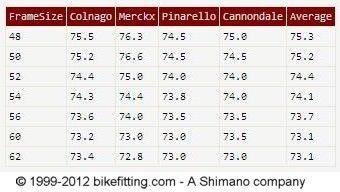
The table below shows that four well known frame manufacturers still build their frames with steeper STAs on smaller frames and shallower STAs on larger frames under the erroneous assumption that people with longer legs have relatively longer femurs.
I maintain that since the OP is having a custom frame made, there is no reason other than style for the frame to be designed to have a setback seatpost to put him in the right position for contact points, fore-and-aft weight distribution on the bike, and good handling assuming the framebuilder knows what he's doing.
If he were using a stock frame that’s too small for him, he might have to use a setback seatpost and a longer stem to put him in the right position, but that’s different than the question he posed regarding a custom frame.
08-01-12 | 05:26 AM
#18
Voice of the Industry
Joined: May 2007
Posts: 12,572
Likes: 8
I am sorry but your thinking is frought with some fundamental myths of bicycle fit. In fact, this thinking somewhat creates the illusion of need for a custom geometry frame which the vast majority don't. Frame mfr's know what they are doing and sadly the general public when choosing a frame many times get it wrong. That is the reality. Not only do they get it wrong, but many choose the wrong frame size for the body size as well, independent of setback and sta. Femur length has little to do with setback. Femur length is just another parameter. Rider C/G is much more complex. What you spout in terms of femur length is tied to another myth known as KOPS which should be called SWAG because that is what it is. Further there are still thousands of bike shops that use this method to position their uninformed customers on a new bike. KOPS based upon femur length is a feeble attempt to position a rider on the bike with proper fore/aft weight distribution. This method is more expedient than good and fails woefully in this objective.
The reason why many if not most frame manufactures have proportional sta sizing is because taller riders 'generally' need the C/G farther behind the BB for proper weight distribution on the bike. Again, this transcends femur length. Femur length is incidental. So what trumps femur length? Length and mass of torso and arms and how much average wattage a rider puts out which naturally unweights the upper body. Taller riders generally have longer torso and arms and therefore more forward mass on the bike. To offset this, a greater proportion of weight needs to move behind the BB. I am a notable example. I wouldn't buy a bike with 73.5 deg sta. I grew up riding bikes with 72 degree sta. I have long legs and ride a 73.0 sta with 32mm setback post.
Again, choice of setback has NOTHING to do with style as you say. It is about what I stated in my first post. It is about reducing bike wheelbase in an effort to quicken handling. It allows a larger rider to ride a shorter wheelbase frame with longer stem for balanced CG on the bike. Most will choose a frame with setback. Not that pros are the bellweather but they do as well and they can ride whatever they want or have custom geometry. Many will prefer the quicker handling of a shorter wheelbase bike with shorter chainstays and a setback post with still adequate tire clearance.
Again, frame manufacturers know what they are doing and sadly the public, not so much. This begs the whole philosophical argument about so called 'custom' geometry. If I had a nickel for every poor fitting custom bike because the customer 'thought he needed' custom geometry, I would be a rich man.
Stan,
Thanks for
The reason why many if not most frame manufactures have proportional sta sizing is because taller riders 'generally' need the C/G farther behind the BB for proper weight distribution on the bike. Again, this transcends femur length. Femur length is incidental. So what trumps femur length? Length and mass of torso and arms and how much average wattage a rider puts out which naturally unweights the upper body. Taller riders generally have longer torso and arms and therefore more forward mass on the bike. To offset this, a greater proportion of weight needs to move behind the BB. I am a notable example. I wouldn't buy a bike with 73.5 deg sta. I grew up riding bikes with 72 degree sta. I have long legs and ride a 73.0 sta with 32mm setback post.
Again, choice of setback has NOTHING to do with style as you say. It is about what I stated in my first post. It is about reducing bike wheelbase in an effort to quicken handling. It allows a larger rider to ride a shorter wheelbase frame with longer stem for balanced CG on the bike. Most will choose a frame with setback. Not that pros are the bellweather but they do as well and they can ride whatever they want or have custom geometry. Many will prefer the quicker handling of a shorter wheelbase bike with shorter chainstays and a setback post with still adequate tire clearance.
Again, frame manufacturers know what they are doing and sadly the public, not so much. This begs the whole philosophical argument about so called 'custom' geometry. If I had a nickel for every poor fitting custom bike because the customer 'thought he needed' custom geometry, I would be a rich man.
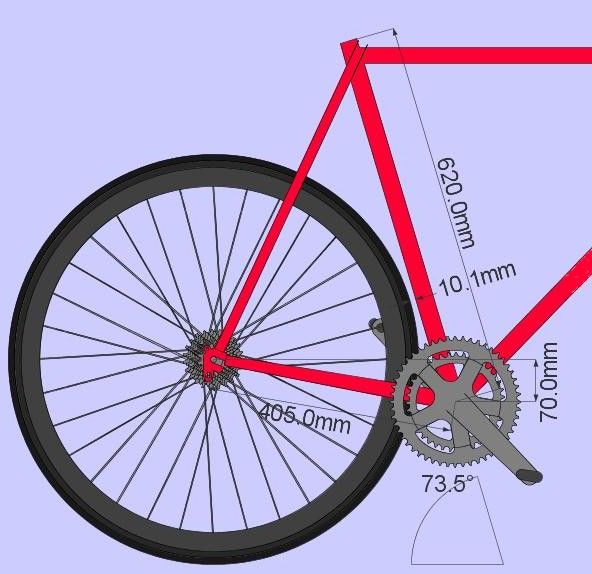
My point in posting the second link was to show that the optimum average seat tube angle for 974 male cyclists with inner leg length between 800mm and 960mm (little guys to big guys) is 73.5°. A 73.5° STA is steep enough so that with a 700c wheel and 25c tires, you can make the chainstays 405mm long and the tire will still clear the seat tube by a centimeter.
The bikefitting.com article maintains that "standard" seat tube angle geometry in which large frames have shallow seat angle (~72°) and small frames have steeper seat angles (~75°) presupposes that people with longer legs automatically have relatively longer femurs than persons with shorter legs. The table below shows that this presupposition is incorrect. As this table shows, there is no difference in the upper leg length to lower leg length ratio between people with longer legs and people with shorter legs.
The table below shows the seat angle on the personally owned frames of 1028 cyclists and the optimum seat angle for those cyclists for maximum pedaling efficiency as determined by the bikefitting.com fitting system. While the cyclists’ own frames had STAs from 73.5° to 74.9°, the optimum STA turned out to be 73.6° or 73.5° for all of the cyclists regardless of inner leg length.
The table below shows that four well known frame manufacturers still build their frames with steeper STAs on smaller frames and shallower STAs on larger frames under the erroneous assumption that people with longer legs have relatively longer femurs.
I maintain that since the OP is having a custom frame made, there is no reason other than style for the frame to be designed to have a setback seatpost to put him in the right position for contact points, fore-and-aft weight distribution on the bike, and good handling assuming the framebuilder knows what he's doing.
If he were using a stock frame that’s too small for him, he might have to use a setback seatpost and a longer stem to put him in the right position, but that’s different than the question he posed regarding a custom frame.
The bikefitting.com article maintains that "standard" seat tube angle geometry in which large frames have shallow seat angle (~72°) and small frames have steeper seat angles (~75°) presupposes that people with longer legs automatically have relatively longer femurs than persons with shorter legs. The table below shows that this presupposition is incorrect. As this table shows, there is no difference in the upper leg length to lower leg length ratio between people with longer legs and people with shorter legs.
The table below shows the seat angle on the personally owned frames of 1028 cyclists and the optimum seat angle for those cyclists for maximum pedaling efficiency as determined by the bikefitting.com fitting system. While the cyclists’ own frames had STAs from 73.5° to 74.9°, the optimum STA turned out to be 73.6° or 73.5° for all of the cyclists regardless of inner leg length.
The table below shows that four well known frame manufacturers still build their frames with steeper STAs on smaller frames and shallower STAs on larger frames under the erroneous assumption that people with longer legs have relatively longer femurs.
I maintain that since the OP is having a custom frame made, there is no reason other than style for the frame to be designed to have a setback seatpost to put him in the right position for contact points, fore-and-aft weight distribution on the bike, and good handling assuming the framebuilder knows what he's doing.
If he were using a stock frame that’s too small for him, he might have to use a setback seatpost and a longer stem to put him in the right position, but that’s different than the question he posed regarding a custom frame.
Thanks for
Last edited by Campag4life; 08-01-12 at 05:41 AM.
08-01-12 | 05:58 AM
#19
Still can't climb
Joined: Sep 2006
Posts: 23,024
Likes: 6
From: Limey in Taiwan
When i built my bikes, I didn't know until after it was complete and I rode it a bit. Only then did I know if my fit was alright. On one bike I was comfy with zero set back thomson and on the other a set back ritchey wcs.
strangely I also had to use different width handlebars to get comfy and when I interchanged them, they didn't work. riddle me that one!
strangely I also had to use different width handlebars to get comfy and when I interchanged them, they didn't work. riddle me that one!
__________________
coasting, few quotes are worthy of him, and of those, even fewer printable in a family forum......quote 3alarmer
No @coasting, you should stay 100% as you are right now, don't change a thing....quote Heathpack
coasting, few quotes are worthy of him, and of those, even fewer printable in a family forum......quote 3alarmer
No @coasting, you should stay 100% as you are right now, don't change a thing....quote Heathpack
08-01-12 | 08:10 AM
#20
Voice of the Industry
Joined: May 2007
Posts: 12,572
Likes: 8
When i built my bikes, I didn't know until after it was complete and I rode it a bit. Only then did I know if my fit was alright. On one bike I was comfy with zero set back thomson and on the other a set back ritchey wcs.
strangely I also had to use different width handlebars to get comfy and when I interchanged them, they didn't work. riddle me that one!
strangely I also had to use different width handlebars to get comfy and when I interchanged them, they didn't work. riddle me that one!
A number of factors affect reach, including no. of spacers under the stem...sine of the HTA.
08-01-12 | 08:20 AM
#21
Decrepit Member
Joined: Aug 2005
Posts: 10,488
Likes: 92
From: Santa Rosa, California
Bikes: Waterford 953 RS-22, several Paramounts
Whatever works for you is good. Ride your setback post in style.
08-01-12 | 08:23 AM
#22
I chose 43mm because that's what all my bikes have had to this point. I did some research beforehand, and 43mm seems to be generally recommended. I would have loved to engage the builder in a back-and-forth discussion about which was best for me, but there was a bit of a language barrier and they took a lot of time answering questions.
so, I did ask about it on this forum and others, and I was told repeatedly that I should leave the builder alone and just let him build the bike, and to not trouble him with all my little questions.
so, I did ask about it on this forum and others, and I was told repeatedly that I should leave the builder alone and just let him build the bike, and to not trouble him with all my little questions.
Best of luck. I hope you get exactly what you want. :-)
__________________
-------
Some sort of pithy irrelevant one-liner should go here.
-------
Some sort of pithy irrelevant one-liner should go here.

Thread
Thread Starter
Forum
Replies
Last Post
reno327
Clydesdales/Athenas (200+ lb / 91+ kg)
5
08-14-12 09:41 AM
