I am sorry but your thinking is frought with some fundamental myths of bicycle fit. In fact, this thinking somewhat creates the illusion of need for a custom geometry frame which the vast majority don't. Frame mfr's know what they are doing and sadly the general public when choosing a frame many times get it wrong. That is the reality. Not only do they get it wrong, but many choose the wrong frame size for the body size as well, independent of setback and sta. Femur length has little to do with setback. Femur length is just another parameter. Rider C/G is much more complex. What you spout in terms of femur length is tied to another myth known as KOPS which should be called SWAG because that is what it is. Further there are still thousands of bike shops that use this method to position their uninformed customers on a new bike. KOPS based upon femur length is a feeble attempt to position a rider on the bike with proper fore/aft weight distribution. This method is more expedient than good and fails woefully in this objective.
The reason why many if not most frame manufactures have proportional sta sizing is because taller riders 'generally' need the C/G farther behind the BB for proper weight distribution on the bike. Again, this transcends femur length. Femur length is incidental. So what trumps femur length? Length and mass of torso and arms and how much average wattage a rider puts out which naturally unweights the upper body. Taller riders generally have longer torso and arms and therefore more forward mass on the bike. To offset this, a greater proportion of weight needs to move behind the BB. I am a notable example. I wouldn't buy a bike with 73.5 deg sta. I grew up riding bikes with 72 degree sta. I have long legs and ride a 73.0 sta with 32mm setback post.
Again, choice of setback has NOTHING to do with style as you say. It is about what I stated in my first post. It is about reducing bike wheelbase in an effort to quicken handling. It allows a larger rider to ride a shorter wheelbase frame with longer stem for balanced CG on the bike. Most will choose a frame with setback. Not that pros are the bellweather but they do as well and they can ride whatever they want or have custom geometry. Many will prefer the quicker handling of a shorter wheelbase bike with shorter chainstays and a setback post with still adequate tire clearance.
Again, frame manufacturers know what they are doing and sadly the public, not so much. This begs the whole philosophical argument about so called 'custom' geometry. If I had a nickel for every poor fitting custom bike because the customer 'thought he needed' custom geometry, I would be a rich man.
Originally Posted by
Scooper
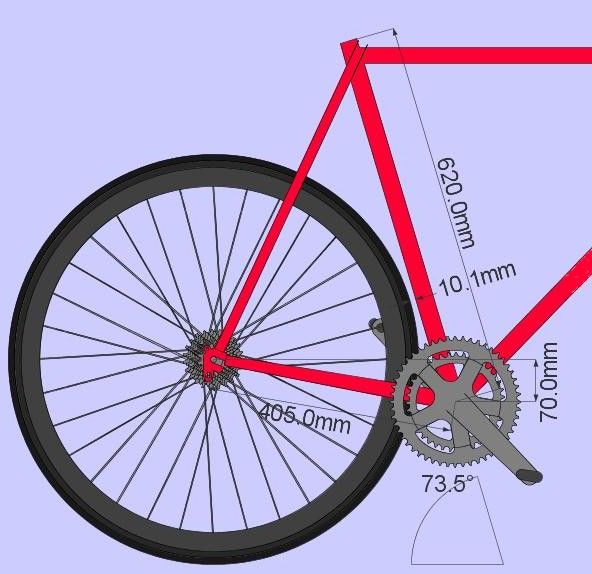
My point in posting the second link was to show that the optimum average seat tube angle for 974 male cyclists with inner leg length between 800mm and 960mm (little guys to big guys) is 73.5°. A 73.5° STA is steep enough so that with a 700c wheel and 25c tires, you can make the chainstays 405mm long and the tire will still clear the seat tube by a centimeter.
The bikefitting.com article maintains that "standard" seat tube angle geometry in which large frames have shallow seat angle (~72°) and small frames have steeper seat angles (~75°)
presupposes that people with longer legs automatically have relatively longer femurs than persons with shorter legs. The table below shows that this presupposition is incorrect. As this table shows, there is no difference in the upper leg length to lower leg length ratio between people with longer legs and people with shorter legs.
The table below shows the seat angle on the personally owned frames of 1028 cyclists and the optimum seat angle for those cyclists for maximum pedaling efficiency as
determined by the bikefitting.com fitting system. While the cyclists’ own frames had STAs from 73.5° to 74.9°, the optimum STA turned out to be 73.6° or 73.5° for all of the cyclists regardless of inner leg length.
The table below shows that four well known frame manufacturers still build their frames with steeper STAs on smaller frames and shallower STAs on larger frames under the erroneous assumption that people with longer legs have relatively longer femurs.
I maintain that since the OP is having a custom frame made, there is no reason other than style for the frame to be designed to have a setback seatpost to put him in the right position for contact points, fore-and-aft weight distribution on the bike, and good handling assuming the framebuilder knows what he's doing.
If he were using a stock frame that’s too small for him, he might have to use a setback seatpost and a longer stem to put him in the right position, but that’s different than the question he posed regarding a custom frame.
Stan,
Thanks for