Originally Posted by
uncle uncle
Okay, so, I read the comments related to my additional questions connected to the original posters questions. I agree with T-Mar's remarks to Tom's comments. 4130 Chromoly (aka bike tube chromoly) is 1.75 times stronger than 1020 high tensile (aka bike tube hi-ten). So, in theory, a frame made from chromoly could end up being 60% lighter. Chances are though, the difference is less. For one, standardized tube diameters and standardized tube wall thicknesses mean that you probably couldn't get EXACTLY the tubing dimensions that would be ideal. For instance, your calculations may say that the perfect seat tube (with a chosen wall thickness of .08") would have a diameter of .83467 inches. Well, .83467 isn't standard, so you would probably be forced to round up to the nearest standard diameter, say .875". Also, a lot of frames used chromoly tubing for the main tubes (which have approximately 1" diameter) but hi-ten stays (where, because of the comparatively smaller cross-sectional area of the tube, the weight savings would be more diminished, and the cost not worth the weight savings). I would like to know a comparative weight of a 23" size frame made with hi-ten tubing, anyone know? Plus, I have a KHS Classic bike, made with Tange #5 tubing (which I believe to be seamless) that has components with a 1981 manufacturing date. I assume that it was fairly "entry level" for it's era, with it's components being fairly closely matched to my 1977 Schwinn LeTour II (definitely near entry level specimen for it's day). So, I question whether the ability to create seamed chromoly tubesets was the driving factor for the reasoning as to why chromoly tubing became so affordable and widespread in the eighties. It seems to me, since Tange seamed chromoly tubing (like Tange 1000) showed up AFTER it's other tubing offerings (like Tange #3, which is quite similar in size/strength as Tange 1000, but seamless). So seamed chromoly tubing did provide lower pricing, but it did so after seamed chromoly tubing had already shown up. Any arguments to refute my claims (more like guesses than claims really)?
You invited a response, so I'm going to try and use some bicycle tubing data from Columbus to take a slightly different tack. It’s just easier for me to go through the exercise this way rather than try to follow your train of thought. I apologize in advance for any confusion. I certainly don't know everything, but as an amateur framebuilder (limited so far to brazed lugged steel), I'm pretty familiar with standard tubing dimensions (diameters, wall thickness, weights).
Most bicycle tubing has wall thickness in the range of 0.5mm to 1.0mm in the center (non-butted) sections of the tubes. It can be as thin as 0.3mm (Reynolds 953) and as thick as 1.22mm (18 gauge non-butted 1020 carbon steel used in late seventies Schwinn Le Tours, Travelers, and World Sports). A wall thickness of .08" (2.032mm) would be almost a millimeter thicker than the 1020 steel tubing used in these late seventies Schwinns.
Standard Imperial O.D. for the main tubes in the 1980s (pre-O.S.) were:
Top Tube – 25.4 mm (1”)
Down Tube – 28.6 mm (1-1/8”)
Seat Tube – 28.6 mm (1-1/8”)
Head Tube – 31.75 mm (1-1/4”)
Since the density of all steel alloys is virtually identical, a tube that's twice as thick as another with the same O.D. and length will weigh nearly twice as much.
Columbus SL is a double-butted chromoly tubeset used extensively in the eighties for competition bicycles, and the diameters, butting profiles, and weight of a raw tubeset (not cut to length and mitered by the framebuilder) are shown in the data sheet below.
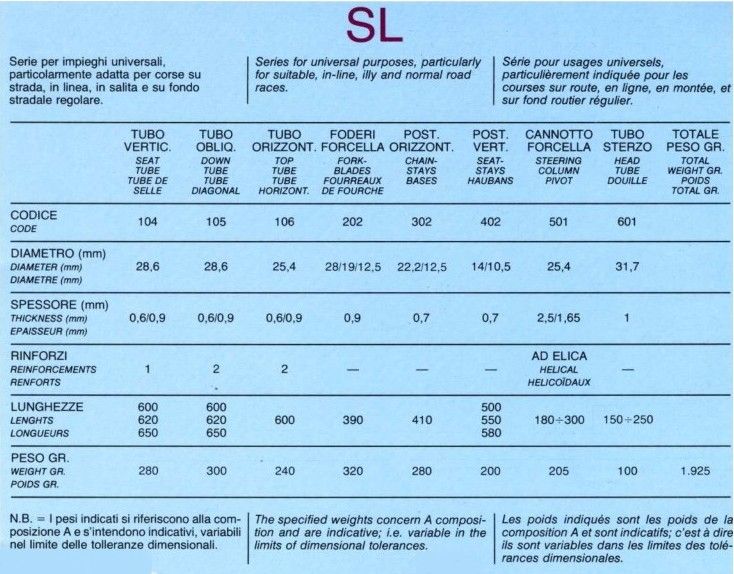
Notice the weight of the raw tubeset is 1,925 grams (4.244 pounds).
Columbus Zeta is a straight-gauge carbon steel tubeset used in the eighties for lower end sport bicycles, and the diameters, butting profiles, and weight of a raw tubeset are shown in the data sheet below.
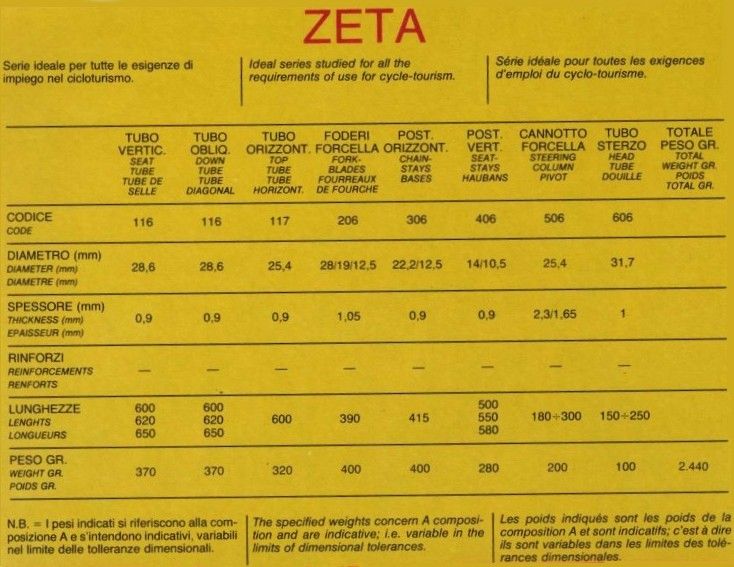
The weight of the raw tubeset is 2,440 grams (5.379 pounds), or more than 1.1 lbs heavier than the SL tubeset.
The Zeta tubing has a 0.9mm wall thickness, while SL is 0.6mm in the center part of the tubes and 0.9mm in the butts.
The 18 gauge 1020 straight gauge tubing in the late seventies Le Tours and Travelers had a wall thickness of 1.22 mm, which would add a bit more than a pound to the weight of the 0.9mm Zeta tubeset, putting it at about 6.5 pounds.
In contrast to the SL, Zeta, and 18 ga. 1020 tubesets, the new Columbus XCr for lugs stainless OS raw tubeset weighs 1,425 grams (3.142 pounds), or more than a pound less than SL.
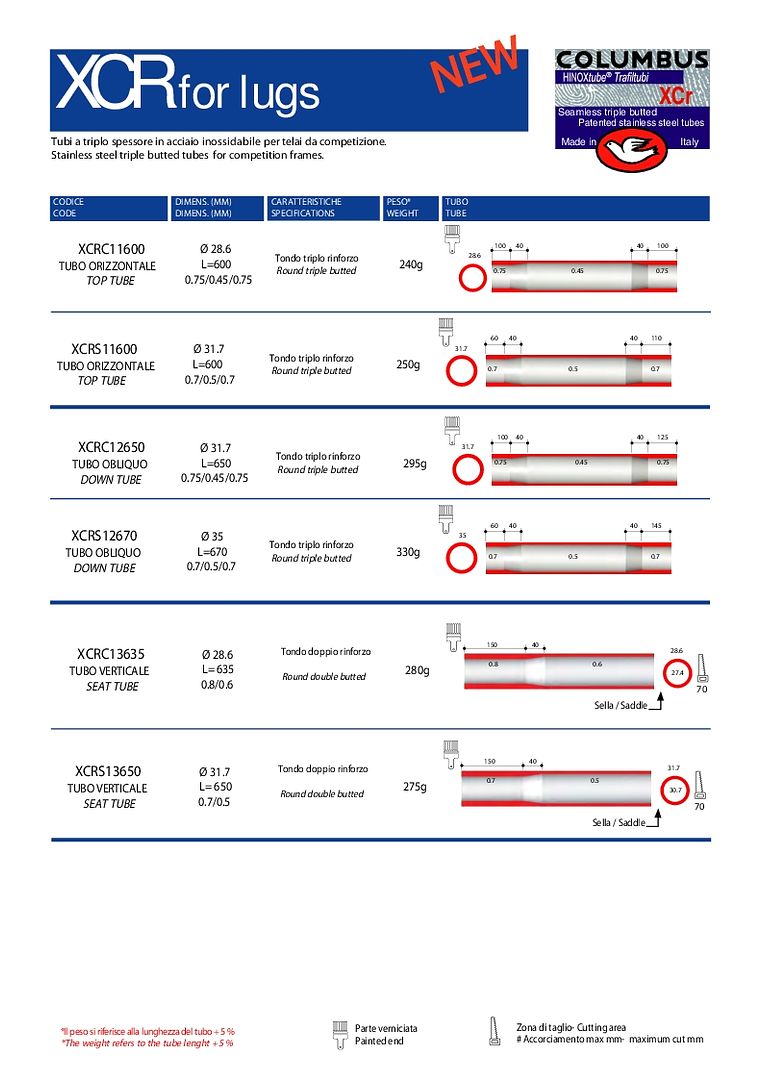
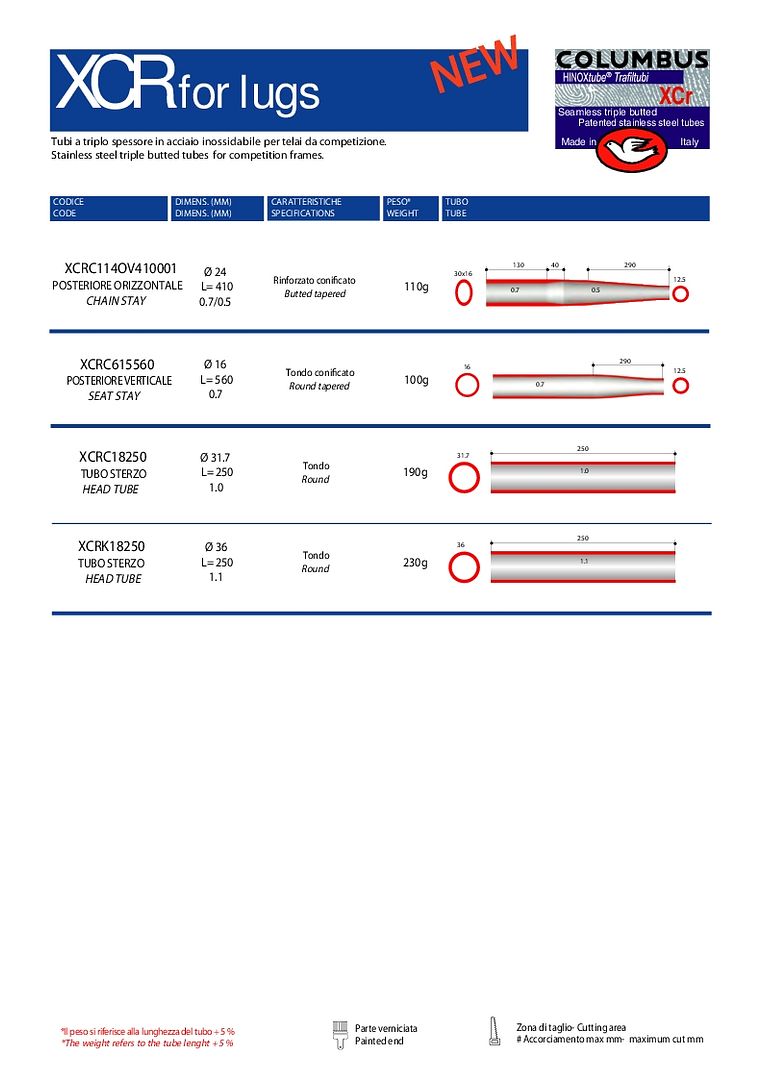
Of course, these weights are for full length tubing, so the differences between tubeset weights will be less for smaller frames. Also, for practical purposes, let’s specify that the weights of lugs, dropouts, and BB shells will be the same for each frame.
Basically, my point is that the weight of a raw 1979 Traveler 18 gauge 1020 alloy tubeset at 6.5 pounds is going to be more than twice as heavy as a raw Columbus XCr for lugs tubeset and more than two pounds heavier than a Columbus SL raw tubeset.