


When was chrome moly first used in frames?
 03-27-13 | 02:53 PM
#51


Decrepit Member
Joined: Aug 2005
Posts: 10,488
Likes: 92
From: Santa Rosa, California
Bikes: Waterford 953 RS-22, several Paramounts
Okay, so, I read the comments related to my additional questions connected to the original posters questions. I agree with T-Mar's remarks to Tom's comments. 4130 Chromoly (aka bike tube chromoly) is 1.75 times stronger than 1020 high tensile (aka bike tube hi-ten). So, in theory, a frame made from chromoly could end up being 60% lighter. Chances are though, the difference is less. For one, standardized tube diameters and standardized tube wall thicknesses mean that you probably couldn't get EXACTLY the tubing dimensions that would be ideal. For instance, your calculations may say that the perfect seat tube (with a chosen wall thickness of .08") would have a diameter of .83467 inches. Well, .83467 isn't standard, so you would probably be forced to round up to the nearest standard diameter, say .875". Also, a lot of frames used chromoly tubing for the main tubes (which have approximately 1" diameter) but hi-ten stays (where, because of the comparatively smaller cross-sectional area of the tube, the weight savings would be more diminished, and the cost not worth the weight savings). I would like to know a comparative weight of a 23" size frame made with hi-ten tubing, anyone know? Plus, I have a KHS Classic bike, made with Tange #5 tubing (which I believe to be seamless) that has components with a 1981 manufacturing date. I assume that it was fairly "entry level" for it's era, with it's components being fairly closely matched to my 1977 Schwinn LeTour II (definitely near entry level specimen for it's day). So, I question whether the ability to create seamed chromoly tubesets was the driving factor for the reasoning as to why chromoly tubing became so affordable and widespread in the eighties. It seems to me, since Tange seamed chromoly tubing (like Tange 1000) showed up AFTER it's other tubing offerings (like Tange #3, which is quite similar in size/strength as Tange 1000, but seamless). So seamed chromoly tubing did provide lower pricing, but it did so after seamed chromoly tubing had already shown up. Any arguments to refute my claims (more like guesses than claims really)?
Most bicycle tubing has wall thickness in the range of 0.5mm to 1.0mm in the center (non-butted) sections of the tubes. It can be as thin as 0.3mm (Reynolds 953) and as thick as 1.22mm (18 gauge non-butted 1020 carbon steel used in late seventies Schwinn Le Tours, Travelers, and World Sports). A wall thickness of .08" (2.032mm) would be almost a millimeter thicker than the 1020 steel tubing used in these late seventies Schwinns.
Standard Imperial O.D. for the main tubes in the 1980s (pre-O.S.) were:
Top Tube – 25.4 mm (1”)
Down Tube – 28.6 mm (1-1/8”)
Seat Tube – 28.6 mm (1-1/8”)
Head Tube – 31.75 mm (1-1/4”)
Since the density of all steel alloys is virtually identical, a tube that's twice as thick as another with the same O.D. and length will weigh nearly twice as much.
Columbus SL is a double-butted chromoly tubeset used extensively in the eighties for competition bicycles, and the diameters, butting profiles, and weight of a raw tubeset (not cut to length and mitered by the framebuilder) are shown in the data sheet below.
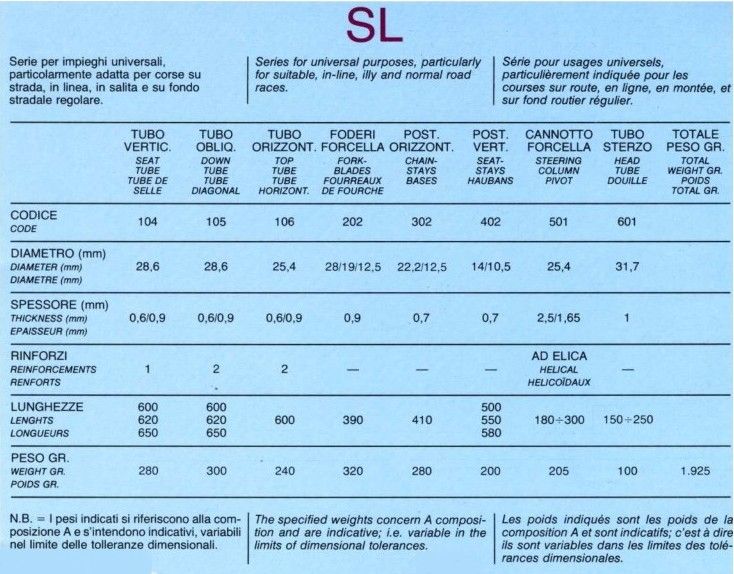
Notice the weight of the raw tubeset is 1,925 grams (4.244 pounds).
Columbus Zeta is a straight-gauge carbon steel tubeset used in the eighties for lower end sport bicycles, and the diameters, butting profiles, and weight of a raw tubeset are shown in the data sheet below.
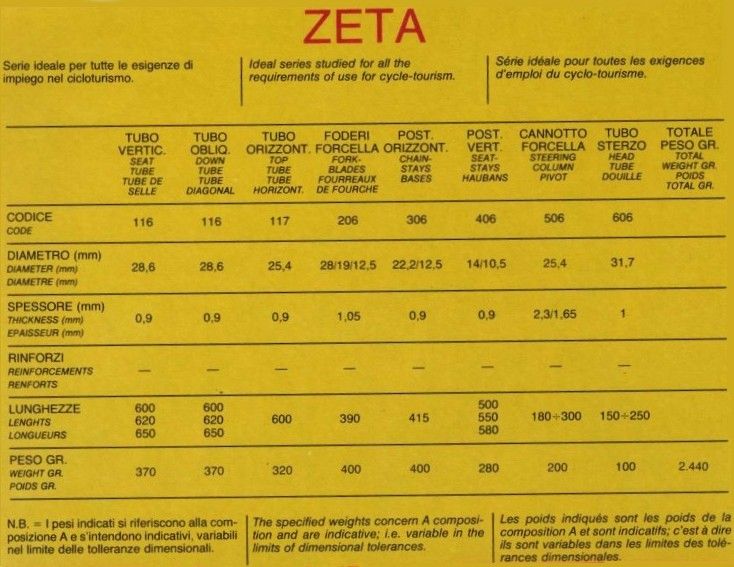
The weight of the raw tubeset is 2,440 grams (5.379 pounds), or more than 1.1 lbs heavier than the SL tubeset.
The Zeta tubing has a 0.9mm wall thickness, while SL is 0.6mm in the center part of the tubes and 0.9mm in the butts.
The 18 gauge 1020 straight gauge tubing in the late seventies Le Tours and Travelers had a wall thickness of 1.22 mm, which would add a bit more than a pound to the weight of the 0.9mm Zeta tubeset, putting it at about 6.5 pounds.
In contrast to the SL, Zeta, and 18 ga. 1020 tubesets, the new Columbus XCr for lugs stainless OS raw tubeset weighs 1,425 grams (3.142 pounds), or more than a pound less than SL.
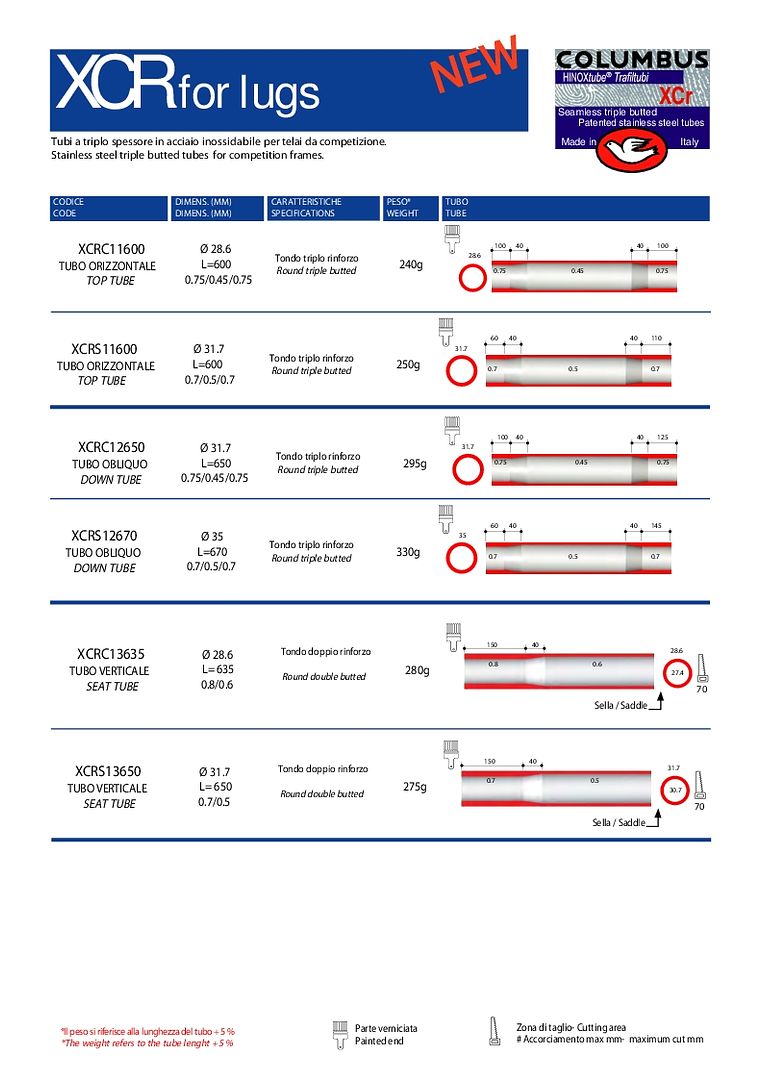
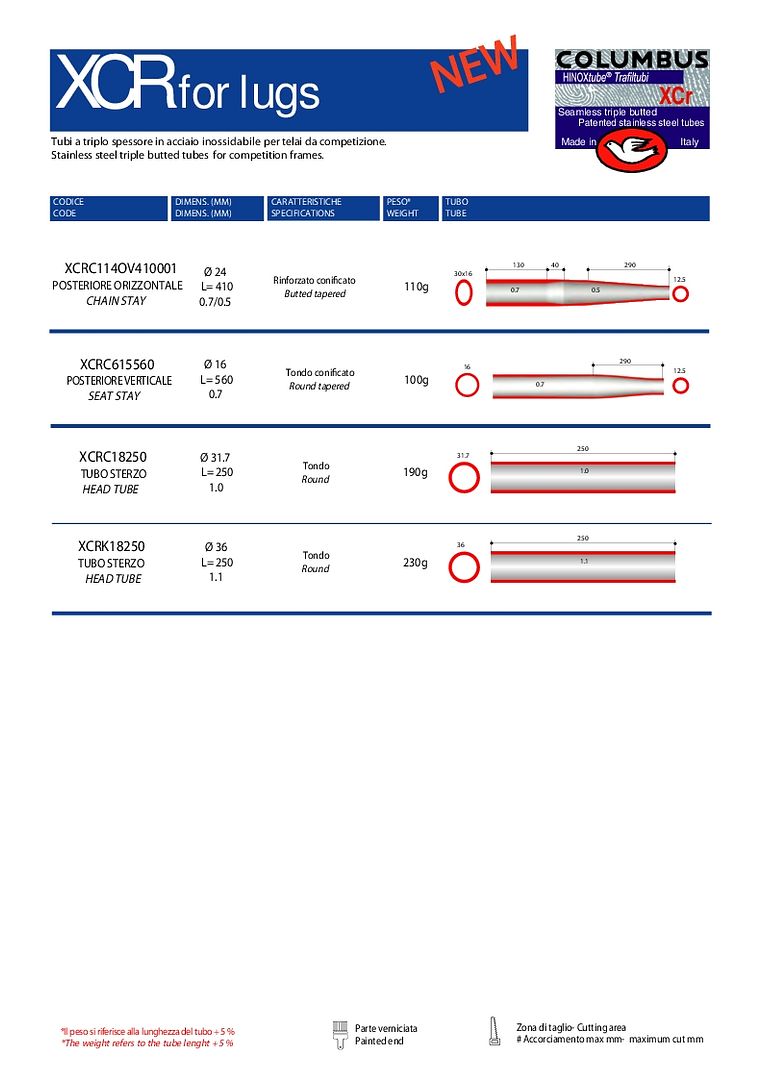
Of course, these weights are for full length tubing, so the differences between tubeset weights will be less for smaller frames. Also, for practical purposes, let’s specify that the weights of lugs, dropouts, and BB shells will be the same for each frame.
Basically, my point is that the weight of a raw 1979 Traveler 18 gauge 1020 alloy tubeset at 6.5 pounds is going to be more than twice as heavy as a raw Columbus XCr for lugs tubeset and more than two pounds heavier than a Columbus SL raw tubeset.

Last edited by Scooper; 03-27-13 at 03:52 PM. Reason: revise for clarity


 03-27-13 | 07:10 PM
#53

Senior Member

Joined: Sep 2009
Posts: 1,389
Likes: 115
From: EagleRiver AK
Okay, so, I read the comments related to my additional questions connected to the original posters questions. I agree with T-Mar's remarks to Tom's comments. 4130 Chromoly (aka bike tube chromoly) is 1.75 times stronger than 1020 high tensile (aka bike tube hi-ten). So, in theory, a frame made from chromoly could end up being 60% lighter. Chances are though, the difference is less. For one, standardized tube diameters and standardized tube wall thicknesses mean that you probably couldn't get EXACTLY the tubing dimensions that would be ideal. For instance, your calculations may say that the perfect seat tube (with a chosen wall thickness of .08") would have a diameter of .83467 inches. Well, .83467 isn't standard, so you would probably be forced to round up )
Thickwalled hi-ten tube bikes probably suffered a bit from trying to conform to the standard tube OD of nicer CrMo bikes. The hi-ten steel was not strong enough to use as a thinner wall but they were overly stiff and heavy because they used such thick tubing. Probably would be possible to have built a slighlty more optimized hi-ten bike using smaller diameter tubing throughout.
Also note that as steel strength increased beyond that of plain non-HT CrMo, it became necessary to bump up the tubing OD by +1/8" and later +1/4" OD in order to better optimize the strength-stiffness-weight ballance to the material.
I have run across a few older mid-low end bikes that proclaim that they used butted hi-tensile tubing. Interesting to see that it was at all economically viable to produce butted hi-ten tubes to compete in the same marketplace as strait-gauge CrMo.
03-27-13 | 07:40 PM
#54
Senior Member

Joined: Nov 2004
Posts: 23,212
Likes: 3,122
Chances are though, the difference is less. For one, standardized tube diameters and standardized tube wall thicknesses mean that you probably couldn't get EXACTLY the tubing dimensions that would be ideal. For instance, your calculations may say that the perfect seat tube (with a chosen wall thickness of .08") would have a diameter of .83467 inches. Well, .83467 isn't standard, so you would probably be forced to round up to the nearest standard diameter, say .875". Also, a lot of frames used chromoly tubing for the main tubes (which have approximately 1" diameter) but hi-ten stays (where, because of the comparatively smaller cross-sectional area of the tube, the weight savings would be more diminished, and the cost not worth the weight savings).
The better material frame will probably also have more fittings. The rear dropout will likely have a hanger that adds weight while the hi-tensile frame likely has a hangerless, stamped dropout. The better frame probably has shifter bosses, which weigh less than the cable stops for the stem shifters on the hi-tensile frame. The CrMo frame probably has an extra water bottle boss. Basically, the better frame likely has more convenience fittings which add weight and further compromise it’s weight advantage over the hi-tensile frame.
However, the biggest compromise are the stays and forks. In these applications CrMo’s potential weight savings cannot be fully realized because the forks and rear triangle would be too whippy. Stiffness in a round tube is a function of the material’s modulus of elasticity, its outer diameter and its thickness. In the case of CrMo and 1020 hi-tensile, the modulus of elastic are similar and the stiffness primarily becomes a function of diameter and thickness.
A main triangle can maintain good stiffness, primarily due to the larger diameter tubes. But shrink the diameter, as in the stays and fork blades and things start to get whippy. In order to maintain the necessary rigidity, Tange used CrMo stays that are about 80% the thickness of their hi-tensile stays. So, in these regions you lose about ½ the potential weight savings of CrMo. This is why designers often substitute lesser grade material in the stays and forks. It saves money without affecting the weight as much.
Then there is the whole question of how much the designer wants to push envelope in either direction. Does he want to go heavier than the norm, knowing it is more likely to be abused and used in all sorts of applications? Or can he make it lighter, knowing that it will be used only in certain applications and that the extra cost will result in better care? A designer of an X-mart bicycle is going to build in a heavier safety factor than a standard hi-tensile frame, while a designer of a time trial frame will build in a lot less than your typical CrMo frame.
Now, here’s the bonus. I found a road on a 1985 KHS Fiero with a Tange 900, seamed, double butted, main triangle. Frame weight was 5 lbs 2.5 oz and it’s a 2" larger frame. So you’d get about an additional ½ lb saving by going butted CrMo in the main triangle.
Plus, I have a KHS Classic bike, made with Tange #5 tubing (which I believe to be seamless) that has components with a 1981 manufacturing date. I assume that it was fairly "entry level" for it's era, with it's components being fairly closely matched to my 1977 Schwinn LeTour II (definitely near entry level specimen for it's day). So, I question whether the ability to create seamed chromoly tubesets was the driving factor for the reasoning as to why chromoly tubing became so affordable and widespread in the eighties. It seems to me, since Tange seamed chromoly tubing (like Tange 1000) showed up AFTER it's other tubing offerings (like Tange #3, which is quite similar in size/strength as Tange 1000, but seamless). So seamed chromoly tubing did provide lower pricing, but it did so after seamed chromoly tubing had already shown up. Any arguments to refute my claims (more like guesses than claims really)?
Let’s take a look at the two previously mentioned KHS bicycles. In 1983 a KHS Citation with a seamless, plain gauge CrMo main triangle cost $219. Two years later the KHS Fiero costs only $20 more, yet it’s got a ½ lb lighter frame, thanks to going seamed, butted CrMo. To top it off, the rate of inflation over those two years was about 7.5%, so the adjusted price increase was only about $5. The components were comparable and, if anything, arguably better on the Fiero. They were certainly lighter based on overall weights.
Seamless, butted, CrMo tubes were pretty much restricted to mid-range and higher models. The best you got for an entry level price up to the very early 1980s was a plain gauge, CrMo main triangle. The mid-1980s seamed tubesets brought butted CrMo butted into the entry level. You got the weight savings of butted tubes but perhaps more importantly you also got their more resilient ride quality. A couple of years earlier you would have had to pay a lot more to get the weight savings and resiliency.
Last edited by T-Mar; 03-27-13 at 08:00 PM. Reason: bolded butting in last paragraph
02-12-17 | 11:38 AM
#55
Senior Member
Joined: Aug 2010
Posts: 1,941
Likes: 271
From: south kansas america
Bikes: too many
After coming across another KHS bicycle this week and was hoping to find more info on via the WWW, I happened across this thread. Even though it's been four or so years, I just want to thank everyone who offered up insights and observations to my questions. I really appreciate all the help and knowledge given without any attitude towards this novice. It creates a great community here on the forum, and I hope that sometime in the future, I get to meet some of you and thank you in person for all good you have graciously given me throughout my years participating on this forum. Thanks once again, you make this the best of WWW for me.
02-12-17 | 11:40 AM
#56

Senior Member


Joined: Apr 2012
Posts: 21,785
Likes: 5,707
From: Middle Earth (aka IA)
Bikes: A bunch of old bikes and a few new ones
I thought all the early high end steel sets grew out of technology used from the aircraft industry but I could be wrong on this.


Thread
Thread Starter
Forum
Replies
Last Post
Veloh
Classic & Vintage
85
10-13-12 10:02 AM
