Originally Posted by
I-Like-To-Bike
Howsteepisit has asked the exactly correct question. Mr. Ratliff insists on placing the cart before the horse.
In any respectable Risk Management Program, the various potential hazards are considered and evaluated for their relative risk, be it financial or safety related, BEFORE various controls are considered. When hazards are evaluated as having an insignificant risk value (probability of event x likely severity of event,) seldom are controls considered necessary or even desirable. This is especially true where controls with negative effects on the desired activity /or with debatable capability in reducing the risk value, especially a hazard evaluated as having an already very low risk value.
emphasis added, jcr
Something like this:
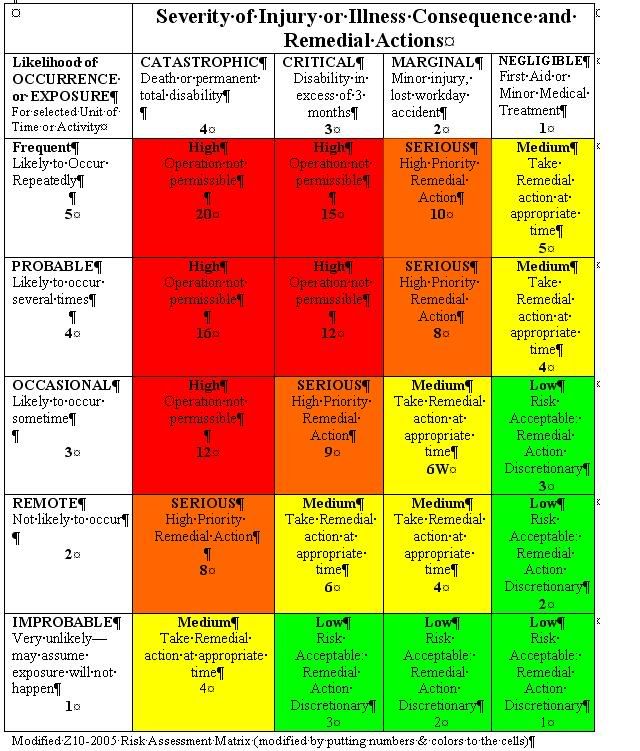
From ANSI Z10-2005, American National Standard for Occupational Safety and Health Management Systems
Note that falling off a bike would be an occasional happening, so the frequency would be "Occasional," with a Liklihood rating of 3. The Severity rating would be either a 3 or 4 (with the potential of disability of greater than 3 months, a permanent disability, or death). This gets a "High" or "Serious" rating, with the designation "Operations not Permissible" or "High Priority Remedial Action." For bicycling, training, equipping the bike correctly, fitting it, and PPE (helmet) are indicated.
I'll go into Howsteepitis' question later.
John