Originally Posted by
Carbonfiberboy
I appreciate the long post. However my experience gives me problems with it, mostly this idea that one must exhaust one's glycogen before one can improve one's fatty acid oxidation. I wish I understood all this much better but there's just very little info in the literature.
So #1 is that it's extremely difficult to exhaust one's muscle glycogen. That's called bonking and it's never pleasant. Fasted resting does almost nothing to deplete muscle gycogen. Between a fully digested dinner at whatever time and awakening, there's no change. So the fasted athlete starts their workout with a full load of muscle glycogen. So what's being accomplished, especially by going hard for an hour, other than the usual good effects of going hard and burning a decent amount of glycogen? So what did fasting accomplish?
Agreed that you aren't completely exhausting muscle glycogen, almost impossible to do as a mentioned, but practically speaking we are trying to arrive at this pre bonking state and staying there to get the fat adaption, the amount of liver and muscle glycogen that is depleted isn't well studied as far as a iknow.
A fasted athlete starts with full muscle glycogen(which can't be mobilized to other muscles like liver glycogen) but depleted liver glycogen(not fully) and lower blood glucose, and increased fatty acid oxidation pathways. There are some signaling pathways that are upregulated here that wouldn't be turned on after a meal. Is it as good as being at the pre bonk state most of us get after 2-3 hours without food? Probably not quite there but it kickstarts that process. It is more efficient.
Originally Posted by
Carbonfiberboy
#2, there was a poster here who was very into polarized training. He did a tremendous amount of work below VT1. He was working hard on increasing his fat oxidation by so doing. His method was to measure his blood lactate. If his blood lactate rose above resting levels, he knew he was going too hard. The object was to get to be able to train just below VT1 with zero increase in blood lactate. Now here's the part I'm not sure I'm correct about: my research seems to indicate that the oxidation of carbohydrate results in increases in blood lactate. The oxidation of fatty acids does not. Is so? If so, our poster was exercising at up to VT1 while burning only fat. With no change to his muscle glycogen. I.e. no dietary alteration was necessary for this achievement, only lots of riding at a moderate pace.
At no state even at rest are we burning only fat. VT1 occurs at 40-60% of V02max for most people so you can see roughly the contribution from each.

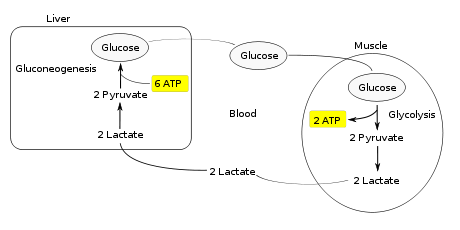
If you look at the Cori cycle then you see how lactate is converted back to glucose in the liver, so at lower output levels he's just at a steady state conversion, just like at MLSS you reach another plateu
Originally Posted by
Carbonfiberboy
#3, my experience. Today, I went on my first fat-burner ride of the year. It's a sunny day and I had the time. I had breakfast, a very small bean burrito from a 6" corn tortilla, a glass of juice, and 15g of whey protein. Two hours later, when my blood sugar had stabilized, I rode for 33 miles and 1500' gain, a 2 hour ride. I took one bottle of sports drink with me, nothing else, and did not touch the sports drink.
I rode the hills in the first couple miles hard, to deplete my blood sugar, and then settled down to ride mostly below VT1. Almost all the climbing was in the first 15 miles. At that point, my blood sugar was way down. I could tell because my HR at VT1 had dropped 6 beats and I had the usual hypoglycemic symptoms, this being my first fat-burner ride.
I kept up the below-VT1 pace so as not to access glycogen and pop my blood sugar/lactate back up. My experience is that as I repeat these sorts of rides as the season goes on, I need to eat less and less on training rides until I can do 4 hour hilly training rides on our tandem on ~500 calories of sugar. So I'm saying that these below-VT1 training rides increase my ability to oxidize fat with no dietary intervention other than not eating on the ride, or much glycogen depletion. After I got back, I had 15g sugar and 25g protein in a recovery drink and ate a small lunch. I'm not hungry and won't need to snack before dinner, more evidence that I wasn't burning much in the way of carbs, mostly fat.
Strava estimated 954 kj, but that's probably low because I had a good headwind all the way back. TP gave me a hrTSS of only 114, my HR being so low during most of the ride.
See above in terms of accessing glycogen. Since the first 15 miles were climbing I'm going to assume that at least the 1st hour was used to deplete glycogen and reach that pre bonk stage, the remaining <1hr was in this fat adaption zone. I'd like to see you repeat that ride in a fasted state, its real nice here this week, maybe tomorrow morning or fri/sat? I would guess you get to the HR dip point earlier in the ride. I want to make it clear that fasted training isn't the
only way to get these adaptions, its just a more efficient way. I've been slacking all winter and my FTP has tanked, but I'm about a month into resuming my fasted morning commutes, and felt like I retained much of my adaptions from last season. I haven't even done any rides over an hour until last weekend(snowboard season is finally coming to an end) Here's a ride I did on Sat which was similar to yours, completed fasted for ~18 hours(last meal around 7pm previous day, started ride at noon)
https://www.strava.com/activities/1523213463#. Similar distance/time/elevation, IF 0.91(SST), ~1300kJ(actual) all without any food/calories. I also carried a bottle of sports mix but didn't touch it.
Originally Posted by
Carbonfiberboy
Be all the forgoing as it may, there's still little evidence that training low produces performance increases:
https://www.peakendurancesport.com/e...ogen-training/
However my opinion is that most train low studies don't incorporate sufficient training which stresses the glycolytic pathways.
So what's your take on this?
Training low trains a few specific adaptions but don't allow you to do quality work thats necessary for racing, would be good for ultradistance types of races like RAAM but I don't think it would help at all for things like crits and cyclocross etc. Figuring out how to get both types of training in and getting both benefits is what the sleep low train high strategy Dr. Hawley is studying can maybe do this. I haven't tested it yet, and probably won't. The idea of a protein shake and no carbs for dinner after a ride doesn't appeal to me at all, but the research is interesting. I think we both agree we need to train low(however you get there is up to you) and train high to meet all the demands of cycling, which differs significantly from running in regards to variation in intensity.