You lost me at Zwift. Toss the software and use your smart trainer as the tool it is.
Load monitoring can be extremely precise using smart trainer ERG mode indoors where you can quantify and control both external load and the environment.
External load is the work you perform. Internal load is the effect that external load has on you.
If internal load decreases for the same external load or stays the same for increased external load then you have improved and need to progress your training.
If internal load increases for the same external load then you are tired or your fitness has declined. You need to figure out what went wrong which is external load or recovery time or both. A look at recent history, especially why you set external load and recovery time as you did will likely give you clues as to what needs to change.
Then make a change and test and see how internal:exteral-load ratio changes. If for the better then you learned something. If no then change something else.
Keep a training log and review it regularly for patterns.
Regarding periodization, there are plenty of resources for that but it largely comes down to general ==> specific, long ==> short, low ==> high. There are plenty of guidelines regarding proportion of available training time dedicated to base ==> build ==> peak. There are also signals, especially useful indoors, of readiness to move from one phase to another, such as a cardiac drift of 5-7% at your target event duration.
See also
https://www.britishcycling.org.uk/kn...raining-Plan-0
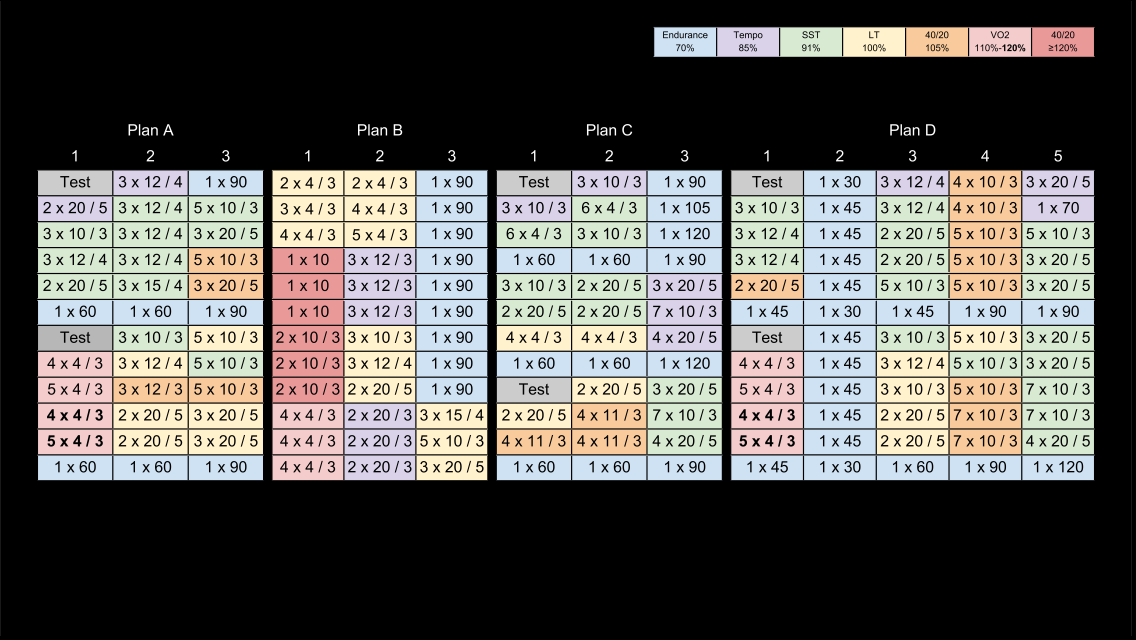
You can also grab a free trial of any software and decode a plan by converting workouts into fixed power repeats which will then reveal the periodization pattern, which is almost always progress combined interval duration to a practical limit ==> increase intensity ==> repeat: