


Long Term Training Plan?
 11-13-18 | 02:02 PM
#1

Thread Starter
Senior Member
Joined: Aug 2016
Posts: 2,524
Likes: 57
From: Chicago
Bikes: Marin Four Corners, 1960's Schwinn Racer in middle of restoration, mid 70s Motobecane Grand Touring, various other heaps.
Long Term Training Plan?
Looking for some suggestions as far as what a long term, general training plan should look like.
I'm 6', 193 lbs. Racing cross at the moment...finish generally middle/front 1/2 of races. Middle of the pack, maybe slightly better. I'd like to move up from cat 5 to cat 3 next year, which I think is possible if I drop 10 pounds and gain 10-15% power.
I've got a smart trainer with power/zwift that I'm starting to use over the winter. Any general criteria for setting up a plan over the next ~ 9 months to get ready for 2019 cross season?
I'm 6', 193 lbs. Racing cross at the moment...finish generally middle/front 1/2 of races. Middle of the pack, maybe slightly better. I'd like to move up from cat 5 to cat 3 next year, which I think is possible if I drop 10 pounds and gain 10-15% power.
I've got a smart trainer with power/zwift that I'm starting to use over the winter. Any general criteria for setting up a plan over the next ~ 9 months to get ready for 2019 cross season?
 11-13-18 | 02:58 PM
#3
Senior Member
Joined: Apr 2014
Posts: 631
Likes: 3
 11-14-18 | 07:09 AM
#4
Senior Member

Joined: Feb 2003
Posts: 389
Likes: 0
From: Lexington, KY
You lost me at Zwift. Toss the software and use your smart trainer as the tool it is.
Load monitoring can be extremely precise using smart trainer ERG mode indoors where you can quantify and control both external load and the environment.
External load is the work you perform. Internal load is the effect that external load has on you.
If internal load decreases for the same external load or stays the same for increased external load then you have improved and need to progress your training.
If internal load increases for the same external load then you are tired or your fitness has declined. You need to figure out what went wrong which is external load or recovery time or both. A look at recent history, especially why you set external load and recovery time as you did will likely give you clues as to what needs to change.
Then make a change and test and see how internal:exteral-load ratio changes. If for the better then you learned something. If no then change something else.
Keep a training log and review it regularly for patterns.
Regarding periodization, there are plenty of resources for that but it largely comes down to general ==> specific, long ==> short, low ==> high. There are plenty of guidelines regarding proportion of available training time dedicated to base ==> build ==> peak. There are also signals, especially useful indoors, of readiness to move from one phase to another, such as a cardiac drift of 5-7% at your target event duration.
See also https://www.britishcycling.org.uk/kn...raining-Plan-0
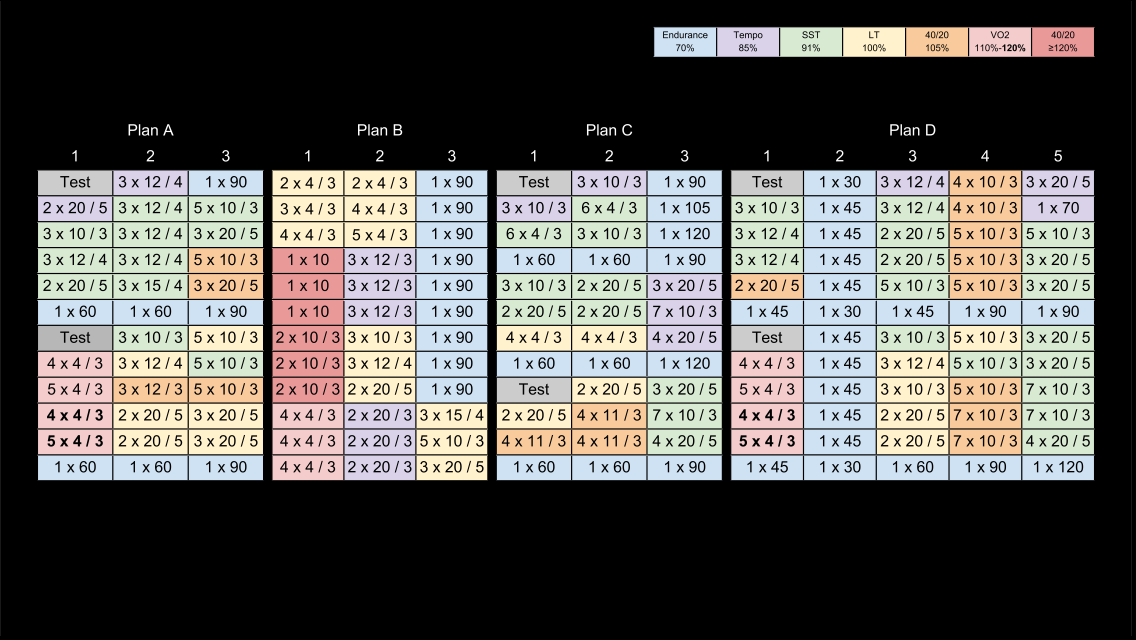
You can also grab a free trial of any software and decode a plan by converting workouts into fixed power repeats which will then reveal the periodization pattern, which is almost always progress combined interval duration to a practical limit ==> increase intensity ==> repeat:
Load monitoring can be extremely precise using smart trainer ERG mode indoors where you can quantify and control both external load and the environment.
External load is the work you perform. Internal load is the effect that external load has on you.
If internal load decreases for the same external load or stays the same for increased external load then you have improved and need to progress your training.
If internal load increases for the same external load then you are tired or your fitness has declined. You need to figure out what went wrong which is external load or recovery time or both. A look at recent history, especially why you set external load and recovery time as you did will likely give you clues as to what needs to change.
Then make a change and test and see how internal:exteral-load ratio changes. If for the better then you learned something. If no then change something else.
Keep a training log and review it regularly for patterns.
Regarding periodization, there are plenty of resources for that but it largely comes down to general ==> specific, long ==> short, low ==> high. There are plenty of guidelines regarding proportion of available training time dedicated to base ==> build ==> peak. There are also signals, especially useful indoors, of readiness to move from one phase to another, such as a cardiac drift of 5-7% at your target event duration.
See also https://www.britishcycling.org.uk/kn...raining-Plan-0
You can also grab a free trial of any software and decode a plan by converting workouts into fixed power repeats which will then reveal the periodization pattern, which is almost always progress combined interval duration to a practical limit ==> increase intensity ==> repeat:
Last edited by fstrnu; 11-14-18 at 07:34 AM.
11-14-18 | 12:51 PM
#5
Thread Starter
Senior Member
Joined: Aug 2016
Posts: 2,524
Likes: 57
From: Chicago
Bikes: Marin Four Corners, 1960's Schwinn Racer in middle of restoration, mid 70s Motobecane Grand Touring, various other heaps.
Zwift has set workouts with prescribed intervals based off of % of FTP, and resistance is automatically adjusted to hit those prescribed power outputs exactly. Is there a reason Zwift would be inferior at this relative to some other application?
11-14-18 | 12:51 PM
#6

just another gosling


Joined: Feb 2007
Posts: 20,563
Likes: 2,673
From: Everett, WA
Bikes: CoMo Speedster 2003, Trek 5200, CAAD 9, Fred 2004
I look at my last year's training records mostly to see how much total training time I spent and about how much per week as I went from here to there. A very simple thing is to get a TrainingPeaks (TP) premium subscription, which allows creation of a year's training plan. The plan won't tell you specifically what to do, but it gives a general outline of hours/week and stuff to focus on. From there you could get Friel's book and add detail as he recommends. In TP, read up on the Performance Manager Chart, what it measures, and how that works. To use the PMC or really any training plan with any kind of control over the results, you have to have numbers for training stress. These can come from a HRM or a PM or a combination, the important thing being to have a training stress measurement for every workout, whatever it may be. So you gradually increase your training stress from now to whenever, then taper for events as necessary. You start with generalized training, base and strength, probably some running for you, then gradually increase intensity and specificity.
I start the fall with mostly zone 2 work, pedaling drills, some running, some weight training. Then add zone 3, then zone 4 intervals, then VO2max work, then sprints. As each new training level comes in, each week includes all the previous training levels. I do most of my weight training in the fall, gradually decreasing the volume and increasing the intensity as the year progresses. For the year, weight training is 10%-15% of total hours.
Weight control is via diet. If you want to weigh less, you have to eat less, but keep the macro balance where it needs to be.
I plan all my workouts in TP about a month in advance, using their training library feature to make it easy. Most folks don't do anything this rigorous, but it seem to me that a real plan is just like a budget - you lay out some numbers for various things and then you reconcile those numbers with your results as you go. Otherwise it doesn't seem like a plan to me.
I start the fall with mostly zone 2 work, pedaling drills, some running, some weight training. Then add zone 3, then zone 4 intervals, then VO2max work, then sprints. As each new training level comes in, each week includes all the previous training levels. I do most of my weight training in the fall, gradually decreasing the volume and increasing the intensity as the year progresses. For the year, weight training is 10%-15% of total hours.
Weight control is via diet. If you want to weigh less, you have to eat less, but keep the macro balance where it needs to be.
I plan all my workouts in TP about a month in advance, using their training library feature to make it easy. Most folks don't do anything this rigorous, but it seem to me that a real plan is just like a budget - you lay out some numbers for various things and then you reconcile those numbers with your results as you go. Otherwise it doesn't seem like a plan to me.
__________________
Results matter
Results matter
11-14-18 | 01:54 PM
#7
Senior Member
Joined: Feb 2003
Posts: 389
Likes: 0
From: Lexington, KY
https://journals.humankinetics.com/d...JSPP.2017-0208
Well, I was under the impressino I WAS using the trainer as the tool it is...
Zwift has set workouts with prescribed intervals based off of % of FTP, and resistance is automatically adjusted to hit those prescribed power outputs exactly. Is there a reason Zwift would be inferior at this relative to some other application?
Zwift has set workouts with prescribed intervals based off of % of FTP, and resistance is automatically adjusted to hit those prescribed power outputs exactly. Is there a reason Zwift would be inferior at this relative to some other application?
 11-14-18 | 02:32 PM
#9
Thread Starter
Senior Member
Joined: Aug 2016
Posts: 2,524
Likes: 57
From: Chicago
Bikes: Marin Four Corners, 1960's Schwinn Racer in middle of restoration, mid 70s Motobecane Grand Touring, various other heaps.
11-14-18 | 03:30 PM
#10

Version 7.0
Joined: Oct 2006
Posts: 13,844
Likes: 3,858
From: SoCa
Bikes: Road, Track, TT and Gravel
I suggest checking out the recipe thread that is a sticky in the 33 racing forum. Building aerobic fitness is about increasing threshold and VO2 power which would probably be of value in cross racing and in general, make you faster in many situations.
When I started racing, I hired a coach. I had a lot of fun and learned a lot from the coach and the other racers who also used the same coach. Good luck upgrading!
When I started racing, I hired a coach. I had a lot of fun and learned a lot from the coach and the other racers who also used the same coach. Good luck upgrading!
11-14-18 | 04:37 PM
#11
Senior Member

Joined: Nov 2015
Posts: 4,444
Likes: 1,429
From: Music City, USA
Bikes: bikes
Well, I was under the impressino I WAS using the trainer as the tool it is...
Zwift has set workouts with prescribed intervals based off of % of FTP, and resistance is automatically adjusted to hit those prescribed power outputs exactly. Is there a reason Zwift would be inferior at this relative to some other application?
Zwift has set workouts with prescribed intervals based off of % of FTP, and resistance is automatically adjusted to hit those prescribed power outputs exactly. Is there a reason Zwift would be inferior at this relative to some other application?
He has some "different" ideas that don't really make practical sense.
I'd keep doing the zwift plan, or trainerroad as mentioned.
You might consider trying some road races and crits as well over the summer. Could be a big boon for cyclocross prep.
11-14-18 | 05:21 PM
#12
Thread Starter
Senior Member
Joined: Aug 2016
Posts: 2,524
Likes: 57
From: Chicago
Bikes: Marin Four Corners, 1960's Schwinn Racer in middle of restoration, mid 70s Motobecane Grand Touring, various other heaps.

I figure the worst that is going to happen in cross is I fall down in the mud and I sprain something.
11-15-18 | 05:52 PM
#15
Senior Member
Joined: Feb 2003
Posts: 389
Likes: 0
From: Lexington, KY
The integrated internal:external-load ratio assesses the psychophysiological stress experienced by the athlete (ie, heart rate, RPE, blood lactate, etc) during training in the context of the external training load completed and can be used to infer on athlete training status. For example, an increase in the internal load to a standard external load may infer athlete fatigue or decreased fitness, while a reduced internal load (a lower heart rate or perception of effort to a standard external load) indicates that an athlete is gaining fitness and coping with training. Furthermore, this may inform on the consequences of training programs, identify fatigue during team-sport competition, and identify changes in fitness or fatigue status. However, while practically attractive, the implementation of this approach is limited unless care is taken in controlling and quantifying the athlete’s external loads and the environment in which the exercise is completed.
https://journals.humankinetics.com/d...JSPP.2017-0208
Can't imagine how this would be practical indoors on a smart trainer with quantified/controlled external load and environment
https://journals.humankinetics.com/d...JSPP.2017-0208
Can't imagine how this would be practical indoors on a smart trainer with quantified/controlled external load and environment
11-15-18 | 06:06 PM
#16
Senior Member
Joined: Nov 2015
Posts: 4,444
Likes: 1,429
From: Music City, USA
Bikes: bikes
The integrated internal:external-load ratio assesses the psychophysiological stress experienced by the athlete (ie, heart rate, RPE, blood lactate, etc) during training in the context of the external training load completed and can be used to infer on athlete training status. For example, an increase in the internal load to a standard external load may infer athlete fatigue or decreased fitness, while a reduced internal load (a lower heart rate or perception of effort to a standard external load) indicates that an athlete is gaining fitness and coping with training. Furthermore, this may inform on the consequences of training programs, identify fatigue during team-sport competition, and identify changes in fitness or fatigue status. However, while practically attractive, the implementation of this approach is limited unless care is taken in controlling and quantifying the athlete’s external loads and the environment in which the exercise is completed.
https://journals.humankinetics.com/d...JSPP.2017-0208
Can't imagine how this would be practical indoors on a smart trainer with quantified/controlled external load and environment
https://journals.humankinetics.com/d...JSPP.2017-0208
Can't imagine how this would be practical indoors on a smart trainer with quantified/controlled external load and environment
11-15-18 | 06:28 PM
#17
just another gosling
Joined: Feb 2007
Posts: 20,563
Likes: 2,673
From: Everett, WA
Bikes: CoMo Speedster 2003, Trek 5200, CAAD 9, Fred 2004
Nothing made up about load monitoring. There's a really good method for that: morning resting and standing heart rates and the difference between them. Resting and orthostatic HRs, they're called. Resting goes up 6-8 beats. or the difference between resting and orthostatic goes up more than 10 beats, take a day or days off until it or they drop below that threshold. This is a very simple and reliable test. Nothing else works as well, not even Training Stress Balance.
__________________
Results matter
Results matter
11-15-18 | 06:32 PM
#18

Senior Member
Joined: Sep 2013
Posts: 343
Likes: 12
From: Austin Texas USA
Bikes: 1989 Trek 400, 2000 Lemond Buenos Aires, 2013 GT Attack, 2017 Lynskey R250
11-15-18 | 07:05 PM
#19
Senior Member
Joined: Feb 2003
Posts: 389
Likes: 0
From: Lexington, KY
I'm religious about RHR too (probably too much) but thanks for the reminder about orthostatic as I want to experiment with that but keep forgetting to do that in the morning 
I pay close attention to sleep quality, mood, motivation, etc too.
I pay close attention to sleep quality, mood, motivation, etc too.
Nothing made up about load monitoring. There's a really good method for that: morning resting and standing heart rates and the difference between them. Resting and orthostatic HRs, they're called. Resting goes up 6-8 beats. or the difference between resting and orthostatic goes up more than 10 beats, take a day or days off until it or they drop below that threshold. This is a very simple and reliable test. Nothing else works as well, not even Training Stress Balance.
11-15-18 | 07:07 PM
#20
Senior Member
Joined: Feb 2003
Posts: 389
Likes: 0
From: Lexington, KY
FAF gets a bum rap IMO but I like the accessibility of his system for high/med/low dose + priorities, etc.
11-16-18 | 10:22 AM
#21
Version 7.0
Joined: Oct 2006
Posts: 13,844
Likes: 3,858
From: SoCa
Bikes: Road, Track, TT and Gravel
I'd love to try crits. But, to be honest...I kinda chose cyclocross last year because I see it as being safer. I'm getting old enough (39), and have a 4 yr old, where the prospect of taking a header into a curb at 30mph and having a crankset lodged in my liver doesn't have the appeal it used to
I figure the worst that is going to happen in cross is I fall down in the mud and I sprain something.
I figure the worst that is going to happen in cross is I fall down in the mud and I sprain something.
11-16-18 | 11:18 AM
#22
Thread Starter
Senior Member
Joined: Aug 2016
Posts: 2,524
Likes: 57
From: Chicago
Bikes: Marin Four Corners, 1960's Schwinn Racer in middle of restoration, mid 70s Motobecane Grand Touring, various other heaps.
Join us in the 33 racers forum if you are not there already. We have a few racers who do cross and everything else. I race road and track but do not do mass start road races or crits. I will do mass start hill climbs. I got my Cat4 road and track doing the requisite mass start racing and it is sufficient to allow me to compete in most any race. And I do structured sessions at the track and workout with the P/1/2s so I am not missing anything. Everyone has to handicap the risk factor in racing. My philosophy is do not pee in the other guys cheerio bowl by pointing out how risky his event is compared to yours. If one wants to race crits, then one accepts the risks and manages that risk with skill, practice and knowledge.
 11-16-18 | 11:23 AM
#23

Senior Member
Joined: Jul 2002
Posts: 40,863
Likes: 3,116
From: Sacramento, California, USA
Bikes: Specialized Tarmac, Canyon Exceed, Specialized Transition, Ellsworth Roots, Ridley Excalibur
My main takeaway from FAF was to keep the intensity high. Cut volume if necessary (assuming you have the miles in your legs) but keep the intensity.
11-16-18 | 02:49 PM
#24
Thread Starter
Senior Member
Joined: Aug 2016
Posts: 2,524
Likes: 57
From: Chicago
Bikes: Marin Four Corners, 1960's Schwinn Racer in middle of restoration, mid 70s Motobecane Grand Touring, various other heaps.
11-17-18 | 11:07 PM
#25
- Soli Deo Gloria -
Joined: Aug 2015
Posts: 14,779
Likes: 743
From: Northwest Georgia
Bikes: 2018 Rodriguez Custom Fixed Gear, 2017 Niner RLT 9 RDO, 2015 Bianchi Pista, 2002 Fuji Robaix
We used to say, "You don't get faster by running more. You get faster by running faster."
The same is true of cycling. You can't coast through metrics every day. At a certain point, once you have built your base, it has to hurt.
By the way, I just ordered the Training Bible book.
-Tim-
Last edited by TimothyH; 11-17-18 at 11:13 PM.

Thread
Thread Starter
Forum
Replies
Last Post
fstrnu
Training & Nutrition
40
02-27-19 08:53 PM
