Originally Posted by
Bianchigirll
OH I see now, the insert was the plastic protector inside the BB shell. I though you had some sort of new BB with a threaded plastic cup.
OK first of all there is a reason this is called a fixed cup. Unless you are changing the BB you should try and just leave it in. Does the threading on the cup read 36x24 or 1.37x24? 1.37 is left hand thread and 36 is right hand.
To get that off you best bet is to get or make a fixed cup tool. You leave the spindle in and thread the tool into it to help hold the wrench in place. You may also need more leverage than you get with the stock tool, mine has about 3 to 3 1/2 foot piece of aluminium bar on it.

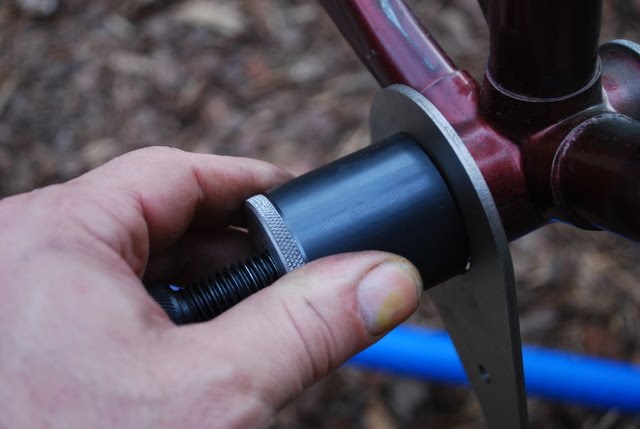
Ina pinch you can make on with a PVC pipe cap and bolt.
Thanks, I called it an insert, meaning the metal outer race that threads into the chain ring side of the BB. That plastic bearing spacer sleeve came out with a little wrangling and a needlenose, as it swelled into the openings of the bottom stays and is no longer concentric. I don't want to leave that outer race in if it will come out, as I am stripping this frame for either paint or powdercoat. I realize these bikes were built to be lightweight, but it seems they went overboard when it comes to the thinness of the paint. That brown stuff is the rust coming thru the paint. Other spots are bare metal, like under the top tube where the rear brake cable passes by. I doubt there's much if any primer under that white, and it seems like a flat white, to boot. Even under the headbadge it was flat white
On a related topic, does anyone know who the paint vendor was for Schwinn? Were there different paint vendors used on the two separate paint lines at Schwinn (electro-forged and fillet-brazed vs. Paramount)? Some of the colors seem the same on both lines but the Paramount line had some finishes not offered on the lesser priced bikes. I've seen cans of Schwinn touch up paint in cases from a company called Fix-All (still in business by the way), but this was enamel. Some of the better finishes I've seen resemble automotive finishes (ie: acrylic enamel with hardener, or lacquer...) and I'm thinking there has to be a paint chip book out there with the formulations for mixing these colors. These things exist in the automotive world today, even back into the 60's and beyond.