Originally Posted by
SurferRosa
I disagree with this. It reads like 531c and 531sl are different eras of the same tubing. They are not. 531sl is substantially lighter. It is really easy to feel this difference under you if you ever get the chance to ride a 531sl bike.
Not trying to be contrarian, just want to share some of my experience.
I built frames in the 70's including 531SL plus I made two frames for myself in the early 90's at Albert Eisentraut's shop.
I did a lot of research on the subject of bicycle frames in the mid 70's because we were in the process of setting up a Trek like operation in New Mexico.
We had jigs made, put together a prototype shop and got as far as building some custom frames and also some extra large frames. The work included lots of R & D for setting up a production frame building facility.
Before I ever touched a flame to a tube, I did lots of postmortems on crashed frames - everything from low end gas pipe bike boom bikes to top end British and Italian frames. You'd be surprised at what I found.

My partner (who had the money) took a quick trip over to Europe to visit a number of bicycle and component manufactures in France and Italy. Those included Campy, Cinelli, Stronglight, Bertin and others.
He took photos everywhere he visited (industrial espionage). When I saw the pictures my first response was "These are a bunch of blacksmith shops"!
Getting back to your comment about telling the difference between types of tubing, ride and handling have a lot more to do with the wheels and frame geometry than the specific tubes when you're talking about a slight difference in wall thickness.
I currently have a bike with a 531SL frame and also several with 531C frames.
1982 Bertin C79-SSC - Reynolds 531SL "Extra Leger"

1994 Gazelle Champion Mondial AB - Reynolds 531C Competition tubing

1983 Trek 700 made of Reynolds 531C per their 1983 catalog. Reynolds didn't start using a 531C decal until later.

All 3 ride COMPLETELY DIFFERENT!
Originally Posted by
SurferRosa
The way I understand it, 531c is simply an easier way to say full 531 tubes, forks and stays. So, my '60 Paramount is basically a 531c bike even though it doesn't say that on the decal like my '87 Falcon.
au contraire...
I had a discussion with Richard Schwinn a few years back. He's still active with Waterford and still knows his Schwinn history. He told me that ALL of the standard classic Schwinn Paramounts were made with 1.0mm x 0.7mm Reynolds 531 main tubes!
Back in the 70's that would have been known as the Reynolds 531 "SPRINT" tube set. See chart below.
That set was used on most
PRODUCTION Reynolds 531 frames from France, Italy and other countries from the 1960s through the early 1980's. There were a lot of smaller builders in the UK and constructeurs in France that used lighter gauge Reynolds 531. Lots of exceptions...
Here's a chart from the 1974 edition of Fred DeLong's
"DeLong's Guide To Bicycles And Bicycling". This was probably one of the most accurate books back then.
Note: he lists 9 different sets of Reynolds 531 tubing including 3 straight gauge tube sets.
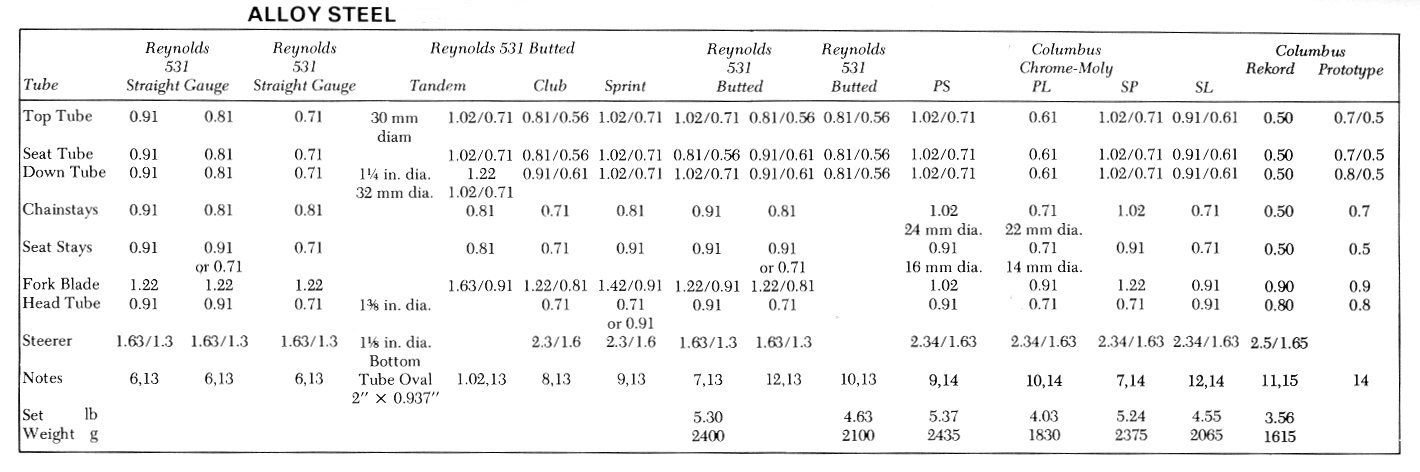
Note 2: Reynolds Sprint tube set was similar in wall thickness to the Columbus SP tubing that was used in a lot of
PRODUCTION Italian frames, also Stella in France used SP.
In the mid 70's a lot of high zoots Italian frames up to 60cm started being made of the lighter gauge Columbus SL tubing.
Getting back to frame manufacturing, I was shopping for bulk prices for components and tubing so that I could figure out a budget.
I had a Reynolds 3-4 page mimeographed "Stock List" from 1976. It listed ALL of the sizes and types of Reynolds 531 bicycle tubes that they could or did manufacturer.
Main tubes were made in wall thicknesses from 0.5mm x 0.3mm on up. The most common sizes like 1.0mm x 0.7mm, 0.9mm x 0.6mm and 0.8mm x 0.5mm main tubes were available from stock. Fork blades and rear stays were available in with different wall thicknesses and tapers too.
The catch was that you had to place a minimum order for enough tubes to make up 100 complete sets of tubing. Also there was a time delay for non-standard sizes.
They wouldn't even consider orders for smaller quantities. They referred those orders to their "Stockists" in the UK like Holdsworth. Delivery for special orders could take up to a year!
There were a number of wholesale bicycle suppliers in the US who were selling Reynolds tubing but at that time they only handled boxed sets of tubes. That wasn't an option for going into frame manufacturing.

These sets had 0.9mm x 0.6mm down tubes and 0.8mm x 0.5mm seat tubes which produced nice light frames.
In essence, if some one ordered enough tube sets they could get anything they wanted from Reynolds. That's why there are a lot of variations in frames that should be about the same.
Eventually we got involved with other projects and my friend with the $$$ lost interest in the project so I left the bicycle business in 1979.
Originally Posted by
SurferRosa
edit: I also still disagree with you about the Grand Record as I already mentioned. My opinion/experience on this is also reflected in the Moto catalogues.
Huh?

I'm not sure what you disagree about?
During the 1970's I stayed on top of every model produced by Gitane, Peugeot, Motobecane and Raleigh plus we imported Bertins for our entry level to mid range bikes.
I have a collection of most of the catalogs from those makers from that era, so where is the disagreement?

verktyg
