


Unknown Completely.
 11-17-19 | 12:30 PM
#26

señor miembro

Joined: Dec 2018
Posts: 3,510
Likes: 8,863
From: Pac NW
Bikes: '70s - '80s Campagnolo
The way I understand it, 531c is simply an easier way to say full 531 tubes, forks and stays. So, my '60 Paramount is basically a 531c bike even though it doesn't say that on the decal like my '87 Falcon.
edit: I also still disagree with you about the Grand Record as I already mentioned. My opinion/experience on this is also reflected in the Moto catalogues.
Last edited by SurferRosa; 11-17-19 at 01:00 PM.

 11-18-19 | 12:29 AM
#28

verktyg
Joined: Jul 2006
Posts: 4,034
Likes: 1,271
From: SF Bay Area
Bikes: Current favorites: 1988 Peugeot Birraritz, 1984 Gitane Super Corsa, 1980s DeRosa, 1981 Bianchi Campione Del Mondo, 1992 Paramount OS, 1988 Colnago Technos, 1985 RalieghUSA SBDU Team Pro
Reynolds Tubing
I built frames in the 70's including 531SL plus I made two frames for myself in the early 90's at Albert Eisentraut's shop.
I did a lot of research on the subject of bicycle frames in the mid 70's because we were in the process of setting up a Trek like operation in New Mexico.
We had jigs made, put together a prototype shop and got as far as building some custom frames and also some extra large frames. The work included lots of R & D for setting up a production frame building facility.
Before I ever touched a flame to a tube, I did lots of postmortems on crashed frames - everything from low end gas pipe bike boom bikes to top end British and Italian frames. You'd be surprised at what I found.

My partner (who had the money) took a quick trip over to Europe to visit a number of bicycle and component manufactures in France and Italy. Those included Campy, Cinelli, Stronglight, Bertin and others.
He took photos everywhere he visited (industrial espionage). When I saw the pictures my first response was "These are a bunch of blacksmith shops"!
Getting back to your comment about telling the difference between types of tubing, ride and handling have a lot more to do with the wheels and frame geometry than the specific tubes when you're talking about a slight difference in wall thickness.
I currently have a bike with a 531SL frame and also several with 531C frames.
1982 Bertin C79-SSC - Reynolds 531SL "Extra Leger"

1994 Gazelle Champion Mondial AB - Reynolds 531C Competition tubing

1983 Trek 700 made of Reynolds 531C per their 1983 catalog. Reynolds didn't start using a 531C decal until later.

All 3 ride COMPLETELY DIFFERENT!
I had a discussion with Richard Schwinn a few years back. He's still active with Waterford and still knows his Schwinn history. He told me that ALL of the standard classic Schwinn Paramounts were made with 1.0mm x 0.7mm Reynolds 531 main tubes!
Back in the 70's that would have been known as the Reynolds 531 "SPRINT" tube set. See chart below.
That set was used on most PRODUCTION Reynolds 531 frames from France, Italy and other countries from the 1960s through the early 1980's. There were a lot of smaller builders in the UK and constructeurs in France that used lighter gauge Reynolds 531. Lots of exceptions...
Here's a chart from the 1974 edition of Fred DeLong's "DeLong's Guide To Bicycles And Bicycling". This was probably one of the most accurate books back then.
Note: he lists 9 different sets of Reynolds 531 tubing including 3 straight gauge tube sets.
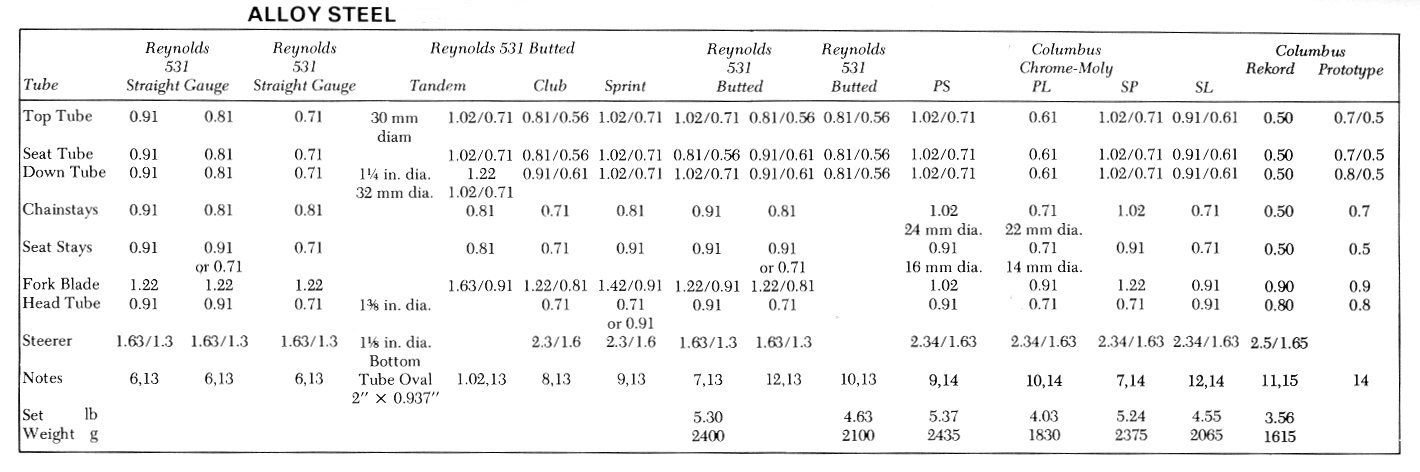
Note 2: Reynolds Sprint tube set was similar in wall thickness to the Columbus SP tubing that was used in a lot of PRODUCTION Italian frames, also Stella in France used SP.
In the mid 70's a lot of high zoots Italian frames up to 60cm started being made of the lighter gauge Columbus SL tubing.
Getting back to frame manufacturing, I was shopping for bulk prices for components and tubing so that I could figure out a budget.
I had a Reynolds 3-4 page mimeographed "Stock List" from 1976. It listed ALL of the sizes and types of Reynolds 531 bicycle tubes that they could or did manufacturer.
Main tubes were made in wall thicknesses from 0.5mm x 0.3mm on up. The most common sizes like 1.0mm x 0.7mm, 0.9mm x 0.6mm and 0.8mm x 0.5mm main tubes were available from stock. Fork blades and rear stays were available in with different wall thicknesses and tapers too.
The catch was that you had to place a minimum order for enough tubes to make up 100 complete sets of tubing. Also there was a time delay for non-standard sizes.
They wouldn't even consider orders for smaller quantities. They referred those orders to their "Stockists" in the UK like Holdsworth. Delivery for special orders could take up to a year!
There were a number of wholesale bicycle suppliers in the US who were selling Reynolds tubing but at that time they only handled boxed sets of tubes. That wasn't an option for going into frame manufacturing.

These sets had 0.9mm x 0.6mm down tubes and 0.8mm x 0.5mm seat tubes which produced nice light frames.
In essence, if some one ordered enough tube sets they could get anything they wanted from Reynolds. That's why there are a lot of variations in frames that should be about the same.
Eventually we got involved with other projects and my friend with the $$$ lost interest in the project so I left the bicycle business in 1979.

I'm not sure what you disagree about?
During the 1970's I stayed on top of every model produced by Gitane, Peugeot, Motobecane and Raleigh plus we imported Bertins for our entry level to mid range bikes.
I have a collection of most of the catalogs from those makers from that era, so where is the disagreement?

verktyg

__________________
Don't believe everything you think! History is written by those who weren't there....
Chas. ;-)
Don't believe everything you think! History is written by those who weren't there....
Chas. ;-)
Last edited by verktyg; 11-18-19 at 12:49 AM.
11-18-19 | 01:01 AM
#29
verktyg
Joined: Jul 2006
Posts: 4,034
Likes: 1,271
From: SF Bay Area
Bikes: Current favorites: 1988 Peugeot Birraritz, 1984 Gitane Super Corsa, 1980s DeRosa, 1981 Bianchi Campione Del Mondo, 1992 Paramount OS, 1988 Colnago Technos, 1985 RalieghUSA SBDU Team Pro
Astra Bikes
I missed this the first time. Probably important to remember, Astra - arguably a "Motobecane", they made them for Beacon, if I recall? - also had these. This Grand Luxe wasn't available when this thread started, so I couldn't link it and was too lazy to hunt for pics: https://www.ebay.com/itm/184039779862

They were the house brand for Beacon Cycles in the US plus may have been sold in the UK and elsewhere. Some were very cheap, made with lugless or semi lugless frames while a few came with better quality tubing and components.
The only ones that I saw were the cheapest models. They made a few that were rebadged Motobecane Grand Jubiles in different colors like the one pictured and a few better models.
verktyg
__________________
Don't believe everything you think! History is written by those who weren't there....
Chas. ;-)
Don't believe everything you think! History is written by those who weren't there....
Chas. ;-)
 11-18-19 | 02:36 AM
#30
señor miembro
Joined: Dec 2018
Posts: 3,510
Likes: 8,863
From: Pac NW
Bikes: '70s - '80s Campagnolo
 11-18-19 | 03:40 AM
#31
Senior Member

Joined: Jan 2019
Posts: 528
Likes: 84
I'll write my own understanding of the Reynolds line-up based on Reynolds catalogs (presumably for UK builders). Conventions and stock for American builders, especially in the dead years for adult American cycling, may be different. Scroll down to the bottom if you don't care to read.
----------------------------------------------
In the 20's (before 531), thin Reynolds tubes were mostly 1/7/1. My impression is that with the introduction of 531, Reynolds sought to make even thinner tubes.
In the 1940's Reynolds lists (in nominal terms, 9=0.81, 7=0.71, 6=0.61, 5=0.56, 3=0.38) 8/5/8 TT, 9/6/9 DT and 8/5/ST as "Typical frame sets using ... 531, which would later be the same for 531c(competition). The DT/TT seem to be designed to have a ~1:45 wall/dia ratio, and the DT is just 9/8 the size of the TT. The 1/7/1 tubes are listed for "SIF bronze welded frames" (as opposed to lugged) but oddly enough it does not mention 1/7/1 downtubes. The SIF bronze recommendation is for a 9/6/9 downtube with a 1/7/1 top tube, and that's also what shows up as line items in the price list.
8/5/8 TT, 9/6/9 DT and 8/5/ST seems to continue as standard spec into the 50's, other grades of Reynolds seem to have other standard gauges listed, but butted 531 only shows 8/5/8 TT, 9/6/9 DT and 8/5/ST in the catalog and the addition of some lady's frame specialty seat tubes in the price list and seems to designate the thicker gauges for lower end tubing.
The first mention I see of a full set of 1/7/1 tubes being available as a standard catalog item is in 1970's (but I haven't found a 60's one, so they may have very well become standard in the 60's) catalogs. They also had a set of 1/7/1 extra long tubes for tall riders. The interesting thing is that for both 1970's catalogs, it only mentions 8/5/8 TT, 9/6/9 DT and 8/5/ST or full 1/7/1. No 9/6/9 TT/ST or 8/5/8 DT (except as part of SL), even though metric variants are mentioned. SL is definitely different from 531c. The catalog definitively states it is 7/5/7 TT, 8/5/8 DT and 7/5 ST. The equivalent to 531SL during the time 531c was produced would be 531Pro. The catalog states the tubes are only available as a complete box set, so I would find it curious if they sold the same tubes individually.
Later, 531c/competition was advertised as "classic," "thorough-bred" and "the yard-stick by which other materials are judged" and was 8/5/8 TT, 9/6/9 DT and 8/5/ST (except for a 1982 video which implies the DT is also 8/5/8 but Reynolds seems to have sometimes implied things that weren't the case). 531Pro was an updated 531SL (and confirmed by Reynolds' own documentation) with 7/5/7 TT, 8/5/8 DT and 7/5 ST.
Back to 1/7/1, it appears to me that 1/7/1 was an alternative spec to the standard for several decades, rather than being the standards with the lighter spec being the alternative. Here's what Reynolds has to say about 1/7/1 tubes. Reynolds seems to have been under the impression that 8/5/8 TT, 9/6/9 DT and 8/5/ST was standard, and 1/7/1 beefy. Reynolds used 1/7/1 on the DT and only the DT and an 8/5/8 TT, for 531ST(special tourist) as well as some some other beefed up non-main-triangle tubes. Also similar to later 531cs(club sport) primarily used by Trek, perhaps showing an American preference for heavier tubes. Later Reynolds introduced 531 Super Tourist (not the same as 531ST/special tourist) with a full 1/7/1 main triangle because Reynolds claimed touring bikes were being loaded up even more than before. Both the touring sets came with imperial fork blades for better clearance and spacing for cantilever brakes.
In some ways, I don't find it surprising Schwinn being Schwinn decided to use 1/7/1 for all their Paramount frames, and that might have had an effect on supply chains and other American builders. But I would find it odd that Europeans, especially UK builders would use 1/7/1 standard unless they anticipated abuse. Reynolds appears not to have thought of 1/7/1 tubes as standard, but as heavy weight tubes. Early on, 1/7/1 tubes were the tubes they made before 531, and 531 tubes were made to be thinner than that. Later on Reynolds seems to have thought of 1/7/1 tubes as tubes for exceptionally tall riders, or for loaded touring.
----------------------------------------------
In summary, I think it's pretty clear from catalogs that 531SL was different from 531c. The updated version of 531SL was 531Pro, and 531c was the label given to the updated version of Reynolds light-standard tubing. I don't know about the building practices of production factories, but Reynolds seems to have thought of 1/7/1 as heavy duty tubes, relegated to lower end steel in the early days of 531, and used for XXL frames and load bearing touring frames later on. This seems to be fairly consistent messaging by Reynolds through several decades.
11-18-19 | 05:15 AM
#32
verktyg
Joined: Jul 2006
Posts: 4,034
Likes: 1,271
From: SF Bay Area
Bikes: Current favorites: 1988 Peugeot Birraritz, 1984 Gitane Super Corsa, 1980s DeRosa, 1981 Bianchi Campione Del Mondo, 1992 Paramount OS, 1988 Colnago Technos, 1985 RalieghUSA SBDU Team Pro
My 1972 Grand Record has butted Reynolds 531 1mm x 0.7mm main tubes with heavy seamed gaspipe forks and stays used on low priced models. It disappointingly rides like a tank.
The Grand Jubile frames from 1974 on until they switched to Vitus 172 tubing had Reynolds 531 1mm x 0.7mm main tubes but the forks and stays were light gauge Motobecane seamed steel tubing so the ride was much better.
Grand Record catalog specs:
The 1973 catalogs stated: Frame - Reynolds 531 double butted Main tubes, Fork - Tubular 531.
In 1974 and 1975 the catalogs say: Reynolds 531 double butted tubing, Forks - Reynolds 531.
1976 and 1977 catalogs say: Reynolds 531 double butted tubing throughout, Forks - Reynolds 531.
Two possibilities, catalogs were put together by layout artists and marketoids who probably knew little if anything about bikes and someone overlooked the word "throughout" (like me).
or... ...the marketoids and bean counters prevailed over manufacturing and engineering, Motobecane saved a few centimes on the price difference between Reynolds 531 rear stays and the gas pipe seamed ones used on lower priced models. End result, customers were deceived!
My bet is they went cheap... The French have been famous for their frugality. A centime saved is a croissant earned!


I have 2 Motobecanes with Reynolds 531 "3 TUBES RENFORCE" (3 MAIN TUBES BUTTED) stickers on the frames and Reynolds 531 stickers on the forks: a 1977 Le Champion and an early 80's Grand Record. I discovered when I was working on them, sure enough, looking in the BB you can see the seamed chain stays!


CHEAP! CHEAP! CHEAP!
[MENTION=494559]Kuromori[/MENTION] (I'll add to your post later, I'm going to go to bed)
When Reynolds changed their stickers and came out with new tubing names in 1983, there was some confusion about what happened to 531SL. It was never that popular and rarely seen on production bikes. 531SL was mainly used on a few high end, custom or team frames.
Back then Reynolds tubing wall thicknesses were designated by BWG numbers. BWG stands for “Birmingham Wire Gauge” which was used to measure tubing in the UK.
For example 20/23 BWG was 0.89mm x 0.64mm and rounded off to 0.9mm x 0.6mm since bicycle tubing was never that accurately rolled and drawn.
The numbers were faintly rolled into the tubes.
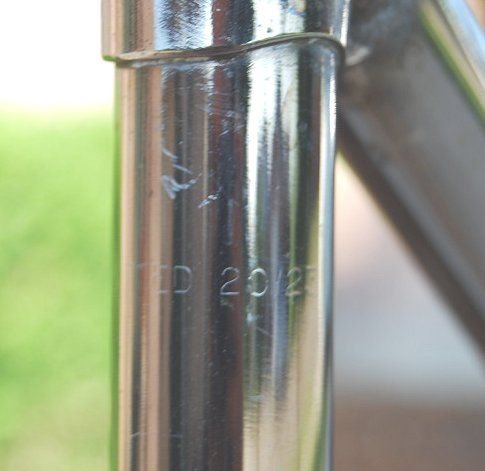
Conversion Chart

Here's a better Reynolds wall thickness chart than I posted above.
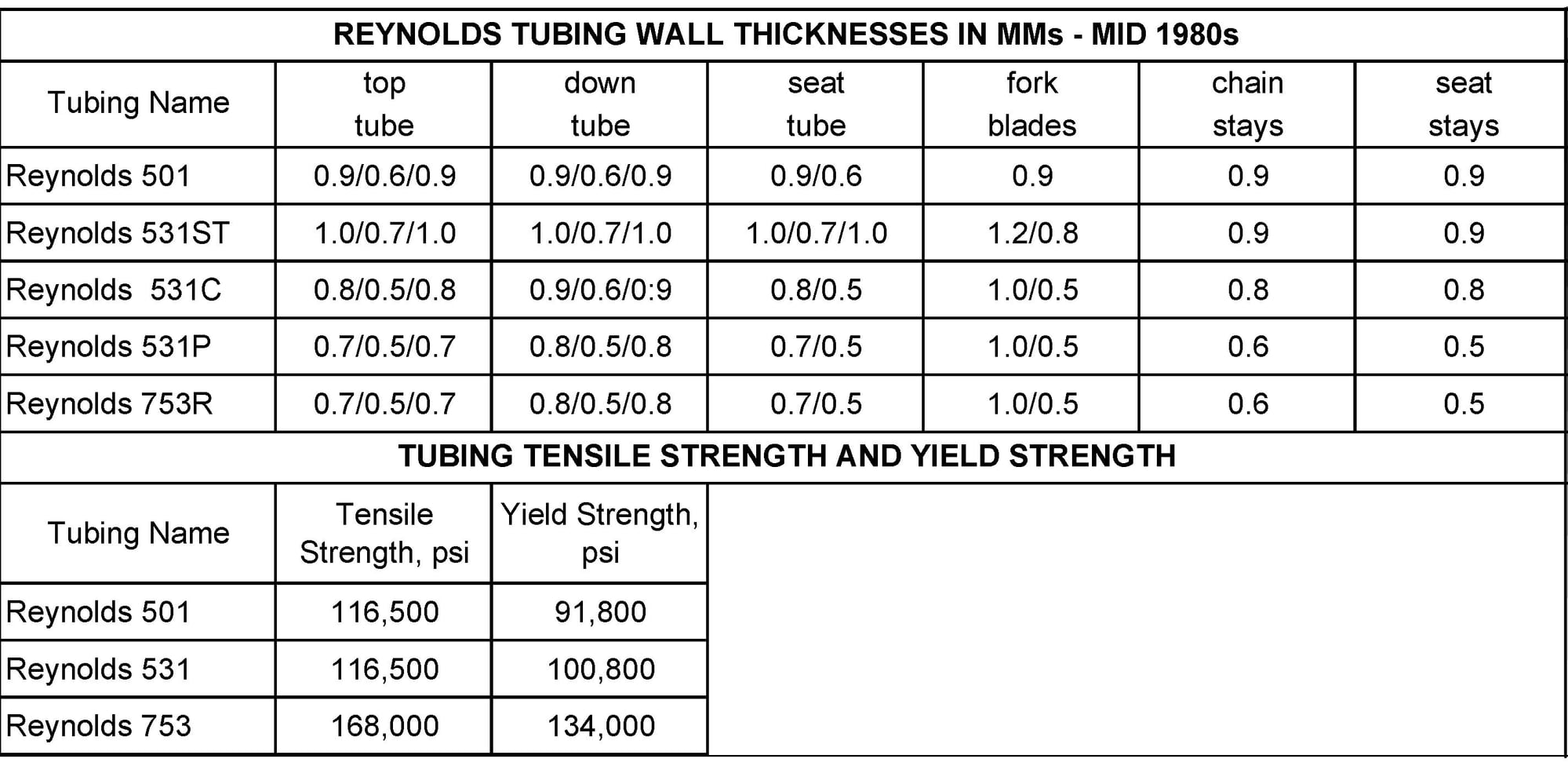
Somewhere I have the wall thickness specs for 531SL. They were not easy to find, even BITD.
To digress a lot, Reynolds 753 was originally available in metric diameters only. Reynolds 531SL was introduced as a lighter version of the standard 531 boxed set - between 531 and 753.
753 was supposed to be restricted for sale only to qualified builders because Reynolds didn't want to have a lot of frame failures due to poor brazing technique which would have reflected badly on their flagship product. 531SL provided a reasonable alternative.
In 1983 Reynolds introduced 2 new versions of 753 in both metric and inch sizes: 753R for Road and 753T for Track.
The then new 531P Professional had the same wall thicknesses as 753R.
531SL was never that thin. If I remember correctly the dimensions were a mix of 531C and 531P....
A feature used on 531SL chain stays was a flat section in the wheel clearance area. Supposedly this area was prone to breaking and it was discontinued in the newer sets.
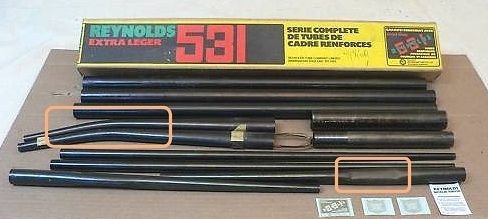
531SL was the first tubing that Reynolds made that used the "New Continental" oval fork blades. They were slightly different than Columbus oval blades.
One other thing, the old 531 Sprint tube set with 1mm x 0.7mm main tubes was just about the same as the then "new" 531ST Special Tourist tubing. There were different wall thickness forks blades and chain stays but back then there was no consistency in what bike manufacturers used.
In the end, there is no way of telling without cutting a frame apart and measuring the tubing wall thicknesses. Bike makers, especially during the bike boom (and after a 3 pint or 1 litre lunch) used what ever they had on the shelf.
My first "pro" bike was an all Campy 1971 Gitane Super Corsa. It was made of some really light Reynolds 531 tubing. I was still a masher then and I could hardly go up a hill without it ghost shifting from lateral frame flex across the BB.
It had a 60cm frame and luckily I was able to trade it for a 57cm Super Corsa frame which has more my size. I don't recall the weight difference but it was significant and the ghost shifting went away.
So, no disagreement....
verktyg
__________________
Don't believe everything you think! History is written by those who weren't there....
Chas. ;-)
Don't believe everything you think! History is written by those who weren't there....
Chas. ;-)
Last edited by verktyg; 11-18-19 at 05:49 AM.
 11-18-19 | 05:32 AM
#33
Senior Member
Joined: Jan 2019
Posts: 528
Likes: 84
Some notes:
Reynolds was drawn to SWG despite being in Birmingham.
See "Top Tubes" brochure:
Reynolds "Top Tubes" booklet (10-1977)
According to Reynolds "531 professional is the direct replacement for the former 531SL"
See 7:58:
531SL was definitely the same gauge as 531pro/753R in the main tubes at least
See bulgier's site for specs:
p10_531_SL.jpg
531 "sprint" is equivalent to Super Tourist, not 531ST(special tourist). This is confusing and even modern Reynolds gets it wrong in their decal history pdf.
See "Top Tubes" brochure:
https://www.equusbicycle.com/bike/rey...80brochure.jpg
See 9:07:
Some of this info is also found in Paterek's tubing chart that was previously posted.
Reynolds was drawn to SWG despite being in Birmingham.
See "Top Tubes" brochure:
Reynolds "Top Tubes" booklet (10-1977)
According to Reynolds "531 professional is the direct replacement for the former 531SL"
See 7:58:
531SL was definitely the same gauge as 531pro/753R in the main tubes at least
See bulgier's site for specs:
p10_531_SL.jpg
531 "sprint" is equivalent to Super Tourist, not 531ST(special tourist). This is confusing and even modern Reynolds gets it wrong in their decal history pdf.
See "Top Tubes" brochure:
https://www.equusbicycle.com/bike/rey...80brochure.jpg
See 9:07:
Some of this info is also found in Paterek's tubing chart that was previously posted.
Last edited by Kuromori; 11-18-19 at 04:34 PM.
11-18-19 | 06:19 AM
#34
verktyg
Joined: Jul 2006
Posts: 4,034
Likes: 1,271
From: SF Bay Area
Bikes: Current favorites: 1988 Peugeot Birraritz, 1984 Gitane Super Corsa, 1980s DeRosa, 1981 Bianchi Campione Del Mondo, 1992 Paramount OS, 1988 Colnago Technos, 1985 RalieghUSA SBDU Team Pro
SWG vs BWG
Some notes:
Reynolds was drawn to SWG despite being in Birmingham.
See "Top Tubes" brochure:
Reynolds "Top Tubes" booklet (10-1977)
Reynolds was drawn to SWG despite being in Birmingham.
See "Top Tubes" brochure:
Reynolds "Top Tubes" booklet (10-1977)

https://blog.projectmaterials.com/in...e-gauge-chart/
Way BITD when I was doing my research on bicycle tubing I made up this conversion sheet between BWG, MM & Inch dimensions because that's whats was being used by some sources. Note dot matrix printer.

I wasn't aware that Reynolds changed from BWG to SWG until you brought it to my attention. Also, the SWG standard was discontinued and changed to "mil" .001".
https://www.engineeringtoolbox.com/s...ge-d_1779.html
It's now more sensible MM millimeters.
verktyg
__________________
Don't believe everything you think! History is written by those who weren't there....
Chas. ;-)
Don't believe everything you think! History is written by those who weren't there....
Chas. ;-)
11-18-19 | 06:32 AM
#35
Senior Member
Joined: Jan 2019
Posts: 528
Likes: 84
Actually SWG was used since at least the 40's. There's even a chart in it to convert from SWG to thou. I would link it but VCC has closed off public access to their catalogs. I can only assume that someone saw Reynolds was in Birmingham and had an epiphany that the gauges must actually be BWG even though all the Reynolds documentation says SWG when they bother to specify (which is infrequently).
I'm still trying to figure out the exact date Reynolds switched to proper metric instead of calling 0.38mm 0.3mm metric. And of course in French publications, this is 3/10 mes with no mention of SWG/thou.
I'm still trying to figure out the exact date Reynolds switched to proper metric instead of calling 0.38mm 0.3mm metric. And of course in French publications, this is 3/10 mes with no mention of SWG/thou.
11-18-19 | 05:57 PM
#36

Senior Member

Joined: Feb 2013
Posts: 15,369
Likes: 4,391
From: Alta California
I missed this the first time. Probably important to remember, Astra - arguably a "Motobecane", they made them for Beacon, if I recall? - also had these. This Grand Luxe wasn't available when this thread started, so I couldn't link it and was too lazy to hunt for pics: https://www.ebay.com/itm/184039779862
Hello francophile,
the forum has had at least two of these quality model Astra cycles from the circa 1970 time.
this example has the same finish as your find -
Mystery Astra
here is a jaune lass -
Show your French bikes!
-----
