Originally Posted by
SurferRosa
I don't believe the Grand Records were full 531 except for the '76 and '77 models. The catalogues reflect this. The stays are heavier on previous models.
Also, 531sl is not the same as 531c as you sort of stated above.

I see what you are saying about the Grand Records.
My 1972 Grand Record has butted Reynolds 531 1mm x 0.7mm main tubes with heavy seamed gaspipe forks and stays used on low priced models. It disappointingly rides like a tank.
The Grand Jubile frames from 1974 on until they switched to Vitus 172 tubing had Reynolds 531 1mm x 0.7mm main tubes but the forks and stays were light gauge Motobecane seamed steel tubing so the ride was much better.
Grand Record catalog specs:
The 1973 catalogs stated: Frame - Reynolds 531 double butted Main tubes, Fork - Tubular 531.
In 1974 and 1975 the catalogs say: Reynolds 531 double butted tubing, Forks - Reynolds 531.
1976 and 1977 catalogs say: Reynolds 531 double butted tubing throughout, Forks - Reynolds 531.
Two possibilities, catalogs were put together by layout artists and marketoids who probably knew little if anything about bikes and someone overlooked the word "throughout" (like me).
or... ...the marketoids and bean counters prevailed over manufacturing and engineering, Motobecane saved a few centimes on the price difference between Reynolds 531 rear stays and the gas pipe seamed ones used on lower priced models. End result, customers were deceived!
My bet is they went cheap... The French have been famous for their frugality. A centime saved is a croissant earned!


I have 2 Motobecanes with Reynolds 531 "3 TUBES RENFORCE" (3 MAIN TUBES BUTTED) stickers on the frames and Reynolds 531 stickers on the forks: a 1977 Le Champion and an early 80's Grand Record. I discovered when I was working on them, sure enough, looking in the BB you can see the seamed chain stays!


CHEAP! CHEAP! CHEAP!
[MENTION=494559]Kuromori[/MENTION] (I'll add to your post later, I'm going to go to bed)
When Reynolds changed their stickers and came out with new tubing names in 1983, there was some confusion about what happened to 531SL. It was never that popular and rarely seen on production bikes. 531SL was mainly used on a few high end, custom or team frames.
Back then Reynolds tubing wall thicknesses were designated by BWG numbers. BWG stands for “Birmingham Wire Gauge” which was used to measure tubing in the UK.
For example 20/23 BWG was 0.89mm x 0.64mm and rounded off to 0.9mm x 0.6mm since bicycle tubing was never that accurately rolled and drawn.
The numbers were faintly rolled into the tubes.
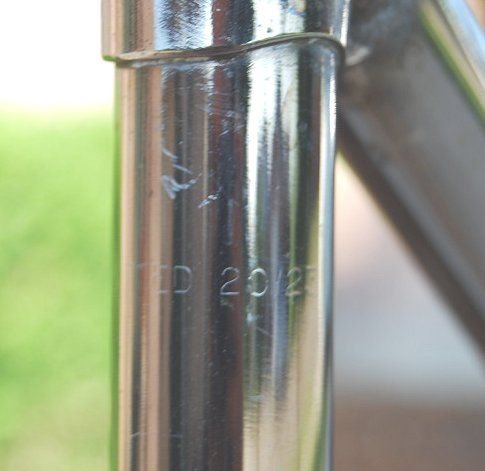
Conversion Chart

Here's a better Reynolds wall thickness chart than I posted above.
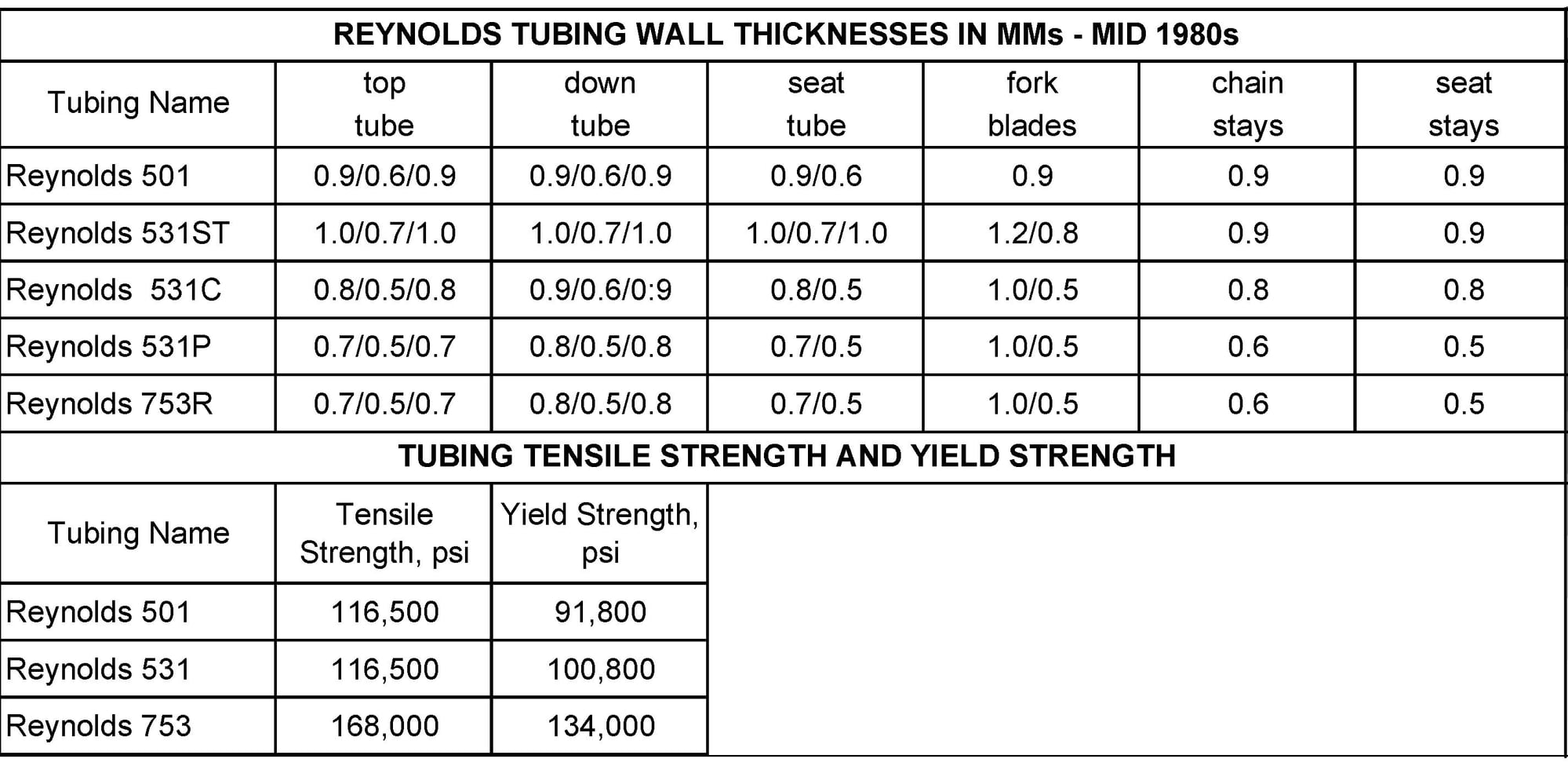
Somewhere I have the wall thickness specs for 531SL. They were not easy to find, even BITD.
To digress a lot, Reynolds 753 was originally available in metric diameters only. Reynolds 531SL was introduced as a lighter version of the standard 531 boxed set - between 531 and 753.
753 was supposed to be restricted for sale only to qualified builders because Reynolds didn't want to have a lot of frame failures due to poor brazing technique which would have reflected badly on their flagship product. 531SL provided a reasonable alternative.
In 1983 Reynolds introduced 2 new versions of 753 in both metric and inch sizes: 753R for Road and 753T for Track.
The then new 531P Professional had the same wall thicknesses as 753R.
531SL was never that thin. If I remember correctly the dimensions were a mix of 531C and 531P....
A feature used on 531SL chain stays was a flat section in the wheel clearance area. Supposedly this area was prone to breaking and it was discontinued in the newer sets.
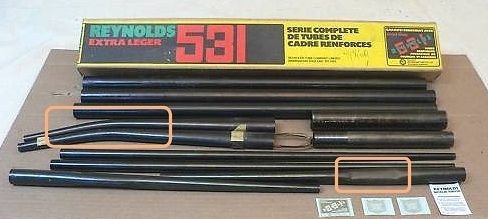
531SL was the first tubing that Reynolds made that used the "New Continental" oval fork blades. They were slightly different than Columbus oval blades.
One other thing, the old 531 Sprint tube set with 1mm x 0.7mm main tubes was just about the same as the then "new" 531ST Special Tourist tubing. There were different wall thickness forks blades and chain stays but back then there was no consistency in what bike manufacturers used.
In the end, there is no way of telling without cutting a frame apart and measuring the tubing wall thicknesses. Bike makers, especially during the bike boom (and after a 3 pint or 1 litre lunch) used what ever they had on the shelf.
My first "pro" bike was an all Campy 1971 Gitane Super Corsa. It was made of some really light Reynolds 531 tubing. I was still a masher then and I could hardly go up a hill without it ghost shifting from lateral frame flex across the BB.
It had a 60cm frame and luckily I was able to trade it for a 57cm Super Corsa frame which has more my size. I don't recall the weight difference but it was significant and the ghost shifting went away.
So, no disagreement....
verktyg
