Originally Posted by
WizardOfBoz
I grew up working in a machine shop. Modern metalworking doctrine is that you use an extremely rigid machine to cut metal, with a rigid fixture holding the workpiece. Else you get chatter, grabbing and gouging, the workpiece breaking, or (worse of all) the workpiece or parts of it flying off the lathe and killing someone. Thus, you'd use a lathe with the rim fastened to a faceplate. Given the rim diameter, you'd need a pretty massive lathe (a 30" swing). The pic below is a 42 inch lathe with a propeller mounted to the faceplate.
A spoked wheel has a very high strength to weight ratio, but is not nearly as rigid as a faceplate that is 2 inches thick and made of heat-treated tool steel. For one thing, transmitting adequate power from a hub to the wheel rim would likely break spokes. A bike hub has superb strength for handling a cyclist's weight, but bike bearings don't really come anywhere near the rigidity of that lathe spindle which are gonna have perhaps 6 inch id, tapered roller bearings in double sets fore and aft.
Not saying it couldn't be done with some clever McGyvering and by suspending normal rules of safety and risk avoidance.

But we agree:
Your advice is IMHO golden and is really what the OP should be doing. Observe, think, and test different methods of solving the problem before getting out the angle grinder, I always say.
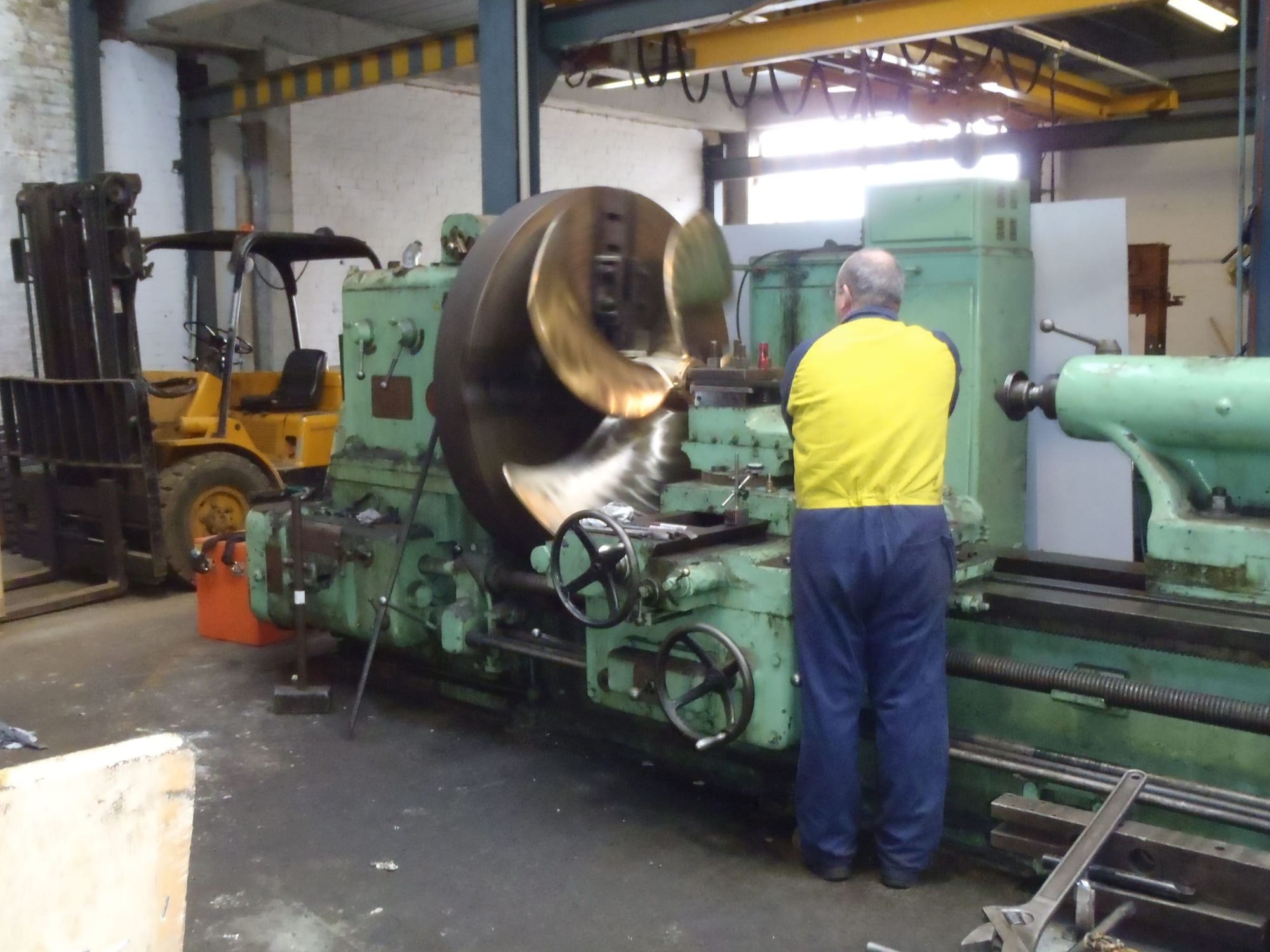
If you have a 42" lathe (horizontal or vertical), then one should be able to chuck up the fully built wheel, although the rim will still have to run straight (no taco).
If using a fixed cutter, then yes, "rigid". But, one could likely break some of the rules if using a rotary cutter (grinder) (noting, of course, potential issues with grinding aluminum).
I have no doubt it would be possible to do with a cheap apparatus if one was slow and cautious. But it still wouldn't be my choice of remedies.