Originally Posted by
lajt
I just watched a good YouTube video that demonstrated how an inline parallelogram derailleur works, and how the slant parallelogram improved on the design so the derailleur follows the slope of the cogs.
But how did the old ones feel on a ride? Like if you had a Campagnolo Nuovo Record from the 70s, and it's clean & smooth, with a nice clean chain, smooth bottom bracket etc--how does it feel when you're riding and shifting? Especially since you're a rider from the future and you know how the newer stuff feels; does the old feel clunky by comparison? Or still very wonderful and smooth?
(I've never actually ridden on a bike with those old Campagnolo parts, just admired them from afar.)
P.S. Why did those Campagnolo Nuovo Record derailleurs stand so vertical? Was that unique to Campagnolo, or did all inline parallelograms look that way? If you look at this pic, the Dura Ace is shaped like the number 7--almost horizontal, then angling back 45 degrees--whereas the Campagnolo is just vertical:
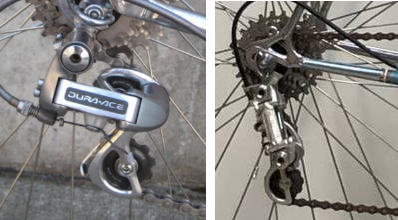
There is a whole book dedicated to this and related questions called
The Dancing Chain by Frank Berto. It discusses these issues (and others you never knew were issues) and has a ton of great photos and Daniel Rebour drawings. I recommend it highly.
As to your questions:
Why the straight drop for Campy NR's? History. When rear derailleurs moved to the rear drop out in the late 1940s/early 1950s (Simplex and the Campagnolo) gear ranges narrower - as in
much narrower - than you see today, and the vertical drop design worked just fine. RD advances wnet hand-in-and with increased range in rear cog sizes. The drop "7" design was an attempt to permit better shifting over wider cog spreads. Campy, Simplex, Huret, and other Europeans makers didn't follow this trend for many years because they didn't have to - they were sellng plenty of RDs, thank you very much, and weren't interested in what the Japanese were doing. Suntour came out with the slant pantograph, a significant advance, in 1964. When their patent expired in 1984, Shimano was ready to make full use of the improved design, with Campy lagging by a couple of years. Suntour ultimately lost out because they made a few mistakes on the late 1980s and into the 1990s. So did Shimano and Campy. Shimano was big enough and devoted so much to R&D that they survived their mistakes. Campy was revered just enough and was just big enough to survive its mistakes. Suntour was neither big enough nor revered enough to survive its mistakes.
Which shift better, modern RDs or older ones? By pretty much any objective measure, modern ones do. That's the same as saying that, by all objective measures, modern automatic transmissions in cars shift better than 1960s or 1970s manual transmissions. That doesn't keep some people form loving old manual transmissions far more, and well designed ones work well, but not as easily as the automatics. The same is true with older versus newer RDs.
Also keep in mind that there is more to making a RD that shifts well than the shape and angling of the parallelogram. Positioning of the jockey wheels is very important. Compare the placement of the jockey wheels on a 1950s Campoy Gran Sport RD with a late 1960s to early 1980s Campy Nuovo Record - the placement of the wheels and where their cage pivots are quite different. That is not an accident.
In preparation for launching their slant pantograph RDs in 1984 when Suntour's patent expired, Shimano did a a ton of R&D to establish the optimum positioning and size of the parallelogram and the optimum placement of the jockey wheels and pivot point for the cage relative to the cogs, each other, and the other pivot on the rest of the RD. The result was excellent shifting geometry that everyone - yes, including you, Campy - copied for at least the next 25 years
Bottom line: A well designed RD from anytime after about 1950, properly set up and not too worn, will shift fairly well across its intended range of cogs. A well designed slant pantograph RD will be easier to shift crisply and accurately than an older non-slant pantopgraph or a straight-drop design. Does "easier" shifting mean "better" shifting? That, like beauty, is in the eye of the beholder.