Originally Posted by
seedsbelize2
A take-off from Mad Honk's for sale thread. I have been led to believe that db spokes are stronger than straight gage due to their ability to stretch without breaking. The opposite is being stated in that thread.. Thought? Experience? Science?
Since this is Classic and Vintage what better than a vintage and classic quote from
Sheldon Brown?
Double-butted spokes do more than save weight. The thick ends make them as strong in the highly-stressed areas as straight-gauge spokes of the same thickness, but the thinner middle sections make the spokes effectively more elastic, allowing them to stretch (temporarily) more than thicker spokes.As a result, when the wheel is subjected to sharp localized stresses, the most heavily-stressed spokes can elongate enough to shift some of the stress to adjoining spokes. This is particularly desirable when the limiting factor is how much stress the rim can withstand without cracking around the spoke holes.
Want stronger? Go to triple butted…2.3/1.8/2.0mm.
This article from Wheel Fanatyk is approaching vintage status but it, nevertheless, still valid.
If you want a scientific approach,
Pillar Spokes is the only place I’ve seen that has actual test results on the strength of spokes. Below are the strength graphs for various gauges and buttings of spokes made by Pillar.
Straight gauge. The P14 (blue line) is a typical 2.0mm straight gauge spoke. The breaking strength is about 250kgf.
 Image 5-11-18 at 1.41 PM
 by
Stuart Black, on Flickr
Double butted. The 1415 (red line) is a 2.0/1.8/2.0mm. It breaks at around 300kgf or a 20% increase in strength.
 Image 5-11-18 at 1.44 PM
 by
Stuart Black, on Flickr
Triple butted: The 2018 is a triple butted spoke that is 2.2/1.9/2.0mm spoke that breaks at about 340kgf or about 40% stronger than the straight gauge spoke.
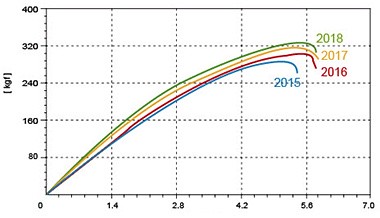 Image 5-11-18 at 1.43 PM
 by
Stuart Black, on Flickr
The Ric Hjertberg article says that going to triple butted spokes is the equivalent of adding 10 spokes to the wheel. I might not go that far…I’d say at least 4 spokes so a 32 performs like a 36 and a 36 performs like a 40, etc…but there is definitely an advantage to butting. And an extra advantage to a thicker head.
I’ve been building with triple butted spokes…mostly DT Swiss Alpine III…since around 2000. Spoke breakages is mostly a thing of the past even though I haven’t changed the way I build wheels.