Originally Posted by
Fredo76
Has everybody forgotten about pulling up on the pedals? It keeps you on your seat quite well! Making your force proportional to quad strength + hamstring strength (in layman's terms

), and has little to do with body weight, which only enters the equation when off the saddle. When standing, hamstring strength is greatly increased, which is one reason why racers often stand when attacking.
You might appreciate this discussion on cycling positions and forces. It’s an excerpt from Keith Bontrager’s article debunking KOPS and explaining his considerations in frame design and particularly the tight constraints on seat tube angle that allow a road rider to use the seated and both standing positions effectively.
“The CG of a seated rider in a fairly aerodynamic position will often be about 1 to 1.5 inches (2.5 to 3 cm) in front of the bottom bracket. I have determined this in two ways: by direct measurement of the rider's anatomy (measuring this balance point), and by weight distribution calculations (weighing the axles). Of the two, the latter is the more accurate. The result is generally consistent with a 45%/55% fore-and-aft weight distribution that many classic cycling texts regard as optimal.
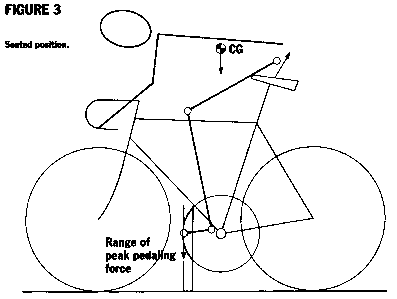
The peak pedaling force applied by the seated rider produces an upward and slightly rearward force at the saddle (Figure 3). If pedaling forces are small, the cyclist is able to remain seated because the upward component of force is smaller than the rider's weight on the saddle, and the rearward force is smaller than the static friction between the rider and the saddle. During the angular phase of the pedal cycle when the pedaling force is small, the rider tends to fall forward due to the moment between his CG and the saddle, and this must be resisted with upper body and torso effort.
As peak pedaling forces increase, the gravitational constraining forces on the rider at the saddle are no longer sufficient and larger arm and torso efforts are required to maintain a seated position. At extremely high pedaling forces, the rider comes out of the saddle to straighten the load path for his arms which allows them to effectively resist the loads created by the much stronger leg muscles. The diagram of the lever system in
Figure 1 is no longer accurate at this point; the rest of the rider becomes a complicated system of levers as well.
The two basic out-of-the-saddle riding positions are useful in many circumstances. The one mentioned above is used to accelerate as rapidly as possible during a start, jump, or sprint. A slightly different position is used to climb hills. These two circumstances are worth considering in more detail in order to understand how the horizontal saddle position determines the rider's overall position on the bicycle.
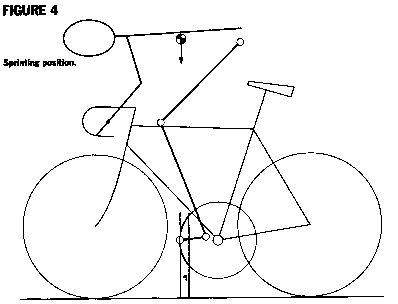
The sprinting position is the simpler of the two. The rider is making such large pedaling forces that his torso and upper body can do little more than resist the peak forces of the power stroke. The arm effects between the peaks keep the bicycle leaning in the direction that puts the pedal being pushed under the rider, as well as locating the rider and contributing a small amount to the pedal forces. Peak pedaling forces are large compared to gravitational forces, and the rider's position adjusts accordingly, shifting his upper body forward to achieve the best load path for the arms (Figure 4). The rider's CG is typically forward of the pedal at this point. During the phases of the pedal cycle when pedaling forces diminish (around the six and twelve o'clock positions), there is a small torque on the rider about the pedal. As before, this will tend to cause the rider to fall forward and will need to be resisted with upper body and torso effort.
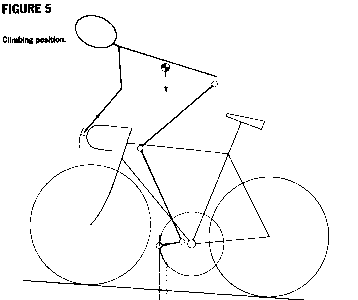
The pedaling forces are smaller when climbing. When a rider gets out of the saddle to climb (Figure 5), his CG moves over the region directly above the range of pedal positions where the pedaling forces are high (from eight to ten o'clock). This allows the rider to "balance" on the pedals when the forces are high, minimizing the arm effort required and lets the full weight of the rider contribute to pedaling forces. The torque on the rider is still there when the pedal forces decrease and must be resisted, but it is smaller because the rider's CG is closer to the bottom bracket spindle. The geometry of the link between the torso and bars made by the rider's arms when climbing out of the saddle is something I pay particular attention to when I fit a rider, but is somewhat flexible due to the larger number of bones and muscles that make it up.
With this insight into pedal forces and weight distribution for both in- and out-of-the-saddle riding, we can look at what happens to rider position as the seat angle is varied, and how these variations affect performance. We can start with something in the middle of the range of seat tube angles and see what changes occur to the rider's position as this angle is varied.
The full article is here, this excerpt starts about 60% of the way down. There is a lot of discussion before that that may be interesting but isn’t that relevant to this topic.
https://www.sheldonbrown.com/kops.html
Otto