Originally Posted by
Kontact
Like I said, the real world is more complicated. And not least of all because the grain of carbon fiber makes it a much more complicated structure.
I found this review document online. Yes it is basically saying "it's complicated", and some of the studies did apparently find a fatigue limit.
https://www.research.ed.ac.uk/files/..._BlackText.pdf
Originally Posted by
Kontact
But unlike the charts of steel and aluminum showing fatigue life, there isn't one like that for carbon. Essentially, as long as you don't bend it far enough to hit the breaking point, you aren't accumulating stress damage. And that likely has something to do with the fact that CF, unlike aluminum, steel or Ti, can't be deformed. It has no plastic deformation limit; it either breaks or not.
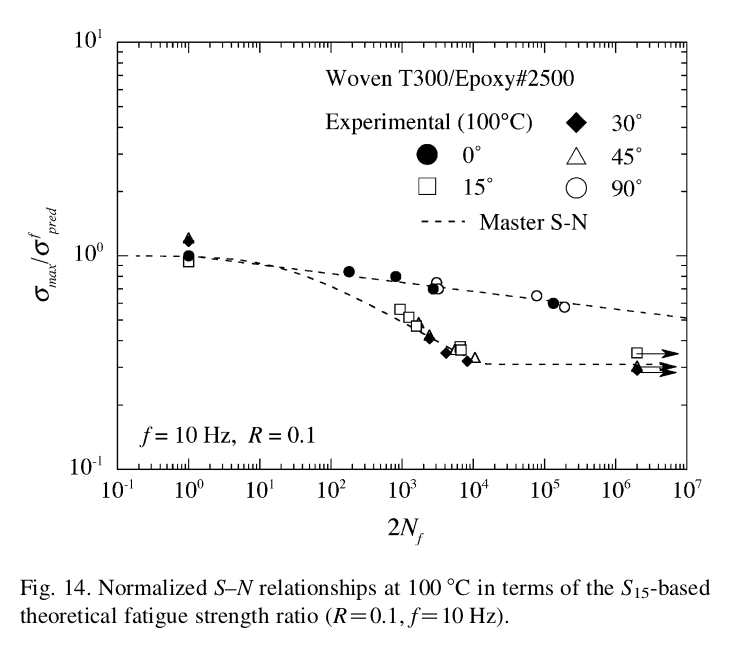
Not sure that's true. The paper and its references show failures happening after a thousand or so cycles of a stress below the breaking stress. For example this one from Kawai et al. 2006. I think the y-axis is the stress they used in the test cycle over the breaking stress (which is why everything interesting is below 1). There is a region where, with less stress than would break the material statically, it still fails after a number of cycles. And then there is an apparent fatigue limit after that.
Originally Posted by
Kontact
I think you also see steel's fatigue limit as an advantage, but it only prevents steel breaking if it never is stressed above that level. Real world, strong riders eventually break steel frames from fatigue. And thinner, narrower tubed steel frames don't last as long.
Agree (and I did say that). It's not clear how relevant it is in practice. Your steel frame might be working above the fatigue limit anyway, and the time to failure of your aluminium one so long that you don't know or care. But it's still theoretically interesting.
Originally Posted by
Kontact
What's funny is that I have seen more steel bikes with fatigue failures than I have seen on any aluminum bike - including all those bonded Treks and Vitus frames. It could be simply because those bikes are constructed in a way that have fewer stress risers, unlike steel with lugs and chainstay bridges. And, bonded aluminum frames have never had a hot torch applied to them, decreasing the material strength.
So the reality is much more complicated than a materials chart would suggest.
Yes completely agree with that.