


Stress around the Bottom Bracket & The Rider
 10-27-25 | 06:52 PM
#51

Thread Starter
BIKE RIDE


Joined: Jun 2014
Posts: 2,218
Likes: 1,012
From: Michigan
Bikes: GUNNAR CrossHairs / Riv RoadUno / TrekBike 950
If MRV's seeing repeated failures in various fabrications at the same point of frame design my take is that he's routinely subjecting his frames to stresses that are beyond what those frames' designers and engineers expected their work to have to endure. He's essentially behaving as a destructive testing consort. (Make no mistake here MRV please! This isn't to be taken personally in any way!!)

-- I'll get the crank pulled Thursday and see what the things look like inside. I think I frame saver'd it when I got it. Pretty sure it didn't have a sealed cartridge BB.
 10-28-25 | 01:05 AM
#52
Senior Member

Joined: Dec 2019
Posts: 1,198
Likes: 394
And not so well of the bus services in the area, which was Plan A, before finding out that that would have taken about 3 hours.
10-28-25 | 06:08 AM
#53

Old fart


Joined: Nov 2004
Posts: 26,411
Likes: 5,350
From: Appleton WI
Bikes: Several, mostly not name brands.
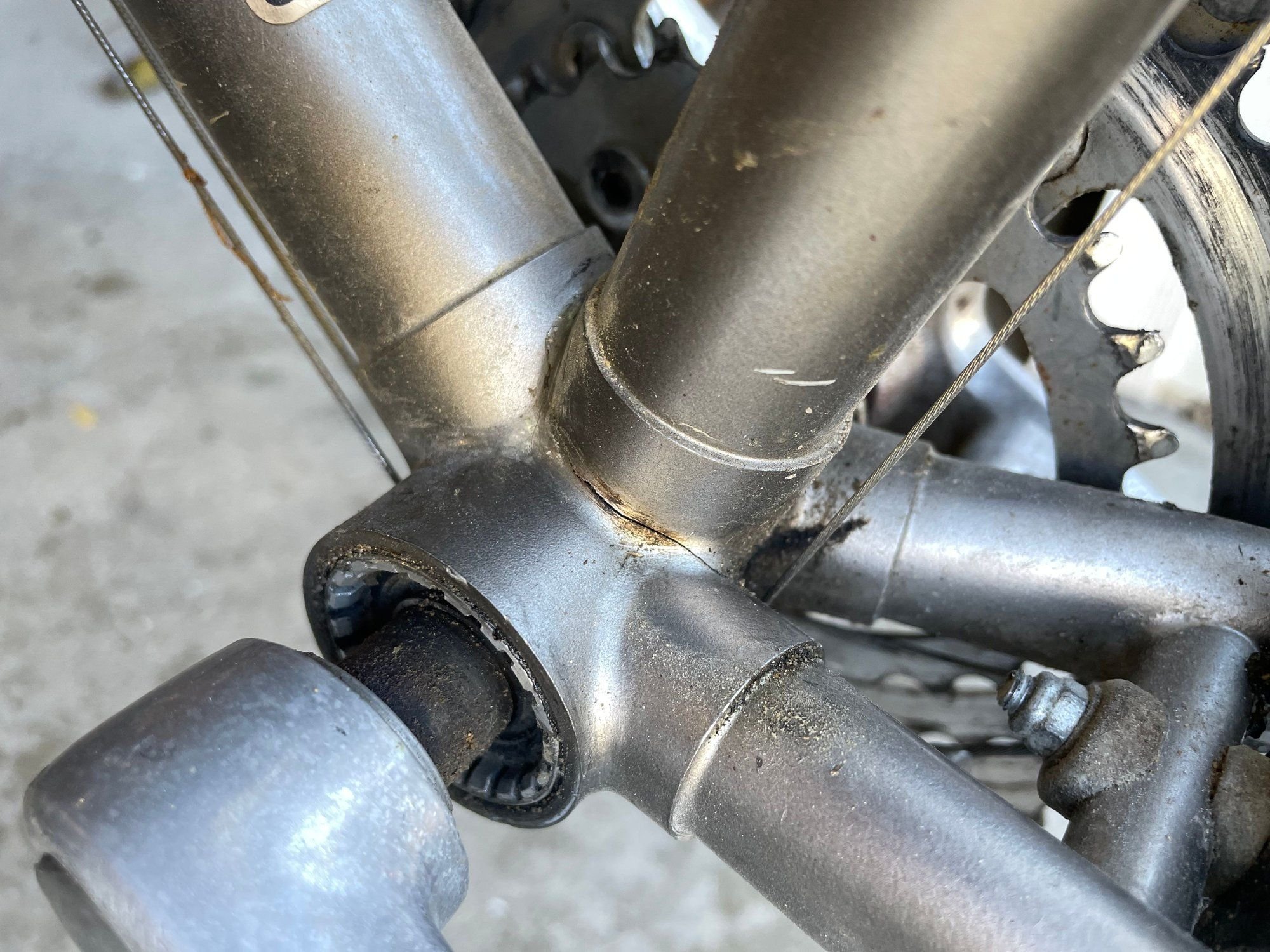
That's a 1989 steel framed Panasonic? I'd like to know more about its history over the 36 years since fabrication, what condition the rest of the frame components were in once that damage became evident.
In the pic I see rust migrated through paint at the juncture of the seat tube / down tube / chain stay join. Everything manmade fails in time.
N.B. still riding the repaired frame 40+ years later.
Last edited by JohnDThompson; 10-28-25 at 06:22 AM.
 10-28-25 | 11:40 AM
#54
Thread Starter
BIKE RIDE
Joined: Jun 2014
Posts: 2,218
Likes: 1,012
From: Michigan
Bikes: GUNNAR CrossHairs / Riv RoadUno / TrekBike 950
That's a bulge-formed bottom bracket shell. Those often do not have direct tube/shell contact for the full depth of the tube socket, leaving a stress riser that can crack. I've repaired such a failure by cutting the shell into pieces, sweating off the pieces, and installing a new investment-cast shell. It's a big job, and not likely worth the expense unless you're doing the work yourself.
N.B. still riding the repaired frame 40+ years later.
N.B. still riding the repaired frame 40+ years later.
.... offer it for the low price of "free" if he wants it kicking around his shop as a project, that is.
10-29-25 | 07:05 PM
#55
Thread Starter
BIKE RIDE
Joined: Jun 2014
Posts: 2,218
Likes: 1,012
From: Michigan
Bikes: GUNNAR CrossHairs / Riv RoadUno / TrekBike 950
Got the BB cartridge out. Almost cracked all round. Not much rust considering 36 years old.
I’m thankful I didn’t get stranded somewhere, like Kalamazoo. Although that’s where the Bells Brewery is. So maybe I would have been fine.
here’s some pics

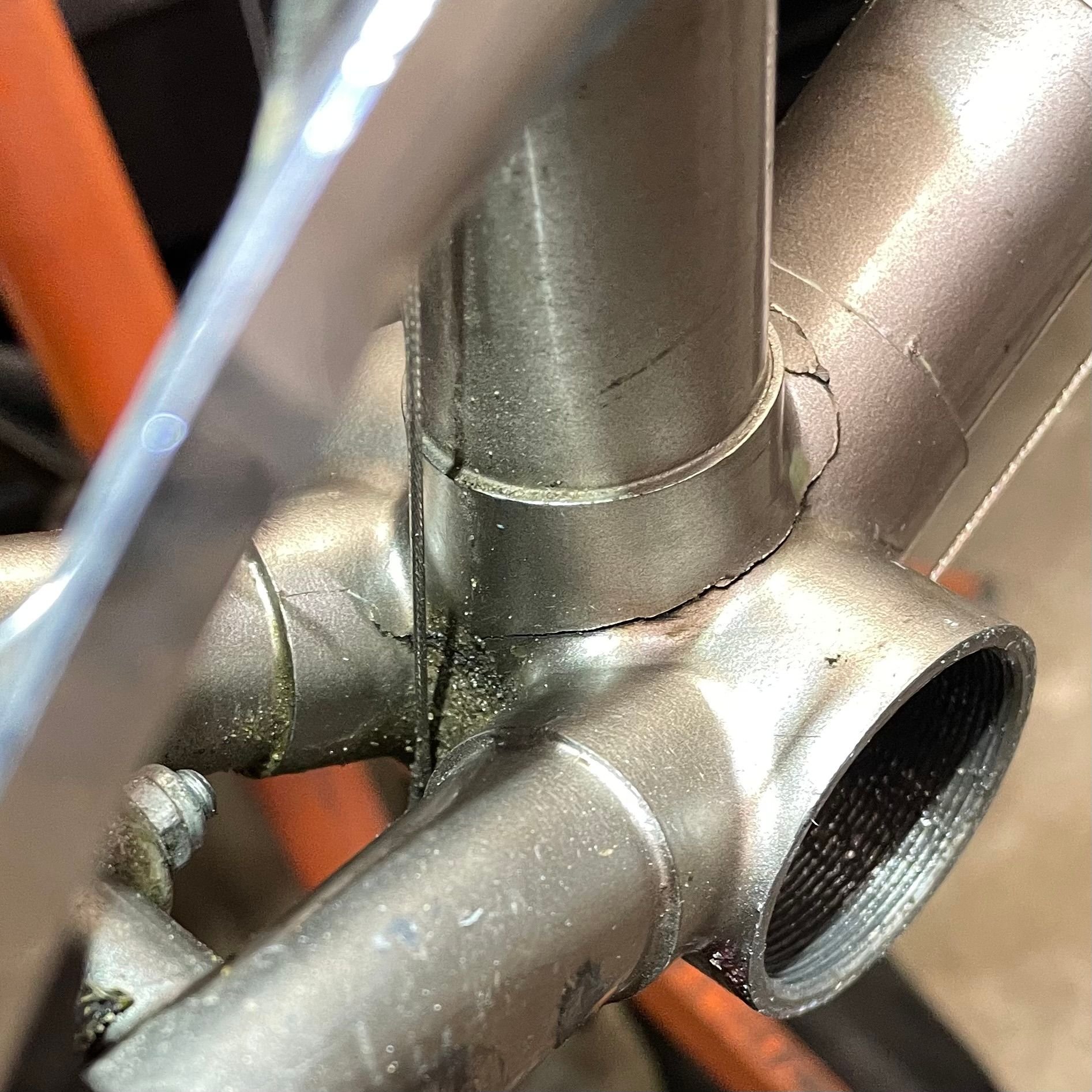
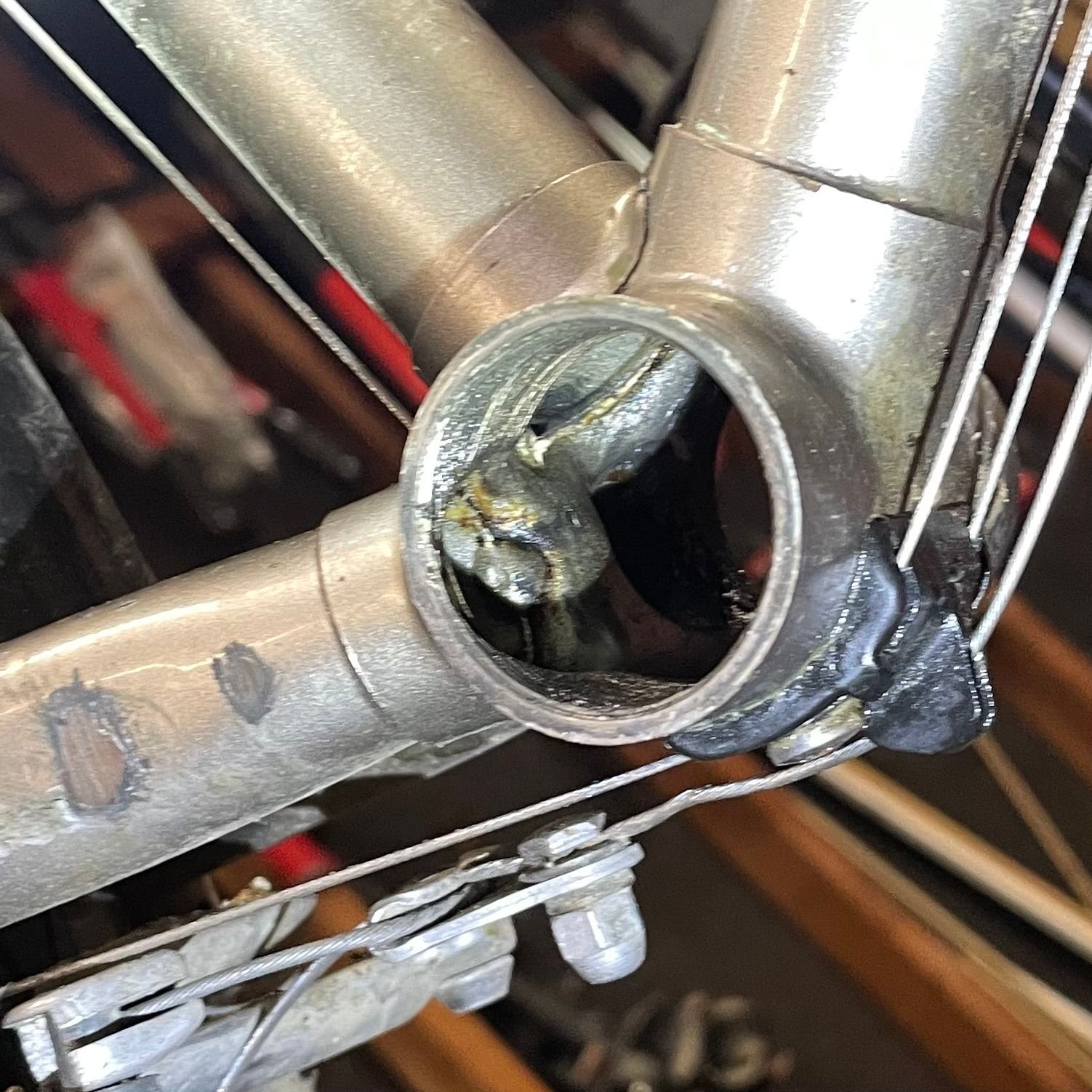


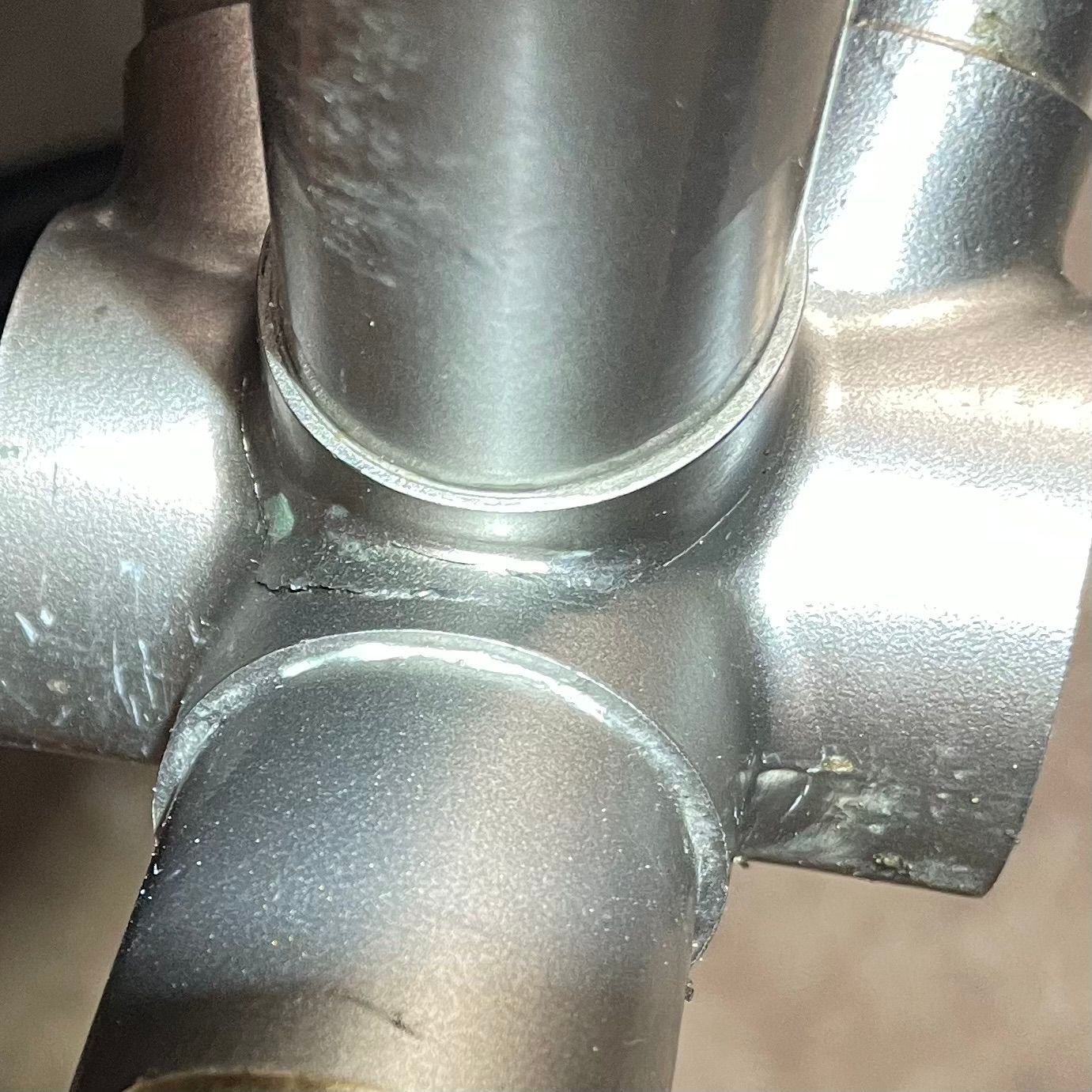
hopefully the next pics will be the repaired steamroller
I’m thankful I didn’t get stranded somewhere, like Kalamazoo. Although that’s where the Bells Brewery is. So maybe I would have been fine.
here’s some pics
hopefully the next pics will be the repaired steamroller
10-29-25 | 09:32 PM
#56

Senior Member
Joined: Feb 2012
Posts: 19,381
Likes: 5,527
From: Rochester, NY
Bikes: Stewart S&S coupled sport tourer, Stewart Sunday light, Stewart Commuting, Stewart Touring, Co Motion Tandem, Stewart 3-Spd, Stewart Track, Fuji Finest, Mongoose Tomac ATB, GT Bravado ATB, JCP Folder, Stewart 650B ATB
About what I thought what the inside of the shell would look like.
Too bad an earlier owner didn't know how to trim their ft der,, or shift the ft der under no pedaling force.
Given the poor mitering I wouldn't think of fixing this frame. Andy.
Too bad an earlier owner didn't know how to trim their ft der,, or shift the ft der under no pedaling force.
Given the poor mitering I wouldn't think of fixing this frame. Andy.
__________________
AndrewRStewart
AndrewRStewart
11-06-25 | 09:08 AM
#57

Senior Member


Joined: Apr 2011
Posts: 12,780
Likes: 4,885
I can't see the tube ends, but that is what it sounds like you're saying about them not being mitered.
11-06-25 | 09:47 AM
#58
Senior Member
Joined: Feb 2012
Posts: 19,381
Likes: 5,527
From: Rochester, NY
Bikes: Stewart S&S coupled sport tourer, Stewart Sunday light, Stewart Commuting, Stewart Touring, Co Motion Tandem, Stewart 3-Spd, Stewart Track, Fuji Finest, Mongoose Tomac ATB, GT Bravado ATB, JCP Folder, Stewart 650B ATB
I doubt that only one factor was at play here. Poorly mitered tubes that don't contact each other and also don't fully engage the Bb sockets are a biggie. But I'll also suggest that this BB was way over heated during brazing and I bet let to cool off real fast. Both weakening and embrittling the shell some. Then there's the rider's contribution. With such obvious evidence of poor drivetrain management (the chain sawed through ft der cage and damaged chainstay...) this bike likely had a rough life right from the beginning. Andy
__________________
AndrewRStewart
AndrewRStewart
11-06-25 | 09:10 PM
#59
Senior Member
Joined: Jan 2014
Posts: 511
Likes: 411
From: San Francisco - it used to be nice
Bikes: 1970 Alex Singer, 63 Hetchins, 75 Motobecane Townie, more . . .
The stamped or bulge-formed BB shell has to be made of a softer, weaker and more ductile steel in order to be formed in the first place.
I don't think that the mild-steel that is used is affected by "overheating" or cooling issues. Alloy steel tubing, yes. Mild steel - ?
I don't think that the mild-steel that is used is affected by "overheating" or cooling issues. Alloy steel tubing, yes. Mild steel - ?
 11-11-25 | 08:29 PM
#60
Thread Starter
BIKE RIDE
Joined: Jun 2014
Posts: 2,218
Likes: 1,012
From: Michigan
Bikes: GUNNAR CrossHairs / Riv RoadUno / TrekBike 950
Originally Posted by Andrew R Stewart;[url=tel:23639343
23639343]Then there's the rider's contribution. With such obvious evidence of poor drivetrain management (the chain sawed through ft der cage and damaged chainstay...) this bike likely had a rough life right from the beginning. Andy
I would say I’ll stick with single speeds, but I done ordered a Sam Hillborne.
I’ll strive to do better.
But now!
…. the moment you all have been waiting for…..
Last edited by mrv; 11-11-25 at 08:40 PM.
11-11-25 | 08:39 PM
#61
Thread Starter
BIKE RIDE
Joined: Jun 2014
Posts: 2,218
Likes: 1,012
From: Michigan
Bikes: GUNNAR CrossHairs / Riv RoadUno / TrekBike 950
Repaired. Powdered. Ready to roll!
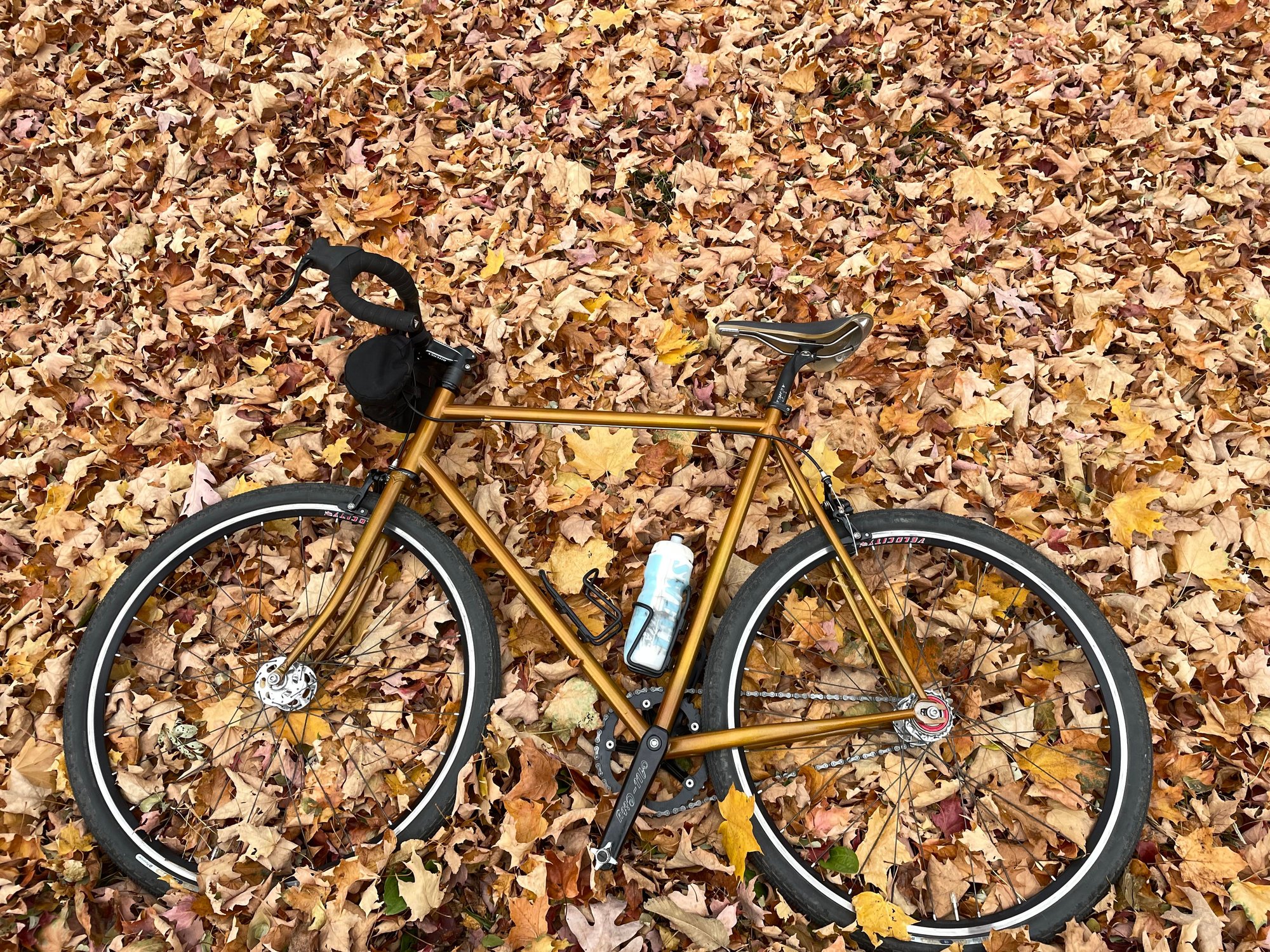

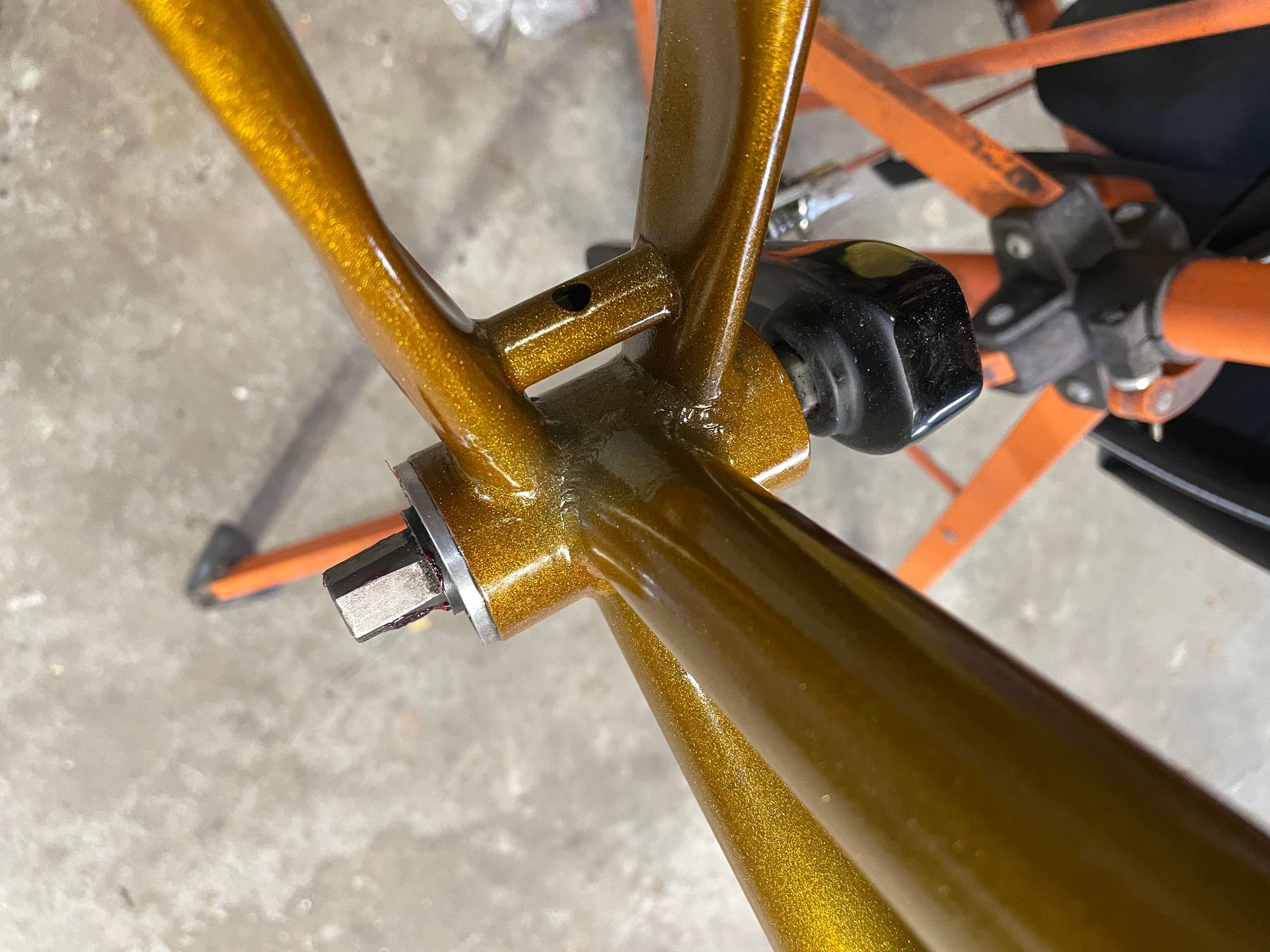
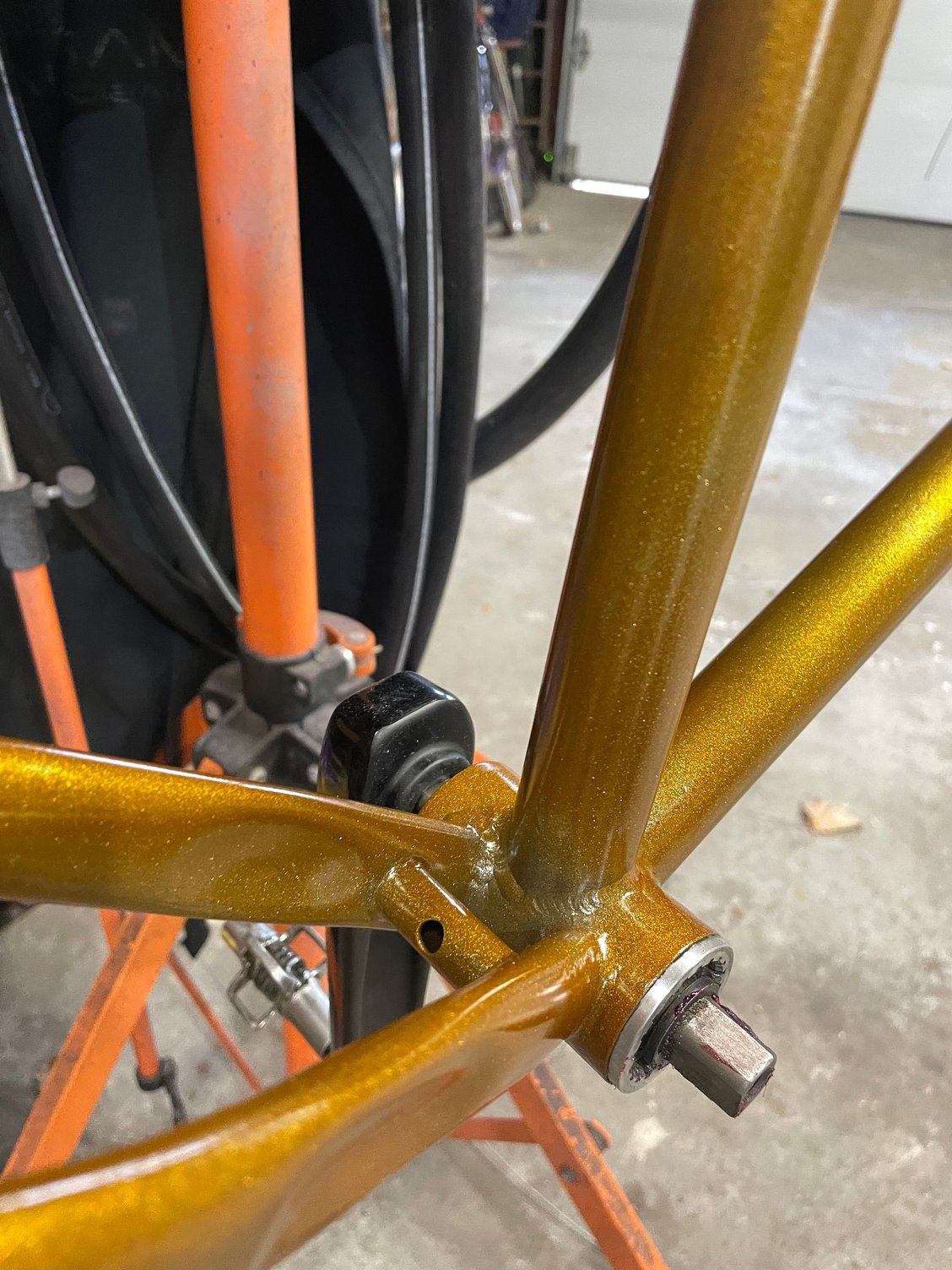
Got it back Friday.
Love the color.
Coating Is thin in some joints. I can’t recall how to avoid that. It’s been a long time since I did any coating. Maybe those tight bends need the coating first.
I think it’s got something with how the charge doesn’t build up in the bend. Someone google that for me.
cheers
11-14-25 | 08:06 AM
#62
Senior Member
Joined: Dec 2013
Posts: 2,098
Likes: 353
Three in a row in same location is not happenstance. Yes, the rider caused the stress that broke the frame. Your frames would not have broken if left parked in the garage, so yes, the rider is involved.
What you need is a bottom bracket shell. Well, you do have simple tubular bottom bracket shells on each of those bikes. But what I'm talking about is the old style shells that had four sockets, one for each frame tube. Looked like lugs. Reinforced the tube ends. Tube ends bathed in a coat of nice ductile brass.
What you want is a normal frame. You are not getting away with a cost-cutting frame. Sure welded frames work for most riders. Pretty plain they do not work for you.
There are riders who can break anything. And there are riders who break specific things. The fault here is your pedal stroke. Training pedal stroke is best started young and if you don't have a good coach (they no longer exist) and spend decades training your stroke, you need a good strong BB shell.
When I started group rides back in 60s pedal stroke was what we talked about. The old guys were mostly sixday racers and all track riders. Making an exchange on the sixday track would often result in speed above 50mph. Most of those small tracks had gear limits. The common gear limit was 24x8 (same as 48x16). So the racers needed 200rpm on tap instantly. They needed that 200rpm instantly after six sixteen hour days of racing. Any attempting to race without that souplesse crashed out quickly. Those who had it could perform balletic exchanges while half asleep.
Best training for pedal style is riding a fixed gear. Even for that simple step you are going to need help from someone very old. Eighty or up is my guess. I just watched a GCN video about building a fixie. The only thing the 'mechanic' got right was the paint. Which was the only part he much cared about.. 'Tensioning the chain" does not mean putting tensile load on the full length of the chain, top run and bottom run, and across all the teeth. That rides very rough and wears out the drivetrain very quickly. Everything else moderns do is equally without purpose or function. Classic training gears are 46x18, 48x19 or 50x20. For winter if not young and very strong add another tooth at the rear. Or two teeth at the rear. And even if young and strong 48x21 will be good for you.
I am 73 years old and still ride 200rpm downhill. This is normal. Except I am about the only person doing it. What you want is a normal frame with a BB shell. They aren't normal any longer.
What you need is a bottom bracket shell. Well, you do have simple tubular bottom bracket shells on each of those bikes. But what I'm talking about is the old style shells that had four sockets, one for each frame tube. Looked like lugs. Reinforced the tube ends. Tube ends bathed in a coat of nice ductile brass.
What you want is a normal frame. You are not getting away with a cost-cutting frame. Sure welded frames work for most riders. Pretty plain they do not work for you.
There are riders who can break anything. And there are riders who break specific things. The fault here is your pedal stroke. Training pedal stroke is best started young and if you don't have a good coach (they no longer exist) and spend decades training your stroke, you need a good strong BB shell.
When I started group rides back in 60s pedal stroke was what we talked about. The old guys were mostly sixday racers and all track riders. Making an exchange on the sixday track would often result in speed above 50mph. Most of those small tracks had gear limits. The common gear limit was 24x8 (same as 48x16). So the racers needed 200rpm on tap instantly. They needed that 200rpm instantly after six sixteen hour days of racing. Any attempting to race without that souplesse crashed out quickly. Those who had it could perform balletic exchanges while half asleep.
Best training for pedal style is riding a fixed gear. Even for that simple step you are going to need help from someone very old. Eighty or up is my guess. I just watched a GCN video about building a fixie. The only thing the 'mechanic' got right was the paint. Which was the only part he much cared about.. 'Tensioning the chain" does not mean putting tensile load on the full length of the chain, top run and bottom run, and across all the teeth. That rides very rough and wears out the drivetrain very quickly. Everything else moderns do is equally without purpose or function. Classic training gears are 46x18, 48x19 or 50x20. For winter if not young and very strong add another tooth at the rear. Or two teeth at the rear. And even if young and strong 48x21 will be good for you.
I am 73 years old and still ride 200rpm downhill. This is normal. Except I am about the only person doing it. What you want is a normal frame with a BB shell. They aren't normal any longer.
11-14-25 | 08:53 PM
#63
Senior Member
Joined: Jan 2014
Posts: 511
Likes: 411
From: San Francisco - it used to be nice
Bikes: 1970 Alex Singer, 63 Hetchins, 75 Motobecane Townie, more . . .
Does it really take "decades" to learn how to pedal smoothly and spin - ? I'm 64 and I wonder if I have enough time left to develop Souplesse ?
Your estimate of over 50 mph exchanges (especially on a small track) is also a touch exaggerated, IMHO.
BITD a smooth high cadence was more important because of the larger jumps on the 5 speed freewheels and not being able to shift under a heavy pedal load. With the crappy shallow shoe cleats of the day you would pull out of your pedal if you tried to "muscle" the pedals around.
Nowadays when I see a rider flailing away in too low of a gear I sorta feel sorry for them.
There's a lot more to riding than smooth extremely high cadences. This is 2025, not 1965. Like a lot of things it doesn't hurt to have that ability, but it's about as useful as having a smooth graceful step-up to mount your high-wheeler.
Your estimate of over 50 mph exchanges (especially on a small track) is also a touch exaggerated, IMHO.
BITD a smooth high cadence was more important because of the larger jumps on the 5 speed freewheels and not being able to shift under a heavy pedal load. With the crappy shallow shoe cleats of the day you would pull out of your pedal if you tried to "muscle" the pedals around.
Nowadays when I see a rider flailing away in too low of a gear I sorta feel sorry for them.
There's a lot more to riding than smooth extremely high cadences. This is 2025, not 1965. Like a lot of things it doesn't hurt to have that ability, but it's about as useful as having a smooth graceful step-up to mount your high-wheeler.
 11-15-25 | 06:06 AM
#64

Three in a row in same location is not happenstance. Yes, the rider caused the stress that broke the frame. Your frames would not have broken if left parked in the garage, so yes, the rider is involved.
What you need is a bottom bracket shell. Well, you do have simple tubular bottom bracket shells on each of those bikes. But what I'm talking about is the old style shells that had four sockets, one for each frame tube. Looked like lugs. Reinforced the tube ends. Tube ends bathed in a coat of nice ductile brass.
What you want is a normal frame. You are not getting away with a cost-cutting frame. Sure welded frames work for most riders. Pretty plain they do not work for you.
There are riders who can break anything. And there are riders who break specific things. The fault here is your pedal stroke. Training pedal stroke is best started young and if you don't have a good coach (they no longer exist) and spend decades training your stroke, you need a good strong BB shell.
When I started group rides back in 60s pedal stroke was what we talked about. The old guys were mostly sixday racers and all track riders. Making an exchange on the sixday track would often result in speed above 50mph. Most of those small tracks had gear limits. The common gear limit was 24x8 (same as 48x16). So the racers needed 200rpm on tap instantly. They needed that 200rpm instantly after six sixteen hour days of racing. Any attempting to race without that souplesse crashed out quickly. Those who had it could perform balletic exchanges while half asleep.
Best training for pedal style is riding a fixed gear. Even for that simple step you are going to need help from someone very old. Eighty or up is my guess. I just watched a GCN video about building a fixie. The only thing the 'mechanic' got right was the paint. Which was the only part he much cared about.. 'Tensioning the chain" does not mean putting tensile load on the full length of the chain, top run and bottom run, and across all the teeth. That rides very rough and wears out the drivetrain very quickly. Everything else moderns do is equally without purpose or function. Classic training gears are 46x18, 48x19 or 50x20. For winter if not young and very strong add another tooth at the rear. Or two teeth at the rear. And even if young and strong 48x21 will be good for you.
I am 73 years old and still ride 200rpm downhill. This is normal. Except I am about the only person doing it. What you want is a normal frame with a BB shell. They aren't normal any longer.
What you need is a bottom bracket shell. Well, you do have simple tubular bottom bracket shells on each of those bikes. But what I'm talking about is the old style shells that had four sockets, one for each frame tube. Looked like lugs. Reinforced the tube ends. Tube ends bathed in a coat of nice ductile brass.
What you want is a normal frame. You are not getting away with a cost-cutting frame. Sure welded frames work for most riders. Pretty plain they do not work for you.
There are riders who can break anything. And there are riders who break specific things. The fault here is your pedal stroke. Training pedal stroke is best started young and if you don't have a good coach (they no longer exist) and spend decades training your stroke, you need a good strong BB shell.
When I started group rides back in 60s pedal stroke was what we talked about. The old guys were mostly sixday racers and all track riders. Making an exchange on the sixday track would often result in speed above 50mph. Most of those small tracks had gear limits. The common gear limit was 24x8 (same as 48x16). So the racers needed 200rpm on tap instantly. They needed that 200rpm instantly after six sixteen hour days of racing. Any attempting to race without that souplesse crashed out quickly. Those who had it could perform balletic exchanges while half asleep.
Best training for pedal style is riding a fixed gear. Even for that simple step you are going to need help from someone very old. Eighty or up is my guess. I just watched a GCN video about building a fixie. The only thing the 'mechanic' got right was the paint. Which was the only part he much cared about.. 'Tensioning the chain" does not mean putting tensile load on the full length of the chain, top run and bottom run, and across all the teeth. That rides very rough and wears out the drivetrain very quickly. Everything else moderns do is equally without purpose or function. Classic training gears are 46x18, 48x19 or 50x20. For winter if not young and very strong add another tooth at the rear. Or two teeth at the rear. And even if young and strong 48x21 will be good for you.
I am 73 years old and still ride 200rpm downhill. This is normal. Except I am about the only person doing it. What you want is a normal frame with a BB shell. They aren't normal any longer.
Almost all, that is: Giovanni Battaglin attributed a Giro win to his use of a triple crank.
(Edit: forgot to mention that the lowest climbing gear used in the '50's was often 47/21 or 23!)
It's amazing how long it took the racing community to accept that spinning lower gears wins mountainous races.
But maybe they'd all still be grunting up hills if not for the fact that the manufacturers kept adding sprockets to the cluster to persuade their customer base that they had to buy the latest and greatest. They quickly fetched up against a limit on the small sprockets, so all they could do was add larger and larger climbing sprockets.
That's one of the few obvious instances where market-driven changes actually unambiguously benefited the riders. Looking at videos of pros climbing in the Alps or Pyrenees from even as recently as 15 years ago, it's clear that current racers are spinning up climbs at markedly higher cadences.
Digression aside:
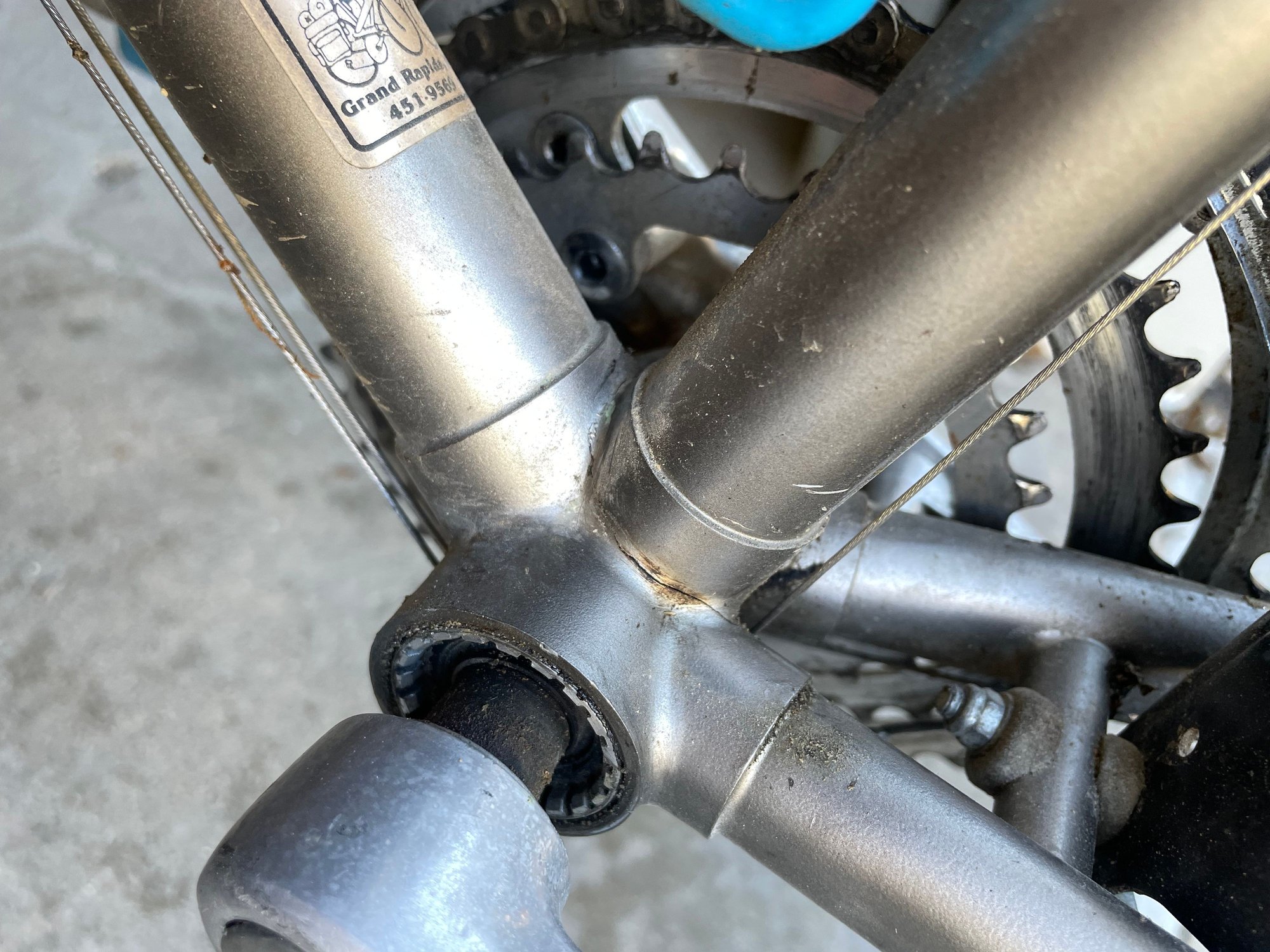
From what I've seen over the decades, the incidence of failure for lugged bottom brackets is comparable to that of welded BB's. Here's a photo of the OP's most recent failure at the bottom bracket (1989 Panasonic MounCat 3500), from post 34 in this thread.
__________________
You are always the same age inside.---Gertrude Stein
My aluminum bikes: Light, strong, cheap, and comfy.
You are always the same age inside.---Gertrude Stein
My aluminum bikes: Light, strong, cheap, and comfy.
Last edited by Trakhak; 11-19-25 at 03:40 AM.
11-15-25 | 09:59 AM
#65
Senior Member
Joined: Feb 2012
Posts: 19,381
Likes: 5,527
From: Rochester, NY
Bikes: Stewart S&S coupled sport tourer, Stewart Sunday light, Stewart Commuting, Stewart Touring, Co Motion Tandem, Stewart 3-Spd, Stewart Track, Fuji Finest, Mongoose Tomac ATB, GT Bravado ATB, JCP Folder, Stewart 650B ATB
If spinning low gears was crucial for those 80-year-old spinning mentors when they were racing as professionals or amateurs 50 years ago, why did they all insist on using, e.g., 42/21 as their climbing gear? Or, reluctantly, for the toughest climbs, maybe 42/23 for a bailout gear? (In the early '80's, one of the guys on my team insisted on using a 44/18 as his only cluster for even the hilliest races.)
Almost all, that is: Giovanni Battaglin attributed a Giro win to his use of a triple crank.
(Edit: forgot to mention that the lowest climbing gear used in the '50's was often 47/21 or 23!)
It's amazing how long it took for the racing community to accept that spinning lower gears wins mountainous races.
But maybe they'd all still be grunting up hills if not for the fact that the manufacturers kept adding sprockets to the cluster to persuade their customer base that they had to buy the latest and greatest. They quickly fetched up against a limit on the small sprockets, so all they could do was add larger and larger climbing sprockets.
That's one of the few obvious instances where market-driven changes actually unambiguously benefited the riders. Looking at videos of pros climbing in the Alps or Pyrenees from even as recently as 15 years ago, it's clear that current racers are spinning up climbs at markedly higher cadences.
Digression aside:
From what I've seen over the decades, the incidence of failure for lugged bottom brackets is comparable to that of welded BB's. Here's a photo of the OP's most recent failure at the bottom bracket (1989 Panasonic MounCat 3500), from post 34 in this thread.
Almost all, that is: Giovanni Battaglin attributed a Giro win to his use of a triple crank.
(Edit: forgot to mention that the lowest climbing gear used in the '50's was often 47/21 or 23!)
It's amazing how long it took for the racing community to accept that spinning lower gears wins mountainous races.
But maybe they'd all still be grunting up hills if not for the fact that the manufacturers kept adding sprockets to the cluster to persuade their customer base that they had to buy the latest and greatest. They quickly fetched up against a limit on the small sprockets, so all they could do was add larger and larger climbing sprockets.
That's one of the few obvious instances where market-driven changes actually unambiguously benefited the riders. Looking at videos of pros climbing in the Alps or Pyrenees from even as recently as 15 years ago, it's clear that current racers are spinning up climbs at markedly higher cadences.
Digression aside:
From what I've seen over the decades, the incidence of failure for lugged bottom brackets is comparable to that of welded BB's. Here's a photo of the OP's most recent failure at the bottom bracket (1989 Panasonic MounCat 3500), from post 34 in this thread.
 ) I asked the seller (later to be my boss) how to use the gears and he said "shift into one gear easier than you think is right". You can see the endless path this can be. Spinning at 90rpm smoothly... oh right, one gear easier. Now spinning at 105... and on. These days with a weakening body I am so glad I learned how to spin smoothly...
While I do agree with the increasing of cadences when riding up hill and in the saddle (and one might credit Lance A for bring this to the public) that the pros use these days I also see an increasing of the high gear ratios too. 54x11 is no longer the highest gearing easily seen. Recently the UCI wanted to ban 10t cogs... I would suggest that today's pro has far better training (both movement and strength), better diets, better team management and equipment that has far more capacity than that of only 30 years ago. Still through all that there's also a certain amount of ego and one upsmanship that goes on too, we are dealing with young gifted athletes. Just as there was way back when and will be decades from now in the future. Andy
__________________
AndrewRStewart
AndrewRStewart
11-15-25 | 02:10 PM
#66
I am a spinner, small and in my youth rather skinny. When I got my first 10 speed (a Huffy Mark 10 with a Wright leather saddle and Huret Alvit gearing, some here will note the age this suggests) I asked the seller (later to be my boss) how to use the gears and he said "shift into one gear easier than you think is right". You can see the endless path this can be. Spinning at 90rpm smoothly... oh right, one gear easier. Now spinning at 105... and on. These days with a weakening body I am so glad I learned how to spin smoothly...
While I do agree with the increasing of cadences when riding up hill and in the saddle (and one might credit Lance A for bring this to the public) that the pros use these days I also see an increasing of the high gear ratios too. 54x11 is no longer the highest gearing easily seen. Recently the UCI wanted to ban 10t cogs... I would suggest that today's pro has far better training (both movement and strength), better diets, better team management and equipment that has far more capacity than that of only 30 years ago. Still through all that there's also a certain amount of ego and one upsmanship that goes on too, we are dealing with young gifted athletes. Just as there was way back when and will be decades from now in the future. Andy
) I asked the seller (later to be my boss) how to use the gears and he said "shift into one gear easier than you think is right". You can see the endless path this can be. Spinning at 90rpm smoothly... oh right, one gear easier. Now spinning at 105... and on. These days with a weakening body I am so glad I learned how to spin smoothly...While I do agree with the increasing of cadences when riding up hill and in the saddle (and one might credit Lance A for bring this to the public) that the pros use these days I also see an increasing of the high gear ratios too. 54x11 is no longer the highest gearing easily seen. Recently the UCI wanted to ban 10t cogs... I would suggest that today's pro has far better training (both movement and strength), better diets, better team management and equipment that has far more capacity than that of only 30 years ago. Still through all that there's also a certain amount of ego and one upsmanship that goes on too, we are dealing with young gifted athletes. Just as there was way back when and will be decades from now in the future. Andy
"How should I train in the winter?" the interviewer asked, perhaps a bit helplessly, given the circumstances.
The Italian replied, "Use the first gear where you feel the pedal." Sound advice.
And "I also see an increasing of the high gear ratios too" reminds of an interview with a team mechanic who said he'd been berated by one of his riders after a stage that ended with a very long, shallow descent. The rider said the mechanic should have known he'd need a 12 on the stage, not a 13. The mechanic pointed out that he had indeed fitted the bike with a 12.
The 10- and 11-tooth sprockets are probably most useful for keeping up with the bunch on long, straight descents. And maybe for towing designated sprinters in the last couple of kilometers, but sprints don't seem to be much more dangerous than they were in the era when clusters ended with 13-tooth sprockets. That is, they've always been dangerous.
__________________
You are always the same age inside.---Gertrude Stein
My aluminum bikes: Light, strong, cheap, and comfy.
You are always the same age inside.---Gertrude Stein
My aluminum bikes: Light, strong, cheap, and comfy.
11-17-25 | 07:48 AM
#67
Thread Starter
BIKE RIDE
Joined: Jun 2014
Posts: 2,218
Likes: 1,012
From: Michigan
Bikes: GUNNAR CrossHairs / Riv RoadUno / TrekBike 950
... an interesting turn in the discussion.....
.... like a crankset on a single speed.... Which I had a whole 'nother discussion on earlier this year!! Dirt Road Race - Advise and Condescend
AND it's about the SteamRoller that got repaired! .... just keeping things relevant.
~ welp, no debate there....
After 50 years of pedaling (the training wheels came off when I was 6, so I'll pick that at the start date of pedaling), I can't imagine I'll change much. Those cadence sensors were a boon to learnin' me how to spin. Having that and access to winter roller riding 'back in the day' (circa 1992ish). Definitely targeting 90rpm + a few rotations improved on my riding. And none of the frames cracked I used back then broke around the BB (Schwinn PDG2 lugged in Japan; lugged Bianchi road bike something or other; Jamis Dakota trail bike; John Cherry's Cherry Bomb road bike). I was also 15 to 20lbs lighter! (liter? no, that's a volume unit...)
And I was clipped in and pedaling most of the rides. Not jumping on and off for coffee stops and hike a bike and whatever other excuse i can come up with to make rides more interesting.
So I'll summarize ~ I've convinced myself it was bad-form on my part having 200lbs.... ok, 205lbs... hop on a pedal and cantilevering the NDS of the bike.
cheers! and ride safely
AND it's about the SteamRoller that got repaired! .... just keeping things relevant.
After 50 years of pedaling (the training wheels came off when I was 6, so I'll pick that at the start date of pedaling), I can't imagine I'll change much. Those cadence sensors were a boon to learnin' me how to spin. Having that and access to winter roller riding 'back in the day' (circa 1992ish). Definitely targeting 90rpm + a few rotations improved on my riding. And none of the frames cracked I used back then broke around the BB (Schwinn PDG2 lugged in Japan; lugged Bianchi road bike something or other; Jamis Dakota trail bike; John Cherry's Cherry Bomb road bike). I was also 15 to 20lbs lighter! (liter? no, that's a volume unit...)
And I was clipped in and pedaling most of the rides. Not jumping on and off for coffee stops and hike a bike and whatever other excuse i can come up with to make rides more interesting.
So I'll summarize ~ I've convinced myself it was bad-form on my part having 200lbs.... ok, 205lbs... hop on a pedal and cantilevering the NDS of the bike.
cheers! and ride safely
11-17-25 | 04:45 PM
#68

Senior Member
Joined: Jul 2006
Posts: 11,511
Likes: 4,929
From: San Jose (Willow Glen) Ca
Bikes: Kirk Custom JK Special, 86 De Rosa Pro, '84 Team Miyata,(dura ace old school) 80?? SR Semi-Pro 600 Arabesque
.... like a crankset on a single speed.... Which I had a whole 'nother discussion on earlier this year!! Dirt Road Race - Advise and Condescend
AND it's about the SteamRoller that got repaired! .... just keeping things relevant.
~ welp, no debate there....
After 50 years of pedaling (the training wheels came off when I was 6, so I'll pick that at the start date of pedaling), I can't imagine I'll change much. Those cadence sensors were a boon to learnin' me how to spin. Having that and access to winter roller riding 'back in the day' (circa 1992ish). Definitely targeting 90rpm + a few rotations improved on my riding. And none of the frames cracked I used back then broke around the BB (Schwinn PDG2 lugged in Japan; lugged Bianchi road bike something or other; Jamis Dakota trail bike; John Cherry's Cherry Bomb road bike). I was also 15 to 20lbs lighter! (liter? no, that's a volume unit...)
And I was clipped in and pedaling most of the rides. Not jumping on and off for coffee stops and hike a bike and whatever other excuse i can come up with to make rides more interesting.
So I'll summarize ~ I've convinced myself it was bad-form on my part having 200lbs.... ok, 205lbs... hop on a pedal and cantilevering the NDS of the bike.
cheers! and ride safely
AND it's about the SteamRoller that got repaired! .... just keeping things relevant.
~ welp, no debate there....
After 50 years of pedaling (the training wheels came off when I was 6, so I'll pick that at the start date of pedaling), I can't imagine I'll change much. Those cadence sensors were a boon to learnin' me how to spin. Having that and access to winter roller riding 'back in the day' (circa 1992ish). Definitely targeting 90rpm + a few rotations improved on my riding. And none of the frames cracked I used back then broke around the BB (Schwinn PDG2 lugged in Japan; lugged Bianchi road bike something or other; Jamis Dakota trail bike; John Cherry's Cherry Bomb road bike). I was also 15 to 20lbs lighter! (liter? no, that's a volume unit...)
And I was clipped in and pedaling most of the rides. Not jumping on and off for coffee stops and hike a bike and whatever other excuse i can come up with to make rides more interesting.
So I'll summarize ~ I've convinced myself it was bad-form on my part having 200lbs.... ok, 205lbs... hop on a pedal and cantilevering the NDS of the bike.
cheers! and ride safely
__________________
Life is too short not to ride the best bike you have, as much as you can.
Life is too short not to ride the best bike you have, as much as you can.
