


Stress around the Bottom Bracket & The Rider
 08-24-25 | 11:10 AM
#1

Thread Starter
BIKE RIDE


Joined: Jun 2014
Posts: 2,218
Likes: 1,012
From: Michigan
Bikes: GUNNAR CrossHairs / Riv RoadUno / TrekBike 950
Stress around the Bottom Bracket & The Rider
Supposing a potential customer came to one of you frame builders and said
“This is the third frame! The third time I’ve had a failure around the bottom bracket!!”
And you learn it’s three different TiG welded frames
a 30 year old Rockhopper
a 1 year old Gunnar Crosshairs
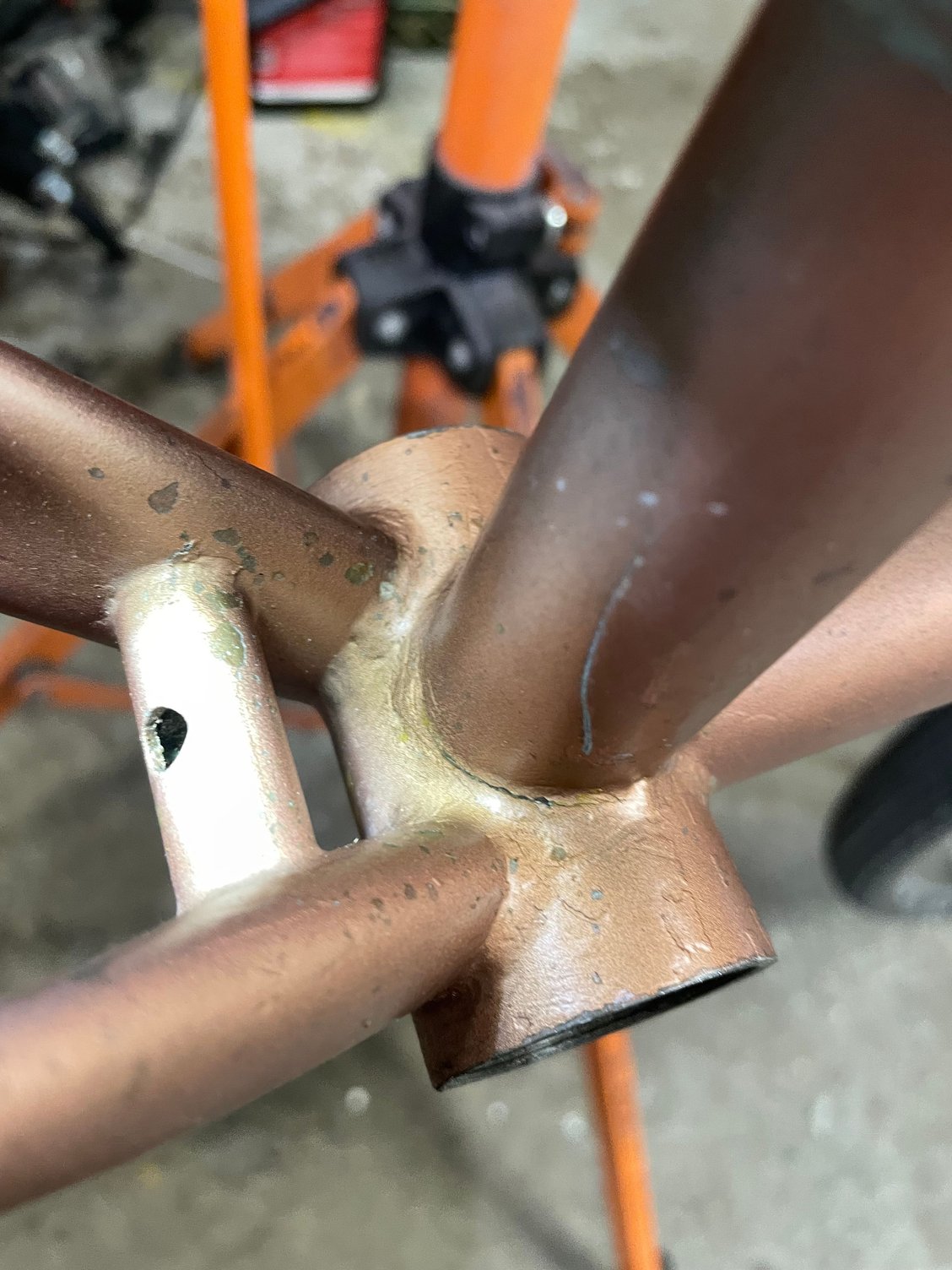
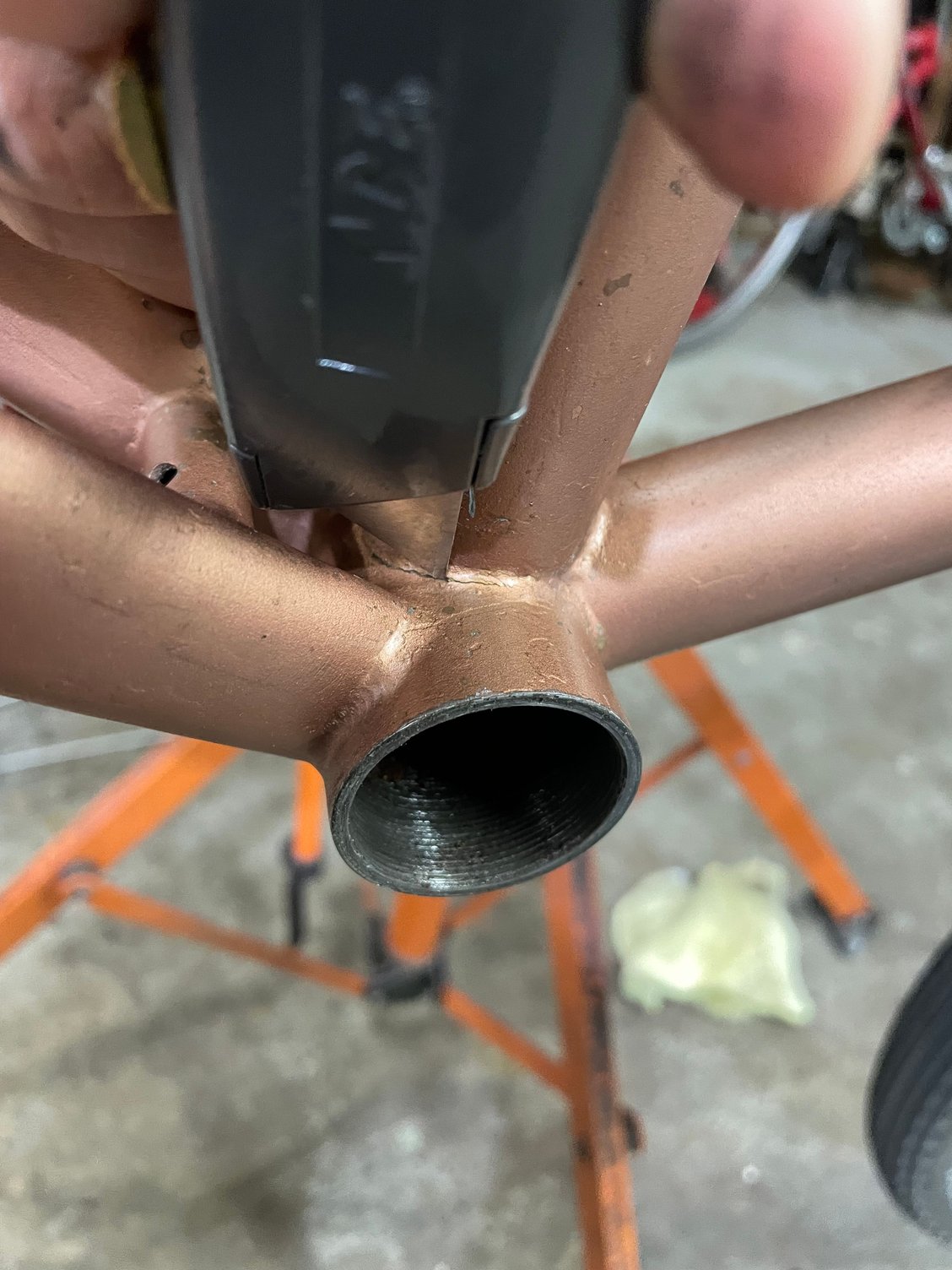
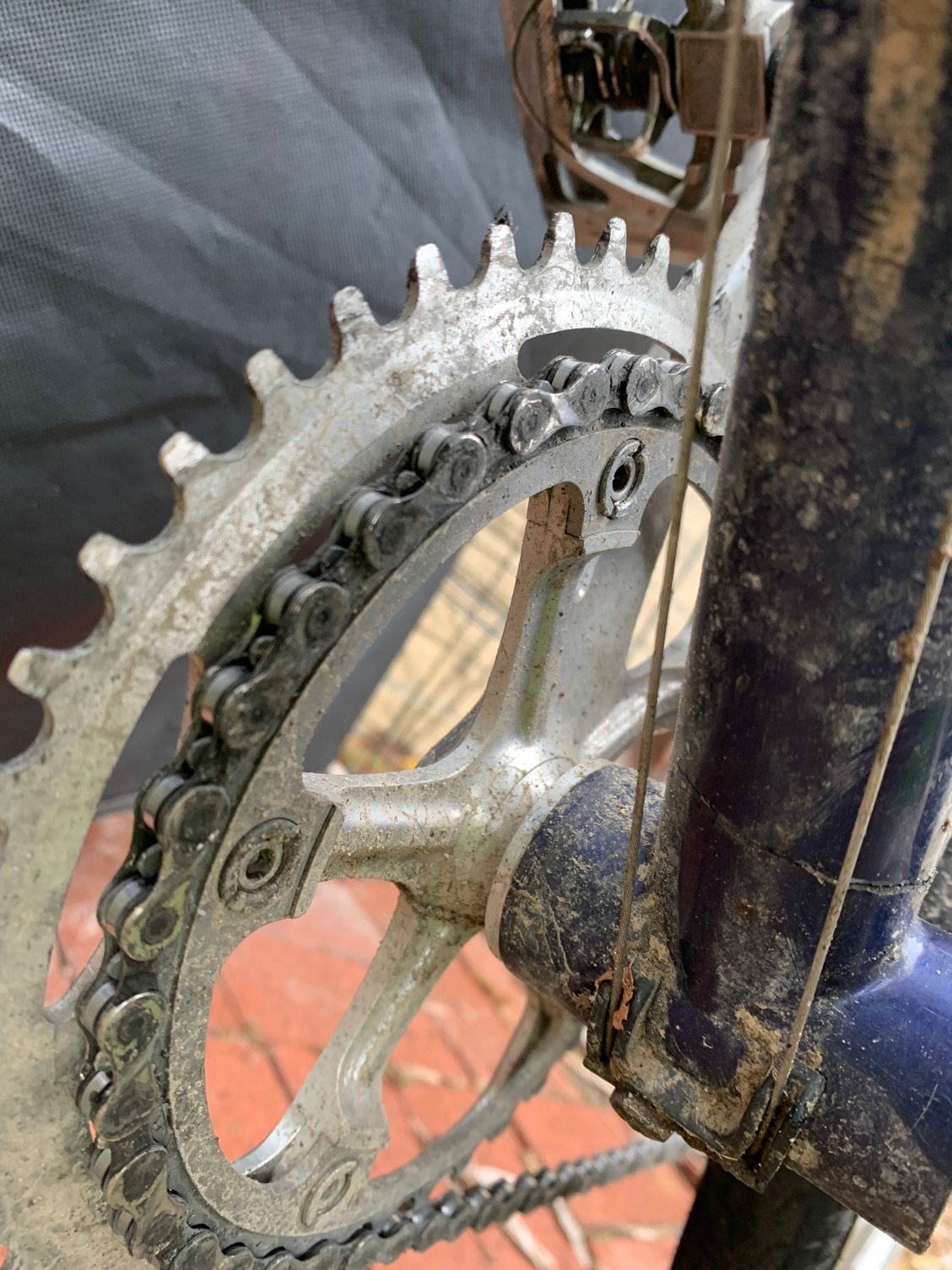
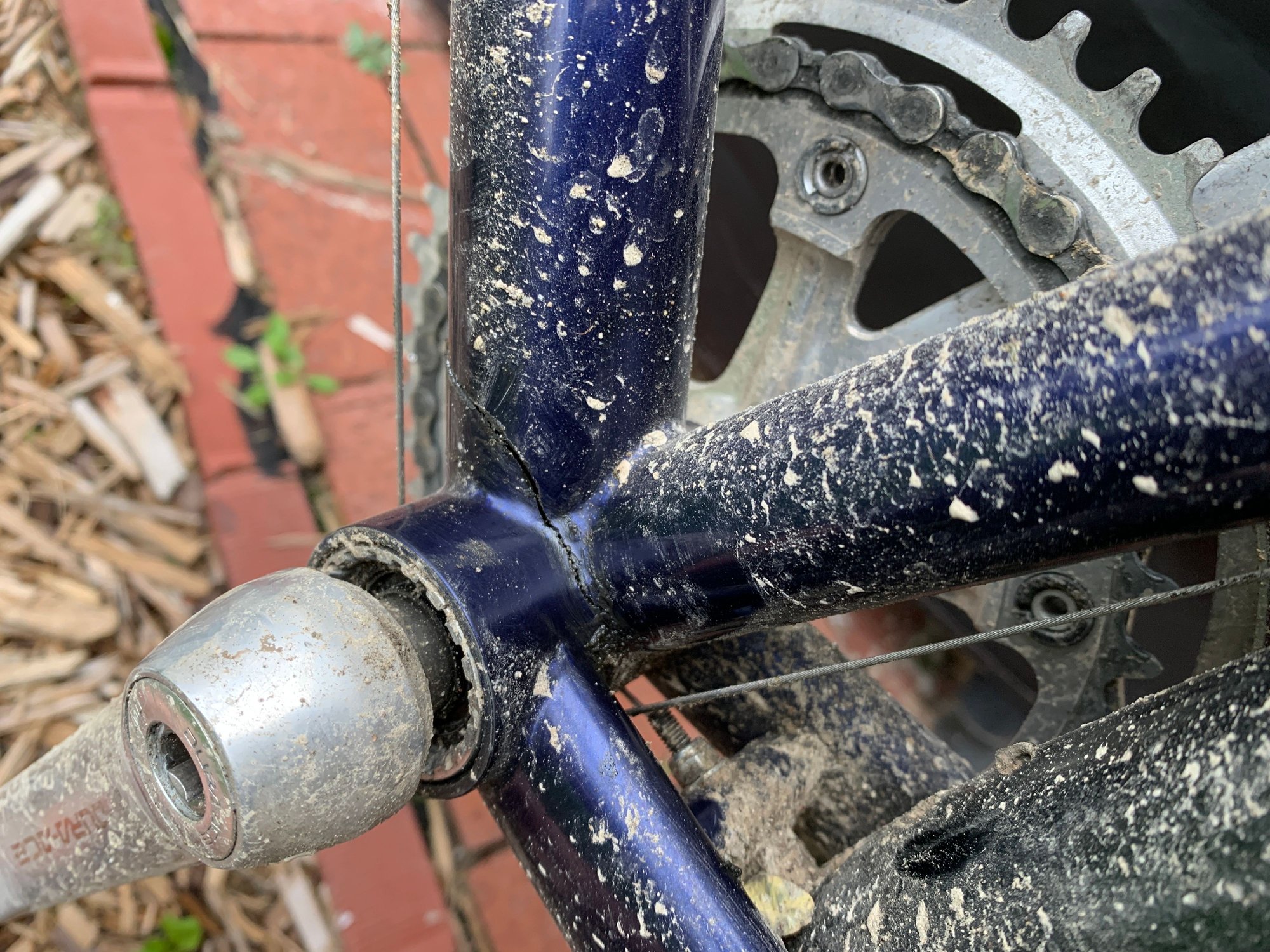
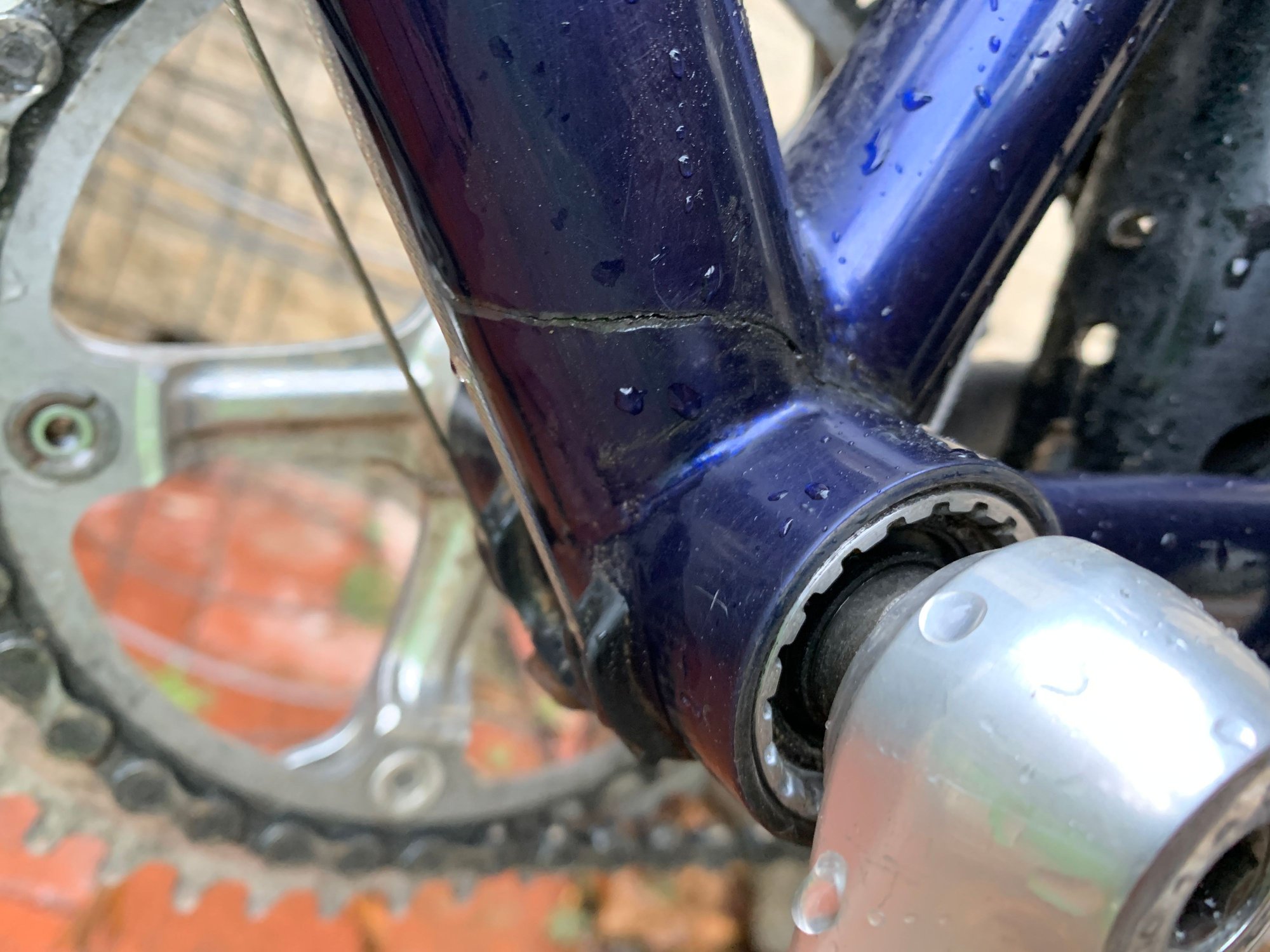
a few years old Surly Steamroller (fresh pic below!)
Are you blaming the rider?
“I WAS JUST RIDING ALONG!!! …and it broke”
Or am I…. I mean said customer… abusing things?
Failures are not identical, the RockHopper kind of a tubing failure. Fatigue. Corrosion. Occasionally loaded for touring.
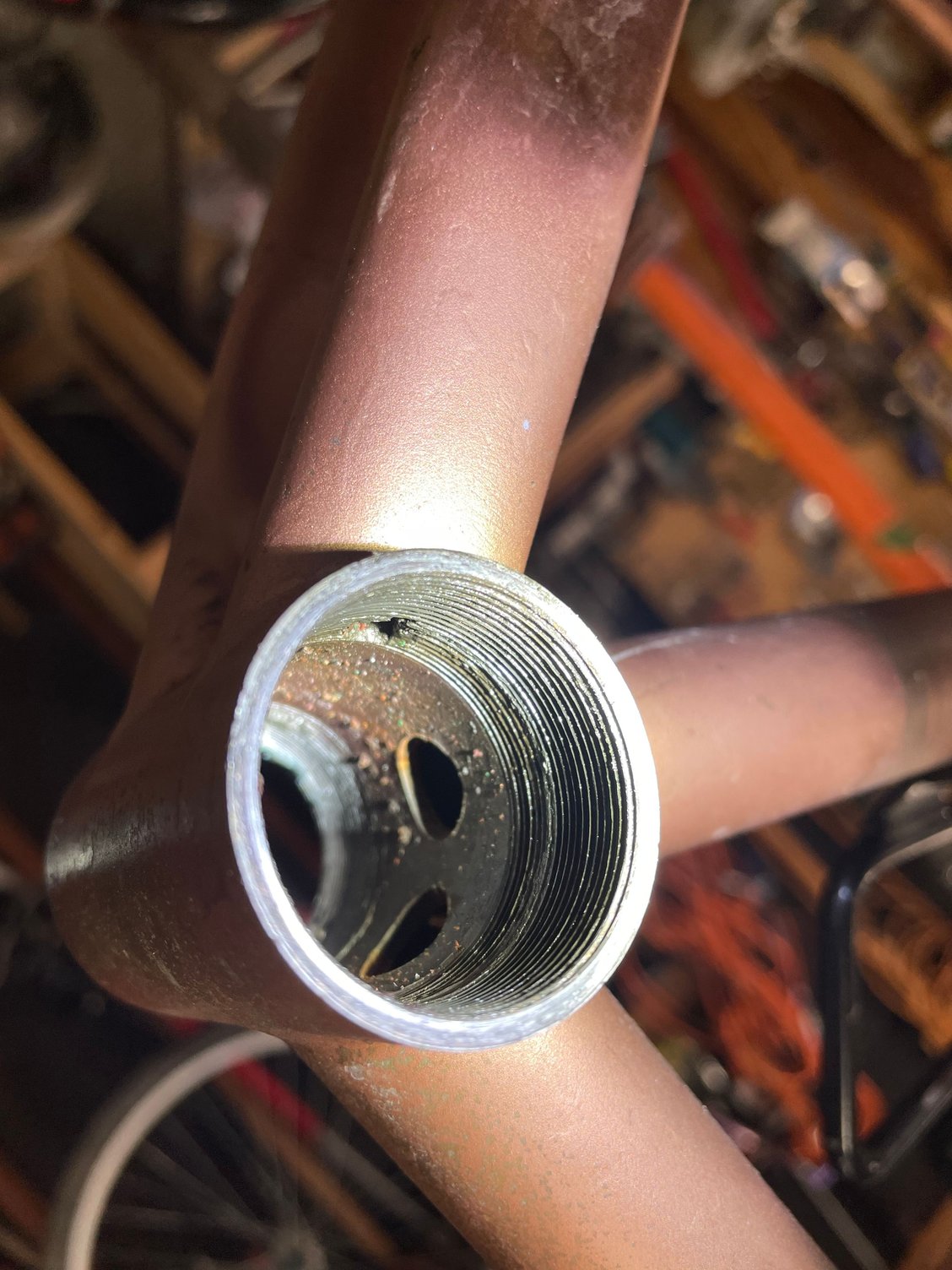
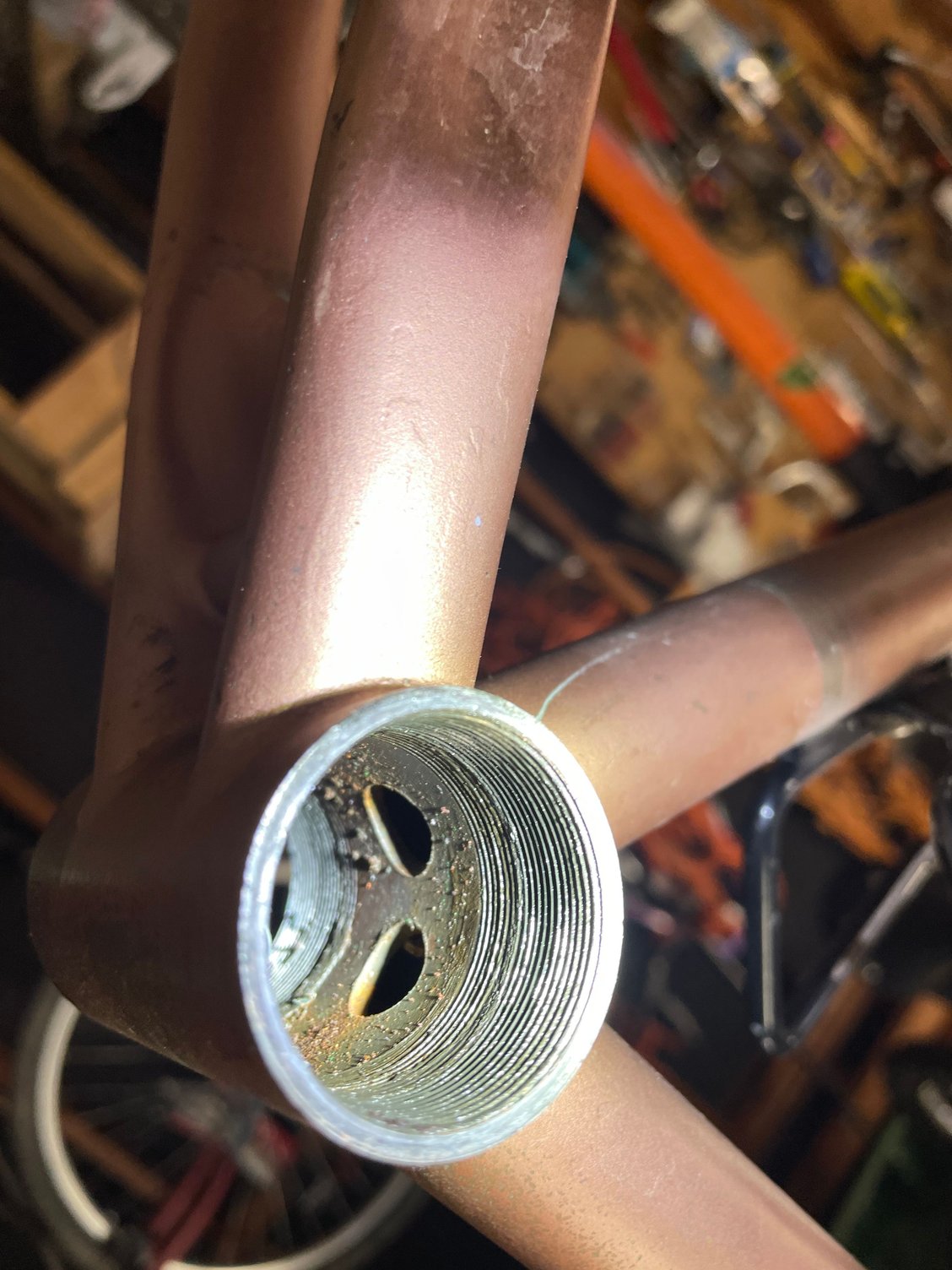
The Gunnar, while it was involved in a crash that bent the fork, 😭😭😭, was new. and the BB fault was many months after the crash.
Thank you to Mr Schwinn for replacing the frame under warranty hassle free.
The Surly looks like a weld failure. Two hundred pound rider doing long fixed rides? Not infrequent 60 to 80 miles.
Is this a customer who doesn’t know how to pedal properly since the training wheels came off 50 years ago? Our dumb luck?
Should the customer stick with lugs? Like a Wabi classic for fixed riding and a Rivendell Appaloosa for touring?
All thoughts and heckling appreciated.
and last comment-a local frame builder shot me a price of $250 for weld & powder coat on the surly. Probably I’ll do that as I ponder if a Cinelli Tutto might not be fun to try instead.
cheers.

“This is the third frame! The third time I’ve had a failure around the bottom bracket!!”
And you learn it’s three different TiG welded frames
a 30 year old Rockhopper
a 1 year old Gunnar Crosshairs
a few years old Surly Steamroller (fresh pic below!)
Are you blaming the rider?
“I WAS JUST RIDING ALONG!!! …and it broke”
Or am I…. I mean said customer… abusing things?
Failures are not identical, the RockHopper kind of a tubing failure. Fatigue. Corrosion. Occasionally loaded for touring.
The Gunnar, while it was involved in a crash that bent the fork, 😭😭😭, was new. and the BB fault was many months after the crash.
Thank you to Mr Schwinn for replacing the frame under warranty hassle free.
The Surly looks like a weld failure. Two hundred pound rider doing long fixed rides? Not infrequent 60 to 80 miles.
Is this a customer who doesn’t know how to pedal properly since the training wheels came off 50 years ago? Our dumb luck?
Should the customer stick with lugs? Like a Wabi classic for fixed riding and a Rivendell Appaloosa for touring?
All thoughts and heckling appreciated.
and last comment-a local frame builder shot me a price of $250 for weld & powder coat on the surly. Probably I’ll do that as I ponder if a Cinelli Tutto might not be fun to try instead.
cheers.
Last edited by mrv; 08-24-25 at 11:15 AM.
 08-24-25 | 12:34 PM
#2

Senior Member


Joined: Jul 2023
Posts: 2,027
Likes: 1,250
From: "Driftless" WI
Bikes: 1972 Motobecane Grand Record, 2023 Specialized Tarmac SL7,'26 Spesh Diverge, '22 Kona Dew+
There's a tradeoff between lightness and durability in every frame ever built.
91kg rider? Power riders who are also Clydesdales will take a toll on frames.
91kg rider? Power riders who are also Clydesdales will take a toll on frames.
__________________
"Bramo assai,poco spero,nulla chieggio."
"Bramo assai,poco spero,nulla chieggio."
08-24-25 | 02:54 PM
#4
Thread Starter
BIKE RIDE
Joined: Jun 2014
Posts: 2,218
Likes: 1,012
From: Michigan
Bikes: GUNNAR CrossHairs / Riv RoadUno / TrekBike 950
I didn't think I had a pic of my GUNNAR - but it failed much like the RockHopper (i think) in / at / around the downtube / seat tube
if you think the frames i ride got it bad, then you should know I'm hell on wheels.......
come on man, that was funny....
Last edited by mrv; 08-24-25 at 02:55 PM. Reason: downtube!
08-24-25 | 03:39 PM
#5


""A few years old Surly Steamroller" . . .
Warranty is three years, so if you registered the bike or have the receipt or the shop where you bought it has a record of the purchase (assuming you bought it new), you should see about getting a warranty replacement frame.
What happened to the other frames is irrelevant, but mentioning those failures could muddy the waters, so best not to. Keep it simple. Frame broke. Clearly a defect in materials or workmanship.
Warranty is three years, so if you registered the bike or have the receipt or the shop where you bought it has a record of the purchase (assuming you bought it new), you should see about getting a warranty replacement frame.
What happened to the other frames is irrelevant, but mentioning those failures could muddy the waters, so best not to. Keep it simple. Frame broke. Clearly a defect in materials or workmanship.
08-27-25 | 06:28 PM
#6
Senior Member
Joined: Jan 2014
Posts: 511
Likes: 411
From: San Francisco - it used to be nice
Bikes: 1970 Alex Singer, 63 Hetchins, 75 Motobecane Townie, more . . .
He broke a Surly ?
That's impressive.
Have they lightened up their tubing selection ? BITD they were not overly "lightweight".
That's impressive.
Have they lightened up their tubing selection ? BITD they were not overly "lightweight".
Last edited by vintage cellar; 08-27-25 at 06:32 PM.
08-27-25 | 07:47 PM
#8

Senior Member


Joined: Apr 2011
Posts: 12,752
Likes: 4,866
 08-28-25 | 05:40 AM
#9
Senior Member
Joined: Jul 2023
Posts: 2,027
Likes: 1,250
From: "Driftless" WI
Bikes: 1972 Motobecane Grand Record, 2023 Specialized Tarmac SL7,'26 Spesh Diverge, '22 Kona Dew+
I should have used this:
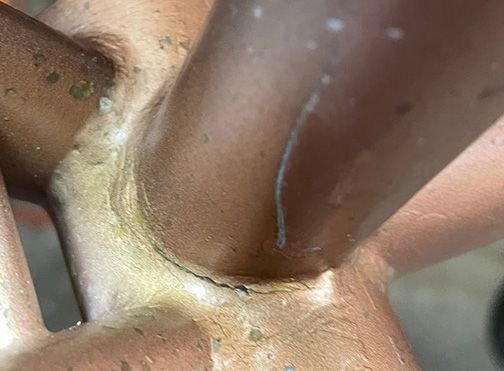
- and I agree that the weld was insufficient there.
It would seem that STRONG riders who make it a routine practice when cranking HARD are the test pilots for just how robust a frame can be made.
Twisting, imparted onto their BB's when cranking hard, will reveal any flaws in frame design or fabrication.
Yet when it happens over time to a series of frames under one rider, the element of chance that defects are the cause of failure in these manufactured products becomes less likely than that the rider should maybe be testing frame designs for a living?
Their cranking practices may routinely exceed the design parameters frame manufacturers are building into their products. A 'good enough' reason for lifetime warranties on frames IMHO.
__________________
"Bramo assai,poco spero,nulla chieggio."
"Bramo assai,poco spero,nulla chieggio."
Last edited by spclark; 08-28-25 at 05:43 AM.
08-28-25 | 06:22 AM
#10
Could be that the techniques used for building modern steel frames generally depend on "good enough" practices that have been in place for decades. The tech used for modern aluminum and carbon frames is probably based on more up-to-date engineering methods such as finite element analysis. Hence the results of the 1997 tests sponsored by the German Tour magazine, where the only frames to survive the toughest testing were carbon or aluminum (all the steel and titanium frames failed the testing).
08-28-25 | 08:29 PM
#11
Thread Starter
BIKE RIDE
Joined: Jun 2014
Posts: 2,218
Likes: 1,012
From: Michigan
Bikes: GUNNAR CrossHairs / Riv RoadUno / TrekBike 950
Originally Posted by Trakhak;[url=tel:23595437
23595437[/url]]Could be that the techniques used for building modern steel frames generally depend on "good enough" practices that have been in place for decades. The tech used for modern aluminum and carbon frames is probably based on more up-to-date engineering methods such as finite element analysis. Hence the results of the 1997 tests sponsored by the German Tour magazine, where the only frames to survive the toughest testing were carbon or aluminum (all the steel and titanium frames failed the testing).
thanks for the article tip. I’ll take a look at it.
I appreciate the other comments as well.
I’m planning on getting it welded and powder coated. Since I mostly ride this fixed, and gear it for flat Detroit riding, the abusive mashing will promptly continue after the repair.
so far I’ve not considered looking for an aluminum or carbon fiber fixie. To date I’ve not seen a kind of fattish tire / cyclocross fixed gear. Lots of steel for that bill.
08-29-25 | 05:36 AM
#12
Senior Member

Joined: Dec 2019
Posts: 1,196
Likes: 394
Could be that the techniques used for building modern steel frames generally depend on "good enough" practices that have been in place for decades. The tech used for modern aluminum and carbon frames is probably based on more up-to-date engineering methods such as finite element analysis. Hence the results of the 1997 tests sponsored by the German Tour magazine, where the only frames to survive the toughest testing were carbon or aluminum (all the steel and titanium frames failed the testing).
08-29-25 | 05:50 AM
#13
The tests aren't representative of real-world failures. But they are the reason why if you buy an off-the-shelf steel frame it's usually a boat anchor. But I guess this is good for custom builders really so I shouldn't complain! But yes I think you're right: they can probably use the FEA to be fairly sure their frame will pass the test.
08-29-25 | 02:30 PM
#14
Senior Member
Joined: Dec 2019
Posts: 1,196
Likes: 394
It's true that steel has a "fatigue limit" so if kept within a certain range it will last theoretically forever. Carbon fibre and aluminium won't. But it's less clear how relevant this is in practice. Your steel frame might be operating outside that range and fail early (especially if it has stress risers due to defects) and your al or CF frame might last longer than you use it for.
08-29-25 | 03:51 PM
#15
It's true that steel has a "fatigue limit" so if kept within a certain range it will last theoretically forever. Carbon fibre and aluminium won't. But it's less clear how relevant this is in practice. Your steel frame might be operating outside that range and fail early (especially if it has stress risers due to defects) and your al or CF frame might last longer than you use it for.
Still, the fact that every single one of the tested steel and titanium frames failed leads to an obvious conclusion: that the lighter-is-better mania in the high-performance bike market forces manufacturers who use those metals to get too close to their strength limits.
And the fact that those manufacturers stay in business probably reveals something else: that the people who still buy high-end steel frames are probably mostly older guys who can now afford bucket-list bikes they lusted after decades earlier. If they were doing the miles on those bikes that they were capable of in their youth, frame failures might be fairly common.
But the riders are not as strong or light as they once were, and anyway, the bike is mostly a trophy piece that gets taken out for 50 km or so every once in a while.
Just occurred to me to search for info on possible test standards for steel bikes in Europe. I have a vague memory of having read of such somewhere.
"Steel racing bicycles sold in Europe are required to pass strength and fatigue tests. These requirements are mandated by the international standard ISO 4210, which has been adopted by European standards bodies to ensure bicycle safety for consumers."
So I would guess that high-performance steel frames are indeed heavier and more durable than they were in 1997. Just a guess, though. I'm sure that there's more to the story.
Another guess: I'd wondered why Koga-Miyata, at one time a well-known European manufacturer of steel racing and touring bikes, has no more steel bikes in their lineup. I checked out their touring bikes recently. They have at least 10 different touring models, all with aluminum frames and forks (though a carbon fork may be available as an upgrade for some models). Guess they decided that it was easier to meet the testing standards with aluminum than with steel while still keeping the bike weight reasonable.
08-29-25 | 04:06 PM
#16

Disco Infiltrator
Joined: May 2013
Posts: 15,345
Likes: 3,542
From: Folsom CA
Bikes: Stormchaser, Paramount, Tilt, Samba tandem
I'm choosing sympathy for your bad luck, except for the Rockhopper, which most likely just wore out.
__________________
Genesis 49:16-17
"Well, well!" said Holmes, impatiently. "A good cyclist does not need a high road. The moor is intersected with paths and the moon is at the full."
Genesis 49:16-17
"Well, well!" said Holmes, impatiently. "A good cyclist does not need a high road. The moor is intersected with paths and the moon is at the full."
08-29-25 | 04:46 PM
#17
Thread Starter
BIKE RIDE
Joined: Jun 2014
Posts: 2,218
Likes: 1,012
From: Michigan
Bikes: GUNNAR CrossHairs / Riv RoadUno / TrekBike 950
Originally Posted by Darth Lefty;[url=tel:23596479
23596479[/url]]I'm choosing sympathy for your bad luck, except for the Rockhopper, which most likely just wore out.
many folks don’t understand the strong disappointment/sadness/bit of melancholy that follows the failure of a much enjoyed AND depended upon bike.
08-30-25 | 08:16 AM
#18
Senior Member
Joined: Dec 2019
Posts: 1,196
Likes: 394
Still, the fact that every single one of the tested steel and titanium frames failed leads to an obvious conclusion: that the lighter-is-better mania in the high-performance bike market forces manufacturers who use those metals to get too close to their strength limits.
And the fact that those manufacturers stay in business probably reveals something else: that the people who still buy high-end steel frames are probably mostly older guys who can now afford bucket-list bikes they lusted after decades earlier. If they were doing the miles on those bikes that they were capable of in their youth, frame failures might be fairly common.
Another guess: I'd wondered why Koga-Miyata, at one time a well-known European manufacturer of steel racing and touring bikes, has no more steel bikes in their lineup. I checked out their touring bikes recently. They have at least 10 different touring models, all with aluminum frames and forks (though a carbon fork may be available as an upgrade for some models). Guess they decided that it was easier to meet the testing standards with aluminum than with steel while still keeping the bike weight reasonable.
 08-30-25 | 09:19 AM
#19
Senior Member
Joined: Apr 2011
Posts: 12,752
Likes: 4,866
It's true that steel has a "fatigue limit" so if kept within a certain range it will last theoretically forever. Carbon fibre and aluminium won't. But it's less clear how relevant this is in practice. Your steel frame might be operating outside that range and fail early (especially if it has stress risers due to defects) and your al or CF frame might last longer than you use it for.
In the real world neither statements are predictive. Aluminum can last effectively forever if it is stiff enough, like an old Klein.
That's true of steel as well, where one way to stay below the fatigue limit is to make the structure stiffer via large diameter tubing to limit stress amplitude.
The downside to stiffness is that a person is sitting on this structure and doesn't enjoy perfect transference of vibration from road to rider. So accepting that certain kinds of frames, like traditional steel, can wear out some day is considered a reasonable trade off.
08-30-25 | 11:31 AM
#20
The standards may have come in partly because when steel was basically the only game in town some bikes were pushing the weight down a bit too much. But now with the UCI weight limit there's carbon fibre to spare anyway (and you can even actually make a safe bike at the UCI weight limit out of steel nowadays).
By '97 they were probably already quite good. We had Reynolds 853 by then. Things were a bit more sketchy when people were drawing 531 super-thin or using 753.
Those aluminium Koga Miyatas are very heavy. 20.7kg for the "world traveller" and 15kg for the one they say is supposed to be light. I'm sure they have their reasons, but you can meet the testing standards with steel easily, especially on a touring frame-- you can buy still buy plenty of Surlies, Treks, Konas etc. It's the lightweight road frame that's now effectively custom-only. And I made my touring frame out of 0.8/0.5/0.8. Those off-the-shelf ones are generally more like 0.9/0.7/0.9.
By '97 they were probably already quite good. We had Reynolds 853 by then. Things were a bit more sketchy when people were drawing 531 super-thin or using 753.
Those aluminium Koga Miyatas are very heavy. 20.7kg for the "world traveller" and 15kg for the one they say is supposed to be light. I'm sure they have their reasons, but you can meet the testing standards with steel easily, especially on a touring frame-- you can buy still buy plenty of Surlies, Treks, Konas etc. It's the lightweight road frame that's now effectively custom-only. And I made my touring frame out of 0.8/0.5/0.8. Those off-the-shelf ones are generally more like 0.9/0.7/0.9.
It's sitting in the basement, covered in dust. It was a great bike, but all I ride now are aluminum bikes with aluminum or carbon forks. I love the torsional stability of aluminum frames.
Trek no longer sells any touring bikes, steel or otherwise. Their last version for the 520 model had an aluminum fork, probably to meet the European testing standards. They must have known that adding the aluminum fork burnt their bridges with touring riders in the U.S., who are less open to the idea of using aluminum frames and forks than European riders apparently are.
There are exceptions, of course. Frequent poster cyccommute has ridden a staggering number of miles on heavily loaded touring bikes over the last few decades, and he has mostly or exclusively toured on bikes with aluminum frames for years now.
By the way, for anyone following this side-discussion, the stock version of the bike described in the quoted post as "very heavy" is pictured below. I would guess that any similarly equipped steel-framed bike that passed the testing standards would be somewhat heavier.
Last edited by Trakhak; 08-30-25 at 11:40 AM.
08-30-25 | 02:00 PM
#21

Senior Member
Joined: Apr 2009
Posts: 3,785
Likes: 5,636
From: Seattle
A bit off topic, but no way could I live with that water bottle (or whatever it is) on top of the toptube. I can't imagine any adult human whose pelvis would fit in that space between the saddle and the TT bottle. Clue me in if I'm missing something but it looks like a huge design fail.
But I am not the intended audience! I need drop bars for any ride over about 15 miles, for varied hand positions, and a lower body position for headwinds and downhills.
I have a strong preference for supple forks, which pretty much requires rim brakes, so almost the entire bike industry has decided to ditch me.
Plus the bike is ugly and poorly designed, in my book. The "ugly" is probably just down to me being old and set in my ways, but you don't even get full fenders or a place to put a bag over the front wheel? Yes I could add a front rack, but this is a "fully" loaded bike, with TWO kickstands and a lock that you can't even leave at home on rides where you won't need a lock. Please tell me there are H2O bosses on the DT, just not visible in the pic. Another big design fail if not.
Kids these days!
But I am not the intended audience! I need drop bars for any ride over about 15 miles, for varied hand positions, and a lower body position for headwinds and downhills.
I have a strong preference for supple forks, which pretty much requires rim brakes, so almost the entire bike industry has decided to ditch me.
Plus the bike is ugly and poorly designed, in my book. The "ugly" is probably just down to me being old and set in my ways, but you don't even get full fenders or a place to put a bag over the front wheel? Yes I could add a front rack, but this is a "fully" loaded bike, with TWO kickstands and a lock that you can't even leave at home on rides where you won't need a lock. Please tell me there are H2O bosses on the DT, just not visible in the pic. Another big design fail if not.
Kids these days!
08-30-25 | 02:06 PM
#22
Senior Member
Joined: Dec 2019
Posts: 1,196
Likes: 394
Really? You're saying CF can be stress cycled forever (like mild or HSLA steel) and never fatigue? I didn't think that was true (but am ready to learn to something of course). I thought this was quite an unusual property fairly unique to steel (due to dislocations diffusing).
08-30-25 | 02:14 PM
#23
Really? You're saying CF can be stress cycled forever (like mild or HSLA steel) and never fatigue? I didn't think that was true (but am ready to learn to something of course). I thought this was quite an unusual property fairly unique to steel (due to dislocations diffusing).
08-30-25 | 02:23 PM
#24
A bit off topic, but no way could I live with that water bottle (or whatever it is) on top of the toptube. I can't imagine any adult human whose pelvis would fit in that space between the saddle and the TT bottle. Clue me in if I'm missing something but it looks like a huge design fail.
But I am not the intended audience! I need drop bars for any ride over about 15 miles, for varied hand positions, and a lower body position for headwinds and downhills.
I have a strong preference for supple forks, which pretty much requires rim brakes, so almost the entire bike industry has decided to ditch me.
Plus the bike is ugly and poorly designed, in my book. The "ugly" is probably just down to me being old and set in my ways, but you don't even get full fenders or a place to put a bag over the front wheel? Yes I could add a front rack, but this is a "fully" loaded bike, with TWO kickstands and a lock that you can't even leave at home on rides where you won't need a lock. Please tell me there are H2O bosses on the DT, just not visible in the pic. Another big design fail if not.
Kids these days!
But I am not the intended audience! I need drop bars for any ride over about 15 miles, for varied hand positions, and a lower body position for headwinds and downhills.
I have a strong preference for supple forks, which pretty much requires rim brakes, so almost the entire bike industry has decided to ditch me.
Plus the bike is ugly and poorly designed, in my book. The "ugly" is probably just down to me being old and set in my ways, but you don't even get full fenders or a place to put a bag over the front wheel? Yes I could add a front rack, but this is a "fully" loaded bike, with TWO kickstands and a lock that you can't even leave at home on rides where you won't need a lock. Please tell me there are H2O bosses on the DT, just not visible in the pic. Another big design fail if not.
Kids these days!
Full commitment, too, since there are apparently no bottle cage drillings on the down tube. I've never been to Europe, though, so maybe I'm just not tuned in to the culture.
08-30-25 | 02:42 PM
#25
Senior Member
Joined: Dec 2019
Posts: 1,196
Likes: 394
Sure, but if you're flexing them much less than that (below the fatigue limit) you can keep going forever. Most materials can't do this. I think the failure when you flex it with huge bends like that (yielding it) is also not strictly fatigue. But you certainly can fatigue a paperclip if the mean stress is above the fatigue limit.