Originally Posted by
63rickert
Three in a row in same location is not happenstance. Yes, the rider caused the stress that broke the frame. Your frames would not have broken if left parked in the garage, so yes, the rider is involved.
What you need is a bottom bracket shell. Well, you do have simple tubular bottom bracket shells on each of those bikes. But what I'm talking about is the old style shells that had four sockets, one for each frame tube. Looked like lugs. Reinforced the tube ends. Tube ends bathed in a coat of nice ductile brass.
What you want is a normal frame. You are not getting away with a cost-cutting frame. Sure welded frames work for most riders. Pretty plain they do not work for you.
There are riders who can break anything. And there are riders who break specific things. The fault here is your pedal stroke. Training pedal stroke is best started young and if you don't have a good coach (they no longer exist) and spend decades training your stroke, you need a good strong BB shell.
When I started group rides back in 60s pedal stroke was what we talked about. The old guys were mostly sixday racers and all track riders. Making an exchange on the sixday track would often result in speed above 50mph. Most of those small tracks had gear limits. The common gear limit was 24x8 (same as 48x16). So the racers needed 200rpm on tap instantly. They needed that 200rpm instantly after six sixteen hour days of racing. Any attempting to race without that souplesse crashed out quickly. Those who had it could perform balletic exchanges while half asleep.
Best training for pedal style is riding a fixed gear. Even for that simple step you are going to need help from someone very old. Eighty or up is my guess. I just watched a GCN video about building a fixie. The only thing the 'mechanic' got right was the paint. Which was the only part he much cared about.. 'Tensioning the chain" does not mean putting tensile load on the full length of the chain, top run and bottom run, and across all the teeth. That rides very rough and wears out the drivetrain very quickly. Everything else moderns do is equally without purpose or function. Classic training gears are 46x18, 48x19 or 50x20. For winter if not young and very strong add another tooth at the rear. Or two teeth at the rear. And even if young and strong 48x21 will be good for you.
I am 73 years old and still ride 200rpm downhill. This is normal. Except I am about the only person doing it. What you want is a normal frame with a BB shell. They aren't normal any longer.
If spinning low gears was crucial for those 80-year-old spinning mentors when they were racing as professionals or amateurs 50 years ago, why did they all insist on using, e.g., 42/21 as their climbing gear? Or, reluctantly, for the toughest climbs, maybe 42/23 for a bailout gear? (In the early '80's, one of the guys on my team insisted on using a 44/18 as his lowest gear for even the hilliest races.)
Almost all, that is:
Giovanni Battaglin attributed a Giro win to his use of a triple crank.
(Edit: forgot to mention that the lowest climbing gear used in the '50's was often 47/21 or 23!)
It's amazing how long it took the racing community to accept that spinning lower gears wins mountainous races.
But maybe they'd all still be grunting up hills if not for the fact that the manufacturers kept adding sprockets to the cluster to persuade their customer base that they had to buy the latest and greatest. They quickly fetched up against a limit on the small sprockets, so all they could do was add larger and larger climbing sprockets.
That's one of the few obvious instances where market-driven changes actually unambiguously benefited the riders. Looking at videos of pros climbing in the Alps or Pyrenees from even as recently as 15 years ago, it's clear that current racers are spinning up climbs at markedly higher cadences.
Digression aside:
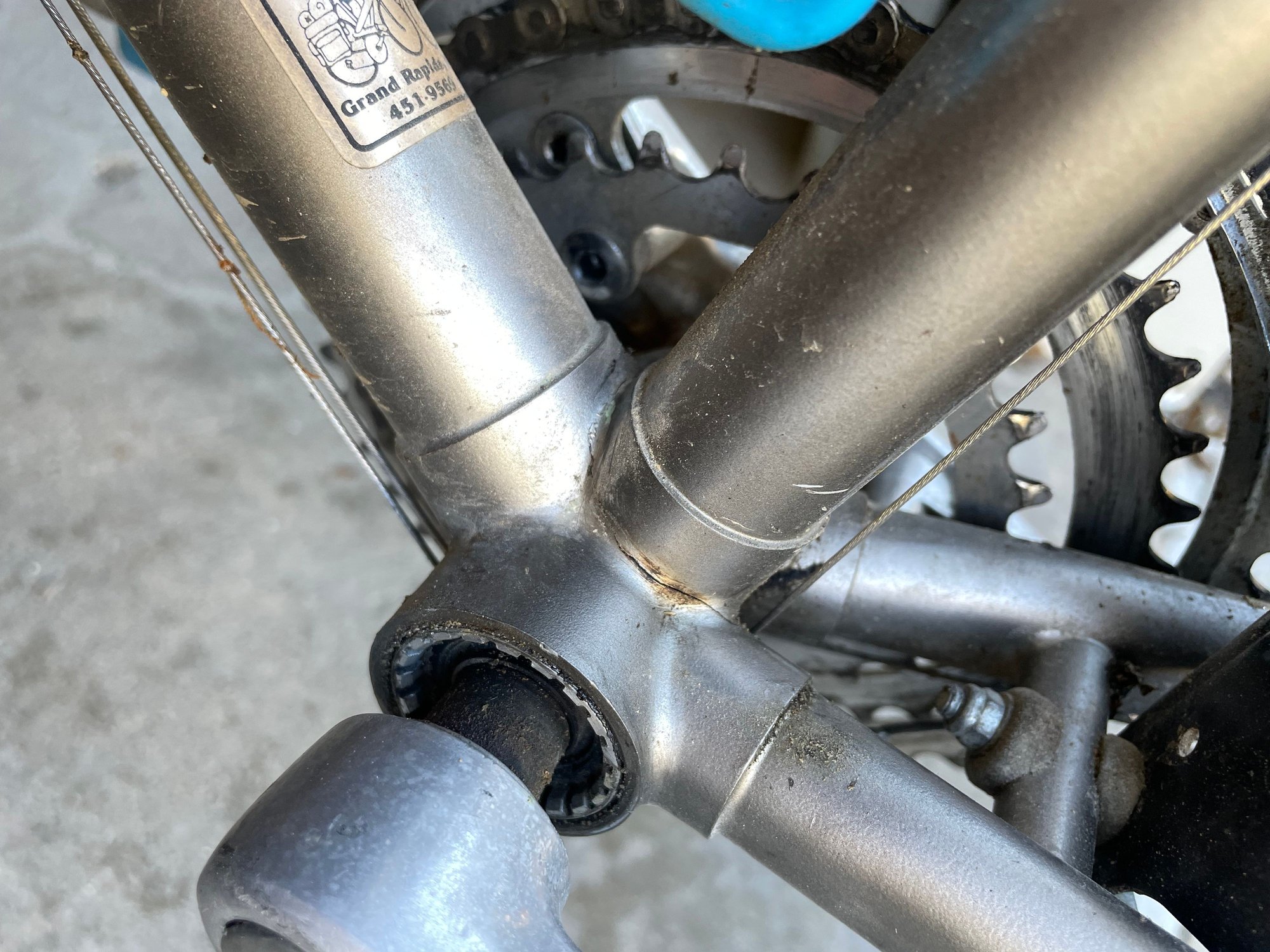
From what I've seen over the decades, the incidence of failure for lugged bottom brackets is comparable to that of welded BB's. Here's a photo of the OP's most recent failure at the bottom bracket (1989 Panasonic MounCat 3500), from post 34 in this thread.