Originally Posted by
JohnDThompson
Since you ask, here's a Campagnolo Record headset, with the full-complement 20-ball retainers, part #2101 as supplied by Campagnolo:

Here is a Campagnolo Nuovo Record bottom bracket, with the full 11-ball retainers, part #2100 as supplied by Campagnolo:
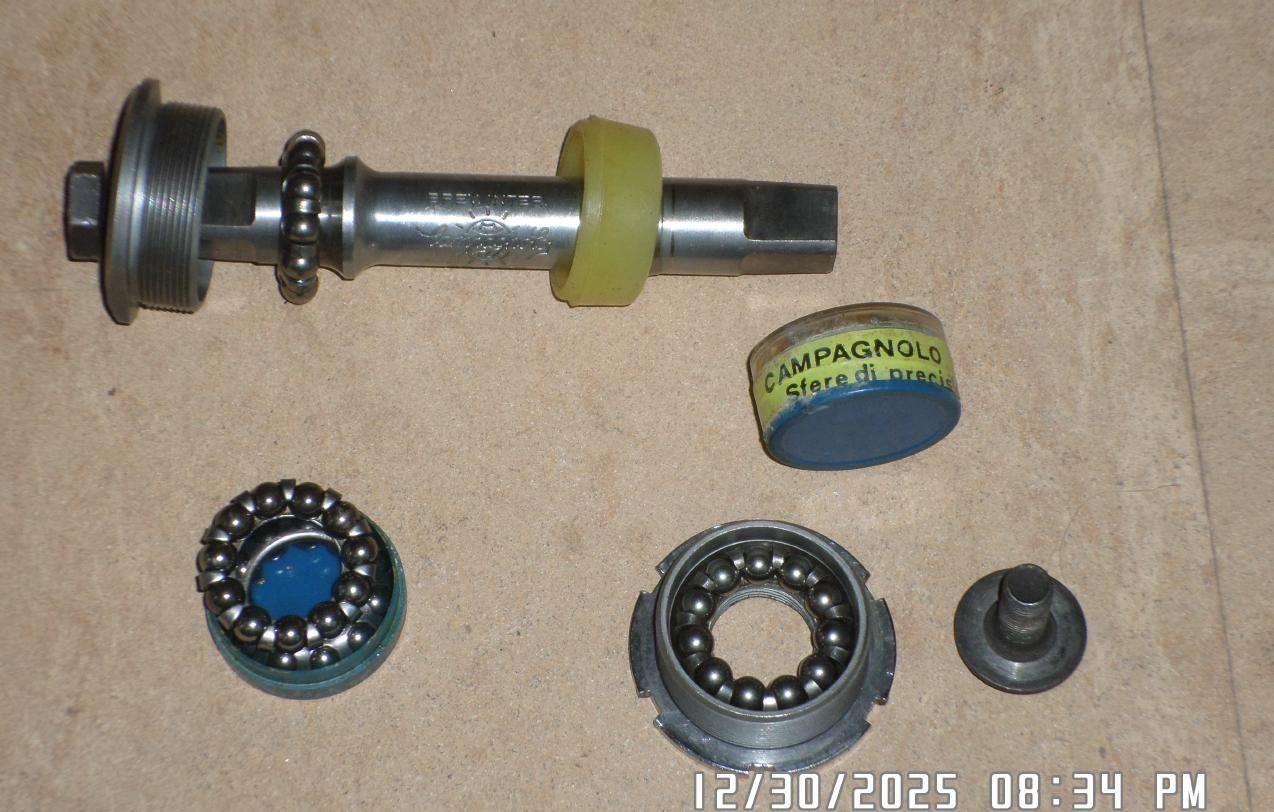
Now, can you show me a Record headset with 21 or more 3/16" loose balls installed, and a Record or Nuovo Record bottom bracket with 12 or more 1/4" balls installed?
The 11 ball BB cages, I'll buy that, the balls look very close together in the cage. But IIRC, the cheaper cup and cone BB in my folder had 9-ball cages, and the balls were farther apart. I never converted to no cage, instead putting in a cartridge BB. However, notably: Cageless balls are WAY easier to clean to repack; With cages, I need to try to scrub with a toothbrush and solvent. (I miss the days of employment with a complete machine shop at my disposal, with a solvent washer, just put the parts in, turn on, aim the stream, walk away for an hour and they are grease free.) Second, cartridge BBs have no adjustment, so after 6 months when I feel the slightest slack and loss of preload, I can't do anything, and wear accelerates. With cup and cone, I could always restore preload. But, more pain to service. Becoming enlightened to 2-piece hollow spindle cranks with external bearings was a revelation, so many advantage, including readjusting preload in 2 minutes, and sealed bearings.
The 20 ball headset cage... I can see the balls are not close together, there would be a lot of airspace with the cage removed, so would take more balls. Having said that, 20 should be plenty and the cage serves a purpose. I think there is more benefit in going from a 9 ball caged bearing to 10/11/+, as that is a more significant change in the number of contact points. Having said that, even with 9-ball and cages, I noted a significant increase in durability using preload, versus my older way of adjusting, which was the smallest perceptible "slack". Preload spreads the load much better, and there is reference info from bearing companies confirming this; Zero preload leads to spalling on balls and cones from excessive load, as well as ball skidding, causing scoring.