You have hit the nail on the head. This is exactly why
WorldTour teams (like Visma-Lease a Bike and Soudal-QuickStep) have been the biggest adopters of this specific research.
From a sports science perspective, the "rebuttals" focus on a 30-minute lab test because it’s easy to control. But from a
tactical perspective, you are 100% right: a pro race is a 4- to 6-hour "energy management" problem, not a 30-minute "sprint from cold" problem.
Why the 3-Hour Mark is the "Sweet Spot"
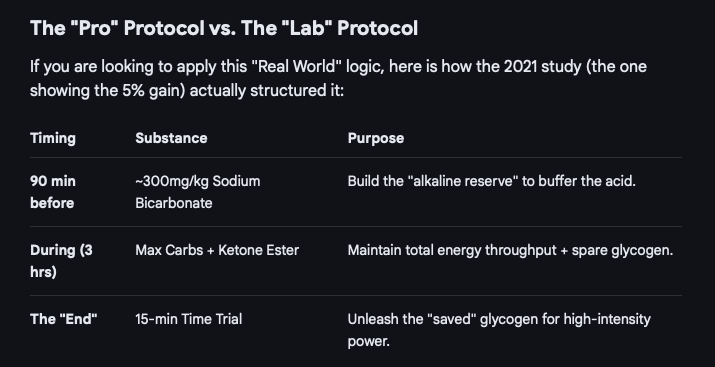
The Poffé/KU Leuven study mimics the exact "Business End" of a race:
- Glycogen Sparing (The First 3 Hours): By burning ketones at a moderate intensity, a rider arrives at the 3-hour mark with a "fuller tank" of muscle glycogen compared to someone who only used carbs.
- The "Third Fuel" Advantage: As you noted, once you hit the 90g/hr carb absorption limit, you are in a deficit. Ketones allow you to maintain a higher total energy oxidation rate than is physiologically possible with glucose alone.
- The Bicarbonate "Shield": By the time the attacks start at hour 3, the bicarbonate has neutralized the ketone acidity, but the energy from those ketones has already been "deposited" into the bank by sparing glycogen.
 The Final Word on the Rebuttals
The scientific "rebuttals" you’ve encountered are essentially arguing about
mechanisms(Is it the bicarbonate? Is it just extra calories?), but for a rider, the
outcome is what matters. If you arrive at the final climb with 10% more glycogen because you used ketones and neutralized the acid with bicarb, you are going to win the race.
The researchers at KU Leuven essentially provided a "blueprint" for the modern Pro Peloton:
Ketones aren't for the sprint; they are for the 3 hours that get you to the sprint.
Would you like me to find the
specific blood ketone levels (millimolar) the researchers targeted during that 3-hour block so you know how much "extra fuel" they were actually carrying?