Thanks for your questions, guys!
I'll start answering the question from Dan.
Originally Posted by
_ForceD_
I’ve been wondering when this was going to happen. It seems kind of bulky…compared to traditional drive/shifting systems. But, it looks like lighter than metal materials were used. What’s the weight comparison of this belt drive system to a comparable traditional system?
Dan
Measured weight of transmission-related components is approx. 1.6 kg.
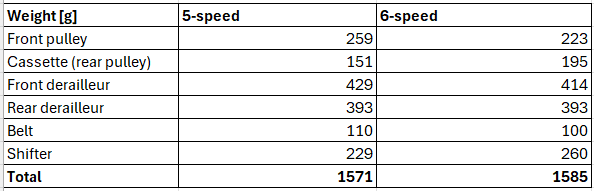 Shifted belt drivetrain weight
There is potential to downsize the shifter and the custom front derailleur, first prototypes were overdesigned just to work reliably. Pulleys were also not weight-optimized. I believe that 1.2-1.3 kg would be a realistic target for the final product.
Typical derailleur transmission setups weigh 1.1-1.4 kg. Belt drives with planetary hubs are heavier, ~2 kg in total. The conclusion is that the weight of shifted belt transmission (with plastic pulleys) is comparable to conventional derailleur chain drive, and it is obviously lighter than the planetary hub with fixed-speed belt. Agree, it looks bulky visually, but low contact pressures from the belt make lightweight plastic pulleys suitable.
Vitaly aka Dry Mechanic
 34/54T front pulley
 18/24/30/40T rear cassette
 36/60T front pulley
 20/26/36T rear cassette