


Shifted belt drive
 05-01-26 | 03:54 AM
#1

Thread Starter
Newbie
Joined: May 2026
Posts: 5
Likes: 3
From: Graz
Shifted belt drive
Hello, folks!
I hope that's the right forum to introduce new bicycle technology, a shifted tooth belt drive with derailleurs. All expert opinions found in the Wed are categoric - chain-style belt shifting with derailleurs is not possible. Patent search I made also hasn't revealed any known designs of shifted toothed belt drives.
Of course, I am aware of 2-speed cassette from Veer. However, I was motivated to make a multi-speed belt driven twin of the derailleur-shifted chain drive.
After some months of work am glad to present first experimental results here. The experts are partially right - the belt is lot wider than the chain, so I could manage integrating a 5-speed drive into the standard frame, and a 6-speed version with slightly increased frame spacing. Nevertheless, 5-6 gears are enough for recreational cycling. 5-speed prototype has ratio spread of 300%, and the 6-speed version is extended to 343%.

5-speed road bike

6-speed MTB

5-speed road bike

6-speed MTB
Both versions have double front pulley with a custom-made front derailleur. The rear derailleur is almost the standard one. 5-speed version is based on triple rear cassette, while the 6-speed version includes additional 4th row. 8-9 speed versions are also possible, if belt OEMs manage to reduce belt width to 9 mm. With actual width of 12 mm it will result in larger Q-factor.
Front and rear derailleurs are shifted synchronously by one rotary shifter based on shift drum. This concept is similar to EGS Synchro Shift system from 1990's. Shifting is easy, and the drum pattern prevents excessive cross-belting (what belts do not like, experts are correct here as well).

6-speed combo shifter
Both bike prototypes turned out to be rideable without severe issues. Shifting is smooth, running is quiet and efficient. Despites plastic-made main components, I could apply full load without any failures so far. The 5-speed prototype has already run more than 500 km on the trainer on complex hilly tracks.

5-speed prototype on the trainer
As intended, the belt drive runs dry, tolerates water, dust, and remains clean all the time. As a bonus to known belt drive advantages, this one enables 5-6 gear ratios without rear hub or front gearbox. Efficiency was not yet measured. From the feeling, it's the same as for fresh-lubricated chain, and way better than I can experience on my old bike with a 7-speed hub.
You can watch on my YouTube channel, how this transmission works.
I would be glad to answer your questions in this thread.
Best regards,
Vitaly aka Dry Mechanic
I hope that's the right forum to introduce new bicycle technology, a shifted tooth belt drive with derailleurs. All expert opinions found in the Wed are categoric - chain-style belt shifting with derailleurs is not possible. Patent search I made also hasn't revealed any known designs of shifted toothed belt drives.
Of course, I am aware of 2-speed cassette from Veer. However, I was motivated to make a multi-speed belt driven twin of the derailleur-shifted chain drive.
After some months of work am glad to present first experimental results here. The experts are partially right - the belt is lot wider than the chain, so I could manage integrating a 5-speed drive into the standard frame, and a 6-speed version with slightly increased frame spacing. Nevertheless, 5-6 gears are enough for recreational cycling. 5-speed prototype has ratio spread of 300%, and the 6-speed version is extended to 343%.
5-speed road bike
6-speed MTB
5-speed road bike
6-speed MTB
Both versions have double front pulley with a custom-made front derailleur. The rear derailleur is almost the standard one. 5-speed version is based on triple rear cassette, while the 6-speed version includes additional 4th row. 8-9 speed versions are also possible, if belt OEMs manage to reduce belt width to 9 mm. With actual width of 12 mm it will result in larger Q-factor.
Front and rear derailleurs are shifted synchronously by one rotary shifter based on shift drum. This concept is similar to EGS Synchro Shift system from 1990's. Shifting is easy, and the drum pattern prevents excessive cross-belting (what belts do not like, experts are correct here as well).
6-speed combo shifter
Both bike prototypes turned out to be rideable without severe issues. Shifting is smooth, running is quiet and efficient. Despites plastic-made main components, I could apply full load without any failures so far. The 5-speed prototype has already run more than 500 km on the trainer on complex hilly tracks.
5-speed prototype on the trainer
As intended, the belt drive runs dry, tolerates water, dust, and remains clean all the time. As a bonus to known belt drive advantages, this one enables 5-6 gear ratios without rear hub or front gearbox. Efficiency was not yet measured. From the feeling, it's the same as for fresh-lubricated chain, and way better than I can experience on my old bike with a 7-speed hub.
You can watch on my YouTube channel, how this transmission works.
I would be glad to answer your questions in this thread.
Best regards,
Vitaly aka Dry Mechanic

 05-01-26 | 09:39 AM
#3

Sr Member on Sr bikes

Joined: Jul 2015
Posts: 3,075
Likes: 1,251
From: Rhode Island (sometimes in SE Florida)
Bikes: Several...from old junk to new all-carbon.
I’ve been wondering when this was going to happen. It seems kind of bulky…compared to traditional drive/shifting systems. But, it looks like lighter than metal materials were used. What’s the weight comparison of this belt drive system to a comparable traditional system?
Dan
Dan
05-01-26 | 09:46 AM
#4

Senior Member


Joined: Aug 2009
Posts: 4,257
Likes: 3,664
This is really ingenious. But is there a belt wear issue when the belt is misaligned front to back?
I remember reading that, when Harley Davidson first experimented with final belt drive, the engineers noticed that from Harleys had poorly controlled alignment between the front and rear sprockets, right from the factory. It was never an issue when they were running chains, which tolerated misalignment very well, but became an issue when they switched to belt drive, which did not tolerate misalignment.
I remember reading that, when Harley Davidson first experimented with final belt drive, the engineers noticed that from Harleys had poorly controlled alignment between the front and rear sprockets, right from the factory. It was never an issue when they were running chains, which tolerated misalignment very well, but became an issue when they switched to belt drive, which did not tolerate misalignment.
05-01-26 | 10:43 AM
#5
Clark W. Griswold

Joined: Mar 2014
Posts: 18,205
Likes: 6,606
From: ,location, location
Bikes: Foundry Chilkoot Ti W/Ultegra Di2, Salsa Timberjack Ti, Cinelli Mash Work RandoCross Fun Time Machine, 1x9 XT Parts Hybrid, Co-Motion Cascadia, Specialized Langster, Phil Wood Apple VeloXS Frame (w/DA 7400), R+M Supercharger2 Rohloff, Habanero Ti 26
That is neat but I am curious if it will work with long term and real world riding.
05-01-26 | 11:26 AM
#6

Senior Member
Joined: Nov 2011
Posts: 692
Likes: 125
From: CA
What exactly is being tested by this prototype? Is this intended as a test of the claim that belts cannot be used with derailleurs (since the belt won't work and/or won't last when loaded in skewed position)? Or is this intended as a test for some unusual new belt technology, which will supposedly withstand such abuse?
In other words, did you do it just for the heck of it (i.e. "damn the torpedoes")? Or did you take some non-obvious measures to alleviate the known problems?
In other words, did you do it just for the heck of it (i.e. "damn the torpedoes")? Or did you take some non-obvious measures to alleviate the known problems?
05-01-26 | 02:28 PM
#7

Senior Member
Joined: Apr 2016
Posts: 3,810
Likes: 1,754
I hope that's the right forum to introduce new bicycle technology, a shifted tooth belt drive with derailleurs. All expert opinions found in the Wed are categoric - chain-style belt shifting with derailleurs is not possible. Patent search I made also hasn't revealed any known designs of shifted toothed belt drives.
Of course, I am aware of 2-speed cassette from Veer. However, I was motivated to make a multi-speed belt driven twin of the derailleur-shifted chain drive.
Of course, I am aware of 2-speed cassette from Veer. However, I was motivated to make a multi-speed belt driven twin of the derailleur-shifted chain drive.
05-01-26 | 02:53 PM
#8

Really Old Senior Member
Joined: Feb 2007
Posts: 14,610
Likes: 1,861
From: Mid Willamette Valley, Orygun
Bikes: 87 RockHopper,2008 Specialized Globe. Both upgraded to 9 speeds. 2019 Giant Explore E+3
Here's a link to the video-
Intriguing I must say- I give you kudos for coming up with something NEW.
I guess the term Shift Ramps has taken on a new meaning?
I'm the kind of person that looks to see what can wrong, before I look to see what can go right. So, please don't be offended.
With the wide spread push for 1X >10 speed, I'm not sure how 5-6 speeds would sell.
5-6 may be enough for "casual" riders, but those riders will probably go to the big box store and buy an INEXPENSIVE 3x7 or similar.
What are the ratios of the available gears?
How quick are the shifts compared to "conventional" DER systems?
Would the wide gears tend to collect pebbles & other debris too easily?
Intriguing I must say- I give you kudos for coming up with something NEW.
I guess the term Shift Ramps has taken on a new meaning?
I'm the kind of person that looks to see what can wrong, before I look to see what can go right. So, please don't be offended.
With the wide spread push for 1X >10 speed, I'm not sure how 5-6 speeds would sell.
5-6 may be enough for "casual" riders, but those riders will probably go to the big box store and buy an INEXPENSIVE 3x7 or similar.
What are the ratios of the available gears?
How quick are the shifts compared to "conventional" DER systems?
Would the wide gears tend to collect pebbles & other debris too easily?
Last edited by Bill Kapaun; 05-01-26 at 02:59 PM.
05-01-26 | 05:55 PM
#9

Senior Member
Joined: Jul 2015
Posts: 7,327
Likes: 3,195
From: NW Oregon
Bikes: 1982 Trek 930R Custom, '91 Diamondback Ascent w/ XT, XTR updates, Fuji Team Pro CF road flyer, Specialized Sirrus Gravel Convert, '09 Comencal Meta 5.5 XC, '02 Marin MBX500, '84 Gitane Criterium bike
have you tested this in heavy clay mud laced with grass and leaves yet?
are you aware of the inherent drag generated by belts flexing?
how granular in lengths is the supply of belts you intend to use?
are you aware of the inherent drag generated by belts flexing?
how granular in lengths is the supply of belts you intend to use?
05-02-26 | 05:06 AM
#10
Thread Starter
Newbie
Joined: May 2026
Posts: 5
Likes: 3
From: Graz
Weight estimation
Thanks for your questions, guys!
I'll start answering the question from Dan.
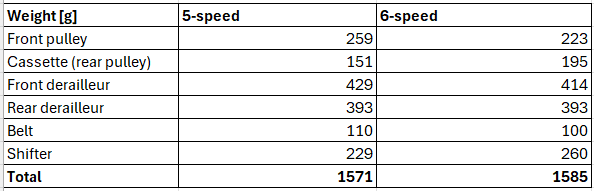
Measured weight of transmission-related components is approx. 1.6 kg.
Shifted belt drivetrain weight
There is potential to downsize the shifter and the custom front derailleur, first prototypes were overdesigned just to work reliably. Pulleys were also not weight-optimized. I believe that 1.2-1.3 kg would be a realistic target for the final product.
Typical derailleur transmission setups weigh 1.1-1.4 kg. Belt drives with planetary hubs are heavier, ~2 kg in total. The conclusion is that the weight of shifted belt transmission (with plastic pulleys) is comparable to conventional derailleur chain drive, and it is obviously lighter than the planetary hub with fixed-speed belt. Agree, it looks bulky visually, but low contact pressures from the belt make lightweight plastic pulleys suitable.
Vitaly aka Dry Mechanic

34/54T front pulley

18/24/30/40T rear cassette

36/60T front pulley

20/26/36T rear cassette
I'll start answering the question from Dan.
I’ve been wondering when this was going to happen. It seems kind of bulky…compared to traditional drive/shifting systems. But, it looks like lighter than metal materials were used. What’s the weight comparison of this belt drive system to a comparable traditional system?
Dan
Dan
Measured weight of transmission-related components is approx. 1.6 kg.
Shifted belt drivetrain weight
There is potential to downsize the shifter and the custom front derailleur, first prototypes were overdesigned just to work reliably. Pulleys were also not weight-optimized. I believe that 1.2-1.3 kg would be a realistic target for the final product.
Typical derailleur transmission setups weigh 1.1-1.4 kg. Belt drives with planetary hubs are heavier, ~2 kg in total. The conclusion is that the weight of shifted belt transmission (with plastic pulleys) is comparable to conventional derailleur chain drive, and it is obviously lighter than the planetary hub with fixed-speed belt. Agree, it looks bulky visually, but low contact pressures from the belt make lightweight plastic pulleys suitable.
Vitaly aka Dry Mechanic
34/54T front pulley
18/24/30/40T rear cassette
36/60T front pulley
20/26/36T rear cassette
05-02-26 | 05:26 AM
#11
Thread Starter
Newbie
Joined: May 2026
Posts: 5
Likes: 3
From: Graz
Intriguing I must say- I give you kudos for coming up with something NEW.
I guess the term Shift Ramps has taken on a new meaning?
I'm the kind of person that looks to see what can wrong, before I look to see what can go right. So, please don't be offended.
With the wide spread push for 1X >10 speed, I'm not sure how 5-6 speeds would sell.
5-6 may be enough for "casual" riders, but those riders will probably go to the big box store and buy an INEXPENSIVE 3x7 or similar.
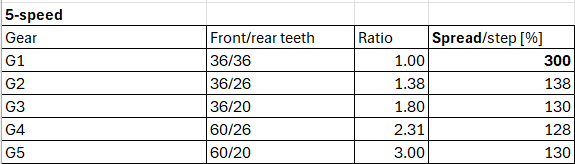
What are the ratios of the available gears?
How quick are the shifts compared to "conventional" DER systems?
Would the wide gears tend to collect pebbles & other debris too easily?
5-speed transmission ratios

6-speed transmission ratios
The step between two upper ratios is experienced as large, a "half-gear" is wanted in some conditions. In principle, there are no limitations in gear stepping, shift ramps make big jumps possible. Overall spread and upper/lower ratios match the original transmission of the mule bikes (Nexus-7 and 7x3 SunRun), stepping is a bit less dense.
The first thought were about "special" bikes for tech geeks. But with plastic gears and upcoming cheaper belts - why not for mass-market? If I was able to print in in my home workshop, why should that technology be expensive?
Shifting is a bit slower and lot smoother than normal derailleur. My younger son is riding that dirt-cheap 6-speed MTB and he loves how it is shifted, at least in comparison with crappy stock shifters of that 250 EUR mule.
Dirt testing is upcoming. First functional tests were made in clean conditions not to scrap the first protos to early.
Vitaly aka Dry Mechanic
05-02-26 | 05:46 AM
#12
Thread Starter
Newbie
Joined: May 2026
Posts: 5
Likes: 3
From: Graz
Drag from belt flexing is definitely higher than from the chain. I know this, the belt tech is niche, and the target of my project is to eliminate additional gearbox in belt-driven bikes. Shifted belt drive keeps most of fixed belt drive advantages - smoothly driven, maintenance-free, rust-free, dry and clean all the time. Compared to fixed gear belt with planetary hub this drive is lighter and same efficient or better on all gears except direct drive with locked planetary internals.
Testing in dirt is coming, just do not want to break first prototypes before time.
Vitaly aka Dry Mechanic

Available belt lengths
05-02-26 | 06:23 AM
#13
Thread Starter
Newbie
Joined: May 2026
Posts: 5
Likes: 3
From: Graz
What exactly is being tested by this prototype? Is this intended as a test of the claim that belts cannot be used with derailleurs (since the belt won't work and/or won't last when loaded in skewed position)? Or is this intended as a test for some unusual new belt technology, which will supposedly withstand such abuse?
In other words, did you do it just for the heck of it (i.e. "damn the torpedoes")? Or did you take some non-obvious measures to alleviate the known problems?
In other words, did you do it just for the heck of it (i.e. "damn the torpedoes")? Or did you take some non-obvious measures to alleviate the known problems?
I can't even say the belt is abused due to some taken measures:
1. The front guide pulley is profiled and positioned in a way that the belt can get twisted in the pulling upper strand instead of side-bent in misaligned position:
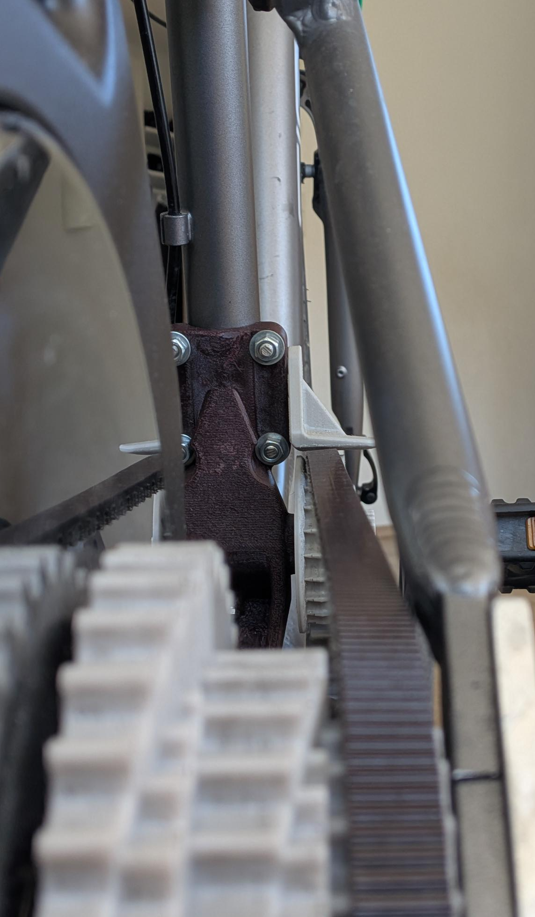
Belt misalignment on G3
2. Jockey pulley is made as large as possible to reduce back-bending the belt is not designed for. Probably that one makes the drive bulky-looking:

Rear derailleur
The belt wear is quite intensive in the first prototype. The upper plastic layer peeled off after 300-400 km reaching nylon fabric, and then the wear seems to have been stabilized:

Belt condition after 550 km (top) vs. new (bottom)
I think the main reason for that is abrasion from the teeth with obvious layer marks in printing direction. The belt slides along the tooth within 0.5-1.3 mm between belt entry and exit point in misaligned condition. That sliding causes "grinding" the belt even by relatively soft pulleys (PETG without fill).

Pulley teeth microgeometry and belt wear traces
However, these visible wear has not caused any troubles, and I think the belt withstands at least a few thousand kilometres even with these rough pulleys. In the next prototypes I plan to use chemically polished or SLA-printed pulleys to mitigate this effect.
Vitaly aka Dry Mechanic
