Originally Posted by
AndreyT
What exactly is being tested by this prototype? Is this intended as a test of the claim that belts cannot be used with derailleurs (since the belt won't work and/or won't last when loaded in skewed position)? Or is this intended as a test for some unusual new belt technology, which will supposedly withstand such abuse?
In other words, did you do it just for the heck of it (i.e. "damn the torpedoes")? Or did you take some non-obvious measures to alleviate the known problems?
I have not found any published research of derailleur shifted belt drives. If this concept is first of its kind, let that be a starting point for the other researchers. I am not following academic approach with the first prototypes, it's more a "myth buster" style. And yes, it is fully functional and rideable, and the belt has not immediately failed.
I can't even say the belt is abused due to some taken measures:
1. The front guide pulley is profiled and positioned in a way that the belt can get twisted in the pulling upper strand instead of side-bent in misaligned position:
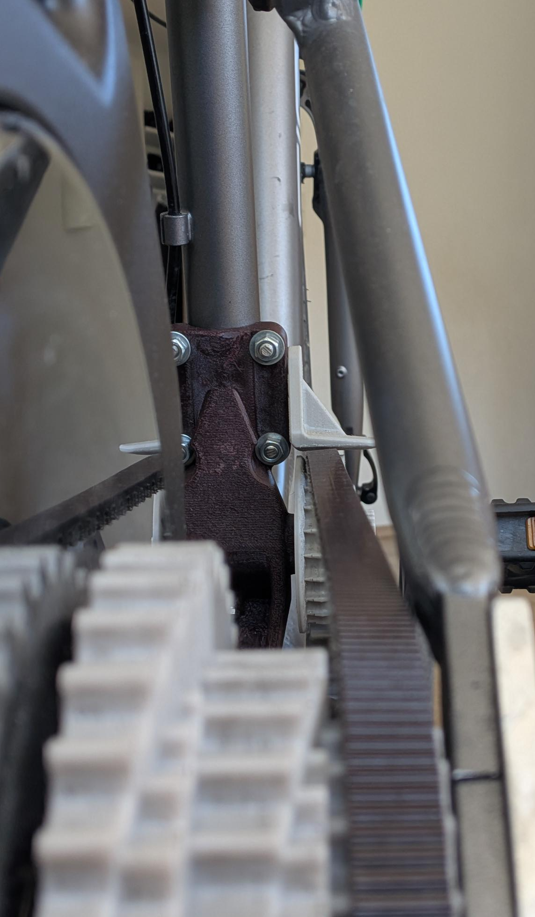 Belt misalignment on G3
2. Jockey pulley is made as large as possible to reduce back-bending the belt is not designed for. Probably that one makes the drive bulky-looking:
 Rear derailleur
The belt wear is quite intensive in the first prototype. The upper plastic layer peeled off after 300-400 km reaching nylon fabric, and then the wear seems to have been stabilized:
 Belt condition after 550 km (top) vs. new (bottom)
I think the main reason for that is abrasion from the teeth with obvious layer marks in printing direction. The belt slides along the tooth within 0.5-1.3 mm between belt entry and exit point in misaligned condition. That sliding causes "grinding" the belt even by relatively soft pulleys (PETG without fill).
 Pulley teeth microgeometry and belt wear traces
However, these visible wear has not caused any troubles, and I think the belt withstands at least a few thousand kilometres even with these rough pulleys. In the next prototypes I plan to use chemically polished or SLA-printed pulleys to mitigate this effect.
Vitaly aka Dry Mechanic