Originally Posted by
Bill Kapaun
Intriguing I must say- I give you kudos for coming up with something NEW.
I guess the term Shift Ramps has taken on a new meaning?
I'm the kind of person that looks to see what can wrong, before I look to see what can go right. So, please don't be offended.
With the wide spread push for 1X >10 speed, I'm not sure how 5-6 speeds would sell.
5-6 may be enough for "casual" riders, but those riders will probably go to the big box store and buy an INEXPENSIVE 3x7 or similar.
What are the ratios of the available gears?
How quick are the shifts compared to "conventional" DER systems?
Would the wide gears tend to collect pebbles & other debris too easily?
Fully agree, actual 5/6 speeds limit application range to casual riders. The first two prototypes were built with these ratios:
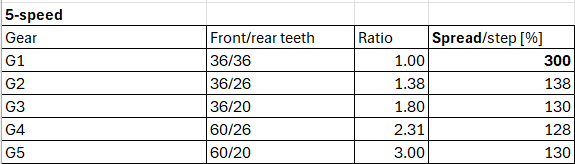 5-speed transmission ratios
 6-speed transmission ratios
The step between two upper ratios is experienced as large, a "half-gear" is wanted in some conditions. In principle, there are no limitations in gear stepping, shift ramps make big jumps possible. Overall spread and upper/lower ratios match the original transmission of the mule bikes (Nexus-7 and 7x3 SunRun), stepping is a bit less dense.
The first thought were about "special" bikes for tech geeks. But with plastic gears and upcoming cheaper belts - why not for mass-market? If I was able to print in in my home workshop, why should that technology be expensive?
Shifting is a bit slower and lot smoother than normal derailleur. My younger son is riding that dirt-cheap 6-speed MTB and he loves how it is shifted, at least in comparison with crappy stock shifters of that 250 EUR mule.
Dirt testing is upcoming. First functional tests were made in clean conditions not to scrap the first protos to early.
Vitaly aka Dry Mechanic