Originally Posted by
desperion
The other question I have how do you effectively change gear. For example if I am approaching a hill with the chain on the centre cog front and the big cog rear, I can happily change down through the nine gears. When I get to the lowest gear set if need be I then have to change to an even lower gear presumably by dropping to the small cog front, first. This leaves me in the position where I am in an extremely low gear (since my rear cog is also the smallest) and I am left wasting energy by spinning pedals. Is this correct or am I doing something wrong ?
If you're already using the big cog rear, there's no lower gear to shift to. You must mean using the small cog rear. Anyway, plug your gearing into one of the calculators you can find on the internet (here's one:
http://www.sheldonbrown.com/gears/), and see what your gear ratios really are for your bike. You'll probably find that changing by one gear in the front is equivalent to changing by 2 or 3 at the rear. In any case, you don't have to run through all the rear gears before changing the front...there's probably a lot of overlap, and you can change to the small front while in the middle rear, and then shift up a gear or two at the rear, before continuing to shift down at the rear.
Here's a calculation I did for my mountain bike:
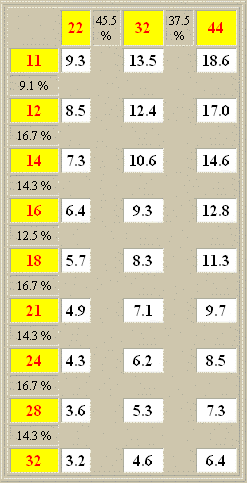
The figures are in mph at a cadence of 60 rpm at the pedals. Notice the large amount of overlap of the gearing available with the different front gears. Even the largest and smallest overlap by several rear gears.